Understanding the Corruption Trial of Oakland’s Former Mayor Sheng Thao
Airdate: Tuesday, October 10, 2026 at 9 AM
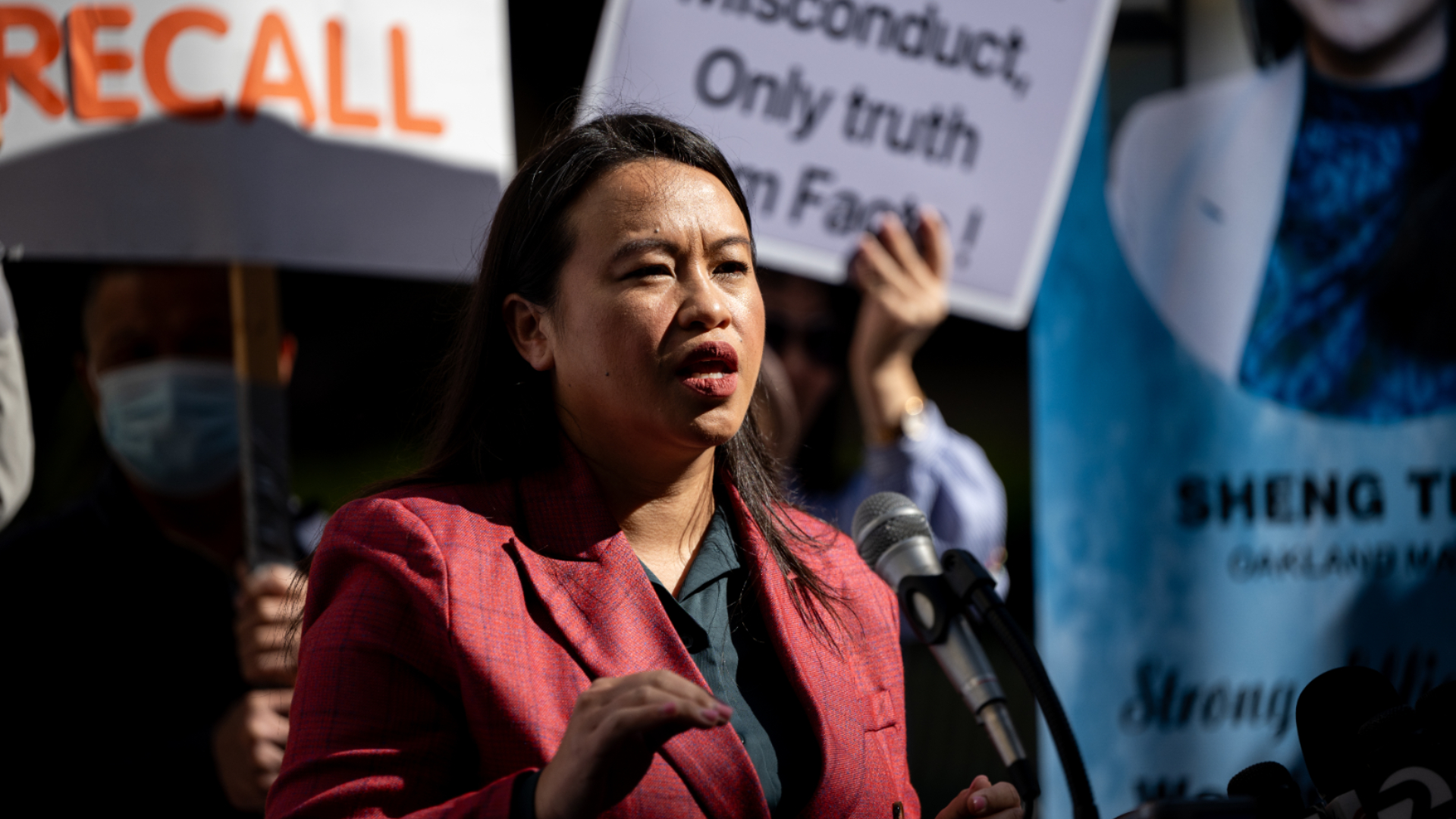
The long-awaited federal corruption trial of former Oakland mayor Sheng Thao kicked off last week, with prosecutors arguing that Thao put her power up for sale and defense attorneys attacking the credibility of key government witnesses. It’s been nearly two years since a federal grand jury indicted Thao and three codefendants in an alleged “pay to play” scheme. Thao — alongside her former romantic partner Andre Jones, California Waste Solutions CEO David Duong and his son, Andy Duong — have pleaded not guilty to charges that include bribery and conspiracy. We’ll talk about the alleged scheme, how the case is unfolding and what to expect from the six-week trial.
Guests:
- Alex Hall, enterprise and accountability reporter. KQED
- Robert Weisberg, law professor and co-director of Criminal Justice Center, Stanford Law School
- Davina Hurt, government ethics director of The Markkula Center for Applied Ethics, Santa Clara University; former mayor of Belmont
Episode Transcript
This is a computer-generated transcript. While our team has reviewed it, there may be errors.
Alexis Madrigal: Welcome to Forum. I’m Alexis Madrigal. Sheng Thao had an incredible biography for a mayor. She had a rough childhood in Stockton, spending time homeless in her youth. But she forged ahead, found a home in Oakland City Hall, and began to move up the political ranks. Her rise culminated in a surprising mayoral win over Loren Taylor by just a few hundred votes, making her the first Hmong American mayor of a major U.S. city.
From the beginning, her administration faced major headwinds. Oakland’s fitful attempts at recovering from the pandemic were hampered by a staggering rise in crime, just when it was falling across the rest of the Bay Area. Less than a year into her term, a recall campaign began, and then, six months later, the FBI raided her house. A few months after that, the recall succeeded, and a few months after that, she was indicted by a grand jury on bribery charges.
And now, a year and a half later, she gets her day in court, a day that technically may last many weeks. Here to describe the court case and what we might learn in the months ahead, we’re joined by Alex Hall, enterprise and accountability reporter here at KQED. Welcome, Alex.
Alex Hall: Good morning.
Alexis Madrigal: We’ve also got Davina Hurt, government ethics director at the Markkula Center for Applied Ethics at Santa Clara University, also former mayor of Belmont. Welcome, Davina.
Davina Hurt: Good morning.
Alexis Madrigal: And we’ve got Robert Weisberg, who’s a professor of criminal law at Stanford. Welcome.
Robert Weisberg: Thank you.
Alexis Madrigal: So, Alex, let’s go through a little bit of the basics. Who’s on trial? Because it’s not just Sheng Thao. What charges are they facing?
Alex Hall: Yeah, so Thao is on trial with three other co-defendants. One is Andre Jones, her longtime romantic partner. David Duong is the CEO of California Waste Solutions, which is Oakland’s current curbside recycling provider. And his son, Andy Duong, is also charged in the case.
They’re facing a combination of bribery, conspiracy, and fraud charges: honest services mail fraud, honest services wire fraud. Andy Duong is also charged with an additional count of making false statements to a government agency, so essentially lying to the FBI.
Alexis Madrigal: How unusual is it, Robert Weisberg, for a group of people like this to be charged and not just have sort of one trial at a time?
Robert Weisberg: Oh, it’s not unusual. In all kinds of cases, gang cases and various kinds of organized crime cases, but certainly in some white-collar cases, it’s quite common for several defendants to be charged together. It’s pretty much the choice of the prosecutor, as long as the charges against each are reasonably interlinked and so long as no one defendant convinces the judge that it is utterly prejudicial for that person to be in the same trial. So it’s really not unusual.
Alexis Madrigal: Alex, how can you try and describe the alleged scheme, how it was supposed to work? Who was being bribed to do what, how, you know?
Alex Hall: Yeah, absolutely. So prosecutors are alleging that in the lead-up to the 2022 Oakland mayoral election, the defendants agreed to a corruption scheme. And the alleged deal was essentially this: the Duongs would finance negative campaign mailers that targeted Thao’s opponents in that mayoral race, and they would pay Jones money through a no-show job with their nascent housing company.
In exchange, Thao allegedly promised that if she won that election, she would take certain steps as mayor to benefit the Duongs’ companies. That included extending California Waste Solutions’ contract with the city of Oakland, committing the city of Oakland to purchasing housing units from Evolutionary Homes, which was this housing company that the Duongs and another individual, I’m sure we’ll talk about Mario Juarez, had recently started to convert shipping containers into housing for the homeless and market them to local Bay Area governments.
And also, she allegedly agreed to allow the Duongs and Juarez to influence the appointment of high-level city officials to high-up positions in city government.
Alexis Madrigal: So how exactly did we end up finding out about this scheme? It all seems to come down to Mario Juarez, right?
Alex Hall: That is a great question at a great time, because we just heard in court yesterday from an FBI special agent, Katherine Barclay, who disclosed in the most detail we’ve heard to date how exactly this case got on the FBI’s radar.
She said that the Oakland Public Ethics Commission came to the FBI with information about a print shop owner who had been hired to print negative campaign mailers by a man who had supposedly made statements about expecting certain things in exchange for the political candidate he was supporting. And that individual was Mario Juarez. And that candidate was, according to prosecutors, Sheng Thao.
As for how the public found out about the investigation, there were very public FBI raids in the summer of 2024. At the time, there wasn’t a lot of information out about what the federal government was actually interested in. You know, Sheng Thao was adamant that she was innocent. At that point, of course, she hadn’t been charged with a crime.
Over the following months, there were certain clues that emerged through the U.S. Attorney’s Office subpoenaing the city of Oakland for records. The names they were interested in kind of provided hints about what they might be looking for.
Later on, we found out that the FBI was interviewing all kinds of people. People were being called to testify before a grand jury. And in November of 2024, we know Sheng Thao was recalled by voters, and two months later, she was officially indicted.
Alexis Madrigal: Right before she was recalled, she came on for an event on October 18, 2024. Keep in mind, at the time, there were many hard things going on in Oakland. Her mayorship was not going well. We asked her how these events were impacting her day-to-day work.
Sheng Thao: At the end of the day, I’m innocent, so I’m not worried. This doesn’t actually overshadow anything I do from a day-to-day perspective. It’s frustrating and it’s annoying, but I’m innocent, so there’s nothing to hide. You know, I have nothing to hide, so I carry on with my day.
And again, I don’t wake up worried about the FBI raid. I wake up worrying about whether it’s going to be a red-flag day and whether there’s going to be a wildfire. I worry about, you know, how many lives can we protect on our streets? And so those are the things that I’m focused on, and it’s really showing through the results that we see.
Alexis Madrigal: That was Sheng Thao, October 18, 2024, here in conversation with me on Forum, talking about trying to be the mayor under the shadow of the FBI raid that turned into what is now the trial going on in Oakland.
We’re joined by KQED’s Alex Hall. We also have Davina Hurt, government ethics director at the Markkula Center for Applied Ethics at Santa Clara University. We’ve got Robert Weisberg, professor of criminal law at Stanford.
Want to hear from you. What questions do you have about what’s going on? What kind of impact do you think this alleged bribery scheme has had on the city of Oakland and its residents, not to mention other people here in the Bay Area who do business and more than business in Oakland?
Give us a call at 866-733-6786. That’s 866-733-6786. You can email Forum at kqed.org. You can find us on social media, Bluesky, Instagram, and Discord.
Davina Hurt, you know, one time I had Aaron Peskin on the show, a San Francisco politician, and I asked him, you know, what’s the thing that he’s found most important in his career in city politics? And he said something like, “Stay away from the trash companies and the recycling companies.” He was just adamant that it’s an area where there’s a lot of corruption in local government.
Based on what you have heard, let’s imagine that these allegations of what happened are correct. How out of the ordinary do you think this sort of arrangement would have been?
Davina Hurt: Yeah, it’s a great question. Out of the ordinary? Not really. This is somewhat an issue of political access, which is pretty routine. But the ethical question that this turns on, about being independent, fair, and explainable, is where there’s a lot of concern.
And I think you’ll hear a lot of reaction from the community. These cases, they’re not unprecedented. And, in fact, relationships are what get you elected, but it’s how far those relationships go. Whether it’s recycling or it’s a local business down the street, once you take that oath of office, there’s a real need to have safeguards and separate the duties of them helping you get elected from being accountable to the public at large.
Alexis Madrigal: I mean, Robert Weisberg, is there a specific standard that needs to be met that changes something from being like, “I’ll scratch your back, you scratch mine,” to bribery, conspiracy, these types of things?
Robert Weisberg: The language you always hear, the phrase you always hear from the courts, is quid pro quo. Now, particularly during the phase when Thao was running for office, she’s allowed to collect campaign contributions. The question is, did she make highly specific promises that she would take very specific official acts in exchange for the campaign contribution?
And, frankly, the same thing can occur after her election. In federal law, there’s a separate charge for federal officials. That’s not what we have here. It’s called gratuities, where sometimes it’s a kind of intermediate crime where there’s just an understanding that good things will be done for those who give money.
But for federal bribery and mail fraud like this, the government is going to have to prove that this wasn’t winks and nods. It wasn’t vague promises and representations. It was virtually an explicit contract, orally, but still pretty explicit.
Alexis Madrigal: So they have to basically find a text message or have someone saying, “Sheng Thao said that this would happen in exchange for that”?
Robert Weisberg: Yes, of course. You know, in certain situations like this, language can be somewhat guarded, even coded. So the prosecutor is going to likely put together a great number of messages, some of them a little vague, some of them ambiguous, some of them coded. But it’s still within the jury’s power to infer that this was a pretty clear deal of quid pro quo.
Alexis Madrigal: We’re talking about the federal corruption trial of Oakland’s former mayor, Sheng Thao, who’s on trial with her former romantic partner, Andre Jones, and California Waste Solutions CEO David Duong and his son, Andy Duong.
We’re joined by Alex Hall, enterprise and accountability reporter at KQED. You just heard Robert Weisberg, professor of criminal law at Stanford. We’ve also got Davina Hurt, who’s government ethics director at the Markkula Center for Applied Ethics at Santa Clara University.
I’m Alexis Madrigal. Stay tuned for more right after the break.
Welcome back to Forum. Alexis Madrigal here. We’re talking about the federal corruption trial of Oakland’s former mayor, Sheng Thao, on trial with several other people as well.
We’re joined by Robert Weisberg, professor of criminal law at Stanford; Davina Hurt, government ethics director at the Markkula Center for Applied Ethics at Santa Clara; and Alex Hall, of course, KQED enterprise and accountability reporter.
You know, Alex, I mean, one of the reasons I think people were really interested in this case, and if you’re interested in this case, you can ask your questions of our panel here at 866-733-6786 or email [email protected]. If you’re interested in these things, it’s because not only is it the corruption trial and the bribery, but also all the things that are going to come out about the innards of how a city like Oakland works around these kinds of things, and all the evidence that’s going to get put out there.
Like we had, say, in the trial between Sam Altman and Elon Musk, all this stuff comes out outside of just the core allegations. So what are we starting to learn? What’s the picture that’s sort of emerging from the documents that have come to light and the things that are coming up in court?
Alex Hall: Yeah, so the indictment paints a picture of a timeline that prosecutors appear to be piecing together through, in large part, text messages. And most of the text messages that I think are the most interesting are really between Mario Juarez, an Oakland businessman and political operative who’s pleaded guilty to participating in this alleged scheme, and Andy Duong, one of the defendants.
Alexis Madrigal: Text messages such as, “We may go to jail, but we are $100 million richer.” That’s the one.
Alex Hall: So I think that, you know, we’ve been kind of waiting to see how the defense explains those texts. You know, there are also, for example, Juarez supposedly wrote an Apple Note describing the terms of the deal and sent it to Andy Duong. And, you know, obviously we’re scrutinizing very closely what his response was and what that says.
Alexis Madrigal: There’s really no one involved in this who watched The Wire. I feel like this is just wild. I mean, one of the questions that I have about this Juarez text is, like, the numbers, the dollar amounts here are many digits off, right? I mean, what Juarez actually bankrolled was a $75,000 mailer campaign to get Thao into office, to help her get into office. But then where does this $100 million come from?
Alex Hall: I think he’s referring to Evolutionary Homes. Allegedly, the deal was that Thao would commit the city of Oakland to purchasing these housing units from Evolutionary Homes, and so I think that he’s referencing that.
The prosecution alleges that the deal evolved over time. So at first, they were saying that Andre Jones would receive up to $300,000 over time for the supposed no-show job. And later, as the defendants continued to meet and discuss this alleged bribery scheme, that number jumped up to $3 million. The prosecution says that Jones was ultimately only paid $95,000.
But even some of these texts are kind of like — there’s a lot of typos and numbers here and there that are just kind of, like, I think, haphazard communication.
But even after the indictment, I mean, we’ve definitely seen a lot of clues. Obviously, we don’t know what the prosecution’s case is, all the evidence that they have. And that’s why I think this trial is so interesting. We really haven’t known what the defense’s case was going to be. The prosecution has disclosed way more hints leading up to the trial, mainly because they have the burden of proof in this case.
But there have been a lot of recordings that the FBI seized from Andy Duong’s phone, including a video that appears to show Juarez talking about payments that the Duongs supposedly, he says, made to individuals in exchange for getting help with getting the contract with the city of Oakland, their recycling contract, years ago.
There are recorded phone calls between Andy Duong and city officials, including Sheng Thao, current Oakland City Council member Kevin Jenkins, and current Alameda County Supervisor Nikki Fortunato Bas, who at the time was an Oakland City Council member. And the phone calls appear to have been recorded without the officials’ knowledge. So they’re very candid, and they appear to be very revealing as to these seemingly really close relationships between Andy Duong and elected officials.
The other interesting thing, like you mentioned, is that there are going to be quite a few current and former elected officials and city staffers who are expected to testify in this trial. So we don’t know what’s going to come out. We’ve had two days of witness testimony so far. The first witness was Lee Hanson, who is Thao’s former chief of staff. And, you know, I mean, she saw a lot that went on behind closed doors and had a lot of interesting things to say.
Alexis Madrigal: Yeah. Yeah. I mean, has there already been surprising testimony from people? Tell us a little bit about that.
Alex Hall: I mean, I think that Hanson’s testimony, in my opinion, was very interesting because even though she was a government witness, she almost seemed like a defense witness. She had a lot of glowing things to say about Thao, her leadership, her administration.
She also said a lot about Andre Jones’ role in the mayor’s office. He was never a city employee, but she testified that he would join meetings with city staffers. A couple of examples that she mentioned were when a prospective hire she was interviewing over Zoom, I think it was someone who would be advising on housing in the mayor’s office, and she says that Jones just joined the Zoom meeting and didn’t come on camera, but was audio only. She had no awareness that he was going to join ahead of time.
Also, she mentioned a meeting where they were discussing Thao’s decision to put then-Oakland Police Chief LeRonne Armstrong on administrative leave. Hanson said that, in her experience, she expected this decision to be litigated, and with Oakland’s city attorney in the room, the staffers would be protected by attorney-client privilege. But because Jones was there, they would essentially lose some of those protections, and she was concerned.
She testified that Jones made a comment. She said that when she expressed that concern and eventually walked out, he said, “We’ll see which one of us is left at the end of the day.” And she took that to mean a threat to her position.
Alexis Madrigal: Yeah. Davina Hurt, I mean, we see political spouses and partners get involved in various capacities with their elected officials quite often, actually, I would say. How unusual do you think it is to have a spouse or a romantic partner show up in a city meeting like this? With your government accountability hat on, are you just like, “No way, this cannot happen”?
Davina Hurt: Yeah. It is very rare and shouldn’t happen at all. And it goes to this idea of guardrails that you’re supposed to put up, not only with the public but also with your family.
For someone to bring their own ideas, when they were not elected by the public, and put pressure on decisions involving public business, it definitely is a huge red flag. It’s not respecting the vote and the sacred space of governance for those who have been elected to serve. Yeah, prime example.
Alexis Madrigal: Yeah. Robert Weisberg, if I were Sheng Thao’s defense attorney, doesn’t it make sense to try to pin this on Andre Jones? To just distance herself? Because if she didn’t actually give the command, but there were sort of a rogue person out there trading on her name, then it wouldn’t be her fault, right?
Robert Weisberg: Absolutely. And just to expand on that, on the question of what the defense will do, there will be four defenses because there are four defendants. And yes, Thao could certainly concede, through the lawyers and evidence, that bribery and fraud occurred, and conspiracy, just that she wasn’t part of it. She was just being mentioned.
But mind you, you can have other combinations where any defendant can become, in effect, a prosecutor against other defendants, because they don’t have to create reasonable doubt necessarily about whether any crime occurred. They just have to create reasonable doubt about whether they were involved.
I noticed yesterday, I believe Mr. Chan, who is, I believe, the attorney for David Duong, the father, seemed to be suggesting that some allegation raised by Ms. Hanson really applied to his son Andy and not to him.
Alexis Madrigal: Hmm. Wow. So we’ve got basically a father-son combo, and then we’ve got former romantic partners. It’s so intense, Alex Hall, the storylines here.
One other thing that has come up were allegations of sex trafficking that somehow are making their way into this, apparently on a trip to Vietnam.
Alex Hall: Yeah, that’s something that came up that was pretty interesting. Just to give some background, Thao and a number of other East Bay officials took this trip to Vietnam in the summer of 2023.
Alexis Madrigal: Supposed to be like a trade and goodwill kind of thing.
Alex Hall: And, you know, when they returned from the trip, Hanson testified that a reporter called the mayor’s office with some questions, and one of the questions that Thao’s then-chief of communications relayed to her was in regard to sex trafficking of minors.
She also said that there was a concern that some individuals on the trip had been stopped by customs on the way out. There was a concern about drug paraphernalia and involvement with young women.
Hanson said that when she and the other staff member told Thao about this, she was very upset and said, “I hate that playboy.” She used an expletive. “He has always been trouble. He’s going to ruin my career.”
And Andy Duong’s attorney, Winston Chan, was pretty upset about this. There was some discussion, not in front of the jury, but after they had left the room, about how Chan didn’t want to draw attention to this, but that his understanding was that the government had told Hanson not to mention anything to do with minors, and that she could mention prostitution, but not anything to do with minors.
There was some back-and-forth between both sides over the weekend. And then, when they came back on Monday, they decided to strike that from the record.
Chan questioned Hanson again and tried to point out that the reporter was really interested in former San Leandro City Council member Brian Azevedo, right? He even tried to show her some document. I think it might have been an FBI 302 form showing, you know, this is what you had told the Department of Justice previously. Doesn’t it show that you really said she was upset at David Duong?
And she stuck to her guns and was like, “I remember her being upset at Andy Duong.”
Alexis Madrigal: Geez. We’re talking about the federal corruption trial of Oakland’s former mayor, Sheng Thao, and the various other people caught up in it as well.
We’ve got KQED’s Alex Hall. We’ve got Davina Hurt from the Markkula Center for Applied Ethics, and we’ve got professor of criminal law at Stanford, Robert Weisberg.
If you’ve got questions about the trial, I mean, we were getting a lot of comments that sound something like this. Steve writes, “This morning’s show about Oakland’s former mayor and corruption is sadly comical compared to the giant, widespread corruption of the current Trump administration. Will Trump be next? I doubt it.”
And that’s a small sampling of the kinds of comments like that. If you have other questions, or if you were a Sheng Thao supporter, how are these allegations making you feel about that support?
The number is 866-733-6786, [email protected]. You can find us on social media, Bluesky, Instagram, and Discord. We’re KQED Forum.
Robert, I wanted to ask you about how much of the case we think actually rests on Mario Juarez. This is something that I’m not actually sure about. I mean, he seems to be the guy who’s pointing the finger and saying, “They promised us this.” He’s providing the link between what seems like a corrupt scheme and Thao herself. Does he have to be seen as someone who’s telling the truth in order for the government to win this case?
Robert Weisberg: Well, some degree of truth. He is really a fascinating character in all this. He played a role in a lot of the dealmaking, or attempted dealmaking. He engaged in a lot of the communications. He was heavily involved in this rather bizarre mailer campaign that actually is what started the FBI investigating the whole thing. And, of course, he’s been, in effect, ratting out everybody else.
So he’ll have to be the major prosecution witness, to be sure. The prosecutor, because this is going to happen anyway from the defense, will elicit from Juarez an acknowledgment that he has pleaded guilty, at least to a conspiracy charge, and indeed that how much leniency he gets in ultimate sentencing, because he hasn’t been sentenced yet, depends on just how much of a contribution he makes to the prosecution’s case.
So pretty much all the defendants are going to try to slice him and dice him. It’s interesting, the point raised earlier about the different amounts. Now, it doesn’t really matter, once you get past a few thousand dollars, how much was really at issue. What matters is that a substantial amount of money is exchanged.
But the very fact that there were some inconsistencies means that the various defense lawyers will say, “Well, you know, on day X you said this amount, on day Y you said that amount. Why can’t you keep your story straight?” He is crucial to the case.
Alexis Madrigal: I mean, it’s amazing, though. I have to say, when you look into his background, it’s just like all these lawsuits, all this stuff. It’s really made me wonder, Alex Hall, why any Oakland official, why any city official of any kind, would come within a mile of this guy.
Alex Hall: That is a fascinating question. I’ve wondered that myself. You know, when I’ve talked to people, I’ve definitely gotten the sense that he is a charismatic individual. He obviously has a reputation. I think you’d have to ask the people who have gone into business with him, honestly.
Alexis Madrigal: I mean, my raw speculation was just that people needed someone to do some dirty work, and he was a guy who seemed willing to do that sort of stuff.
Alex Hall: That’s literally the language that the prosecution has used. They said that he did the Duongs’ dirty work.
It was really interesting listening to opening statements because he came up in every one. It’s not just the prosecution and one defense attorney making opening statements. It’s the prosecution and one attorney from each team of attorneys for each defendant. So we had five opening statements, and Juarez came up in every single one of them.
The prosecution made sure to almost get ahead of it and tell the jury, “You’re going to hear about Mario Juarez saying he’s no angel.”
Andy Duong’s attorney called him a consummate hustler. He said his face should be in the dictionary under “hustler.” Other attorneys said, you know, he’s the narrator of this story. The case lives or dies on Mario Juarez.
It’s really interesting because even just in the last year, the defense has really focused quite a bit on Mario Juarez, on his credibility, indicating that they will likely try to impeach him as a witness before the jury.
They’ve talked about, in their words, his decades-long history of fraud, that he has this documented, quote-unquote, counterattack history in which he’ll go into business with people and then, if he walks away with their money and they try to contact the police, he files a restraining order. Basically, in their words, he accuses others of wrongdoing or misconduct in reaction to accusations against him.
A lot of that does appear to be substantiated by court records. If you look up Mario Juarez and Alameda County Superior Court, there are a lot of cases that do appear to paint that kind of pattern.
But it’s also really interesting because some of the things he says turn out to be corroborated by other evidence.
For example, there’s this really important moment in the timeline of this case in which Mario Juarez had a falling-out with the Duongs because they had gone into business together. There was a confrontation that took place in May of 2024 at California Waste Solutions. Juarez said that the Duongs ordered a group of men to beat him up and that they stole his watch and chain.
We’ll come to find out that when the FBI raided the defendants’ homes, they found Juarez’s watch and chain in a bag in Andy Duong’s garage.
Alexis Madrigal: We’re talking about the federal corruption trial of Oakland’s former mayor, Sheng Thao, her former romantic partner, Andre Jones, and California Waste Solutions’ David Duong and his son, Andy Duong.
We’re joined by Alex Hall from KQED, of course, Davina Hurt, government ethics director at the Markkula Center for Applied Ethics at Santa Clara University, and Robert Weisberg, professor of criminal law at Stanford.
Taking your questions on the trial itself or the impact you think it could have on local politics. Give us a call at 866-733-6786 or email [email protected].
I’m Alexis Madrigal. Stay tuned.
Welcome back to Forum. I’m Alexis Madrigal, here with KQED’s Alex Hall. We’ve got Davina Hurt, government ethics director at the Markkula Center for Applied Ethics. We’ve got Robert Weisberg, professor of criminal law at Stanford. Of course, we’ve got all of you out there.
We’re looking at this federal corruption trial of Oakland’s former mayor, Sheng Thao, who obviously served before Barbara Lee.
Kyle writes, “Coming out of the pandemic and into Thao’s term, I watched as trash piled up, crime skyrocketed, and our city’s fortunes declined. It infuriates me that while all this was happening, Thao and her conspirators were busy lining their pockets instead of guiding the city out of a dark time. Occupancy rates are insane, San Francisco is rising, Oakland desperately trying to dig its way out. That’s the real crime.”
I think one question that many listeners have, and certainly people I’ve talked to in Oakland, too, is, Alex Hall, how much shrapnel could this send across Oakland politics? I mean, it doesn’t seem to me like Sheng Thao is a mastermind of these things. It seems like, just based on what we’re hearing, things were happening in the city, and she’s in this whole kind of title movement of, like, “Oh, I guess this is just how politics works in this place.”
Alex Hall: I don’t think that it’s going to be detrimental to Oakland city government. I do think that Oakland residents have had distrust and, I think, a loss of faith to a certain extent over the years, just with everything that’s gone on in Oakland.
But pretty soon after Thao was indicted, Barbara Lee was running for mayor, along with a number of other candidates in the special election to replace Thao after she was recalled. And I definitely got the sense that pretty much every elected official and politician distanced themselves from Thao.
As different evidence has been filed in this case, we’ve kind of gotten the sense that that might not be the full picture. Because, like I said, there have been recorded phone calls between Andy Duong and Kevin Jenkins or Nikki Fortunato Bas that seem like, well, they seem to have a close working relationship or at least be on friendly terms.
That, to me, seemed like maybe the Duongs do have a much more constant presence in Oakland government than most Oakland city officials would maybe admit once the indictment was filed.
I get the sense that now that Lee has become mayor, it kind of seems like the city has moved on. But, like I said, now that there are all these city officials and East Bay officials who could testify in this trial, maybe they’ll raise new questions. You know, we really don’t know what they’re going to say.
Alexis Madrigal: I mean, I’ve just wondered if it’s going to spread to other cities, too. California Waste Solutions, as I mentioned, does have other customers, including the city of San Jose, where it serves 175,000 single-family homes.
So you’ve got a whole bunch of people. Rob Bonta has been mentioned in the same breath, I suppose, as some of these other folks.
Davina Hurt, I wanted to ask you this. One of our listeners writes in to say, “Do we have any sense about how corrupt Oakland is compared to other cities? Because I have a sense that it doesn’t function well, but I don’t know if that’s just a matter of policy or if there are really institutional problems with the Oakland government.”
Davina Hurt: Well, I would say you could have all the ethics rules on the books, and that doesn’t change an unethical culture. I would say that Oakland reveals issues that are in other cities as well. I wouldn’t say they’re unique, but they do have many different problems layered on top of others.
As I think about this opportunity that we have with the trial, it’s to pull the covers back, open the doors to how the city does run. There’s an Ethics Commission, there’s an Ethics Act, there is a city auditor. What happened where none of these agencies within the government caught these acts or stepped in to advise better ways of moving forward?
So there’s a lot to learn. Other cities that don’t have ethics commissions should consider them as ways to ensure that people are serving the public and moving forward in ways that protect the interests of those who are in need.
Alexis Madrigal: You know, Alex Hall, a listener, Alan, writes in to say, “What are the chances that there are other areas where city contracts in Oakland might deserve investigation? For example, road repairs or other cases where companies are given city contracts?”
Alex Hall: Well, you know, when Lee was running for mayor, because it is hard to find — there aren’t, at least to my knowledge, when I was covering Oakland politics and government much more closely, all the contracts just listed on the website. There wasn’t some all-encompassing, comprehensive system for looking at them.
Lee, when she was campaigning, said that she wanted to do a forensic audit of the contracts with the city of Oakland. That kind of seemed to show that she would be taking more accountability for Oakland’s budget, but also probably in reaction to this criminal case and the concerns about ethics in Oakland city government.
It does appear that the city is taking steps in that direction to actually conduct that audit.
But, as you mentioned, California Waste Solutions does have an active contract with the city of Oakland. If the CEO of that contractor were to be convicted of federal crimes, would that change the calculus for the city of Oakland? I don’t know exactly what the terms of that contract are or whether they would allow the city to end it.
Alexis Madrigal: I mean, one has to hope that might be something they wrote into the contract. If someone goes down for federal bribery, maybe this contract is null. I don’t know.
Alex Hall: I don’t know. You know, it is a family-run business, so presumably one of the other members of the Duong family could take over. But when Lee was running for mayor, I actually did ask her about that, you know, if she would consider reopening, amending, or canceling any part of the —
Alexis Madrigal: Robert Weisberg, what are the potential punishments that could come out of this? Could it be that each defendant gets their own sentence, let’s say they are convicted, they’re eventually found guilty? And are they long sentences here? What would a typical sentence be in a case like this?
Robert Weisberg: First of all, there will be four separate sentences. Indeed, there will be five, because Mario Juarez will ultimately be sentenced, although presumably for less time than the others.
It may be that not every defendant is convicted of every one of the six or seven charges, so that will also affect how much anyone gets.
This is the thing about federal sentencing. First of all, at least on paper, the sentences are really, really long. Some of the charges have a maximum sentence of 20 years, some 10 years, and some 5 years. In theory, but in very theoretical theory, a particular defendant could get consecutive sentences on all of those charges, and that would be, in effect, a life sentence, and more so.
But the federal sentencing guidelines call for something called grouping, so that more often the main sentence will be for the most serious crime that the person is convicted of. We won’t keep augmenting them consecutively.
Even then, although there are a lot of formulas in the federal sentencing guidelines that would suggest a calculation on the part of the judge, because of various legal changes, the guidelines, however rigid and severe they always looked, are now deemed, quote-unquote, advisory. When all is said and done, the judge has plenty of discretion.
The best one can say is that if you compare this to white-collar crime cases around the country, and this is just sort of an impressionistic assessment of how serious the crime is and how much any one individual was a leader of it, I could imagine sentences in the 10- to 15-year range.
Alexis Madrigal: Wow, wow. I mean, have we seen anything like that in a Bay Area corruption case? Does anybody know?
Alex Hall: Yeah, I haven’t heard of that.
Alexis Madrigal: Yeah, yeah, that would be quite something. And that would include Sheng Thao, you think, Robert Weisberg?
Robert Weisberg: Oh, in theory, she’s exposed to every one of those charges and all those maximum sentences. It may turn out, as suggested earlier, that she can avoid conviction on some or all counts by trying to make the case that she was more in the shadows of this and didn’t know completely what was going on.
It’s not always easy for a leader to say, “Well, I didn’t really know what was going on,” because the prosecutor might say, “Well, aren’t you supposed to be in charge of everything that’s going on among the government and among your confederates?”
But again, everybody’s going to be accusing everybody else. That’s what can happen in a multi-defendant trial. Her lawyer is going to attack witnesses who actually say good things about the other defendants, and vice versa.
Alexis Madrigal: Also, I can’t remember how much money actually changed hands here, right? Because Andre Jones did get some money for this job, which the prosecution calls a no-show job with Evolutionary Homes. So was it supposed to be $300,000 a year? At least that was the first number I heard. Do we know how much he actually ever got?
Alex Hall: The prosecution says that he was ultimately paid only $95,000.
Alexis Madrigal: Yeah. So, Robert Weisberg, when I hear the numbers, like, oh, okay, so we had $75,000 go to Juarez, we had $95,000. These don’t look like enormous numbers, and yet it’s the nature of this kind of conspiracy that’s alleged that would lead to this much larger, much longer sentence.
Robert Weisberg: Right. Well, first of all, if the prosecution is conceding, let’s say with Jones, a maximum of $90,000, that will keep his sentence a little lower than otherwise.
But here’s the reason why the amount of money is not the decisive thing here. The government’s case is really based — although there’s a federal bribery charge based on the city being a government contractor — the really serious charge is mail and wire fraud under this thing called honest services deprivation, which is a bizarre thing that Congress came up with many years ago. But here’s the gist of it: what is stolen here, because fraud is a kind of theft, is not so much an amount of money, but rather the right of the people of Oakland to have good government. So, the breach of governmental fiduciary duty, and, of course, aided and abetted by certain people like the Duongs who are not government officials.
That’s really the heart of the matter, and that’s why, although the amount of money is important, it’s back to that specificity of the quid pro quo.
Alexis Madrigal: Man, it’s actually quite dramatic when you put it in those terms, you know? Like, they stole our trust in the government is essentially what the charge is.
Robert Weisberg: Charges are based on that when it involves federal prosecutors prosecuting state and local officials.
Alexis Madrigal: Yeah. Wow. Do you think, Alex Hall, that this hurt the progressive movement in Oakland, or more broadly, given that Sheng Thao was sort of the standard-bearer for this in the city?
Alex Hall: I don’t know if I really fully know the answer to that question. I don’t perceive any indication of that.
I remember when, I think it was the week after Thao was indicted, I went to a campaign event for Barbara Lee at a bar in downtown Oakland where I had gone to other election-night parties for Sheng Thao and Oakland City Council members. A lot of local elected officials, Democratic politicians, showed up, and they were all the same officials who showed up to Sheng Thao’s event, showing up to Barbara Lee’s event.
So to me, it kind of felt like there’s — I don’t know how to explain it, but it’s like —
Alex Hall: Mm-hmm.
Alex Hall: I did not have the indication that this was going to somehow — and, you know, this is Oakland. I mean, people have their political views, and I don’t think that distrust in one public official is going to destroy their opinion of the whole party or whether these officials have the ability to represent their interests.
Alexis Madrigal: Let’s bring in Judith in Oakland. Welcome, Judith.
Judith: Hi. Yeah, I was just commenting and can ask a question about the impact this has. It does, for me, on my vote, in regard to Barbara Lee’s request for more executive power. And, like Barbara Lee, I think, well, if this can happen to Sheng Thao, and you look at Trump and his massive corruption, it’s having an impact on me. Does anyone have any idea what’s happening in Oakland?
Alexis Madrigal: Yeah, that’s a really good question. I mean, one thing I’ll say, I think related to Oakland politics, thank you for this, Judith, is people do seem to have baseline lower levels of trust in the government than before. And, of course, when Barbara Lee is trying to be able to move more quickly as mayor, I think some people are thinking about it like Judith is here.
Let me ask one other thing, because we have a long way to go on this trial, Alex Hall. What are you looking out for? The prosecution has given a list of up to 70 witnesses. They may not call them all, but they could call up to 70 people. Are there any in particular that you think might be crucial?
Alex Hall: Well, Mario Juarez. I think Mario Juarez’s testimony is going to be fascinating, not only what he says, but also what the defense attorneys ask him. They’re going to be asking about his track record and what he said. And what they respond with, I think, is going to be really, really interesting.
I’m going to look for what evidence the government has that undeniably corroborates that this scheme played out the way they’re alleging that it did, that does not come from Juarez.
Another thing that I’m going to be looking out for is we’ve seen a number of videos and audio recordings that prosecutors have filed in federal court.
Alexis Madrigal: But we haven’t actually seen them, right? Oh, yeah, we have. Oh, okay.
Alex Hall: Some. But there’s been descriptions of other recordings that we haven’t seen that I think will be very interesting.
Supposedly, we’re going to hear the FBI’s interview with Andy Duong. There have been descriptions of other recordings of conversations that Andy Duong allegedly recorded with elected officials that will be really interesting.
But supposedly, there are recordings of Evolutionary Homes’ board meetings in which the scheme was allegedly discussed.
And then I think it will be interesting to see how Juarez’s allegations of broader corruption come up in this trial. There’s this video of him talking about the Duongs supposedly receiving payment or paying individuals who supposedly helped them get this city of Oakland contract for the recycling company.
He also told the FBI that he saw people lining up outside California Waste Solutions, getting bags of cash from David Duong, that they’ve been involved in money laundering, and that he’s witnessed them deleting evidence from security footage.
So I think how those allegations of broader corruption in Oakland come up in the trial is going to be really interesting. And, yeah, just Juarez in general. I think a lot of people are waiting to hear.
Alexis Madrigal: Robert Weisberg, just with our last 30 seconds here, do you think the government’s going to win its case here against at least some of the defendants?
Robert Weisberg: I don’t like to predict, but the government has a lot of strong evidence against a lot of people. So I don’t think a mixed verdict is out of the question, mixed in the sense that a particular individual doesn’t get busted on all counts and that different people get busted on different counts.
But it looks like a very strong case, except so much of it assumes that Mario Juarez has credibility.
Alexis Madrigal: Thanks so much, Robert Weisberg, professor of criminal law at Stanford. Davina Hurt, thank you as well, government ethics director at the Markkula Center for Applied Ethics at Santa Clara University and former mayor of Belmont. And thank you, Alex Hall, enterprise and accountability reporter here at KQED. I feel like I understand what’s going on a lot better.
Last listener comment. A listener writes on Bluesky, “As a native of Chicago, is it hard for me to believe that the history of corruption in Oakland begins and ends with Sheng Thao? Was she just bad at covering her tracks?”
I’m Alexis Madrigal. Stay tuned for another hour of Forum ahead with Mina.
Announcer: Funds for the production of Forum are provided by the Jenerosity Family Fund and the members of KQED.