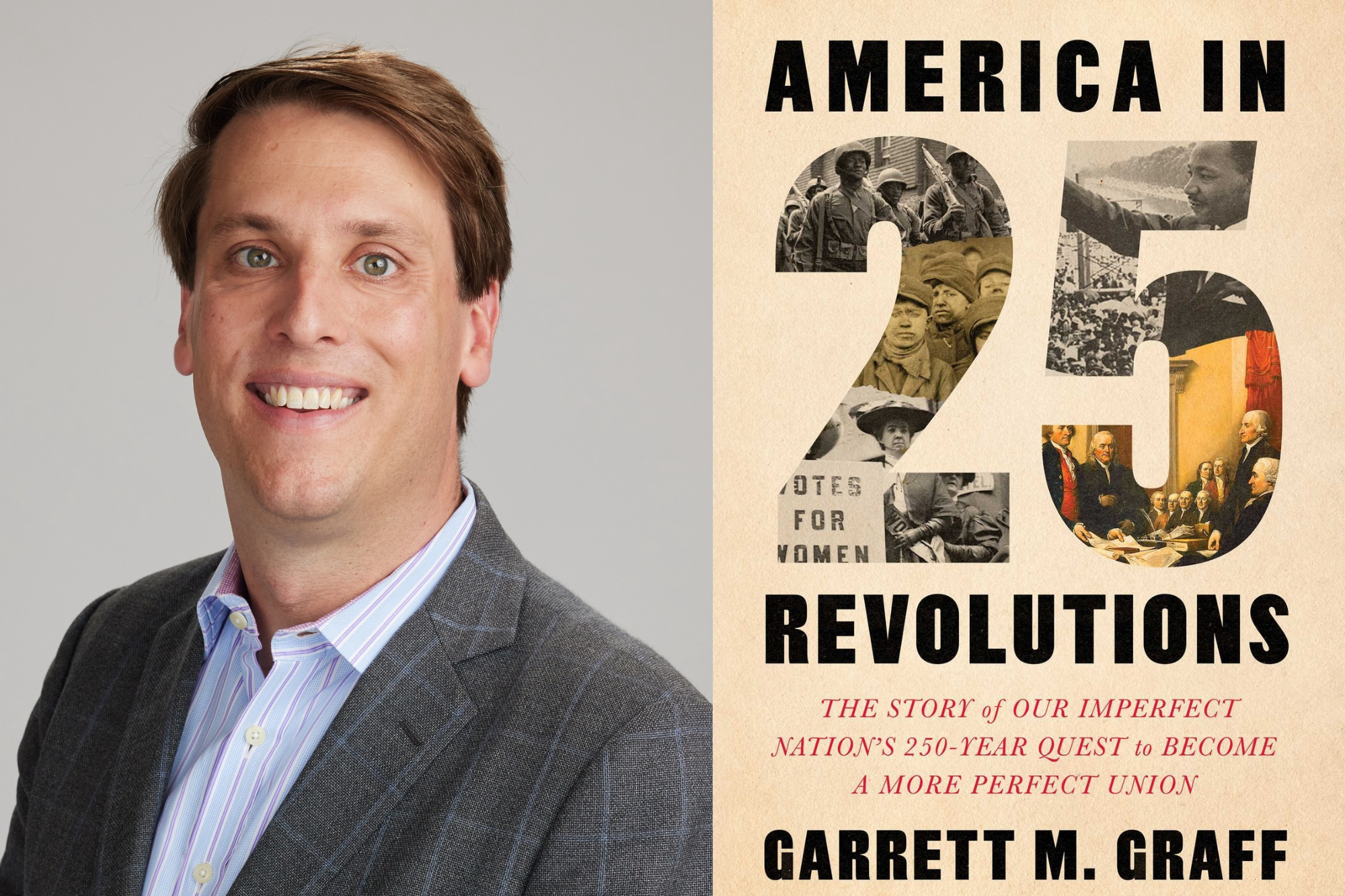
Historian Garrett Graff on 25 ‘Revolutions’ That Shaped America
Airdate: Thursday, November 19, 2026 at 10 am
As the United States marks 250 years, historian and journalist Garrett Graff argues that hard won rights are never guaranteed and that progress often provokes backlash, rollbacks and sometimes even bloodshed. In his new book, America in 25 Revolutions, he traces 25 pivotal “revolutions”— like women’s suffrage and the centuries-long fight for indigenous rights—that helped bring an imperfect nation closer to its founding ideals. We talk to him about what we can learn from past struggles, and why we may be on the precipice of a new revolution in the wake of the 2026 midterm elections.
Guests:
- Garrett Graff, journalist and historian, author, “America in 25 Revolutions”
Episode Transcript
This is a computer-generated transcript. While our team has reviewed it, there may be errors.
Mina Kim: Welcome to Forum. I’m Mina Kim. The last Senate race was called Tuesday in Alaska for Mary Peltola, giving the state its first Alaska Native woman senator and Democrats a 56-to-44 majority. Last week, Scott Colom became the first African American to represent Mississippi since Reconstruction and the first Democrat elected to the Senate since 1982. Add that historic sweep of nine new seats to the dozens of House seats and state houses Democrats flipped, and it’s clear why journalist and historian Garrett Graff has called these midterms a Watergate-level repudiation of the party in power, or a shellacking of Trump’s mega-politics.
Graff has also spent the past year on a new book that’s out now about our country’s capacity for change. It’s called America in 25 Revolutions. And he joins me now. Welcome back to Forum, Garrett.
Garrett Graff: It’s such a pleasure to be with you.
Mina Kim: It’s really good to have you here, too, because I find I’m still trying to wrap my arms around all that has happened since November 3rd and what it represents. And I think it’s some combination of just the sheer volume and maybe also a little bit of my own fear of reading too much into it or making too much of it. But I know you’ve been thinking a lot about this, so tell me what you want us to appreciate about these midterms.
Garrett Graff: Yeah, to me, what is fascinating about them, and I think one of the things that we are struggling to wrap our heads around, as you say, is this election proved history-making in a lot of different ways, many of which we were not thinking about or talking about ahead of the election. And so have been sort of surprised by events like the victory of Scott Colom in Mississippi.
But by and large, to me, what is most interesting about this election is this idea that we have, after two years of what have represented the most nakedly white supremacist policies of a presidential administration since Woodrow Wilson was in the White House, seen the country coast to coast elect the most diverse set of leaders at the state level and the federal level that we have ever seen. And the way that those two things represent, I think, both the politics of the past and also the politics of the future, and that America seems, after this election, sort of poised in between those two in a way that we have not seen since the election of Barack Obama in 2008.
Mina Kim: You noted a photo of Lucy Baines Johnson hugging James Talarico as he won back the Texas Senate seat that was once held by her father, Lyndon Baines Johnson. What was the symbolism you saw there, you know, beyond the obvious?
Garrett Graff: Yeah, I think many people looked at that photo. This was the photo that most struck me on election night — LBJ’s daughter reaching up and hugging James Talarico as he celebrated his victory in Texas, where, on the one hand, you know, the symbolism of that seems so — it’s the seat once held by LBJ. But there’s also this incredible arc of history that is told in that photo.
And it’s one of the stories that I tell in this book, which is the background of the Civil Rights Act of 1964, which is, in many ways, the fulfillment of the promises of Reconstruction in the post-Civil War 1860s and ’70s that were never fulfilled at that time and that fell to Lyndon Johnson and others to push and enact in the 1960s: the Civil Rights Act of 1964, the Voting Rights Act of 1965, other associated legislation.
And what you saw in that moment was Lyndon Johnson coming to the presidency in the worst possible circumstances, obviously in the wake of President Kennedy’s assassination in Dallas, Texas, November 22nd, 1963. And it is a moment when Southern segregationist Democrats, these incredibly racist senators, hold the power on Capitol Hill and the power in the Democratic Party. Lyndon Johnson has come up through that system. He was Senate Majority Leader from Texas. He was at the heart of a lot of these segregationist policies and power structures.
And yet, in the wake of Kennedy’s assassination, when he becomes president, commits himself and then drives the country toward a revolution in civil rights and civil liberties for Black Americans that transforms much of the South, much of the United States. And in doing so, knows that he is leading a massive political realignment that he says to his press aide, Bill Moyers, as he signs this legislation: “You know, we have probably lost the South now for a generation.”
And it leads to the modern political realignment that we would recognize, where the South turns — the party, for the most part, of white voters — turns solidly Republican. Democrats become the party most strong in the North, in communities of color, and with women.
And that fast-forward to 2026, and we see now Democrats winning in all of these incredibly unlikely places — Georgia, South Carolina, Mississippi, Texas — because Democrats now represent the party of civil rights and human rights. And it is this arc from LBJ to James Talarico that helps us, I think, understand how hard so many of these pushes for freedom and liberty in the United States really are, and how long they take.
Mina Kim: Yes. So a major shift, right? You’re talking about how civil rights, in some ways, are the reason that the Democrats won here. But at the same time, when you — I guess, how does that fit into the broader analysis of voters voting based on gas and grocery prices and health care costs and an unpopular war?
Garrett Graff: This election was not any one single thing. You know, we saw incredible concern about the president’s immigration policies in the way that ICE has been remade into a pro-regime authoritarian secret police force. We saw incredible concern about levels of corruption inside the Trump administration, in addition to concerns about gas prices and the Iran war and everything else.
But what you really saw in many corners of the South was unexpectedly high turnout by Black voters after a sustained assault by Republican lawmakers, backed up by the Supreme Court, over the last dozen years that has really tried to undermine and unravel the protections of that Voting Rights Act of 1965. And through gerrymandering and through voter suppression techniques, and what I think you really saw in many of these unlikely victories in South Carolina and Georgia and Texas and Mississippi, was Black voters saying, no, we are not going to be sidelined as we have been in past chapters of American history. We control our own destiny and can reshape our future.
Mina Kim: Well, let me invite listeners into the conversation. Listeners, with midterm results finalizing now, what do you take away from them? What do they mean to you? What do you think it means about America and its voters? And with Garrett Graff’s book about America’s 25 revolutions, what are the moments for you that made America better in your mind?
You can email [email protected], find us on Discord, Bluesky, Facebook, or Instagram at KQED Forum. Or call us at 866-733-6786, 866-733-6786.
So, given sort of some of these different strands and historic moments that these midterms brought, how do you think the newly installed Democrats, when they take power in January, should handle it? How should they lead?
Garrett Graff: I think they have an opportunity to change the way that voters think about what leadership by the Democratic Party actually represents. And what I mean by that is something like 75, 78% of Americans will be under a Democratic governor next year. You know, you will see a lot of places in the country, including Texas, including Georgia, where Republicans have caricatured for years what Democratic rule would actually mean. You know, we’re talking about communism and socialism and, you know, this, that, and the other thing.
And, you know, I hope Democrats really focus on demonstrating to voters across the country what sort of responsible stewardship at the local, state, and federal level really looks like, and focus on how they can help make voters’ lives better.
Mina Kim: Do you think that this has the potential to be the next revolution?
Garrett Graff: I think so. Or I think at least we are poised at the opportunity for one. This book really grew out of my attempt to try to tell the story of America at its 250th birthday this year, and that so often the history of the United States is this incredible story about how America has gotten better generation after generation. And this is, I think, a moment where we are poised to see that right now.
Mina Kim: We’re talking with Garrett Graff, historian and journalist, about what he wants us to appreciate about these midterms and whether they have the potential to revolutionize how democracy works in this country. We’ll have more with him and you, listeners, after the break. Stay with us. I’m Mina Kim.
Welcome back to Forum. We’re talking this hour about the midterm elections and whether they have the potential to usher in a revolution, as defined by my guest, Garrett Graff — a moment when America got better. His new book is America in 25 Revolutions, the story of our imperfect nation’s 250-year quest to become a more perfect union.
Listeners, what do you take away as these midterm results are now finalizing, in terms of what the midterms represent? What are the moments for you that made America better? You can email [email protected], find us on Discord, Bluesky, Facebook, or Instagram at KQED Forum, or call us at 866-733-6786, 866-733-6786.
From Jay in San Francisco: “Garrett, Jay writes, is this really a watershed moment like Watergate, or just the pendulum swinging back? Obama had a similarly weak midterm in 2010. What do you think?”
Garrett Graff: No, he didn’t. I think that there is a belief that presidents always lose some ground in the midterm elections. That is historically true, but it understates what has actually happened in this election, which is the most significant shift in party vote since Watergate itself. You know, this was a once-in-50-year alignment or realignment that we are fundamentally — I’m used to — and again played out not just at the federal level on Capitol Hill, but played out in state houses and communities across the country.
You know, Georgia electing a slate of Democratic state officials, Texas electing a slate of Democratic officials. That’s not just the story of high gas prices and Donald Trump. That is something else shifting.
And to me, what is important about understanding the potential for this moment and what this diverse set of leaders nationwide could represent in the years ahead is really understanding the core thesis of this book. It’s this idea that what has made America better across 250 years is the incredible courageous efforts of generations of people who would not have been considered citizens, either legally or morally, by those original white male Christian founders of 1776 in Philadelphia, who have instead lobbied and written themselves into the American story over the last 250 years.
So I try to tell these stories of these revolutions, when you have seen social movements, political movements fundamentally change the arc of who counts as an American and who have raised our expectations for ourselves as a nation and as a people for what we expect as citizens.
Mina Kim: But can — thinking about this particular moment, right — can a major shift, can a new revolution take root if what has caused the retrenchment that you write about in your book, right? The people in power now are still locked in power in the White House, in the courts. This listener writes, for example, well, how does the guest think MAGA is gonna respond? I don’t think it’s dead. Look at Stephen Miller. So will a new wing of the party just take control now that Trump is weak? How do you think about this, Garrett?
Garrett Graff: The lesson to me across American history is that these struggles are rarely a single moment in time. And yes, Democrats stepping into Capitol Hill in January, they still don’t control the Supreme Court, they still don’t control the White House. They will be limited and circumscribed in what they can achieve.
But what I think we have seen is a broad repudiation of the attempt to transform the United States into an authoritarian white supremacist society. And that attempt across 2025 by the Trump administration was broadly rejected by Americans across the country. And it gives us the potential to build something better going forward.
One of the lessons across many of these revolutions, though, is that these are not single-year or single-election fights, that they are efforts that can take years, they can take decades, they can take generations, and that the American story is not one of linear progress. It is one where you see ongoing battles for rights, progress measured against periods of retrenchment, and that this is, I think, a moment where we have seen a very broad retrenchment of civil rights and civil liberties across the United States over the last decade. And now our question as a country is, are we willing and able to restore a sense of progress?
Mina Kim: For the people who want to do that — the anti-racists, the anti-authoritarians, the people who want to restore a sense of progress as you define it — help us understand what they’re up against. Because you’ve outlined sort of your grand theory of Trumpism. What is it? What is it that needs to be fought? What are the pillars of this?
Garrett Graff: Yeah, so I think understanding Trumpism requires breaking it apart into a couple of different power structures inside the administration that we have seen. There is not really a unified theory of power inside the Trump White House. It’s really best thought of as a three-legged stool.
Your listeners in California probably remember your former governor, Ronald Reagan, laying out the three-legged stool of conservatism as it existed in the 1980s, and the idea of social conservatives, fiscal conservatives, and defense hawks all coming together under the Republican umbrella in the ’70s and ’80s.
And what that looks like, I think, now is something a little bit different, where you see one leg of the stool represented by Stephen Miller, as one of the callers or one of the listeners cited, who is pursuing this very aggressive and very nakedly racist, white supremacist, anti-immigrant set of policies.
There’s separately a power structure that is embodied in Russell Vought, who is the head of the Office of Management and Budget and really the architect of that infamous Project 2025 that we have seen really working to dismantle the federal government, deregulate, you know, diminish state capacity, undermine the nonpartisan civil service that we have worked so hard to achieve in the United States.
And then sort of separate and apart from both of those is Trump and the Trump family, and this culture of grifting and corruption, and sort of focus on self-aggrandizement that really is separate from any other part of the conservative agenda that MAGA represents.
Mina Kim: And you also note that there is a role for certain Silicon Valley, I guess, oligarchs, as you might put it. What role are they playing here?
Garrett Graff: Well, I think we’ve seen, and it’s been interesting, just in the last 24 hours, we’ve begun to see, I think, Elon Musk trying to imagine that he is distancing himself from MAGA, which he obviously was a very eager participant in throughout the first three to six months of the Trump administration last year, and then a huge founder and funder of a lot of conservative efforts over the course of this year.
And that we have seen Silicon Valley, I think, be a very willing participant in a view of sort of techno-fascism represented by Musk and Peter Thiel and others that see an opportunity to remake American government to serve sort of their vision of a tech future.
Mina Kim: I mean, so that’s a lot, you know, to have to address, in addition to the fact you bring up Russell Vought and Stephen Miller, right? I mean, aren’t they talking about accelerating efforts to bypass Congress, the Congress that the Democrats have just taken over? Help us understand how you assess the effect, say, that Stephen Miller will have, in part because I know you wrote a piece really looking into this on your Doomsday Scenario Substack.
Garrett Graff: Yeah, I don’t know that we really know how effective Stephen Miller is going to be as White House chief of staff, in part because he has had this very key role inside the Trump White House that has been very focused on the hard-line immigration work that he is most interested in and most motivated by.
White House chief of staff is a much broader role and involves a whole host of responsibilities far outside what Stephen Miller has been responsible for before. And I think there’s the possibility that it will actually, you know, spread him much more thin across government in a way that diminishes his effectiveness to a certain extent.
In part because what we know about Stephen Miller is he’s a very hard-work colleague. He’s not someone that a lot of people enjoy working with. And so I think that that’s going to lead to more leaking. I think you’re going to see more infighting among the Cabinet.
You know, Suzy Wiles, when she was chief of staff, was widely credited with bringing sort of a stability and focus to the second Trump term that we never saw during the first Trump term. And I think even in this last week, you were beginning to see, you know, in some of the tensions between J.D. Vance, Marco Rubio, Markwayne Mullin, and Sean Duffy, some of the return to the infighting that really marked Trump one.
Mina Kim: So then do you think Trumpism is losing strength? This chasm is weakening it?
Garrett Graff: Yes, I think that that’s been clear, I think, over this last year in all sorts of different ways. You know, this is a historically unpopular president and he, you know, who has seen both his domestic agenda and his foreign policy agenda repudiated. And, uh, he’s, you know, I think does not appear to be — and it actually appears to be getting even less interested in the mechanics of governing than he was in the first Trump term.
And, you know, he is very focused on projects like the East Potomac golf course and building his triumphal arch and, um, you know, these things that normal — and, of course, his ballroom — that are far afield from the issues that voters are most interested in and most keen for the administration to focus on.
Mina Kim: Well, this listener on Bluesky writes, “With much respect to the guest, this wasn’t a pro-Dem moment, as much as simply Americans are fed up with the economy and vote for the other party. Obama to Trump, to Biden back to Trump. I hope Dems understand this.”
Another listener, David, writes, “Our congressional system is designed to make it very difficult to get anything done unless both parties work together. When both parties are so far apart, nothing can get done. Eventually, the electorate gets incredibly frustrated, and that’s when the big pendulum swing starts happening. Trumpism didn’t work out, so here we are back in the other direction. If Dems don’t make very big, bold moves that will serve the American people, it will just swing back the other way again.”
We touched on this before the break with regard to what you would like to see Dems do, but there has definitely been sort of this binary potentially that has been presented of really meeting the needs of the American people around affordability and really meeting the needs that the American people have around their desire for accountability. Where do you land on this, Garrett?
Garrett Graff: I think it’s an entirely false choice and one that I don’t quite understand, the people who are making the argument that you sort of can’t do both.
Because when you look at the question of affordability, when you look at the question of what has made America unaffordable, it is the rise of this unaccountable oligarchy that does not feel like they actually have to serve the interests of American voters or American consumers. It is corruption that we are seeing inside the Pentagon and the White House and other aspects of government contracting that is both spending money that the government doesn’t need to be spending that could be put to other uses.
It is driving up the profit margins of people who don’t have actual goods and services to be selling the American people. It is the collapse of antitrust enforcement by the government, and some of the corrupt business deals that we have seen is directly related to, in many cases, why prices have begun to go up.
Mina Kim: Hmm, so that kind of messaging, it sounds like you think, would be effective, the way that they are connected. Right, Robert writes, “As a Republican, I probably would not have voted for a Democratic candidate if we had had a federal-level contest. This is only my way of telling Donald Trump to knock it off with pointless war and self-enrichment. I’m not thinking about all that civil rights and historical stuff. If the Democrats overplay their hand, which I think they will the next cycle, I’m going back to the post-Trump Republican candidate. Moderates are not married to the Democrats either.”
Interestingly, though, Robert says self-enrichment. What do you think it will take to really get Donald Trump to knock off self-enrichment if, as you say, it is one of the three pillars of Trumpism?
Garrett Graff: I mean, there are efforts that Congress can make at accountability. You know, there are efforts at the state level that you can see, you know, newly empowered state governors and prosecutors and attorneys general launching in terms of investigations and potentially even state-level prosecutions and criminal cases or civil cases.
But, you know, this is a hallmark of the Trump administration. This is a hallmark of Trumpism. And, you know, one answer to your question is that this will not change until Donald Trump is no longer president of the United States.
Mina Kim: Hmm. So there’s that. But in the meantime, in the two years?
Garrett Graff: Well, that’s what I mean. There are efforts in terms of congressional investigations or state-level investigations, but, you know, I don’t know. One of the things that I have written about over the last year is, you know, the most important check and balance in the American system is good character. And if you have someone in the White House who is focused on enriching themselves at the expense of the American people, that’s not something that’s going to change with a couple of congressional subpoenas.
Mina Kim: Garrett Graff on what these midterms mean and how they fit into America’s broader history of revolutions to make the country better. His book is America in 25 Revolutions. More with him and with you, listeners, after the break. Stay with us.
This is Forum. I’m Mina Kim. You’re listening to Forum on KQED. We’re talking this hour with Garrett Graff, historian and journalist, writer of the Doomsday Scenario Substack column, and of a new book, America in 25 Revolutions, the story of our imperfect nation’s 250-year quest to become a more perfect union.
Graff has recently written about the aftermath of the 2026 midterm elections, which are still being finalized, and whether Trumpism and MAGA are waning, and also about how the U.S. has been engaged in countless struggles over its 250 years to meet its founding ideals — progress that often provokes backlash and rollbacks, and then renewed commitments to change.
Tell us what you are thinking about with regard to what these midterm results really mean about America, about our voters. Any moments for you that made America better? Email Forum at kqed.org. Find us on our social channels at KQED Forum, or call us at 866-733-6786.
Neil writes, “I was born in the 1950s, and I’ve always thought of America as the land of the free, the melting pot, civil rights, women’s rights, freedom of religion, and the separation of church and state. And I’ve been saddened to see all of these beliefs eroding.”
Talk to me a little bit about some of the things that you have seen, and what role this book played for you, Garrett, because I suspect, you know, as somebody who has been documenting, you know, efforts to install an authoritarian state or this administration’s abuses of power, that this book was something maybe you needed personally for some hope and perspective.
Garrett Graff: Absolutely. This book, for me, as someone who spends a lot of my day-to-day journalism working on this modern political moment, this was a very hopeful project to work on over the last year. And I hope inspires a sense of optimism in readers about the give and take of American history.
That America has dark chapters. Sometimes they are long dark chapters. But that the animating principle of our country has always been that each subsequent generation has taken up the hard work of making our country more just, more equal, and more fair than it was at the start.
And that one of the things I was really trying to do with this book was reconceptualize even how we think of our own American story. That America is not the story of a single revolution. That 1776 was really just the beginning, and that America is the story of revolutions, plural.
And that we have seen in the last 250 years subsequent generations who, as I said earlier, would have never been considered part of the American experiment by those original founders, write themselves into the American story. And we’ve seen that, you know, I tell stories across the book of different moments when different populations and groups and communities have done this. And, you know, you’ve seen this with Black Americans and Asian Americans and women and LGBTQ populations and Native Americans and Indigenous populations, all of whom were very specifically excluded from that original vision in Philadelphia, but who have lobbied, sometimes across decades and generations, to secure the rights that the founders promised in 1776.