Bay Bridge Traffic Delays Would Double if Transit Tax Measures Fail, Report Finds
Traffic delays at some of the worst freeway bottlenecks in the Bay Area would more than double if voters reject two separate tax measures intended to fund public transit agencies this November, according to a new research brief published Tuesday by the San Francisco Bay Area Planning and Urban Research Association, or SPUR, a nonpartisan, nonprofit public policy think tank.
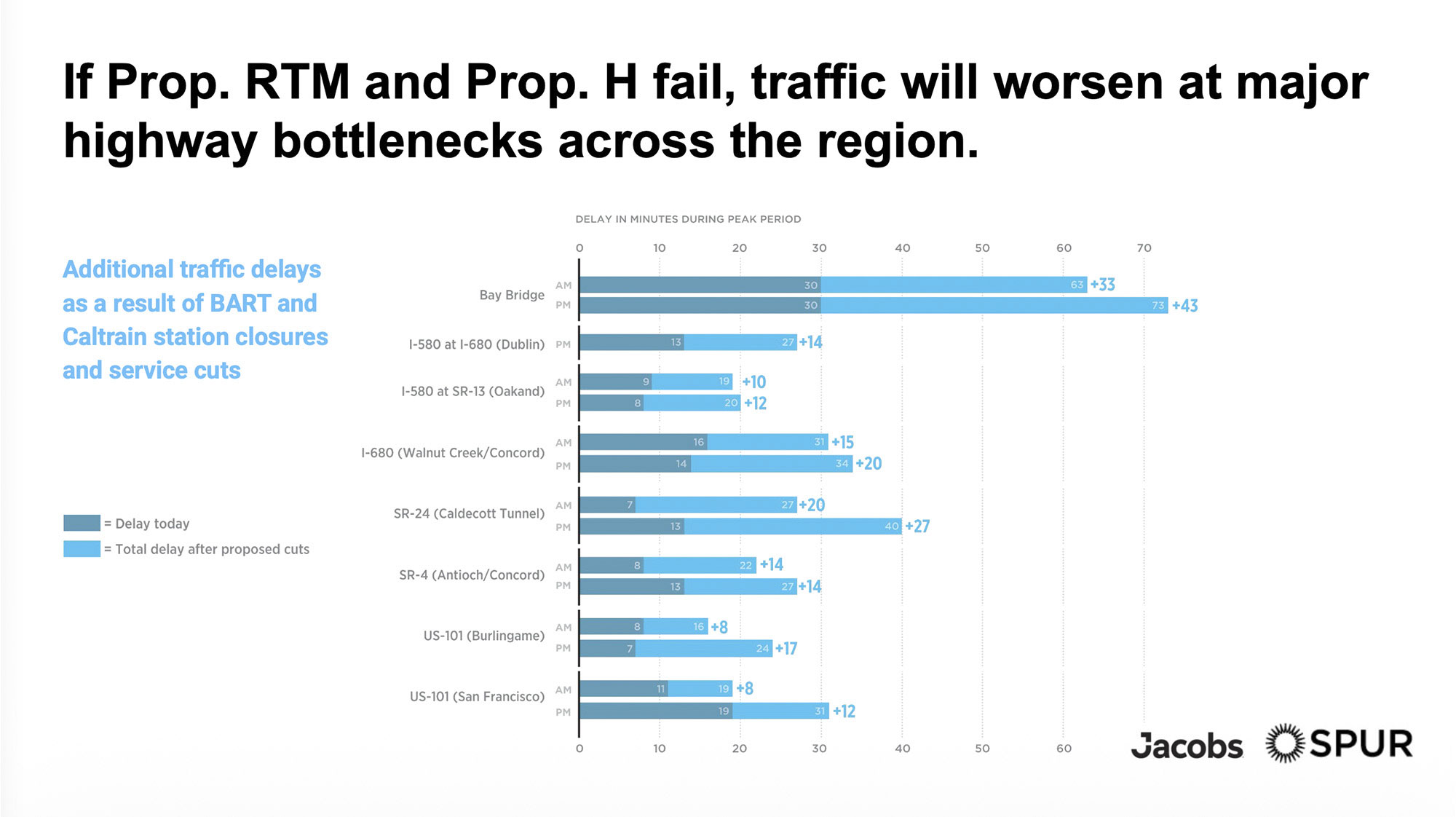
The report found that while Bay Bridge drivers currently face average delays of 30 minutes during morning and afternoon rush hour, slowdowns would extend to 63 minutes in the morning and 73 minutes in the afternoon.
Average afternoon delays at the Caldecott Tunnel on State Route 4 would triple from 13 minutes to 40 minutes, according to the report.
“This really paints a picture of how much worse life is going to get for people living in the Bay Area without transit,” said Laura Tolkoff, transportation policy director at SPUR.
BART, AC Transit, Muni and Caltrain — which represent 80% of all public transit ridership in the Bay Area, according to SPUR — are facing massive budget deficits driven by pandemic-era drops in ridership and revenue.
The agencies plan to make deep service cuts to reduce those deficits, unless voters in five Bay Area counties approve this year’s Regional Transit Measure (RTM). Muni also plans to cut service if San Francisco voters reject a separate parcel tax funding measure, Proposition H, specific to that agency.
BART has said it would close up to 15 stations, and Caltrain has said it would close 10 stations, among other cuts, if the regional transit measure fails.
MUNI plans to eliminate 20 routes, among other cuts, if either Proposition H, a proposed San Francisco-specific parcel tax, or the regional tax measure fails.
SPUR projected that BART and Caltrain would close their lowest-ridership stations, as the agencies haven’t yet specified which stations they would close.
AC Transit has also proposed service cuts, but SPUR’s forecast doesn’t address these impacts in detail, as the agency had not adopted its reduced service plans by the time SPUR’s analysis started, Tolkoff said.
SPUR hired Jacobs, an engineering and infrastructure consulting firm, to conduct the analysis, which used public transit ridership, boarding data and traffic volume statistics from September and October 2025.
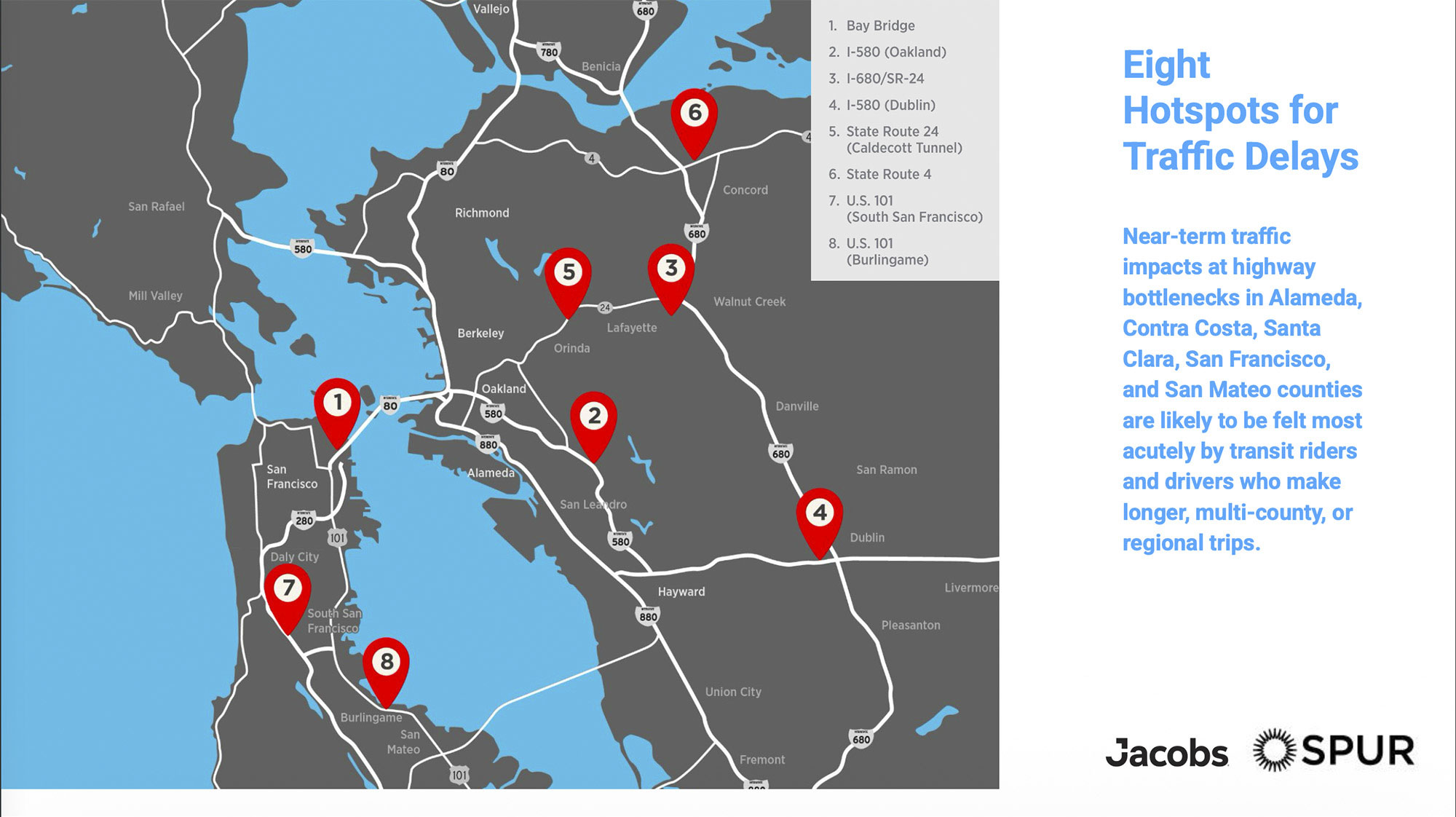
The report considered short-term traffic impacts at eight of the Bay Area’s worst traffic hotspots: the Bay Bridge, I-580, I-880, I-680, State Route 24 at the Caldecott Tunnel, State Route 4 and U.S. 101 in South San Francisco and Burlingame.
East Bay drivers will be particularly impacted, as they potentially traverse multiple worsened bottlenecks, according to Tolkoff.
“ The impacts are going to compound for people who have to make longer multi-county regional trips, as well as to transit riders who are going to be hit hardest and first,” she said.
The report also quantifies the economic, environmental and quality of life impacts that service cuts would have on the Bay Area.
The 430,000 people who live within one mile of a BART or Caltrain station that is expected to close would lose the benefit of easy access to public transit, according to the report. Muni routes proposed for elimination would affect over 27,000 people each weekday; service frequency reductions would affect over 200,000 people.
Tolkoff said the cuts would also have a disproportionate impact on people with disabilities, who make 80,000 trips on the region’s four major public transit agencies every day, and around one-third of the Bay Area who cannot or do not drive, to move around the region.
“ Transit is really key to their independence and ability to have a full life,” she said.
The report makes the case that paying the sales tax associated with the RTM would be a better deal for transit riders than the increased costs service cuts would bring.
If voters pass the RTM, it would institute a half-cent sales tax in Alameda, Contra Costa, San Mateo and Santa Clara counties, and a 1-cent sales tax in San Francisco, generating around $1 billion annually to fund operations and improvements and averting service cuts.
The report estimated taxpayers would spend $82 a year on a half-cent sales tax, whereas transit riders who switch to driving would pay an additional $3,280 per year for increased transportation costs, such as fuel, tolls and parking.
“ It’s very clear that this is going to push a lot of people over the edge when you think about how transportation is the second largest household expense, second only to housing,” Tolkoff said.
A recent report by San Francisco’s Office of the Controller on Proposition H estimated Muni service cuts would cause a labor market impact between $30 million and $48 million annually, due to workers dealing with delayed commutes.
The Committee for Affordable Bay Area Transit, a campaign launched by the Contra Costa Taxpayers Association, is opposed to the RTM. The group has argued that transit agencies should leverage existing funding, including reallocating money from capital projects, to reduce their budget deficits.
The Committee has said transit agencies could increase efficiencies, reduce pay for some of their highest-paid employees and cease construction on mega-projects to fund operations.
Connect Bay Area, the campaign in favor of the regional sales tax measure — which is supported by a broad coalition of labor, business and local leaders — has described the opposition campaign’s arguments as “not grounded in reality.”
SPUR is a sponsor of the RTM and gave input on San Francisco’s Proposition H as a member of the city’s Muni Funding Working Group.
In 2024, 8% of Bay Area commuters took public transit on a typical workday, while 69% drove, according to the Metropolitan Transportation Commission.
The report showed that although public transit riders aren’t a sizable part of the population, public transit makes a big difference on the Bay Area’s quality of life, Tolkoff said.
“Even if you don’t ride transit every day, your life is better because there is transit in the Bay Area,” she said.