This partial transcript was computer-generated. While our team has reviewed it, there may be errors.
Alexis Madrigal: Welcome to Forum. I’m Alexis Madrigal.
There was probably a time when a conflict in the Middle East or global tariffs would not have had a huge effect on California agriculture. But markets and things like diesel fuel and fertilizer are globally interconnected now, and a problem in the Strait of Hormuz is a problem in the Central Valley.
And that’s just the latest thing. Farmers are struggling with climate change, water availability, immigration policy, which has exacerbated their labor problems, and so much more.
We’re going to talk about food and farms with growers and experts. Joining us first, we’ve got Don Cameron, vice president and general manager of Terra Nova Ranch in Fresno and president of the California State Board of Food and Agriculture. Welcome, Don.
Don Cameron: Good morning. Good to be with you.
Alexis Madrigal: Yeah, great to have you. So talk to me about how your farm is dealing with these increases in cost. What’s the most significant one for you?
Don Cameron: Our most significant increase has been the increase in diesel fuel. We’ve seen an eighty-seven percent increase in price in the last month and a half.
Alexis Madrigal: Wow.
Don Cameron: Yeah. What used to be a seven-thousand-gallon truckload of fuel would cost us eighteen thousand dollars. Now we’re at thirty-four thousand and it could possibly go higher.
Alexis Madrigal: Wow. How do you see the relationship between fertilizer, fuel, and water? Put the business model together for us, if you can.
Don Cameron: Well, the increased cost in diesel has been the biggest issue we’ve seen. Fertilizer costs are going up, but they haven’t gone up as fast as fuel has. Right now we’ve seen about a ten percent increase, but we know every day it’s going to keep going up.
We’re also concerned about availability. As these crops grow, they need fertilizer, so we’re worried that supply is going to be limited while the price continues rising.
It’s extremely difficult looking ahead. We looked at 2026 as a year where, if we broke even, that would be a win.
Many of the crops we grow were planted during the fall and winter, and they were contracted late last year. So the price is already set. We’re going to have to live with the prices we agreed to and do whatever we can to get through this year.
Alexis Madrigal: One question I had is, let’s say farmers start producing less of certain crops, like yields go down because fertilizer applications are smaller. Could that actually end up driving up the prices you’re able to get, or can’t it because you’re locked into these contracts you signed a while back?
Don Cameron: No, we’re locked into the contract. So we’ll try to produce the best crop we can so that we can survive.
We need the volume. We need the high yield. Without the fertilizer, though, that could prove difficult — or, more than likely, more expensive.
Alexis Madrigal: You ever thought about leaving farming? How long have you been doing it?
Don Cameron: I’ve been farming forty-five years now, and I’ve thought about it a lot more recently.
Alexis Madrigal: Yeah. What about the people you know? I know life has never been easy as a farmer — going back to biblical times, it seems — but is this a particularly high-stress moment for you?
Don Cameron: It really is a high-stress moment.
We’re seeing pressures on water availability and being able to pump groundwater. We’re dealing with sustainable groundwater management. Each area is a little different in California, so you have different rules and regulations coming forward.
In the past twenty years, we’ve seen a thirteen-hundred-percent increase in the cost of regulatory issues in California. I’ve got friends who have gone to Mexico, Chile, and Peru because California is just difficult to farm in.
Alexis Madrigal: Yeah. Here’s one listener already writing in. Rick says, “I don’t know how our lawmakers in California, particularly my party, the Democrats, expect farmers to deal with the agriculture crisis.”
Are you finding any help from legislators in what they’re asking?
Don Cameron: We tend to just get more regulations. There are some who are sympathetic to agriculture, but it just seems like we continue to get pressure for higher regulations every year.
Alexis Madrigal: Give me an example.
Don Cameron: We have increased costs in dealing with labor. We have increased costs dealing with air and water quality.
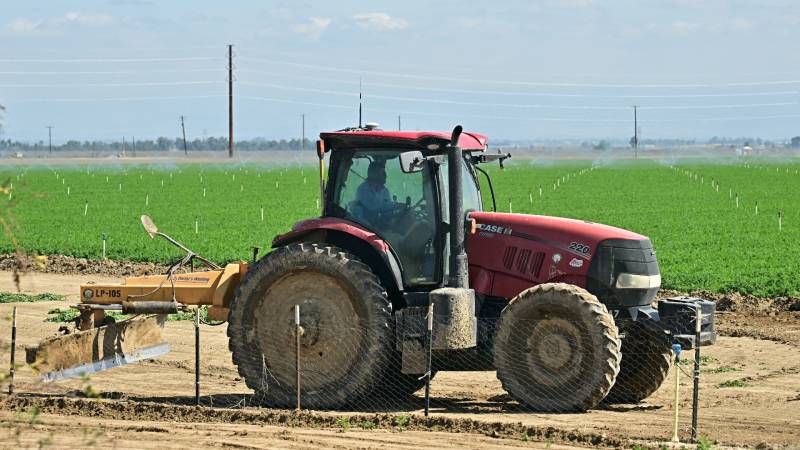
Look, we’re all in favor of air and water quality. There’s no doubt about it. We’ve spent a lot of money over the years making our tractors cleaner, buying cleaner-burning diesel tractors. We’ve looked at electric tractors.
It just seems like every time we turn around, we get hit with additional regulations and higher costs associated with them.
Alexis Madrigal: Well, thank you, Don Cameron. Thanks for letting us into your world.
Don Cameron is vice president and general manager of Terra Nova Ranch in Fresno and president of the California State Board of Food and Agriculture. Thanks so much.
Don Cameron: Thank you.
Alexis Madrigal: Let’s bring in a couple of other voices to zoom out for us.
We’ve got Alexis Maxwell, senior equity analyst for Bloomberg Intelligence. Welcome, Alexis.
Alexis Maxwell: Good afternoon. Hello.
Alexis Madrigal: Great to have another Alexis on the show. I always love it.
Daniel Sumner is also joining us, professor of agricultural and resource economics at UC Davis and director of the UC Giannini Foundation of Agricultural Economics. Welcome.
Dan Sumner: Good morning.
Alexis Madrigal: Alexis, let’s talk a little bit about this spike in fertilizer.
I would bet most of our listeners have not spent a lot of time talking or thinking about the different types of fertilizers that farmers apply. Can you give us a little primer on the fertilizer market?
Alexis Maxwell: Sure.
The fertilizer market is primarily dominated by three major nutrients: nitrogen, phosphate, and potash. Depending on what crop farmers plant, they’re going to consume a certain amount of each of those nutrients. Together, we call that the NPK complex.
When we look at the crisis in the Middle East and the escalation of the war in Iran, what we see is a nutrient-specific supply shortage, primarily on the nitrogen side. About forty percent of the traded urea in the world has been affected by this war.
Alexis Madrigal: Just so I’m clear, why is that fertilizer coming out of there? Is it because it’s made from natural gas to begin with?
Alexis Maxwell: Yeah.
The inputs to your NPK fertilizers are either natural gas, in the case of nitrogen, or mined minerals — phosphate and potash are found in the ground.
The reason the Middle East is so important to nitrogen supply is because it is a large supplier of natural gas.
Alexis Madrigal: Gotcha.
Daniel Sumner, when do our farms need these fertilizers?
We’re talking about major farming operations here — not an organic farm with an acre, but huge operations with a lot of logistics. How do they actually apply these fertilizers, and when do they need them?
Dan Sumner: First, let’s clarify: organic farms are large too.
I wouldn’t be surprised if Don and others have some organic operations, for example, alongside their other operations. A lot of big farms do.
They may not use the same kind of nitrogen, but they’re still trying to find nitrogen from some source, same with the other nutrients.
The big issue across crops is that California has a lot more variation than most places.
In the national news, we hear about corn and soybeans. What we do out here is much more variable, and that means the timing is variable too.
For annual crops — say corn silage or something planted in the spring — they’ll use a lot of fertilizer in the spring. But for orchard crops, you may fertilize in the spring and then throughout the year as well.
There’s just a whole lot more variation.
We’re harvesting a lot of crops right now in California while there’s still snow on the ground in many other places. Don’t forget strawberries, leafy greens, and all that stuff that are really big crops here.
Alexis Madrigal: And they also require a lot of nitrogen, don’t they?
Dan Sumner: Oh yeah. Those are annual crops — in fact, many times a year.
You may be planting leafy greens in Monterey County three or four times a year, which means you’re drawing on fertilizer throughout the year.
A lot of farmers plan ahead. They’re already thinking about 2027 as well.
As Don was talking about selling the crop ahead, they’ve also bought the fertilizer ahead. It’s not like they wake up sometime in the middle of March and say, “Gee, I need some fertilizer this year.”
They’ve thought about that way ahead and sometimes locked in prices.
This year they’d have been happy to lock in prices. Other years they might kick themselves for locking in a price because it falls later.
The one thing every one of these farms has in common is lots of risk and variability. You just don’t know what’s going to happen from one month to the next — or one day to the next.
Alexis Madrigal: Yeah, to say nothing of a historic March heat wave, et cetera.
Dan Sumner: Yeah, we could do a lot, couldn’t we?
Alexis Madrigal: We’re talking about the very local agricultural impacts of the war in Iran and broader geopolitical factors.
We’re joined by Daniel Sumner, professor of agricultural and resource economics at UC Davis, and Alexis Maxwell, senior equity analyst for Bloomberg Intelligence.Earlier you heard Don Cameron, vice president and general manager of Terra Nova Ranch in Fresno.
We’d love to hear from you. Are you a farmer? Are you in a farm-related or adjacent industry? Is what’s happening in the Strait of Hormuz affecting you? Have you been seeing changes in produce or grocery prices already? What are your questions for the panel? Give us a call: 866-733-6786. That’s 866-733-6786. Or email forum@kqed.org.
I’m Alexis Madrigal. Stay tuned.