Episode Transcript
This is a computer-generated transcript. While our team has reviewed it, there may be errors.
Samantha Cole: I have never been a smoker, period. I have never smoked nicotine of any kind. Such a loser.
Morgan Sung: Sam Cole is a tech journalist and co-founder of 404 Media, and last summer, she tried to vape the internet.
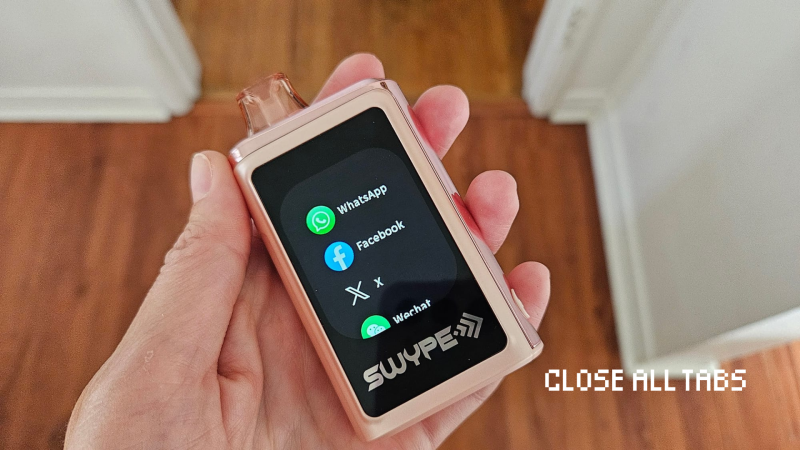
Samantha Cole: There was this tweet going super viral back in July. It was a guy that was like, “no way we got Twitter on my vape.” And it was a photo of him holding a vape with Twitter on it, reading tweets on it.
Morgan Sung: It was exactly what it sounds like, a little flip phone-sized disposable vape, with a digital screen.
Samantha Cole: And everyone was freaking out about it. It became a meme format. Like, there was one where someone was putting Zillow on a vape.
Morgan Sung: In other posts, people were getting breaking news alerts on their vapes or playing games like Tetris and 2048. And Sam, being an intrepid journalist, was determined to figure out if it was real.
Samantha Cole: I’m always looking for new ways to ingest the internet. So I was like, let me look in the comments or in the replies and see if anybody actually has it. And it turned out someone did have a link. God bless the internet. A lot of them were sold out. The other flavors were Fucking Fab — I wish I knew what Fucking Fab tasted like — Juicy Peach, obviously you can imagine. Violent Rainbow was also sold out, I’m sure it was disgusting, but Watermelon Ice was like the only one left.
Morgan Sung: Sam lives in New York, but was staying in California for a few weeks. So she bought the Watermelon Ice smart vape and shipped it to her friend’s house in Los Angeles. This is relevant.
Samantha Cole: I was like, first of all, I can’t believe this goes through the mail. This definitely seems like something that shouldn’t between the battery and the vape juice and everything else and the electronics involved. I was like house sitting. I was, like, “I hope this doesn’t catch fire while I’m not at home.” It looks like a phone. It was, a pink, like a light pink square, kind of like a deck of cards almost. It had a touch screen that wasn’t, like, as janky as I expected a vape touch screen to be.
Morgan Sung: Okay, so the vape looked like a phone, but it didn’t really function as one. It couldn’t connect to the internet by itself. Sam actually had to download a separate app and connect it to the vape via Bluetooth, and then authorize different apps to send notifications to the vape.
Samantha Cole: Once you connected it to your phone, it would start getting push notifications from whatever apps that you set up to connect to the vape. So that’s where the Twitter on the vape came from.
Morgan Sung: There was a calculator in case you need to do math while you’re vaping, and it also had a step tracker and a weather app and a few games, but a lot of the apps didn’t really work unless Sam’s phone was nearby. She said she couldn’t actually browse the internet on her vape, but because she was getting notifications on it, it created this cycle of getting pinged while puffing some watermelon ice and then checking her phone and then puffing again.
Samantha Cole: I mean, I was very quickly like literally addicted to this thing, cause it was nicotine. I was bringing it everywhere. I was like, it was like a fun thing to show people ’cause obviously it’s like weird and kooky. I had it out like drinking and then I was vaping. I was, like, “man, this is, I need to put this away. I need you to put it in a drawer and not think about it.” And then it was just like calling me like the Green Goblin mask.
Green Goblin Mask: COWARD! We have a new world to conquer. Hahaha!
Samantha Cole: It was like, “I need a little, I need Watermelon Ice.”
Morgan Sung: So Sam wrote up this tongue-in-cheek blog post for 404 Media about trying to “vape the internet,” but after publishing it, she still found herself reaching for the vape.
Samantha Cole: So I was just like, this is like the dumbest blog I’ve ever written. It’s up there on like “the dumbest ways to get addicted to vaping” is this stunt where I’m trying to read Twitter on a vape.
Morgan Sung: Yeah, it’s like you’re addicted to the nicotine and you’re addicted to your feed.
Samantha Cole: Right, yeah, I was addicted to all of it at the same time, which is just so dark. Connecting like this very like neurochemical process of like being addicted to nicotine and then getting like dms on the vape and being like, “ooh who’s DMing me on twitter.” This is like such a dark path uh to go to down.
Morgan Sung: Sam ended up kicking the habit when she left the vape at her friend’s house in LA. She said she was scared to take it through airport security. And when she got back to New York, she resisted the temptation to buy another one. Since then, she’s managed to keep her nicotine consumption limited to the very occasional analog cigarette shared among friends.
But Sam said that her vape experience was an eye-opener in more ways than one. There was her brush with this combined nicotine and internet addiction, sure, but she’s also been thinking about another issue: just how wasteful these vapes are. Remember, they’re disposable. There’s no vape pod to swap out if you want to change flavors. You can’t refill it once it’s empty. And a lot of them aren’t even rechargeable. You can easily go through one in a few weeks or a few days if you’re really puffing. Which means that you’re constantly replacing them.
Samantha Cole: There was a time in like New York / Bushwick, surely you recall this, but just the ground was just covered in used Juul pods. It was just everywhere. At the time, I was like, “this is an ecological disaster.” And now I think-
Morgan Sung: It was like plastic everywhere.
Samantha Cole: Yeah, and it’s disgusting. And like, and you know, it’s like, I guess they put them in like cigarette butts, except they don’t degrade or anything. But then this I was like, “okay, when I finish this vape, I can’t refill it?” Even though it has all this stuff in it. Like it has like the touch screen, like it has chips inside of it, it has a battery inside of obviously, lots of plastic. So I was like, “damn, there’s a lot of like engineering that goes into this thing and then it becomes disposable within like a couple of weeks?”
Morgan Sung: Okay, so what exactly makes vapes an “ecological disaster,” like Sam said? Are you supposed to recycle them? And how big of a problem is this really? That’s what we’re getting into today.
This is Close All Tabs. I’m Morgan Sung:, tech journalist, and your chronically online friend, here to open as many browser tabs as it takes to help you understand how the digital world affects our real lives. Let’s get into it.
E-waste, or electronic waste, includes any electronic device that’s thrown away instead of recycled. It’s copper wires, semiconductors, circuit boards, LED screens, heavy metals, batteries, and more. It’s the stuff in our refrigerators and our old iPhones, and in our vapes. When these materials are dumped in landfills, they don’t really break down. And the sheer rate at which people are now buying, puffing, and then tossing disposable vapes, is rapidly adding to the e-waste crisis.
Let’s make that our first tab. Disposable vapes and e-waste.
To explain how disposable vapes became so popular, let me take you back in time to the year 2019. This was the first ever “hot girl summer” as coined by Megan Thee Stallion and mango Juul pods were everywhere.
Ty Dolla $ign: Does she got it?
Morgan Sung: It was a simpler time. And then, fear of popcorn lung swept the nation. Popcorn lung is the informal name for a lung condition in which the small airways in your lungs become so inflamed and scarred that breathing becomes extremely difficult. It’s from inhaling a chemical called diacetyl, which is used as a buttery flavoring in products like popcorn. It’s safe to eat, but when inhaled, it can cause permanent damage. That year, a ton of people especially teenagers, started to get really sick with mysterious lung issues.
News Anchor 1: A seemingly healthy Texas teenager suddenly unable to breathe and hospitalized with lung failure. His doctors suspect vaping was the cause.
News Anchor 2: The CDC released some new numbers today. The new numbers show more than 2,000 people now have been diagnosed with a vaping illness.
Morgan Sung: In the United States, there were over 2,700 confirmed cases related to this mysterious vape illness and 68 deaths. One teenager in Canada had symptoms that aligned with popcorn lung, but all of the cases in the US involved pneumonia and other symptoms that aren’t present in popcorn lung. That pointed to another culprit. The CDC actually identified a different chemical as the probable cause of these vape-related cases: Vitamin E acetate. It was used in a lot of black market weed vape cartridges to dilute cannabis oil and essentially make a cheaper product. The CDC never confirmed whether diacetyl, the flavoring chemical, was related.
Still, the fear of popcorn lung and the amount of teenagers getting sick contributed to a nationwide crackdown on flavored vapes, whether or not they contained diacetyl. At the time, Juul was the biggest e-cigarette company. They sold different flavor pods, like mango, crème brûlée, and berry, which were all interchangeable and worked with a rechargeable battery. In 2020, the FDA banned most flavored cartridges, like Juul pods.
News Anchor 3: A targeted ban on the fruit-flavored e-cigarette cartridges, including mint, most popular with teens.
Morgan Sung: And a recent Supreme Court decision sided with the FDA over its flavored vape ban.
News Anchor 4: In a unanimous ruling, the Supreme Court has given the FDA victory in its ability to regulate e-cigarettes.
Morgan Sung: I confess that I was once a Juul kid. Frankly, the flavor ban made getting ahold of my beloved mango flavored nicotine so inconvenient that I stopped vaping entirely. But that flavor ban did not apply to disposable vapes. And in the years since, an entire unregulated gray market opened up, offering more dessert flavors than Juul ever carried.
So to break this down, we’re going to hear from someone with expertise in both public health and the environment. Dr. Yogi Hale Hendlin. He’s an environmental philosopher who currently teaches at Erasmus University, Rotterdam. But when he was a researcher at UC San Francisco during the height of the vape illness crisis, he very closely studied vaping and nicotine habits. And that included keeping tabs on how people were getting rid of their vapes.
Yogi Hale Hendlin: The FDA banned flavors for refillable, reusable vapes, but not for disposable ones. Because at the time they weren’t a thing really. Juul was the thing. They were 70% of the market for a while. You can hold them accountable at least. But when you get this disposable vape market taking this loophole and exploiting it as much as they can for the thousands and thousands of flavors. Guess which market is most interested in flavors, it’s not 80-year-old smokers looking to quit. It’s kids and young adults, and the industry knows this. The FDA has had years to close this loophole, to do something about it, because it’s really all about flavors. So flavors is driving the disposable vapes.
Morgan Sung: For a while, it seemed like smoking was really falling out of popularity. I mean, cigarettes were really out, at least in the United States. But now it seems like vaping is more popular. What impact is this having on the environment?
Yogi Hale Hendlin: If we look at these devices, they’re not being recycled, they’re not being built for long time use, but to last as long as necessary for a disposable vape and then thrown out. And that’s accumulating in our dumps, in our incinerators.
Morgan Sung: A 2023 report commissioned by the United Nations found that 844 million vapes are thrown away every year. That is enough lithium to make batteries for 5,000 electric cars. Lithium is already a finite resource and mining it involves significant water consumption and deforestation. Even though lithium itself isn’t renewable, batteries that contain it can be rechargeable or can be repurposed. But single-use vapes aren’t always meant to be taken apart or recycled, so these lithium batteries are usually just discarded.
Yogi Hale Hendlin: So this is really quite alarming that we’re allocating our resources towards continued addiction by other means, and at the same time, junking the planet.
Morgan Sung: Right. Can you talk about why disposables are so popular, whether for e-cigarettes or even for weed vapes? Which, weed vape cartridges aren’t banned the same way that a mango Juul pod is, but people do gravitate toward disposables anyway.
Yogi Hale Hendlin: Right now, they’re making them so cheap. We’re not reflecting the true cost of these items in our economy. We are basically subsidizing the waste at the end of life. There’s no extended producer responsibility where the manufacturer has to be responsible for it. There is no brand loyalty where you have to make sure that your device works properly for a certain amount of time. Right now, it is really a race to the bottom in terms of how much can you pack into this single thing, then you throw away. It makes it much easier for students who they can flush it down the toilet if it’s about to get confiscated, which unfortunately happens way too much. And it’s something that they can pass around.
Morgan Sung: Are you familiar with those very advanced, like vapes with screens on them that can connect to your smartphone? They have games, some of them have step trackers. Have you seen these?
Yogi Hale Hendlin: Absolutely. They are the logical progression of tracking multiple addictions all on one device.
Morgan Sung: Right. And what is astonishing to me is that, yeah, these aren’t refillable. You’re not going to buy like, you know, nicotine juice at a vape shop and refill it. You are just going to use it and then get rid of it.
Yogi Hale Hendlin: Yeah, there’s no way to even refill it if you’d want to. You know, you’d probably like break the thing. But these things have LED screens. They have like, you know, they’re like basically old school game boys.
Morgan Sung: I mean, can you speak about like how this trend of super advanced gamified vapes exacerbates the waste issue?
Yogi Hale Hendlin: I’m just gonna take a step back to the problem of disposables, right? So, before you would finish your juice and you’d get a refill and you do that with the same device for a year or two or three. But now you have like this whole unit, this thing that has the battery, that has now these screens, but all this circuitry too, the heating component, and you’re throwing that all away as soon as the juice is gone. Sometimes they integrate with your smartphone, but they also have like GPS tracking, social media notifications, like you said, fitness tracking and built-in games. So it’s like increasing the association of entertainment and sort of the practicality and weaves in like seamlessly with the rest of your life. And I think that this sort of integration is the dream of any product manufacturer. But when you do it with something that’s so addictive and isn’t good for you, that this raises a host of moral problems and societal ones.
Morgan Sung: I also wanted to clarify the difference between what goes into a disposable vape and what goes in to a rechargeable vape battery.
Yogi Hale Hendlin: Obviously with a 10,000-hit, non-rechargeable, disposable vape, you need a bigger battery to compensate for all of those hits, right, to get the heating coil to work. So you’re actually using a bigger in a disposable than you would in your standard rechargeable like a Juul, but you’re only using the battery once. Rather than renewing it, like, you know, 100 or 1,000 times, you’re using that battery once. None of these are really being made in the US anyhow, so there’s also questions about safety for health, safety for the environment, and yeah, it’s a Wild West right now.
Morgan Sung: What happens when a vape is, you know, dropped in the environment? Like what happens to the environment, how does it break down?
Yogi Hale Hendlin: I mean, the lithium batteries, oftentimes in dumpsters, you get dumpster fires if the thing gets impacted. Chemical fire is not so easy to put out either. Sometimes you just have to let it burn out. What happens when it’s on the curb, ultimately, it probably goes into our storm drains and probably leaches a lot of particulate matter, heavy metals into our water stream that goes out to the ocean ultimately.
Morgan Sung: Oh great, so we’re turning the ocean into a giant like vape juice container.
Yogi Hale Hendlin: Totally with the lithium ion batteries and all the like soldering components that are usually made with mercury it’s no bueno
Morgan Sung: Trying to regulate the disposable vape market is like playing a game of whack-a-mole. Nearly all of them are manufactured in China, which ironically also bans flavored e-cigarettes. But it doesn’t ban the export of vapes, which is how the U.S. Became flooded with cotton candy-flavored disposables after 2020. There’s really nothing stopping retailers from selling them. The FDA keeps trying to crack down on them, but new companies pop up and find more loopholes. That also means that trash is piling up. So if it isn’t the FDA, is anyone regulating the disposal of these things? We’ll talk about that after the break.
California has some of the strictest e-waste laws in the country, but when it comes to nicotine vapes, disposal guidelines are fuzzy. New tab, California vape laws. So in California, it’s actually illegal to throw away a lot of electronics from old computers to TVs to even weed pens. They have to be disposed of at special facilities. As of last year, cannabis companies aren’t allowed to market their vapes as disposable. And a lot dispensaries have started taking back used vapes to safely get rid of them. There is a whole cottage industry of cannabis waste companies that collect used vaped from dispensary. Then, they separate the batteries and cartridges to recycle them. Not all of it is recyclable and it’s not a perfect system, but it’s a start. This same system doesn’t really exist for those disposable flavored nicotine vapes.
Yogi Hale Hendlin: One of the major conundrums that keeps these things from being more recyclable than they are currently is that vapes are currently treated as both hazardous waste because of the nicotine and electronic waste, right? So you basically have this thing that you can’t just put in electronic waste and deal with it because it has nicotine. And so you can really have a circular economy with the way that the laws are currently set up. Circular economy is an economy where the products that you’re using are made to be disassembled, refurbished, reassembled and re-appropriated into new products with minimum energy use, minimum waste. In California, I believe that our laws are still preventing us from fully being able to recycle these things. Currently they’re not made to spec so that we can all say, okay, so this is how you take it apart and easily get the valuable metals, take the battery out. They’re not modular.
Morgan Sung: Yeah. I mean, I didn’t know about the vape disposal law until I started reporting on this story, and a lot of people I’ve talked to also just did not know about this law. As a public health expert, is there anything California should be doing to get the message out about vape recycling?
Yogi Hale Hendlin: We need to make it easy as pie. And this is how we do it. You put the deposit on the vape. You say, hey, you wanna buy a vape? Great, here is $5 deposit that you pay when you buy it. When you deposit your vape to be recycled, you get your five bucks back. And everybody, especially those who are in need of money, especially those were young, are going to properly deal with their vape. It’s called the deposit return system. It’s been used for milk bottles for over a century. It’s also in California on our computers.
Morgan Sung: So California lawmakers also introduced a bill that wants to ban disposable vapes entirely. Some are concerned that banning disposable vaping entirely will push people to buy it from the black market instead. What do you think of this? Is this just fear-mongering from the big vaping industry?
Yogi Hale Hendlin: Yes, it is. I mean, we’ve heard for a long time from the tobacco industry that, you know, if you tax cigarettes, the black market will be the place where people get their cigarettes. Most kids are not getting their things from the black market. So it’s an idea of proportionality. It’s not that those arguments are absolutely incorrect, it’s just that they overplay their hand. If we want to protect kids and young adults from these devices, if we want to get rid of the environmental harms, which are so considerable, of single-use vapes, then all you have to do is ban single- use vapes and then they’re not going to become the cool thing anymore. That’s not what people will be using. And the overton window will shift and consumer preferences will change. And so the black market issue for me is sort of a non-starter if you think it logically all the way through.
Morgan Sung: Right. I mean, again, going back to my 21 year old little Juul addicted brain, I stopped dueling because it became inconvenient to buy Juuls. Like, is it that simple, really?
Yogi Hale Hendlin: It really is that simple. If we make access a little bit more difficult, and a deposit is a great way to do that for an addictive drug that harms the environment, you can easily put a deposit on it and it makes it a little less accessible for kids. And it also makes sure that people who do use these devices, that they return them where they’re supposed to go.
There was a recent study showing that somewhere between 70 and 80 percent all vapes are improperly disposed of. Where are they going? They’re going in our waterways. I have a whole collection that I found on the streets of San Francisco. Not that people are always just discarding them, but people also lose them. They fall out of backpacks. So there’s a lot of carelessness because they’re so cheap and disposable and because there’s no accountability.
Morgan Sung: If this ban passes, will moving to rechargeable vapes actually do anything for the environment, or will people just keep treating their rechargeable vape like they’re disposable and keep losing them and keep easily tossing them without actually recycling them, just paying more for it?
Yogi Hale Hendlin: Obviously, just moving to reusable versus disposable is not going to solve the whole issue. I think we still need to deposit because there’s still going to be an end of life issue. If we want to make sure that we get those in the proper place, we also need accessibility. We need it to make it easy for people like you go to your supermarket and there’s a bin and you go the grocer and you give your device, you get your five bucks back and it’s over. So we need to integrate it into our recycling infrastructure. Yeah, there’s going to be a lag time. Just as every generation has to learn new technologies, people are going to have to get used to moving from disposable to non-disposable, just as they also did move from reusable to disposable. That was also a learning curve.
Morgan Sung: With the current administration, the likelihood of further federal regulation on disposable vapes is unclear. Trump has promised to, quote, save vaping, end quote. And during the 2024 campaign, Business Insider reported that some conservative circles have embraced nicotine consumption as masculine and contrarian.
Look, we can regulate vapes until we’re blue in the face, but to meaningfully reduce vape waste, we need a culture-wide shift in how we consume tech products. The current state of vape prohibition hasn’t stopped people from buying flavored vapes or curbed e-waste. That’s why some DIY enthusiasts are actually taking it upon themselves to prove that disposable vapes can be recycled.
Let’s do one more tab, the circular economy and the right to repair.
Last month, this YouTuber who goes by NekoMichi went super viral after someone dumped a single-use vape on their doorstep. Instead of tossing it, NekoMichi broke open the plastic casing, pried the lithium battery out, and wired it to an old iPod Touch. They actually managed to power the iPod using the vape battery. NekoMichi is one of many DIYers who salvage batteries and other parts from so-called disposable vapes and repurpose them for power banks, gaming controllers, and other small devices. One person on the DIY electronics subreddit even built an e-bike battery out of 130 disposable vapes.
Yogi Hale Hendlin: That is a great reuse of these batteries that otherwise would just end up in our landfills or incinerated. At the same time, you can’t expect your average vaper to know how to use Arduino chips and be able to do this. I think it’s a great proof of concept, right? It shows these things are totally reusable. Like it’s insane that we’re just throwing them out after, you know, a single run. We also have to be aware however, that because the batteries are not made to last, that there are lots of possible hazards that could come from that.
Morgan Sung: Like Yogi pointed out, DIY recycling is not exactly going to solve a massive systemic issue. Taking apart and then repurposing vape components is extremely labor-intensive, requires highly technical skills, and may cause a fire that’s nearly impossible to put out. But what is inching us closer to building the circular economy that Yogi was talking about earlier is the Right to Repair movement.
Under Right to Repair laws, now in place in five states, if you buy a new electronic device, the company that sold you that device has to sell the repair manuals and spare parts to fix it if it breaks, instead of forcing you to buy a whole new one. In addition to taking back used cartridges and batteries for recycling, some cannabis vape companies also sell replacement parts and offer repair services. This might be a way forward for more sustainable e-cigarettes too.
Yogi Hale Hendlin: I don’t want to be in disposable relationships. I like having my old cell phone that works exactly the way I like it to, and I don t have to use a month of my time figuring out the new configurations on a new one and getting them exactly how I like. I like stuff that lasts a while so that I can get cozy with it, that I get to know it.
Morgan Sung: I mean, people will always be determined to get their nicotine fix. So when addressing this e-waste issue and having that in mind, is there any sustainable way forward? Do you think? Like, is the answer just to go back to cigarettes?
Yogi Hale Hendlin: No, I don’t think so. But, you know, at the birth of the e-cigarette movement, there were a lot of these mods, they called them, right? So it was sort of-.
Morgan Sung: I remember the Vapelords.
Yogi Hale Hendlin: Yeah, exactly, right. So build your own e-cigarette. And it really did have a lot of that maker’s sort of ethos behind it, where you could optimize, you know, the liquid, the juice, and the battery, and the heating coil, look at the right ohms, so that everything’s perfect and you can blow these amazing clouds, right?
So I do think that we can help raise awareness of making things more sustainable in terms of reusable, number one, by taking off the market the option just to be totally mindless about it. And hopefully all of this is in tandem with raising awareness of the long-term effects of vaping as well because if people need their nicotine fix, they’re going to get it. But there are so many better ways to do so than with disposables.
Morgan Sung: Okay, so here’s what you’re supposed to do when you’re ready to throw away a vape. Don’t toss them in your regular trash or rinse them out. We don’t want those chemicals hitting municipal water systems. Treat it like getting rid of batteries. Put it aside in a cool, dry place until you can drop it off at a household hazardous waste disposal spot. You can look up your local site online, contact your waste management company, or ask at the place where you bought the vape, and maybe… Consider leaving disposable vapes behind.
Yogi Hale Hendlin: I really understand that we are social animals. We are mammals that mimic each other. And so when we are in situations where it’s just easy, out of sight, out-of-mind, hey, that’s really convenient for us. But when we’re forced to understand, okay, so maybe you had to blow up a mountain to get the lithium to make that vape, maybe you have to deforest lots of land in Malawi and have people who got green leaf sickness from harvesting the tobacco leaves. And then you had to flu cure them and extract the nicotine and make that juice. And that’s how I got my thing. Like you become a lot more aware and you treat it in a more sacred way because I’m not saying that people shouldn’t do X or Y, but when we’re aware of the full ramifications of what we’re doing, the whole commodity chain, the global commodity chains that make it super simple just to press a few buttons on the internet, have this thing delivered to me, I suck on it, I throw it in the garbage can, it goes away and that’s it, that’s my entire relationship to it. That makes it all too easy for me to totally bypass the actual impacts that it’s having on people and the environment.
Morgan Sung: And that being said, definitely do not flush your vapes down the toilet. Let’s close these tabs.
Close All Tabs is a production of KQED Studios and is reported and hosted by me, Morgan Sung. Our Producer is Maya Cueva. Chris Egusa is our Senior Editor. Jen Chien is KQED’s Director of Podcasts and helps edit the show. Original music and sound design by Chris Egusa. Additional music by APM. Mixing and mastering by Brendan Willard. Audience engagement support from Maha Sanad and Alana Walker. Katie Springer is our Podcast Operations Manager. And Holly Kernan is our Chief Content Officer.
Support for this program comes from Birong Hu and supporters of the KQED Studios Fund. Some members of the KQED podcast team are represented by the Screen Actors Guild, American Federation of Television and Radio Artists, San Francisco, Northern California Local. Keyboard sounds were recorded on my purple and pink dust silver K84 wired mechanical keyboard with Gateron red switches.
If you have feedback, or a topic you think we should cover, hit us up at closealltabs@kqed.org. Follow us on Instagram at Close All Tabs Pod, or drop it on Discord. We’re in the Close All tabs channel at discord.gg/KQED. And if you’re enjoying the show, give us a rating on Apple Podcasts or whatever platform you use. Thanks for listening.
Samantha Cole: I wish this thing had like a little Tamagotchi on it so then I could like.
Morgan Sung: Oh my god, yeah.
Samantha Cole: Care, care for my little pet and then also be vaping.
Morgan Sung: Don’t give them ideas.
Samantha Cole: I bet that exists.