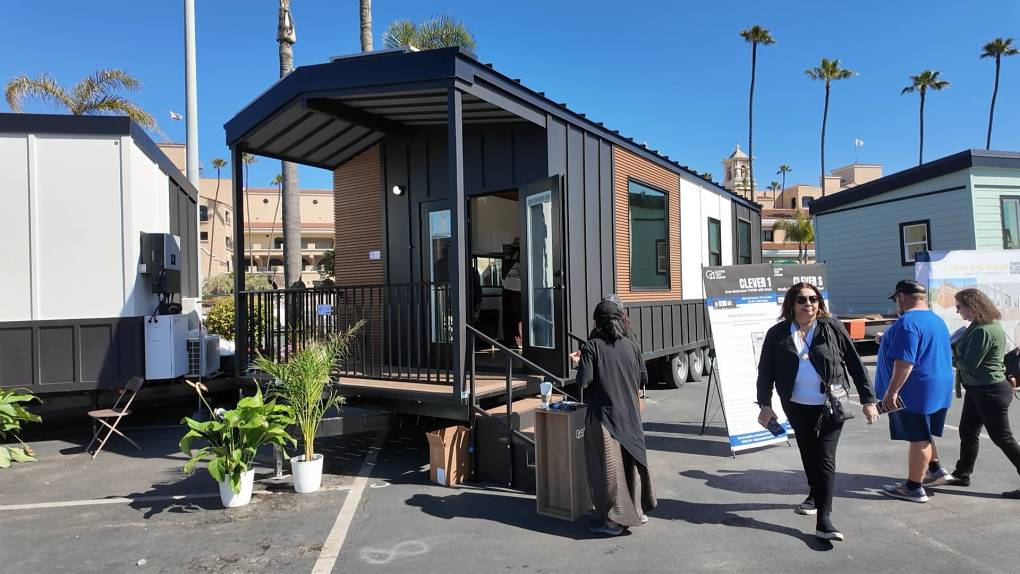
California's Tiny Home Boom Signals Hope In Housing Crisis Though Challenges Remain
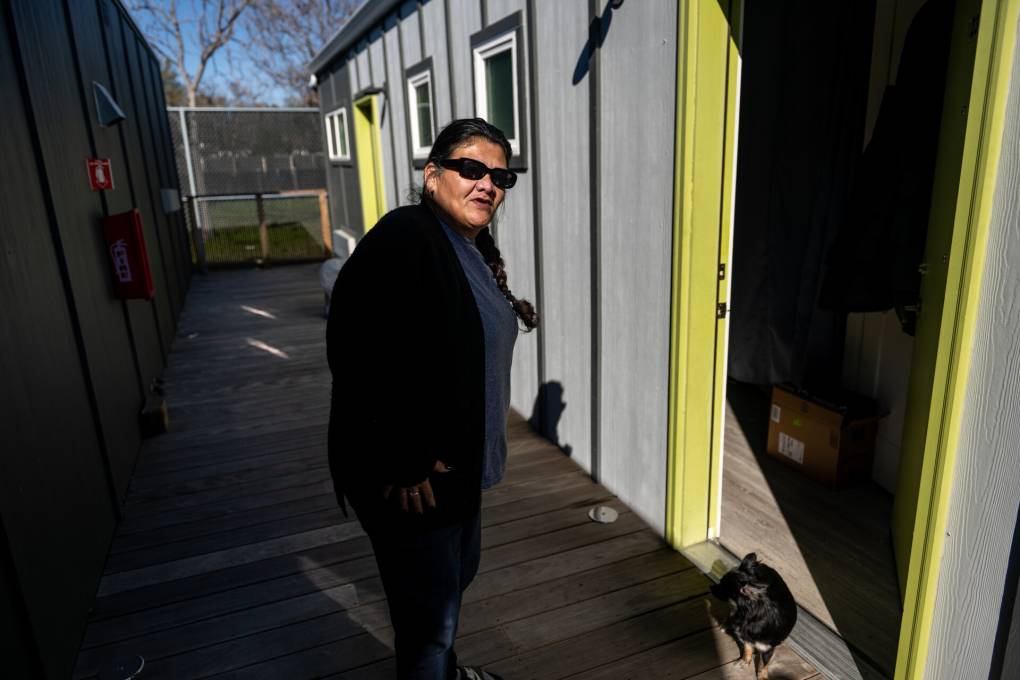
Are Tiny Homes A Viable Solution To Help With Homelessness Crisis?
Should California Double Down on Building Tiny Homes for People Experiencing Homelessness?
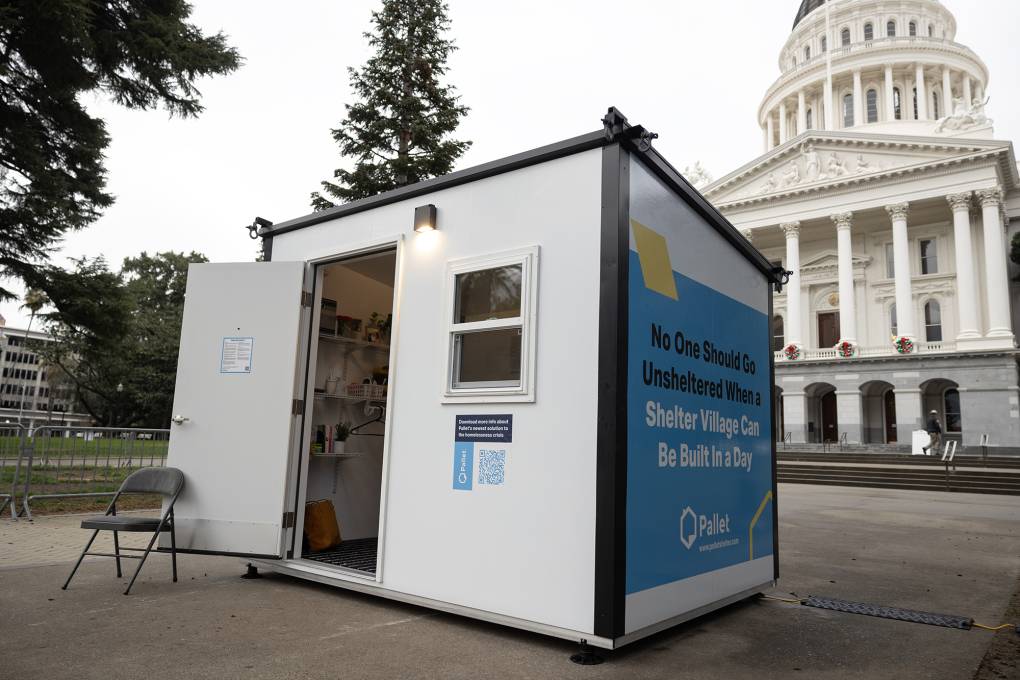
Governor Newsom's Tiny Home Plan Falls Short Of What Was Promised
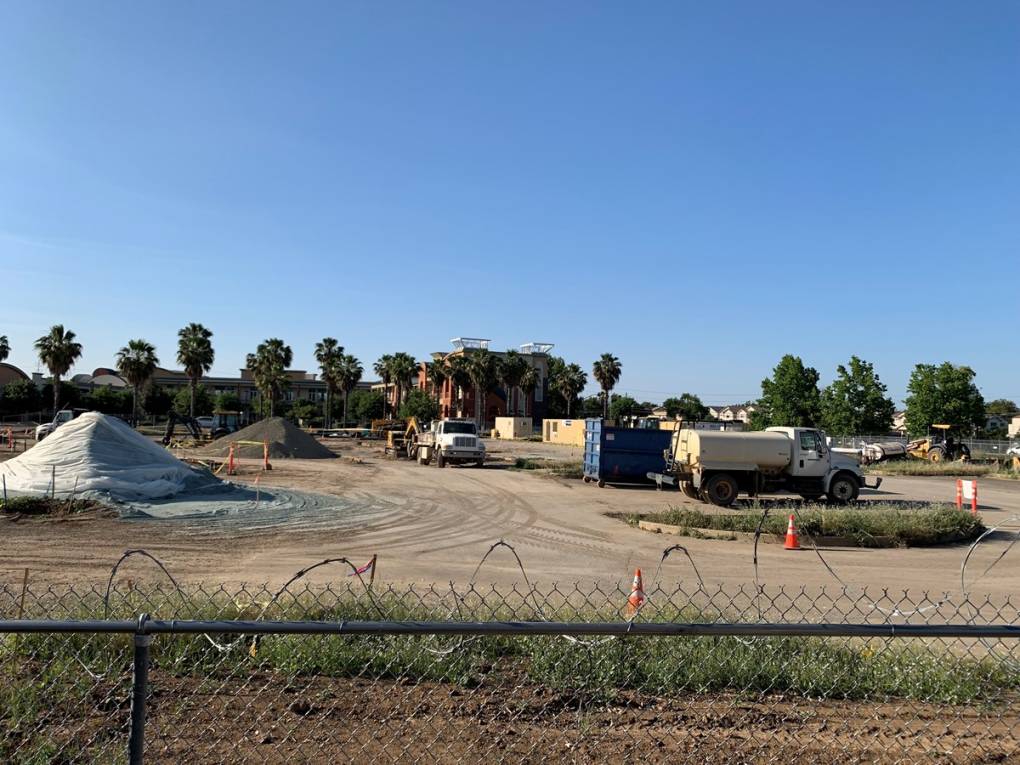
Newsom Promised 1,200 Tiny Homes for Unhoused Californians, but a Year Later None Have Opened
Newsom Reneges on Sending San José Free Tiny Homes for the Unhoused
Newsom's Tiny Home Plan Moves Forward, Construction Timeline Uncertain
Why Tiny Homes Will Remain Part of California’s Homelessness Equation for Years
What Happened to the 1,300 RVs Gov. Newsom Sent to Address Homelessness Back in 2020?
Sponsored
Player sponsored by
window.__IS_SSR__=true
window.__INITIAL_STATE__={
"attachmentsReducer": {
"audio_0": {
"type": "attachments",
"id": "audio_0",
"imgSizes": {
"kqedFullSize": {
"file": "https://ww2.kqed.org/news/wp-content/themes/KQED-unified/img/audio_bgs/background0.jpg"
}
}
},
"audio_1": {
"type": "attachments",
"id": "audio_1",
"imgSizes": {
"kqedFullSize": {
"file": "https://ww2.kqed.org/news/wp-content/themes/KQED-unified/img/audio_bgs/background1.jpg"
}
}
},
"audio_2": {
"type": "attachments",
"id": "audio_2",
"imgSizes": {
"kqedFullSize": {
"file": "https://ww2.kqed.org/news/wp-content/themes/KQED-unified/img/audio_bgs/background2.jpg"
}
}
},
"audio_3": {
"type": "attachments",
"id": "audio_3",
"imgSizes": {
"kqedFullSize": {
"file": "https://ww2.kqed.org/news/wp-content/themes/KQED-unified/img/audio_bgs/background3.jpg"
}
}
},
"audio_4": {
"type": "attachments",
"id": "audio_4",
"imgSizes": {
"kqedFullSize": {
"file": "https://ww2.kqed.org/news/wp-content/themes/KQED-unified/img/audio_bgs/background4.jpg"
}
}
},
"placeholder": {
"type": "attachments",
"id": "placeholder",
"imgSizes": {
"thumbnail": {
"file": "https://cdn.kqed.org/wp-content/uploads/2024/12/KQED-Default-Image-816638274-2000x1333-1-160x107.jpg",
"width": 160,
"height": 107,
"mimeType": "image/jpeg"
},
"medium": {
"file": "https://cdn.kqed.org/wp-content/uploads/2024/12/KQED-Default-Image-816638274-2000x1333-1-800x533.jpg",
"width": 800,
"height": 533,
"mimeType": "image/jpeg"
},
"medium_large": {
"file": "https://cdn.kqed.org/wp-content/uploads/2024/12/KQED-Default-Image-816638274-2000x1333-1-768x512.jpg",
"width": 768,
"height": 512,
"mimeType": "image/jpeg"
},
"large": {
"file": "https://cdn.kqed.org/wp-content/uploads/2024/12/KQED-Default-Image-816638274-2000x1333-1-1020x680.jpg",
"width": 1020,
"height": 680,
"mimeType": "image/jpeg"
},
"1536x1536": {
"file": "https://cdn.kqed.org/wp-content/uploads/2024/12/KQED-Default-Image-816638274-2000x1333-1-1536x1024.jpg",
"width": 1536,
"height": 1024,
"mimeType": "image/jpeg"
},
"fd-lrg": {
"file": "https://cdn.kqed.org/wp-content/uploads/2024/12/KQED-Default-Image-816638274-2000x1333-1-1536x1024.jpg",
"width": 1536,
"height": 1024,
"mimeType": "image/jpeg"
},
"fd-med": {
"file": "https://cdn.kqed.org/wp-content/uploads/2024/12/KQED-Default-Image-816638274-2000x1333-1-1020x680.jpg",
"width": 1020,
"height": 680,
"mimeType": "image/jpeg"
},
"fd-sm": {
"file": "https://cdn.kqed.org/wp-content/uploads/2024/12/KQED-Default-Image-816638274-2000x1333-1-800x533.jpg",
"width": 800,
"height": 533,
"mimeType": "image/jpeg"
},
"post-thumbnail": {
"file": "https://cdn.kqed.org/wp-content/uploads/2024/12/KQED-Default-Image-816638274-2000x1333-1-672x372.jpg",
"width": 672,
"height": 372,
"mimeType": "image/jpeg"
},
"twentyfourteen-full-width": {
"file": "https://cdn.kqed.org/wp-content/uploads/2024/12/KQED-Default-Image-816638274-2000x1333-1-1038x576.jpg",
"width": 1038,
"height": 576,
"mimeType": "image/jpeg"
},
"xxsmall": {
"file": "https://cdn.kqed.org/wp-content/uploads/2024/12/KQED-Default-Image-816638274-2000x1333-1-160x107.jpg",
"width": 160,
"height": 107,
"mimeType": "image/jpeg"
},
"xsmall": {
"file": "https://cdn.kqed.org/wp-content/uploads/2024/12/KQED-Default-Image-816638274-2000x1333-1-672x372.jpg",
"width": 672,
"height": 372,
"mimeType": "image/jpeg"
},
"small": {
"file": "https://cdn.kqed.org/wp-content/uploads/2024/12/KQED-Default-Image-816638274-2000x1333-1-672x372.jpg",
"width": 672,
"height": 372,
"mimeType": "image/jpeg"
},
"xlarge": {
"file": "https://cdn.kqed.org/wp-content/uploads/2024/12/KQED-Default-Image-816638274-2000x1333-1-1020x680.jpg",
"width": 1020,
"height": 680,
"mimeType": "image/jpeg"
},
"full-width": {
"file": "https://cdn.kqed.org/wp-content/uploads/2024/12/KQED-Default-Image-816638274-2000x1333-1-1920x1280.jpg",
"width": 1920,
"height": 1280,
"mimeType": "image/jpeg"
},
"guest-author-32": {
"file": "https://cdn.kqed.org/wp-content/uploads/2025/01/KQED-Default-Image-816638274-1333x1333-1-160x160.jpg",
"width": 32,
"height": 32,
"mimeType": "image/jpeg"
},
"guest-author-50": {
"file": "https://cdn.kqed.org/wp-content/uploads/2025/01/KQED-Default-Image-816638274-1333x1333-1-160x160.jpg",
"width": 50,
"height": 50,
"mimeType": "image/jpeg"
},
"guest-author-64": {
"file": "https://cdn.kqed.org/wp-content/uploads/2025/01/KQED-Default-Image-816638274-1333x1333-1-160x160.jpg",
"width": 64,
"height": 64,
"mimeType": "image/jpeg"
},
"guest-author-96": {
"file": "https://cdn.kqed.org/wp-content/uploads/2025/01/KQED-Default-Image-816638274-1333x1333-1-160x160.jpg",
"width": 96,
"height": 96,
"mimeType": "image/jpeg"
},
"guest-author-128": {
"file": "https://cdn.kqed.org/wp-content/uploads/2025/01/KQED-Default-Image-816638274-1333x1333-1-160x160.jpg",
"width": 128,
"height": 128,
"mimeType": "image/jpeg"
},
"detail": {
"file": "https://cdn.kqed.org/wp-content/uploads/2025/01/KQED-Default-Image-816638274-1333x1333-1-160x160.jpg",
"width": 160,
"height": 160,
"mimeType": "image/jpeg"
},
"kqedFullSize": {
"file": "https://cdn.kqed.org/wp-content/uploads/2024/12/KQED-Default-Image-816638274-2000x1333-1.jpg",
"width": 2000,
"height": 1333
}
}
},
"news_12039289": {
"type": "attachments",
"id": "news_12039289",
"meta": {
"index": "attachments_1716263798",
"site": "news",
"id": "12039289",
"found": true
},
"title": "Tiny Home Frame",
"publishDate": 1746715719,
"status": "inherit",
"parent": 12039282,
"modified": 1746715774,
"caption": null,
"credit": null,
"altTag": null,
"description": "California residents are becoming more and more interested in purchasing tiny homes. ",
"imgSizes": {
"medium": {
"file": "https://cdn.kqed.org/wp-content/uploads/sites/10/2025/05/Tiny-Home-Frame-800x450.jpg",
"width": 800,
"height": 450,
"mimeType": "image/jpeg"
},
"large": {
"file": "https://cdn.kqed.org/wp-content/uploads/sites/10/2025/05/Tiny-Home-Frame-1020x574.jpg",
"width": 1020,
"height": 574,
"mimeType": "image/jpeg"
},
"thumbnail": {
"file": "https://cdn.kqed.org/wp-content/uploads/sites/10/2025/05/Tiny-Home-Frame-160x90.jpg",
"width": 160,
"height": 90,
"mimeType": "image/jpeg"
},
"1536x1536": {
"file": "https://cdn.kqed.org/wp-content/uploads/sites/10/2025/05/Tiny-Home-Frame-1536x864.jpg",
"width": 1536,
"height": 864,
"mimeType": "image/jpeg"
},
"post-thumbnail": {
"file": "https://cdn.kqed.org/wp-content/uploads/sites/10/2025/05/Tiny-Home-Frame-672x372.jpg",
"width": 672,
"height": 372,
"mimeType": "image/jpeg"
},
"twentyfourteen-full-width": {
"file": "https://cdn.kqed.org/wp-content/uploads/sites/10/2025/05/Tiny-Home-Frame-1038x576.jpg",
"width": 1038,
"height": 576,
"mimeType": "image/jpeg"
},
"kqedFullSize": {
"file": "https://cdn.kqed.org/wp-content/uploads/sites/10/2025/05/Tiny-Home-Frame.jpg",
"width": 1920,
"height": 1080
}
},
"fetchFailed": false,
"isLoading": false
},
"news_11988820": {
"type": "attachments",
"id": "news_11988820",
"meta": {
"index": "attachments_1716263798",
"site": "news",
"id": "11988820",
"found": true
},
"title": "013_KQED_SanJoseInterimHousing_01302023_qut",
"publishDate": 1717454635,
"status": "inherit",
"parent": 11988728,
"modified": 1717454673,
"caption": "Amanda Mora stands outside of her temporary home at Evans Lane housing, an interim housing facility located on city-owned land, in San José on Jan. 30, 2023.",
"credit": "Beth LaBerge/KQED",
"altTag": "A woman wearing sunglasses stands outside the door of a grey tiny home.",
"description": null,
"imgSizes": {
"medium": {
"file": "https://cdn.kqed.org/wp-content/uploads/sites/10/2024/06/013_KQED_SanJoseInterimHousing_01302023_qut-800x533.jpg",
"width": 800,
"height": 533,
"mimeType": "image/jpeg"
},
"large": {
"file": "https://cdn.kqed.org/wp-content/uploads/sites/10/2024/06/013_KQED_SanJoseInterimHousing_01302023_qut-1020x680.jpg",
"width": 1020,
"height": 680,
"mimeType": "image/jpeg"
},
"thumbnail": {
"file": "https://cdn.kqed.org/wp-content/uploads/sites/10/2024/06/013_KQED_SanJoseInterimHousing_01302023_qut-160x107.jpg",
"width": 160,
"height": 107,
"mimeType": "image/jpeg"
},
"1536x1536": {
"file": "https://cdn.kqed.org/wp-content/uploads/sites/10/2024/06/013_KQED_SanJoseInterimHousing_01302023_qut-1536x1024.jpg",
"width": 1536,
"height": 1024,
"mimeType": "image/jpeg"
},
"post-thumbnail": {
"file": "https://cdn.kqed.org/wp-content/uploads/sites/10/2024/06/013_KQED_SanJoseInterimHousing_01302023_qut-672x372.jpg",
"width": 672,
"height": 372,
"mimeType": "image/jpeg"
},
"twentyfourteen-full-width": {
"file": "https://cdn.kqed.org/wp-content/uploads/sites/10/2024/06/013_KQED_SanJoseInterimHousing_01302023_qut-1038x576.jpg",
"width": 1038,
"height": 576,
"mimeType": "image/jpeg"
},
"kqedFullSize": {
"file": "https://cdn.kqed.org/wp-content/uploads/sites/10/2024/06/013_KQED_SanJoseInterimHousing_01302023_qut.jpg",
"width": 1920,
"height": 1280
}
},
"fetchFailed": false,
"isLoading": false
},
"news_11988812": {
"type": "attachments",
"id": "news_11988812",
"meta": {
"index": "attachments_1716263798",
"site": "news",
"id": "11988812",
"found": true
},
"title": "IMG_7876_qut",
"publishDate": 1717453713,
"status": "inherit",
"parent": 11988728,
"modified": 1717454965,
"caption": "Carlos Ruben Jacobo, 48, poses for a portrait at the Guadalupe Emergency Interim Housing site in San José on April 10, 2024. Jacobo, who had been unhoused, was initially reluctant to accept a room because he'd heard bad things about other kinds of shelters. But now he says it feels like home.",
"credit": "Vanessa Rancaño/KQED",
"altTag": "A young man with sunglasses and a plaid shirt poses for a photo standing in a walkway between two rows of grey tiny houses.",
"description": null,
"imgSizes": {
"medium": {
"file": "https://cdn.kqed.org/wp-content/uploads/sites/10/2024/06/IMG_7876_qut-800x600.jpg",
"width": 800,
"height": 600,
"mimeType": "image/jpeg"
},
"large": {
"file": "https://cdn.kqed.org/wp-content/uploads/sites/10/2024/06/IMG_7876_qut-1020x765.jpg",
"width": 1020,
"height": 765,
"mimeType": "image/jpeg"
},
"thumbnail": {
"file": "https://cdn.kqed.org/wp-content/uploads/sites/10/2024/06/IMG_7876_qut-160x120.jpg",
"width": 160,
"height": 120,
"mimeType": "image/jpeg"
},
"1536x1536": {
"file": "https://cdn.kqed.org/wp-content/uploads/sites/10/2024/06/IMG_7876_qut-1536x1152.jpg",
"width": 1536,
"height": 1152,
"mimeType": "image/jpeg"
},
"post-thumbnail": {
"file": "https://cdn.kqed.org/wp-content/uploads/sites/10/2024/06/IMG_7876_qut-672x372.jpg",
"width": 672,
"height": 372,
"mimeType": "image/jpeg"
},
"twentyfourteen-full-width": {
"file": "https://cdn.kqed.org/wp-content/uploads/sites/10/2024/06/IMG_7876_qut-1038x576.jpg",
"width": 1038,
"height": 576,
"mimeType": "image/jpeg"
},
"kqedFullSize": {
"file": "https://cdn.kqed.org/wp-content/uploads/sites/10/2024/06/IMG_7876_qut.jpg",
"width": 1920,
"height": 1440
}
},
"fetchFailed": false,
"isLoading": false
},
"news_11988198": {
"type": "attachments",
"id": "news_11988198",
"meta": {
"index": "attachments_1716263798",
"site": "news",
"id": "11988198",
"found": true
},
"title": "tiny homes",
"publishDate": 1717075952,
"status": "inherit",
"parent": 11988197,
"modified": 1717076435,
"caption": "A view of a future state-funded tiny home site on Stockton Blvd. in Sacramento , CA on May 20, 2024.",
"credit": "Kate Wolffe/CapRadio",
"altTag": "tiny homes Sacramento",
"description": null,
"imgSizes": {
"medium": {
"file": "https://cdn.kqed.org/wp-content/uploads/sites/10/2024/05/tiny-homes-800x600.jpg",
"width": 800,
"height": 600,
"mimeType": "image/jpeg"
},
"large": {
"file": "https://cdn.kqed.org/wp-content/uploads/sites/10/2024/05/tiny-homes-1020x765.jpg",
"width": 1020,
"height": 765,
"mimeType": "image/jpeg"
},
"thumbnail": {
"file": "https://cdn.kqed.org/wp-content/uploads/sites/10/2024/05/tiny-homes-160x120.jpg",
"width": 160,
"height": 120,
"mimeType": "image/jpeg"
},
"post-thumbnail": {
"file": "https://cdn.kqed.org/wp-content/uploads/sites/10/2024/05/tiny-homes-672x372.jpg",
"width": 672,
"height": 372,
"mimeType": "image/jpeg"
},
"twentyfourteen-full-width": {
"file": "https://cdn.kqed.org/wp-content/uploads/sites/10/2024/05/tiny-homes-1038x576.jpg",
"width": 1038,
"height": 576,
"mimeType": "image/jpeg"
},
"kqedFullSize": {
"file": "https://cdn.kqed.org/wp-content/uploads/sites/10/2024/05/tiny-homes.jpg",
"width": 1200,
"height": 900
}
},
"fetchFailed": false,
"isLoading": false
},
"news_11987537": {
"type": "attachments",
"id": "news_11987537",
"meta": {
"index": "attachments_1716263798",
"site": "news",
"id": "11987537",
"found": true
},
"title": "090623_Chico_Homeless_FG_CM_18",
"publishDate": 1716497278,
"status": "inherit",
"parent": 11987494,
"modified": 1716505245,
"caption": "An emergency non-congregate housing site in Chico, Butte County, on Sept. 6, 2023.",
"credit": "Fred Greaves for CalMatters",
"altTag": "Rows of modular tiny houses.",
"description": null,
"imgSizes": {
"medium": {
"file": "https://cdn.kqed.org/wp-content/uploads/sites/10/2024/05/090623_Chico_Homeless_FG_CM_18-800x533.jpg",
"width": 800,
"height": 533,
"mimeType": "image/jpeg"
},
"large": {
"file": "https://cdn.kqed.org/wp-content/uploads/sites/10/2024/05/090623_Chico_Homeless_FG_CM_18-1020x680.jpg",
"width": 1020,
"height": 680,
"mimeType": "image/jpeg"
},
"thumbnail": {
"file": "https://cdn.kqed.org/wp-content/uploads/sites/10/2024/05/090623_Chico_Homeless_FG_CM_18-160x107.jpg",
"width": 160,
"height": 107,
"mimeType": "image/jpeg"
},
"1536x1536": {
"file": "https://cdn.kqed.org/wp-content/uploads/sites/10/2024/05/090623_Chico_Homeless_FG_CM_18-1536x1024.jpg",
"width": 1536,
"height": 1024,
"mimeType": "image/jpeg"
},
"post-thumbnail": {
"file": "https://cdn.kqed.org/wp-content/uploads/sites/10/2024/05/090623_Chico_Homeless_FG_CM_18-672x372.jpg",
"width": 672,
"height": 372,
"mimeType": "image/jpeg"
},
"twentyfourteen-full-width": {
"file": "https://cdn.kqed.org/wp-content/uploads/sites/10/2024/05/090623_Chico_Homeless_FG_CM_18-1038x576.jpg",
"width": 1038,
"height": 576,
"mimeType": "image/jpeg"
},
"full-width": {
"file": "https://cdn.kqed.org/wp-content/uploads/sites/10/2024/05/090623_Chico_Homeless_FG_CM_18-1920x1280.jpg",
"width": 1920,
"height": 1280,
"mimeType": "image/jpeg"
},
"kqedFullSize": {
"file": "https://cdn.kqed.org/wp-content/uploads/sites/10/2024/05/090623_Chico_Homeless_FG_CM_18.jpg",
"width": 2000,
"height": 1333
}
},
"fetchFailed": false,
"isLoading": false
},
"news_11975333": {
"type": "attachments",
"id": "news_11975333",
"meta": {
"index": "attachments_1716263798",
"site": "news",
"id": "11975333",
"found": true
},
"parent": 11975319,
"imgSizes": {
"twentyfourteen-full-width": {
"file": "https://cdn.kqed.org/wp-content/uploads/sites/10/2024/02/image-1-1038x576.png",
"width": 1038,
"mimeType": "image/png",
"height": 576
},
"thumbnail": {
"file": "https://cdn.kqed.org/wp-content/uploads/sites/10/2024/02/image-1-160x107.png",
"width": 160,
"mimeType": "image/png",
"height": 107
},
"post-thumbnail": {
"file": "https://cdn.kqed.org/wp-content/uploads/sites/10/2024/02/image-1-672x372.png",
"width": 672,
"mimeType": "image/png",
"height": 372
},
"kqedFullSize": {
"file": "https://cdn.kqed.org/wp-content/uploads/sites/10/2024/02/image-1.png",
"width": 1280,
"height": 853
},
"large": {
"file": "https://cdn.kqed.org/wp-content/uploads/sites/10/2024/02/image-1-1020x680.png",
"width": 1020,
"mimeType": "image/png",
"height": 680
},
"medium": {
"file": "https://cdn.kqed.org/wp-content/uploads/sites/10/2024/02/image-1-800x533.png",
"width": 800,
"mimeType": "image/png",
"height": 533
}
},
"publishDate": 1707528792,
"modified": 1707530102,
"caption": "San José Mayor Matt Mahan (left) joined Governor Gavin Newsom at Cal Expo in Sacramento on March 16, 2023, for the announcement of a program gifting small homes to California jurisdictions to house people experiencing homelessness.",
"description": null,
"title": "image (1)",
"credit": "Courtesy of the Governor's Office",
"status": "inherit",
"altTag": "Two men in suits, including Gov. Newsom, consult with a group of people in a tent.",
"fetchFailed": false,
"isLoading": false
},
"news_11972475": {
"type": "attachments",
"id": "news_11972475",
"meta": {
"index": "attachments_1716263798",
"site": "news",
"id": "11972475",
"found": true
},
"parent": 11972474,
"imgSizes": {
"twentyfourteen-full-width": {
"file": "https://cdn.kqed.org/wp-content/uploads/sites/10/2024/01/010924-Pallet-Shelter-MG-01-1038x576.jpg",
"width": 1038,
"mimeType": "image/jpeg",
"height": 576
},
"thumbnail": {
"file": "https://cdn.kqed.org/wp-content/uploads/sites/10/2024/01/010924-Pallet-Shelter-MG-01-160x107.jpg",
"width": 160,
"mimeType": "image/jpeg",
"height": 107
},
"post-thumbnail": {
"file": "https://cdn.kqed.org/wp-content/uploads/sites/10/2024/01/010924-Pallet-Shelter-MG-01-672x372.jpg",
"width": 672,
"mimeType": "image/jpeg",
"height": 372
},
"kqedFullSize": {
"file": "https://cdn.kqed.org/wp-content/uploads/sites/10/2024/01/010924-Pallet-Shelter-MG-01.jpg",
"width": 2000,
"height": 1333
},
"large": {
"file": "https://cdn.kqed.org/wp-content/uploads/sites/10/2024/01/010924-Pallet-Shelter-MG-01-1020x680.jpg",
"width": 1020,
"mimeType": "image/jpeg",
"height": 680
},
"1536x1536": {
"file": "https://cdn.kqed.org/wp-content/uploads/sites/10/2024/01/010924-Pallet-Shelter-MG-01-1536x1024.jpg",
"width": 1536,
"mimeType": "image/jpeg",
"height": 1024
},
"full-width": {
"file": "https://cdn.kqed.org/wp-content/uploads/sites/10/2024/01/010924-Pallet-Shelter-MG-01-1920x1280.jpg",
"width": 1920,
"mimeType": "image/jpeg",
"height": 1280
},
"medium": {
"file": "https://cdn.kqed.org/wp-content/uploads/sites/10/2024/01/010924-Pallet-Shelter-MG-01-800x533.jpg",
"width": 800,
"mimeType": "image/jpeg",
"height": 533
}
},
"publishDate": 1705018145,
"modified": 1705018240,
"caption": "An \"emergency sleeping cabin\" by the company Pallet Shelter in front of the state Capitol on Jan. 9, 2024. The company recently won a contract by the state to address homelessness with temporary housing. ",
"description": null,
"title": "010924-Pallet-Shelter-MG-01",
"credit": "Miguel Gutierrez Jr./CalMatters",
"status": "inherit",
"altTag": "A small living structure.",
"fetchFailed": false,
"isLoading": false
},
"news_11964995": {
"type": "attachments",
"id": "news_11964995",
"meta": {
"index": "attachments_1716263798",
"site": "news",
"id": "11964995",
"found": true
},
"parent": 11964985,
"imgSizes": {
"twentyfourteen-full-width": {
"file": "https://ww2.kqed.org/app/uploads/sites/10/2023/10/100323-DignityMoves-Tiny-Homes-LE-CM-08-1038x576.jpg",
"width": 1038,
"mimeType": "image/jpeg",
"height": 576
},
"thumbnail": {
"file": "https://ww2.kqed.org/app/uploads/sites/10/2023/10/100323-DignityMoves-Tiny-Homes-LE-CM-08-160x107.jpg",
"width": 160,
"mimeType": "image/jpeg",
"height": 107
},
"post-thumbnail": {
"file": "https://ww2.kqed.org/app/uploads/sites/10/2023/10/100323-DignityMoves-Tiny-Homes-LE-CM-08-672x372.jpg",
"width": 672,
"mimeType": "image/jpeg",
"height": 372
},
"kqedFullSize": {
"file": "https://ww2.kqed.org/app/uploads/sites/10/2023/10/100323-DignityMoves-Tiny-Homes-LE-CM-08.jpg",
"width": 2000,
"height": 1334
},
"large": {
"file": "https://ww2.kqed.org/app/uploads/sites/10/2023/10/100323-DignityMoves-Tiny-Homes-LE-CM-08-1020x680.jpg",
"width": 1020,
"mimeType": "image/jpeg",
"height": 680
},
"1536x1536": {
"file": "https://ww2.kqed.org/app/uploads/sites/10/2023/10/100323-DignityMoves-Tiny-Homes-LE-CM-08-1536x1025.jpg",
"width": 1536,
"mimeType": "image/jpeg",
"height": 1025
},
"full-width": {
"file": "https://ww2.kqed.org/app/uploads/sites/10/2023/10/100323-DignityMoves-Tiny-Homes-LE-CM-08-1920x1281.jpg",
"width": 1920,
"mimeType": "image/jpeg",
"height": 1281
},
"medium": {
"file": "https://ww2.kqed.org/app/uploads/sites/10/2023/10/100323-DignityMoves-Tiny-Homes-LE-CM-08-800x534.jpg",
"width": 800,
"mimeType": "image/jpeg",
"height": 534
}
},
"publishDate": 1697744413,
"modified": 1697756015,
"caption": "Mia Salvaggio organizes her room at the DignityMoves tiny home village in downtown San Francisco on Oct. 3, 2023. The program provides interim supportive housing to individuals experiencing homelessness. ",
"description": null,
"title": "100323-DignityMoves-Tiny-Homes-LE-CM-08",
"credit": "Loren Elliott/CalMatters",
"status": "inherit",
"altTag": "A woman wearing a grey sweater is seen in a mirror with stickers.",
"fetchFailed": false,
"isLoading": false
},
"news_11947621": {
"type": "attachments",
"id": "news_11947621",
"meta": {
"index": "attachments_1716263798",
"site": "news",
"id": "11947621",
"found": true
},
"parent": 11947567,
"imgSizes": {
"twentyfourteen-full-width": {
"file": "https://ww2.kqed.org/app/uploads/sites/10/2023/04/GettyImages-1200613193-1024x576.jpg",
"width": 1024,
"mimeType": "image/jpeg",
"height": 576
},
"thumbnail": {
"file": "https://ww2.kqed.org/app/uploads/sites/10/2023/04/GettyImages-1200613193-160x109.jpg",
"width": 160,
"mimeType": "image/jpeg",
"height": 109
},
"post-thumbnail": {
"file": "https://ww2.kqed.org/app/uploads/sites/10/2023/04/GettyImages-1200613193-672x372.jpg",
"width": 672,
"mimeType": "image/jpeg",
"height": 372
},
"kqedFullSize": {
"file": "https://ww2.kqed.org/app/uploads/sites/10/2023/04/GettyImages-1200613193.jpg",
"width": 1024,
"height": 698
},
"large": {
"file": "https://ww2.kqed.org/app/uploads/sites/10/2023/04/GettyImages-1200613193-1020x695.jpg",
"width": 1020,
"mimeType": "image/jpeg",
"height": 695
},
"medium": {
"file": "https://ww2.kqed.org/app/uploads/sites/10/2023/04/GettyImages-1200613193-800x545.jpg",
"width": 800,
"mimeType": "image/jpeg",
"height": 545
}
},
"publishDate": 1682452342,
"modified": 1682532759,
"caption": "Gov. Gavin Newsom stands next to FEMA trailers after speaking at a press conference on homelessness in Oakland on Jan. 16, 2020. The city received 15 unused FEMA trailers to use as temporary housing for unhoused people.",
"description": null,
"title": "Governor Gavin Newsom Homeless",
"credit": "Jane Tyska/Digital First Media/East Bay Times via Getty Images",
"status": "inherit",
"altTag": "A white man wearing a business suit keeps his hands together facing a man behind a television camera with trailers in the background.",
"fetchFailed": false,
"isLoading": false
}
},
"audioPlayerReducer": {
"postId": "stream_live",
"isPaused": true,
"isPlaying": false,
"pfsActive": false,
"pledgeModalIsOpen": true,
"playerDrawerIsOpen": false
},
"authorsReducer": {
"byline_news_11987494": {
"type": "authors",
"id": "byline_news_11987494",
"meta": {
"override": true
},
"slug": "byline_news_11987494",
"name": "\u003ca href=\"https://calmatters.org/author/marisa-kendall/\">Marisa Kendall\u003c/a>\u003cbr>CalMatters",
"isLoading": false
},
"byline_news_11972474": {
"type": "authors",
"id": "byline_news_11972474",
"meta": {
"override": true
},
"slug": "byline_news_11972474",
"name": "Marisa Kendall",
"isLoading": false
},
"byline_news_11964985": {
"type": "authors",
"id": "byline_news_11964985",
"meta": {
"override": true
},
"slug": "byline_news_11964985",
"name": "Jeanne Kuang",
"isLoading": false
},
"gmarzorati": {
"type": "authors",
"id": "227",
"meta": {
"index": "authors_1716337520",
"id": "227",
"found": true
},
"name": "Guy Marzorati",
"firstName": "Guy",
"lastName": "Marzorati",
"slug": "gmarzorati",
"email": "gmarzorati@KQED.org",
"display_author_email": true,
"staff_mastheads": [
"news"
],
"title": "Correspondent",
"bio": "Guy Marzorati is a correspondent on KQED's California Politics and Government Desk, based in San Jose. A graduate of Santa Clara University, Guy joined KQED in 2013. He reports on state and local politics and produces KQED's digital voter guide.",
"avatar": "https://secure.gravatar.com/avatar/e7038b8dbfd55b104369b76b1cd0b9de?s=600&d=blank&r=g",
"twitter": "guymarzorati",
"facebook": null,
"instagram": null,
"linkedin": null,
"sites": [
{
"site": "",
"roles": [
"editor"
]
},
{
"site": "news",
"roles": [
"editor"
]
},
{
"site": "science",
"roles": [
"editor"
]
},
{
"site": "forum",
"roles": [
"editor"
]
},
{
"site": "elections",
"roles": [
"editor"
]
},
{
"site": "liveblog",
"roles": [
"editor"
]
}
],
"headData": {
"title": "Guy Marzorati | KQED",
"description": "Correspondent",
"ogImgSrc": "https://secure.gravatar.com/avatar/e7038b8dbfd55b104369b76b1cd0b9de?s=600&d=blank&r=g",
"twImgSrc": "https://secure.gravatar.com/avatar/e7038b8dbfd55b104369b76b1cd0b9de?s=600&d=blank&r=g"
},
"isLoading": false,
"link": "/author/gmarzorati"
},
"vrancano": {
"type": "authors",
"id": "11276",
"meta": {
"index": "authors_1716337520",
"id": "11276",
"found": true
},
"name": "Vanessa Rancaño",
"firstName": "Vanessa",
"lastName": "Rancaño",
"slug": "vrancano",
"email": "vrancano@kqed.org",
"display_author_email": false,
"staff_mastheads": [
"news"
],
"title": "Reporter, Housing",
"bio": "Vanessa Rancaño reports on housing and homelessness for KQED. She’s also covered education for the station and reported from the Central Valley. Her work has aired across public radio, from flagship national news shows to longform narrative podcasts. Before taking up a mic, she worked as a freelance print journalist. She’s been recognized with a number of national and regional awards. Vanessa grew up in California's Central Valley. She's a former NPR Kroc Fellow, and a graduate of the UC Berkeley Graduate School of Journalism.",
"avatar": "https://secure.gravatar.com/avatar/f6c0fc5d391c78710bcfc723f0636ef6?s=600&d=blank&r=g",
"twitter": "vanessarancano",
"facebook": null,
"instagram": null,
"linkedin": null,
"sites": [
{
"site": "arts",
"roles": [
"editor"
]
},
{
"site": "news",
"roles": [
"editor"
]
}
],
"headData": {
"title": "Vanessa Rancaño | KQED",
"description": "Reporter, Housing",
"ogImgSrc": "https://secure.gravatar.com/avatar/f6c0fc5d391c78710bcfc723f0636ef6?s=600&d=blank&r=g",
"twImgSrc": "https://secure.gravatar.com/avatar/f6c0fc5d391c78710bcfc723f0636ef6?s=600&d=blank&r=g"
},
"isLoading": false,
"link": "/author/vrancano"
},
"kmizuguchi": {
"type": "authors",
"id": "11739",
"meta": {
"index": "authors_1716337520",
"id": "11739",
"found": true
},
"name": "Keith Mizuguchi",
"firstName": "Keith",
"lastName": "Mizuguchi",
"slug": "kmizuguchi",
"email": "kmizuguchi@kqed.org",
"display_author_email": false,
"staff_mastheads": [],
"title": "KQED Contributor",
"bio": null,
"avatar": "https://secure.gravatar.com/avatar/ce1182f9924192ae5ea66d39a75cd7d1?s=600&d=blank&r=g",
"twitter": null,
"facebook": null,
"instagram": null,
"linkedin": null,
"sites": [
{
"site": "news",
"roles": [
"editor"
]
},
{
"site": "science",
"roles": [
"editor"
]
}
],
"headData": {
"title": "Keith Mizuguchi | KQED",
"description": "KQED Contributor",
"ogImgSrc": "https://secure.gravatar.com/avatar/ce1182f9924192ae5ea66d39a75cd7d1?s=600&d=blank&r=g",
"twImgSrc": "https://secure.gravatar.com/avatar/ce1182f9924192ae5ea66d39a75cd7d1?s=600&d=blank&r=g"
},
"isLoading": false,
"link": "/author/kmizuguchi"
},
"sjohnson": {
"type": "authors",
"id": "11840",
"meta": {
"index": "authors_1716337520",
"id": "11840",
"found": true
},
"name": "Sydney Johnson",
"firstName": "Sydney",
"lastName": "Johnson",
"slug": "sjohnson",
"email": "sjohnson@kqed.org",
"display_author_email": false,
"staff_mastheads": [
"news"
],
"title": "KQED Reporter",
"bio": "Sydney Johnson is a general assignment reporter at KQED. She previously reported on public health and city government at the San Francisco Examiner, and before that, she covered statewide education policy for EdSource. Her reporting has won multiple local, state and national awards. Sydney is a graduate of the University of California, Berkeley and lives in San Francisco.",
"avatar": "https://secure.gravatar.com/avatar/97855f2719b72ad6190b7c535fe642c8?s=600&d=blank&r=g",
"twitter": "sydneyfjohnson",
"facebook": null,
"instagram": null,
"linkedin": null,
"sites": [
{
"site": "news",
"roles": [
"editor"
]
}
],
"headData": {
"title": "Sydney Johnson | KQED",
"description": "KQED Reporter",
"ogImgSrc": "https://secure.gravatar.com/avatar/97855f2719b72ad6190b7c535fe642c8?s=600&d=blank&r=g",
"twImgSrc": "https://secure.gravatar.com/avatar/97855f2719b72ad6190b7c535fe642c8?s=600&d=blank&r=g"
},
"isLoading": false,
"link": "/author/sjohnson"
},
"rpalmer": {
"type": "authors",
"id": "11880",
"meta": {
"index": "authors_1716337520",
"id": "11880",
"found": true
},
"name": "Riley Palmer",
"firstName": "Riley",
"lastName": "Palmer",
"slug": "rpalmer",
"email": "rpalmer@KQED.org",
"display_author_email": true,
"staff_mastheads": [],
"title": "KQED Contributor",
"bio": "Riley Palmer is a North Bay Native who stayed close in order to report on the community she calls home. She is a Santa Rosa Junior College and UC Berkeley alum. Palmer started working at KQED as a radio newscast intern in January 2023. Since then she has reported on school safety, education, and mobile home tenancy rights along with other general assignments. She lives in Oakland, CA.",
"avatar": "https://secure.gravatar.com/avatar/28824e9d4a299de4200bd003607bee3a?s=600&d=blank&r=g",
"twitter": "ReporterRileyp",
"facebook": null,
"instagram": null,
"linkedin": null,
"sites": [
{
"site": "news",
"roles": []
}
],
"headData": {
"title": "Riley Palmer | KQED",
"description": "KQED Contributor",
"ogImgSrc": "https://secure.gravatar.com/avatar/28824e9d4a299de4200bd003607bee3a?s=600&d=blank&r=g",
"twImgSrc": "https://secure.gravatar.com/avatar/28824e9d4a299de4200bd003607bee3a?s=600&d=blank&r=g"
},
"isLoading": false,
"link": "/author/rpalmer"
}
},
"breakingNewsReducer": {},
"pagesReducer": {},
"postsReducer": {
"stream_live": {
"type": "live",
"id": "stream_live",
"audioUrl": "https://streams.kqed.org/kqedradio",
"title": "Live Stream",
"excerpt": "Live Stream information currently unavailable.",
"link": "/radio",
"featImg": "",
"label": {
"name": "KQED Live",
"link": "/"
}
},
"stream_kqedNewscast": {
"type": "posts",
"id": "stream_kqedNewscast",
"audioUrl": "https://www.kqed.org/.stream/anon/radio/RDnews/newscast.mp3?_=1",
"title": "KQED Newscast",
"featImg": "",
"label": {
"name": "88.5 FM",
"link": "/"
}
},
"news_12039282": {
"type": "posts",
"id": "news_12039282",
"meta": {
"index": "posts_1716263798",
"site": "news",
"id": "12039282",
"score": null,
"sort": [
1746715965000
]
},
"guestAuthors": [],
"slug": "californias-tiny-home-boom-signals-hope-in-housing-crisis-though-challenges-remain",
"title": "California's Tiny Home Boom Signals Hope In Housing Crisis Though Challenges Remain",
"publishDate": 1746715965,
"format": "audio",
"headTitle": "California’s Tiny Home Boom Signals Hope In Housing Crisis Though Challenges Remain | KQED",
"labelTerm": {},
"content": "\u003cp>\u003cstrong>Here are the morning’s top stories on Thursday, May 8, 2025…\u003c/strong>\u003c/p>\n\u003cul>\n\u003cli>A bill introduced in the state legislature by Sacramento Democratic Assembly member Maggy Krell aims to increase penalties for loitering to solicit minors for sex. But a provision specifically aimed at soliciting 16- and 17-year olds has divided state Democrats, and given Republicans a political opportunity to criticize their opponents.\u003c/li>\n\u003cli>\u003cspan data-slate-fragment=\"JTVCJTdCJTIydHlwZSUyMiUzQSUyMnBhcmFncmFwaCUyMiUyQyUyMmNoaWxkcmVuJTIyJTNBJTVCJTdCJTIydGV4dCUyMiUzQSUyMkNhbGlmb3JuaWEncyUyMHRpbnklMjBob21lJTIwaW5kdXN0cnklMjBpcyUyMGV4cGVyaWVuY2luZyUyMGElMjBib29tJTIwaW4lMjBwcm9kdWN0aW9uJTJDJTIwd2hpY2glMjBzaWduYWxzJTIwaG9wZSUyMGZvciUyMGElMjBuZXclMjBlcmElMjBvZiUyMGhvbWVvd25lcnNoaXAuJTIwVGhlJTIwYm9vbSUyMGFsc28lMjBjb3VsZCUyMGZhY2UlMjByb2FkJTIwYmxvY2tzJTJDJTIwc3VjaCUyMGFzJTIwc29hcmluZyUyMGNvbnN0cnVjdGlvbiUyMHByaWNlcyUyMGFuZCUyMGxvY2FsJTIwem9uaW5nJTIwY2hhbGxlbmdlcy4lMjAlMjIlN0QlNUQlN0QlNUQ=\">California’s tiny home industry is experiencing a boom in production, which signals hope for a new era of homeownership. The boom also could face road blocks, such as soaring construction prices and local zoning challenges. \u003c/span>\u003c/li>\n\u003c/ul>\n\u003ch2>\u003ca href=\"https://www.capradio.org/news/insight/2025/05/07/teen-sex-solicitation-bill-decarcerate-sacramento-music-in-the-mountains/\">Sex Solicitation Bill Garners Criticism From Both Sides of Political Aisle \u003c/a>\u003c/h2>\n\u003cp>A new bill introduced aimed at combatting underage sex solicitation has sparked controversy, \u003ca href=\"https://calmatters.org/politics/2025/05/california-democrats-teen-sex-solicitation/\">dividing Democrats and eliciting criticism from Republicans\u003c/a>.\u003c/p>\n\u003cp>This year, Democratic Assemblymember Maggy Krell of Sacramento proposed \u003ca href=\"https://calmatters.digitaldemocracy.org/bills/ca_202520260ab379\">Assembly Bill 379\u003c/a>. It seeks to enhance penalties for those who solicit sex from 16 and 17 year olds. But after that policy was taken out of the bill, Krell made an unusual move to buck her party’s leadership and side with Republicans.\u003c/p>\n\u003cp>Democrats have since reversed course and announced they would add language enhancing penalties for soliciting sex from older teens back into the bill. Under the new agreement it would remain a misdemeanor if the offender is within three years of the minor’s age.\u003c/p>\n\u003ch2>California’s Emerging Tiny Home Industry Could Make Path To Homeownership Easier, Though Challenges Loom\u003c/h2>\n\u003cp>A new boom in the tiny home industry could signal promise for a Californians who are conditioned to think of home ownership as out of reach.\u003c/p>\n\u003cp>[ad fullwidth]\u003c/p>\n\u003cp>Across the state, \u003ca href=\"https://www.sacbee.com/news/local/article305067641.html\">villages of tiny homes\u003c/a> are cropping up as solutions to the homelessness. Some counties, \u003ca href=\"https://www.cbsnews.com/sacramento/news/nevada-county-living-in-tiny-homes-legalized/\">such as Nevada County\u003c/a>, have passed ordinances earlier this year to legalize living in homes on wheels–which usually cost between $100,000 to $200,000– to make homeownership more accessible.\u003c/p>\n\u003cp>\u003c/p>\n\u003cp>That being said, external factors could present challenges to tiny home production. Despite changes to state law that have made it easier to site tiny homes in neighborhoods, there have been hostility from local zoning officials and neighborhood groups at times. On a national level, the Trump Administration’s recent tariffs have also raised the cost of modular home production.\u003c/p>\n\n",
"blocks": [],
"excerpt": "More and more California residents are turning to purchasing tiny homes, resulting in a production boom.",
"status": "publish",
"parent": 0,
"modified": 1746715965,
"stats": {
"hasAudio": false,
"hasVideo": false,
"hasChartOrMap": false,
"iframeSrcs": [],
"hasGoogleForm": false,
"hasGallery": false,
"hasHearkenModule": false,
"hasPolis": false,
"paragraphCount": 9,
"wordCount": 388
},
"headData": {
"title": "California's Tiny Home Boom Signals Hope In Housing Crisis Though Challenges Remain | KQED",
"description": "More and more California residents are turning to purchasing tiny homes, resulting in a production boom.",
"ogTitle": "",
"ogDescription": "",
"ogImgId": "",
"twTitle": "",
"twDescription": "",
"twImgId": "",
"schema": {
"@context": "https://schema.org",
"@type": "NewsArticle",
"headline": "California's Tiny Home Boom Signals Hope In Housing Crisis Though Challenges Remain",
"datePublished": "2025-05-08T07:52:45-07:00",
"dateModified": "2025-05-08T07:52:45-07:00",
"image": "https://cdn.kqed.org/wp-content/uploads/2020/02/KQED-OG-Image@1x.png",
"isAccessibleForFree": "True",
"publisher": {
"@type": "NewsMediaOrganization",
"@id": "https://www.kqed.org/#organization",
"name": "KQED",
"logo": "https://cdn.kqed.org/wp-content/uploads/2020/02/KQED-OG-Image@1x.png",
"url": "https://www.kqed.org",
"sameAs": [
"https://www.facebook.com/KQED",
"https://twitter.com/KQED",
"https://www.instagram.com/kqed/",
"https://www.tiktok.com/@kqedofficial",
"https://www.linkedin.com/company/kqed",
"https://www.youtube.com/channel/UCeC0IOo7i1P_61zVUWbJ4nw"
]
}
}
},
"source": "The California Report",
"sourceUrl": "https://www.kqed.org/news/tag/tcrarchive/",
"audioUrl": "https://www.podtrac.com/pts/redirect.mp3/chrt.fm/track/G6C7C3/traffic.megaphone.fm/KQINC2250826611.mp3?updated=1746713337",
"sticky": false,
"nprStoryId": "kqed-12039282",
"templateType": "standard",
"featuredImageType": "standard",
"excludeFromSiteSearch": "Include",
"articleAge": "0",
"path": "/news/12039282/californias-tiny-home-boom-signals-hope-in-housing-crisis-though-challenges-remain",
"audioTrackLength": null,
"parsedContent": [
{
"type": "contentString",
"content": "\u003cdiv class=\"post-body\">\u003cp>\u003cp>\u003cstrong>Here are the morning’s top stories on Thursday, May 8, 2025…\u003c/strong>\u003c/p>\n\u003cul>\n\u003cli>A bill introduced in the state legislature by Sacramento Democratic Assembly member Maggy Krell aims to increase penalties for loitering to solicit minors for sex. But a provision specifically aimed at soliciting 16- and 17-year olds has divided state Democrats, and given Republicans a political opportunity to criticize their opponents.\u003c/li>\n\u003cli>\u003cspan data-slate-fragment=\"JTVCJTdCJTIydHlwZSUyMiUzQSUyMnBhcmFncmFwaCUyMiUyQyUyMmNoaWxkcmVuJTIyJTNBJTVCJTdCJTIydGV4dCUyMiUzQSUyMkNhbGlmb3JuaWEncyUyMHRpbnklMjBob21lJTIwaW5kdXN0cnklMjBpcyUyMGV4cGVyaWVuY2luZyUyMGElMjBib29tJTIwaW4lMjBwcm9kdWN0aW9uJTJDJTIwd2hpY2glMjBzaWduYWxzJTIwaG9wZSUyMGZvciUyMGElMjBuZXclMjBlcmElMjBvZiUyMGhvbWVvd25lcnNoaXAuJTIwVGhlJTIwYm9vbSUyMGFsc28lMjBjb3VsZCUyMGZhY2UlMjByb2FkJTIwYmxvY2tzJTJDJTIwc3VjaCUyMGFzJTIwc29hcmluZyUyMGNvbnN0cnVjdGlvbiUyMHByaWNlcyUyMGFuZCUyMGxvY2FsJTIwem9uaW5nJTIwY2hhbGxlbmdlcy4lMjAlMjIlN0QlNUQlN0QlNUQ=\">California’s tiny home industry is experiencing a boom in production, which signals hope for a new era of homeownership. The boom also could face road blocks, such as soaring construction prices and local zoning challenges. \u003c/span>\u003c/li>\n\u003c/ul>\n\u003ch2>\u003ca href=\"https://www.capradio.org/news/insight/2025/05/07/teen-sex-solicitation-bill-decarcerate-sacramento-music-in-the-mountains/\">Sex Solicitation Bill Garners Criticism From Both Sides of Political Aisle \u003c/a>\u003c/h2>\n\u003cp>A new bill introduced aimed at combatting underage sex solicitation has sparked controversy, \u003ca href=\"https://calmatters.org/politics/2025/05/california-democrats-teen-sex-solicitation/\">dividing Democrats and eliciting criticism from Republicans\u003c/a>.\u003c/p>\n\u003cp>This year, Democratic Assemblymember Maggy Krell of Sacramento proposed \u003ca href=\"https://calmatters.digitaldemocracy.org/bills/ca_202520260ab379\">Assembly Bill 379\u003c/a>. It seeks to enhance penalties for those who solicit sex from 16 and 17 year olds. But after that policy was taken out of the bill, Krell made an unusual move to buck her party’s leadership and side with Republicans.\u003c/p>\n\u003cp>Democrats have since reversed course and announced they would add language enhancing penalties for soliciting sex from older teens back into the bill. Under the new agreement it would remain a misdemeanor if the offender is within three years of the minor’s age.\u003c/p>\n\u003ch2>California’s Emerging Tiny Home Industry Could Make Path To Homeownership Easier, Though Challenges Loom\u003c/h2>\n\u003cp>A new boom in the tiny home industry could signal promise for a Californians who are conditioned to think of home ownership as out of reach.\u003c/p>\n\u003cp>\u003c/p>\u003c/div>",
"attributes": {
"named": {},
"numeric": []
}
},
{
"type": "component",
"content": "",
"name": "ad",
"attributes": {
"named": {
"label": "fullwidth"
},
"numeric": [
"fullwidth"
]
}
},
{
"type": "contentString",
"content": "\u003cdiv class=\"post-body\">\u003cp>\u003c/p>\n\u003cp>Across the state, \u003ca href=\"https://www.sacbee.com/news/local/article305067641.html\">villages of tiny homes\u003c/a> are cropping up as solutions to the homelessness. Some counties, \u003ca href=\"https://www.cbsnews.com/sacramento/news/nevada-county-living-in-tiny-homes-legalized/\">such as Nevada County\u003c/a>, have passed ordinances earlier this year to legalize living in homes on wheels–which usually cost between $100,000 to $200,000– to make homeownership more accessible.\u003c/p>\n\u003cp>\u003c/p>\n\u003cp>That being said, external factors could present challenges to tiny home production. Despite changes to state law that have made it easier to site tiny homes in neighborhoods, there have been hostility from local zoning officials and neighborhood groups at times. On a national level, the Trump Administration’s recent tariffs have also raised the cost of modular home production.\u003c/p>\n\n\u003c/div>\u003c/p>",
"attributes": {
"named": {},
"numeric": []
}
}
],
"link": "/news/12039282/californias-tiny-home-boom-signals-hope-in-housing-crisis-though-challenges-remain",
"authors": [
"11880"
],
"programs": [
"news_72"
],
"categories": [
"news_33520",
"news_34018"
],
"tags": [
"news_35422",
"news_95",
"news_35423",
"news_23908",
"news_17286",
"news_21998",
"news_21268",
"news_22864"
],
"featImg": "news_12039289",
"label": "source_news_12039282"
},
"news_11988775": {
"type": "posts",
"id": "news_11988775",
"meta": {
"index": "posts_1716263798",
"site": "news",
"id": "11988775",
"score": null,
"sort": [
1717527619000
]
},
"guestAuthors": [],
"slug": "are-tiny-homes-a-viable-solution-to-help-with-homelessness-crisis",
"title": "Are Tiny Homes A Viable Solution To Help With Homelessness Crisis?",
"publishDate": 1717527619,
"format": "audio",
"headTitle": "Are Tiny Homes A Viable Solution To Help With Homelessness Crisis? | KQED",
"labelTerm": {},
"content": "\u003cp>\u003cb>Here are the morning’s top stories on Tuesday, June 4, 2024:\u003c/b>\u003c/p>\n\u003cul>\n\u003cli style=\"font-weight: 400\">\u003cspan style=\"font-weight: 400\">The city of San Jose has embraced the idea of tiny homes as a way of getting more unhoused people off the street. There’s no statewide data tallying these homes — the term has become shorthand for everything from rudimentary sheds to multi-story modular housing — but cities across California, from \u003c/span>\u003ca href=\"https://app.powerbi.com/view?r=eyJrIjoiMzVmZDBjYTctNjQ0OS00ZDE3LTg2ODAtNGM2MjkwMDgzODY1IiwidCI6IjBiYWU1NDliLTUyZDgtNGEzYi1hYTE5LWQ1MDY2MmIzMDg5NyIsImMiOjZ9&pageName=ReportSection\">\u003cspan style=\"font-weight: 400\">Los Angeles\u003c/span>\u003c/a>\u003cspan style=\"font-weight: 400\"> to Sacramento to \u003c/span>\u003ca href=\"https://www.oaklandca.gov/news/city-of-oakland-opens-100-bed-cabin-shelter-program-at-wood-street\">\u003cspan style=\"font-weight: 400\">Oakland\u003c/span>\u003c/a>\u003cspan style=\"font-weight: 400\">, have each added scores of them in recent years. But should the state do the same?\u003c/span>\u003c/li>\n\u003cli style=\"font-weight: 400\">\u003cspan style=\"font-weight: 400\">For the second time in recent weeks, the state’s Public Employment Relations Board has \u003c/span>\u003ca href=\"https://www.kqed.org/news/11988823/state-board-upholds-uc-workers-right-to-strike-over-response-to-campus-protests\">\u003cspan style=\"font-weight: 400\">denied a request\u003c/span>\u003c/a>\u003cspan style=\"font-weight: 400\"> from the University of California, for an injunction against an ongoing strike by graduate students and other academic workers. UC maintains the strike is illegal. A statement from the union says, quote – “it’s time for UC to face reality” and negotiate with the union on issues relating to campus protests and free speech.\u003c/span>\u003c/li>\n\u003cli>California’s newest congressman has been \u003ca href=\"https://www.kvpr.org/live-updates/kvpr-news-headlines#vince-fong-officially-becomes-member-of-congress\">sworn in\u003c/a>. Vince Fong took the oath of office on the House floor Monday. He’s serving the remainder of the term of former House Speaker \u003ca href=\"https://www.kqed.org/news/11969228/kevin-mccarthy-surprise-resignation-sets-off-mad-scramble-to-replace-him\">Kevin McCarthy\u003c/a> in the 20th Congressional District.\u003c/li>\n\u003c/ul>\n\u003ch2>\u003ca href=\"https://www.kqed.org/news/11988728/should-california-double-down-on-building-tiny-homes-for-people-experiencing-homelessness\">\u003cb>Should California Double Down on Building Tiny Homes for People Experiencing Homelessness?\u003c/b>\u003c/a>\u003c/h2>\n\u003cp>\u003cspan style=\"font-weight: 400\">More than 1,600 people have lived in a tiny home in San Jose — a city that has embraced this type of temporary housing more aggressively than nearly any other in the state. There’s no statewide data tallying the homes — the term has become shorthand for everything from rudimentary sheds to multi-story modular housing — but cities across California, from \u003c/span>\u003ca href=\"https://app.powerbi.com/view?r=eyJrIjoiMzVmZDBjYTctNjQ0OS00ZDE3LTg2ODAtNGM2MjkwMDgzODY1IiwidCI6IjBiYWU1NDliLTUyZDgtNGEzYi1hYTE5LWQ1MDY2MmIzMDg5NyIsImMiOjZ9&pageName=ReportSection\">\u003cspan style=\"font-weight: 400\">Los Angeles\u003c/span>\u003c/a>\u003cspan style=\"font-weight: 400\"> to Sacramento to \u003c/span>\u003ca href=\"https://www.oaklandca.gov/news/city-of-oakland-opens-100-bed-cabin-shelter-program-at-wood-street\">\u003cspan style=\"font-weight: 400\">Oakland\u003c/span>\u003c/a>\u003cspan style=\"font-weight: 400\">, have each added scores of them in recent years.\u003c/span>\u003c/p>\n\u003cp>\u003cspan style=\"font-weight: 400\">Last year, Gov. Gavin Newsom signaled his support for the approach when \u003c/span>\u003ca href=\"https://www.kqed.org/news/11987494/newsom-promised-1200-tiny-homes-for-unhoused-californians-but-a-year-later-none-have-opened\">\u003cspan style=\"font-weight: 400\">he promised\u003c/span>\u003c/a>\u003cspan style=\"font-weight: 400\"> to distribute 1,200 more to select cities, including San Jose. But that promise \u003c/span>\u003ca href=\"https://calmatters.org/housing/homelessness/2024/05/tiny-homes-not-filled/\">\u003cspan style=\"font-weight: 400\">has not come to fruition.\u003c/span>\u003c/a>\u003c/p>\n\u003cp>\u003cspan style=\"font-weight: 400\">Now lawmakers are considering a plan to expedite their construction. A \u003c/span>\u003ca href=\"https://leginfo.legislature.ca.gov/faces/billTextClient.xhtml?bill_id=202320240SB1395\">\u003cspan style=\"font-weight: 400\">proposed state law\u003c/span>\u003c/a>\u003cspan style=\"font-weight: 400\">, SB 1395, would make it easier to build tiny home villages by clearing some of the red tape that slows new projects.\u003c/span>\u003c/p>\n\u003ch2>\u003ca href=\"https://www.kqed.org/news/11988823/state-board-upholds-uc-workers-right-to-strike-over-response-to-campus-protests\">\u003cb>State Board Upholds UC Workers’ Right to Strike Over Response to Campus Protest\u003c/b>\u003c/a>\u003cb>s\u003c/b>\u003c/h2>\n\u003cp>\u003cspan style=\"font-weight: 400\">State regulators denied the University of California’s claim that recent academic workers’ strikes are illegal, clearing the way for thousands of graduate teaching assistants, researchers and others to continue walking off the job as the union expands its strikes this week.\u003c/span>\u003c/p>\n\u003cp>[ad fullwidth]\u003c/p>\n\u003cp>\u003cspan style=\"font-weight: 400\">The decision by the California Public Employment Relations Board, or PERB, found the UC did not demonstrate “sufficient grounds” for bringing its complaint, the \u003c/span>\u003ca href=\"https://www.kqed.org/news/11987737/academic-workers-strike-will-roll-on-as-ucs-request-for-court-order-is-denied\">\u003cspan style=\"font-weight: 400\">second time in recent weeks\u003c/span>\u003c/a>\u003cspan style=\"font-weight: 400\"> that it declined to order an immediate end to the strike.\u003c/span>\u003c/p>\n\u003cp>Before this week, academic workers were already striking at UC Santa Cruz, \u003ca href=\"https://www.kqed.org/news/11987499/academic-workers-at-ucla-davis-are-next-to-strike-over-response-to-protests\">UCLA and UC Davis\u003c/a>. UC Santa Barbara and UC San Diego followed suit on Monday and UC Irvine is expected to join the strike on Wednesday.\u003c/p>\n\u003ch2>\u003cb>Republican Vince Fong Takes Oath Of Office To Complete McCarthy’s Term\u003c/b>\u003c/h2>\n\u003cp>\u003cspan style=\"font-weight: 400\">Republican Vince Fong of California was sworn into Congress on Monday after winning a special election to complete the remainder of the term of deposed \u003c/span>\u003ca href=\"https://www.kqed.org/news/11963286/kevin-mccarthy-becomes-first-speaker-removed-by-us-house-vote\">\u003cspan style=\"font-weight: 400\">former U.S. House Speaker Kevin McCarthy\u003c/span>\u003c/a>\u003cspan style=\"font-weight: 400\">.\u003c/span>\u003c/p>\n\u003cp>\u003cspan style=\"font-weight: 400\">Fong was a member of the California State Assembly before running for the House. He was backed by former President Donald Trump and McCarthy, who watched the ceremony in person from the House floor. Fong’s swearing-in gives Republicans a 218-213 majority.\u003c/span>\u003c/p>\n\u003cp>\u003c/p>\n\u003cp>\u003cspan style=\"font-weight: 400\">Fong said that as he has traveled his Central Valley-based congressional district, he heard that Congress must do more to address the U.S.-Mexico border, stop the rising cost of everyday essentials and work to keep communities safe, among other priorities.\u003c/span>\u003c/p>\n\n",
"blocks": [],
"excerpt": null,
"status": "publish",
"parent": 0,
"modified": 1740517028,
"stats": {
"hasAudio": false,
"hasVideo": false,
"hasChartOrMap": false,
"iframeSrcs": [],
"hasGoogleForm": false,
"hasGallery": false,
"hasHearkenModule": false,
"hasPolis": false,
"paragraphCount": 12,
"wordCount": 642
},
"headData": {
"title": "Are Tiny Homes A Viable Solution To Help With Homelessness Crisis? | KQED",
"description": "Here are the morning's top stories on Tuesday, June 4, 2024: The city of San Jose has embraced the idea of tiny homes as a way of getting more unhoused people off the street. There’s no statewide data tallying these homes — the term has become shorthand for everything from rudimentary sheds to multi-story modular housing — but cities across California, from Los Angeles to Sacramento to Oakland, have each added scores of them in recent years. But should the state do the same? For the second time in recent weeks, the state's Public Employment Relations Board has denied a",
"ogTitle": "",
"ogDescription": "",
"ogImgId": "",
"twTitle": "",
"twDescription": "",
"twImgId": "",
"schema": {
"@context": "https://schema.org",
"@type": "NewsArticle",
"headline": "Are Tiny Homes A Viable Solution To Help With Homelessness Crisis?",
"datePublished": "2024-06-04T12:00:19-07:00",
"dateModified": "2025-02-25T12:57:08-08:00",
"image": "https://cdn.kqed.org/wp-content/uploads/2020/02/KQED-OG-Image@1x.png",
"isAccessibleForFree": "True",
"publisher": {
"@type": "NewsMediaOrganization",
"@id": "https://www.kqed.org/#organization",
"name": "KQED",
"logo": "https://cdn.kqed.org/wp-content/uploads/2020/02/KQED-OG-Image@1x.png",
"url": "https://www.kqed.org",
"sameAs": [
"https://www.facebook.com/KQED",
"https://twitter.com/KQED",
"https://www.instagram.com/kqed/",
"https://www.tiktok.com/@kqedofficial",
"https://www.linkedin.com/company/kqed",
"https://www.youtube.com/channel/UCeC0IOo7i1P_61zVUWbJ4nw"
]
}
}
},
"source": "Morning Report",
"sourceUrl": "https://www.kqed.org/news/tag/tcrarchive/",
"audioUrl": "https://www.podtrac.com/pts/redirect.mp3/chrt.fm/track/G6C7C3/traffic.megaphone.fm/KQINC3995740433.mp3?updated=1717512011",
"sticky": false,
"nprStoryId": "kqed-11988775",
"excludeFromSiteSearch": "Include",
"articleAge": "0",
"path": "/news/11988775/are-tiny-homes-a-viable-solution-to-help-with-homelessness-crisis",
"audioTrackLength": null,
"parsedContent": [
{
"type": "contentString",
"content": "\u003cdiv class=\"post-body\">\u003cp>\u003cp>\u003cb>Here are the morning’s top stories on Tuesday, June 4, 2024:\u003c/b>\u003c/p>\n\u003cul>\n\u003cli style=\"font-weight: 400\">\u003cspan style=\"font-weight: 400\">The city of San Jose has embraced the idea of tiny homes as a way of getting more unhoused people off the street. There’s no statewide data tallying these homes — the term has become shorthand for everything from rudimentary sheds to multi-story modular housing — but cities across California, from \u003c/span>\u003ca href=\"https://app.powerbi.com/view?r=eyJrIjoiMzVmZDBjYTctNjQ0OS00ZDE3LTg2ODAtNGM2MjkwMDgzODY1IiwidCI6IjBiYWU1NDliLTUyZDgtNGEzYi1hYTE5LWQ1MDY2MmIzMDg5NyIsImMiOjZ9&pageName=ReportSection\">\u003cspan style=\"font-weight: 400\">Los Angeles\u003c/span>\u003c/a>\u003cspan style=\"font-weight: 400\"> to Sacramento to \u003c/span>\u003ca href=\"https://www.oaklandca.gov/news/city-of-oakland-opens-100-bed-cabin-shelter-program-at-wood-street\">\u003cspan style=\"font-weight: 400\">Oakland\u003c/span>\u003c/a>\u003cspan style=\"font-weight: 400\">, have each added scores of them in recent years. But should the state do the same?\u003c/span>\u003c/li>\n\u003cli style=\"font-weight: 400\">\u003cspan style=\"font-weight: 400\">For the second time in recent weeks, the state’s Public Employment Relations Board has \u003c/span>\u003ca href=\"https://www.kqed.org/news/11988823/state-board-upholds-uc-workers-right-to-strike-over-response-to-campus-protests\">\u003cspan style=\"font-weight: 400\">denied a request\u003c/span>\u003c/a>\u003cspan style=\"font-weight: 400\"> from the University of California, for an injunction against an ongoing strike by graduate students and other academic workers. UC maintains the strike is illegal. A statement from the union says, quote – “it’s time for UC to face reality” and negotiate with the union on issues relating to campus protests and free speech.\u003c/span>\u003c/li>\n\u003cli>California’s newest congressman has been \u003ca href=\"https://www.kvpr.org/live-updates/kvpr-news-headlines#vince-fong-officially-becomes-member-of-congress\">sworn in\u003c/a>. Vince Fong took the oath of office on the House floor Monday. He’s serving the remainder of the term of former House Speaker \u003ca href=\"https://www.kqed.org/news/11969228/kevin-mccarthy-surprise-resignation-sets-off-mad-scramble-to-replace-him\">Kevin McCarthy\u003c/a> in the 20th Congressional District.\u003c/li>\n\u003c/ul>\n\u003ch2>\u003ca href=\"https://www.kqed.org/news/11988728/should-california-double-down-on-building-tiny-homes-for-people-experiencing-homelessness\">\u003cb>Should California Double Down on Building Tiny Homes for People Experiencing Homelessness?\u003c/b>\u003c/a>\u003c/h2>\n\u003cp>\u003cspan style=\"font-weight: 400\">More than 1,600 people have lived in a tiny home in San Jose — a city that has embraced this type of temporary housing more aggressively than nearly any other in the state. There’s no statewide data tallying the homes — the term has become shorthand for everything from rudimentary sheds to multi-story modular housing — but cities across California, from \u003c/span>\u003ca href=\"https://app.powerbi.com/view?r=eyJrIjoiMzVmZDBjYTctNjQ0OS00ZDE3LTg2ODAtNGM2MjkwMDgzODY1IiwidCI6IjBiYWU1NDliLTUyZDgtNGEzYi1hYTE5LWQ1MDY2MmIzMDg5NyIsImMiOjZ9&pageName=ReportSection\">\u003cspan style=\"font-weight: 400\">Los Angeles\u003c/span>\u003c/a>\u003cspan style=\"font-weight: 400\"> to Sacramento to \u003c/span>\u003ca href=\"https://www.oaklandca.gov/news/city-of-oakland-opens-100-bed-cabin-shelter-program-at-wood-street\">\u003cspan style=\"font-weight: 400\">Oakland\u003c/span>\u003c/a>\u003cspan style=\"font-weight: 400\">, have each added scores of them in recent years.\u003c/span>\u003c/p>\n\u003cp>\u003cspan style=\"font-weight: 400\">Last year, Gov. Gavin Newsom signaled his support for the approach when \u003c/span>\u003ca href=\"https://www.kqed.org/news/11987494/newsom-promised-1200-tiny-homes-for-unhoused-californians-but-a-year-later-none-have-opened\">\u003cspan style=\"font-weight: 400\">he promised\u003c/span>\u003c/a>\u003cspan style=\"font-weight: 400\"> to distribute 1,200 more to select cities, including San Jose. But that promise \u003c/span>\u003ca href=\"https://calmatters.org/housing/homelessness/2024/05/tiny-homes-not-filled/\">\u003cspan style=\"font-weight: 400\">has not come to fruition.\u003c/span>\u003c/a>\u003c/p>\n\u003cp>\u003cspan style=\"font-weight: 400\">Now lawmakers are considering a plan to expedite their construction. A \u003c/span>\u003ca href=\"https://leginfo.legislature.ca.gov/faces/billTextClient.xhtml?bill_id=202320240SB1395\">\u003cspan style=\"font-weight: 400\">proposed state law\u003c/span>\u003c/a>\u003cspan style=\"font-weight: 400\">, SB 1395, would make it easier to build tiny home villages by clearing some of the red tape that slows new projects.\u003c/span>\u003c/p>\n\u003ch2>\u003ca href=\"https://www.kqed.org/news/11988823/state-board-upholds-uc-workers-right-to-strike-over-response-to-campus-protests\">\u003cb>State Board Upholds UC Workers’ Right to Strike Over Response to Campus Protest\u003c/b>\u003c/a>\u003cb>s\u003c/b>\u003c/h2>\n\u003cp>\u003cspan style=\"font-weight: 400\">State regulators denied the University of California’s claim that recent academic workers’ strikes are illegal, clearing the way for thousands of graduate teaching assistants, researchers and others to continue walking off the job as the union expands its strikes this week.\u003c/span>\u003c/p>\n\u003cp>\u003c/p>\u003c/div>",
"attributes": {
"named": {},
"numeric": []
}
},
{
"type": "component",
"content": "",
"name": "ad",
"attributes": {
"named": {
"label": "fullwidth"
},
"numeric": [
"fullwidth"
]
}
},
{
"type": "contentString",
"content": "\u003cdiv class=\"post-body\">\u003cp>\u003c/p>\n\u003cp>\u003cspan style=\"font-weight: 400\">The decision by the California Public Employment Relations Board, or PERB, found the UC did not demonstrate “sufficient grounds” for bringing its complaint, the \u003c/span>\u003ca href=\"https://www.kqed.org/news/11987737/academic-workers-strike-will-roll-on-as-ucs-request-for-court-order-is-denied\">\u003cspan style=\"font-weight: 400\">second time in recent weeks\u003c/span>\u003c/a>\u003cspan style=\"font-weight: 400\"> that it declined to order an immediate end to the strike.\u003c/span>\u003c/p>\n\u003cp>Before this week, academic workers were already striking at UC Santa Cruz, \u003ca href=\"https://www.kqed.org/news/11987499/academic-workers-at-ucla-davis-are-next-to-strike-over-response-to-protests\">UCLA and UC Davis\u003c/a>. UC Santa Barbara and UC San Diego followed suit on Monday and UC Irvine is expected to join the strike on Wednesday.\u003c/p>\n\u003ch2>\u003cb>Republican Vince Fong Takes Oath Of Office To Complete McCarthy’s Term\u003c/b>\u003c/h2>\n\u003cp>\u003cspan style=\"font-weight: 400\">Republican Vince Fong of California was sworn into Congress on Monday after winning a special election to complete the remainder of the term of deposed \u003c/span>\u003ca href=\"https://www.kqed.org/news/11963286/kevin-mccarthy-becomes-first-speaker-removed-by-us-house-vote\">\u003cspan style=\"font-weight: 400\">former U.S. House Speaker Kevin McCarthy\u003c/span>\u003c/a>\u003cspan style=\"font-weight: 400\">.\u003c/span>\u003c/p>\n\u003cp>\u003cspan style=\"font-weight: 400\">Fong was a member of the California State Assembly before running for the House. He was backed by former President Donald Trump and McCarthy, who watched the ceremony in person from the House floor. Fong’s swearing-in gives Republicans a 218-213 majority.\u003c/span>\u003c/p>\n\u003cp>\u003c/p>\n\u003cp>\u003cspan style=\"font-weight: 400\">Fong said that as he has traveled his Central Valley-based congressional district, he heard that Congress must do more to address the U.S.-Mexico border, stop the rising cost of everyday essentials and work to keep communities safe, among other priorities.\u003c/span>\u003c/p>\n\n\u003c/div>\u003c/p>",
"attributes": {
"named": {},
"numeric": []
}
}
],
"link": "/news/11988775/are-tiny-homes-a-viable-solution-to-help-with-homelessness-crisis",
"authors": [
"11739"
],
"programs": [
"news_72"
],
"categories": [
"news_33520",
"news_34018"
],
"tags": [
"news_4020",
"news_19904",
"news_18541",
"news_2759",
"news_21998",
"news_21268",
"news_22864",
"news_379",
"news_34086"
],
"featImg": "news_11988820",
"label": "source_news_11988775"
},
"news_11988728": {
"type": "posts",
"id": "news_11988728",
"meta": {
"index": "posts_1716263798",
"site": "news",
"id": "11988728",
"score": null,
"sort": [
1717498824000
]
},
"guestAuthors": [],
"slug": "should-california-double-down-on-building-tiny-homes-for-people-experiencing-homelessness",
"title": "Should California Double Down on Building Tiny Homes for People Experiencing Homelessness?",
"publishDate": 1717498824,
"format": "standard",
"headTitle": "Should California Double Down on Building Tiny Homes for People Experiencing Homelessness? | KQED",
"labelTerm": {
"term": 72,
"site": "news"
},
"content": "\u003cp>When 48-year-old Carlos Ruben Jacobo was living on the streets, he preferred to sleep in the park than take a bed at one of San José’s group shelters.\u003c/p>\n\u003cp>“There were just too many horror stories for me to go there — staff robbing you, people robbing you,” he said. “Bad people there.”\u003c/p>\n\u003cp>So, when a caseworker offered him a spot at one of the city’s newest tiny home villages, he was skeptical.\u003c/p>\n\u003cp>He changed his mind when he learned he’d get his own room with a bathroom and air conditioning, and when he saw photos of the colorful shipping container-like buildings arranged around a courtyard with shaded tables, gated dog runs and a communal kitchen that offered three free meals a day.\u003c/p>\n\u003cp>“Once I got in here, I [felt] safe,” he said. “It really feels like home.”\u003c/p>\n\u003cp>[ad fullwidth]\u003c/p>\n\u003cp>Jacobo is one of more than 1,600 people who’ve lived in a tiny home in San José — a city that has embraced this type of temporary housing more aggressively than nearly any other in the state. There’s no statewide data tallying the homes — the term has become shorthand for everything from rudimentary sheds to multi-story modular housing — but cities across California, from \u003ca href=\"https://app.powerbi.com/view?r=eyJrIjoiMzVmZDBjYTctNjQ0OS00ZDE3LTg2ODAtNGM2MjkwMDgzODY1IiwidCI6IjBiYWU1NDliLTUyZDgtNGEzYi1hYTE5LWQ1MDY2MmIzMDg5NyIsImMiOjZ9&pageName=ReportSection\">Los Angeles\u003c/a> to Sacramento to \u003ca href=\"https://www.oaklandca.gov/news/city-of-oakland-opens-100-bed-cabin-shelter-program-at-wood-street\">Oakland\u003c/a>, have each added scores of them in recent years.\u003c/p>\n\u003cp>Last year, Gov. Gavin Newsom signaled his support for the approach when \u003ca href=\"https://www.kqed.org/news/11987494/newsom-promised-1200-tiny-homes-for-unhoused-californians-but-a-year-later-none-have-opened\">he promised\u003c/a> to distribute 1,200 more to select cities, including San José. Supporters have heralded the individual accommodations as a \u003ca href=\"https://www.kqed.org/news/11943746/newsom-will-mobilize-national-guard-to-deliver-1200-tiny-homes-to-address-homelessness-crisis\">faster, cheaper, and more humane\u003c/a> way to whisk people off the streets.\u003c/p>\n\u003cp>At a moment when unsheltered homelessness in California has reached epidemic proportions, and the devastating mental and \u003ca href=\"https://www.healthaffairs.org/doi/full/10.1377/hlthaff.2023.01039\">physical consequences\u003c/a> of living outdoors have never been more clear, tiny homes offer an alternative to group shelters.\u003c/p>\n\u003cp>Now lawmakers are considering a plan to expedite their construction. A \u003ca href=\"https://leginfo.legislature.ca.gov/faces/billTextClient.xhtml?bill_id=202320240SB1395\">proposed state law\u003c/a>, SB 1395, would make it easier to build tiny home villages by clearing some of the red tape that slows new projects.\u003c/p>\n\u003cp>“We’ve seen this dramatic increase in people dying on our streets,” said state Sen. Josh Becker (D-Menlo Park), who introduced the bill. “We have to get people off the streets. This is an extremely cost effective way to do that.”\u003c/p>\n\u003cfigure id=\"attachment_11988811\" class=\"wp-caption alignnone\" style=\"max-width: 1920px\">\u003ca href=\"https://cdn.kqed.org/wp-content/uploads/sites/10/2024/06/006_KQED_SanJoseInterimHousing_01302023_qut.jpg\">\u003cimg loading=\"lazy\" decoding=\"async\" class=\"size-full wp-image-11988811\" src=\"https://cdn.kqed.org/wp-content/uploads/sites/10/2024/06/006_KQED_SanJoseInterimHousing_01302023_qut.jpg\" alt=\"A site with multiple grey tiny homes.\" width=\"1920\" height=\"1280\" srcset=\"https://cdn.kqed.org/wp-content/uploads/sites/10/2024/06/006_KQED_SanJoseInterimHousing_01302023_qut.jpg 1920w, https://cdn.kqed.org/wp-content/uploads/sites/10/2024/06/006_KQED_SanJoseInterimHousing_01302023_qut-800x533.jpg 800w, https://cdn.kqed.org/wp-content/uploads/sites/10/2024/06/006_KQED_SanJoseInterimHousing_01302023_qut-1020x680.jpg 1020w, https://cdn.kqed.org/wp-content/uploads/sites/10/2024/06/006_KQED_SanJoseInterimHousing_01302023_qut-160x107.jpg 160w, https://cdn.kqed.org/wp-content/uploads/sites/10/2024/06/006_KQED_SanJoseInterimHousing_01302023_qut-1536x1024.jpg 1536w\" sizes=\"(max-width: 1920px) 100vw, 1920px\">\u003c/a>\u003cfigcaption class=\"wp-caption-text\">Shipping containers converted to homes line the perimeter of Evans Lane housing, an interim housing facility located on city-owned land, in San Jose on Jan. 30, 2023. \u003ccite>(Beth LaBerge/KQED)\u003c/cite>\u003c/figcaption>\u003c/figure>\n\u003cp>But there are longstanding concerns surrounding the model. Data around outcomes is mixed, with rates of success at getting people into permanent homes varying from city to city and site to site. And skeptics are wary that tiny homes risk normalizing substandard housing, arguing they do nothing to either prevent homelessness or solve it.\u003c/p>\n\u003cp>Meanwhile, \u003ca href=\"https://www.kqed.org/news/11982237/california-audit-questions-state-homelessness-spending-san-jose\">a recent state audit\u003c/a> blasted the Newsom administration, along with local governments, for failing to track whether the $24 billion spent on reducing homelessness in recent years is actually working — calling into question whether tiny homes like the one where Jacobo lives are worth their cost.\u003c/p>\n\u003cp>“If half of American renters can’t pay their rent, is a tiny home the answer?” said Jennifer Loving, CEO of Destination Home, a Silicon Valley organization, \u003ca href=\"https://www.jchs.harvard.edu/americas-rental-housing-2024\">referring to a recent report\u003c/a> from Harvard University’s Joint Center for Housing Studies. “It’s better than somebody being on the streets, but it’s not an answer to homelessness.”\u003c/p>\n\u003ch2>\u003cstrong>The promise\u003c/strong>\u003c/h2>\n\u003cp>The tiny home village where Jacobo lives in San José, called the Guadalupe Emergency Interim Housing site, employs many of the field’s best practices, gleaned from \u003ca href=\"https://www.pdx.edu/homelessness/sites/homelessness.web.wdt.pdx.edu/files/2022-04/PSU%20HRAC%20Village%20Research%20%26%20How-To%20Guide%20-%2004%204%202022%20copy%202.pdf\">studies of existing sites\u003c/a> and \u003ca href=\"https://endhomelessness.org/wp-content/uploads/2022/12/DOC__ReimaginingInterimHousing_StagesActionAreas_FINAL.pdf\">focus groups\u003c/a> with people who’ve experienced homelessness.\u003c/p>\n\u003cp>The 96-room village was designed with input from formerly unhoused people who told developers it should be colorful, dog friendly and free of curfews or limits on how long people can live there. Case managers help clients track down documents, access benefits, and find jobs and housing. Many residents are enrolled in an employment training program run by Goodwill of Silicon Valley.\u003c/p>\n\u003cp>“That is the model that is going to be the most successful anywhere,” said Jocelyn Michelsen, associate vice president of LifeMoves, the nonprofit that operates the site and others across the city.\u003c/p>\n\u003cfigure id=\"attachment_11988815\" class=\"wp-caption alignnone\" style=\"max-width: 1920px\">\u003ca href=\"https://cdn.kqed.org/wp-content/uploads/sites/10/2024/06/IMG_7886_qut.jpg\">\u003cimg loading=\"lazy\" decoding=\"async\" class=\"wp-image-11988815 size-full\" src=\"https://cdn.kqed.org/wp-content/uploads/sites/10/2024/06/IMG_7886_qut.jpg\" alt=\"A young man with sunglasses and a plaid shirt poses for a photo, with a housing complex in the background.\" width=\"1920\" height=\"1440\" srcset=\"https://cdn.kqed.org/wp-content/uploads/sites/10/2024/06/IMG_7886_qut.jpg 1920w, https://cdn.kqed.org/wp-content/uploads/sites/10/2024/06/IMG_7886_qut-800x600.jpg 800w, https://cdn.kqed.org/wp-content/uploads/sites/10/2024/06/IMG_7886_qut-1020x765.jpg 1020w, https://cdn.kqed.org/wp-content/uploads/sites/10/2024/06/IMG_7886_qut-160x120.jpg 160w, https://cdn.kqed.org/wp-content/uploads/sites/10/2024/06/IMG_7886_qut-1536x1152.jpg 1536w\" sizes=\"(max-width: 1920px) 100vw, 1920px\">\u003c/a>\u003cfigcaption class=\"wp-caption-text\">Carlos Ruben Jacobo at the Guadalupe Emergency Interim Housing site in San José on April 10, 2024. \u003ccite>(Vanessa Rancano/KQED)\u003c/cite>\u003c/figcaption>\u003c/figure>\n\u003cp>Jacobo has been in his tiny home for about a year, longer than what Michelsen said is the typical stay of around nine months. Here, he plans to take advantage of job training he hopes will prepare him to work as a security guard. In the meantime, Jacobo said his city-assigned case manager is helping him apply for housing.\u003c/p>\n\u003cp>“I’m nervous because it’s a new journey,” he said. “But I’m excited at the same time because I want financial independence.”\u003c/p>\n\u003cp>San José Mayor Matt Mahan credits the city’s tiny homes with \u003ca href=\"https://news.santaclaracounty.gov/news-release/county-santa-clara-and-city-san-jose-release-preliminary-results-2023-point-time\">reducing unsheltered homelessness by 10%\u003c/a> from 2022 to 2023, even as it \u003ca href=\"https://www.ppic.org/blog/an-update-on-homelessness-in-california/#:~:text=Among%20the%2029%20CoCs%20reporting,was%2012.8%25%20higher%20in%202023.\">increased by roughly the same amount\u003c/a> statewide and nationally over that period.\u003c/p>\n\u003cp>The city doesn’t keep tabs on how often people accept offers of shelter at tiny home sites, but a city spokesperson said there’s a waitlist. And other research has demonstrated that people are more likely to accept offers of shelter at tiny homes, motels, or similar accommodations when residents get an individual room and the privacy it affords.\u003c/p>\n\u003cfigure id=\"attachment_11988816\" class=\"wp-caption alignnone\" style=\"max-width: 1920px\">\u003ca href=\"https://cdn.kqed.org/wp-content/uploads/sites/10/2024/06/002_Oakland_LakeviewVillageTinyHomes_11032021_qut.jpg\">\u003cimg loading=\"lazy\" decoding=\"async\" class=\"size-full wp-image-11988816\" src=\"https://cdn.kqed.org/wp-content/uploads/sites/10/2024/06/002_Oakland_LakeviewVillageTinyHomes_11032021_qut.jpg\" alt=\"A row of small white houses on an semi-developed site, with a larger apartment building in the background.\" width=\"1920\" height=\"1280\" srcset=\"https://cdn.kqed.org/wp-content/uploads/sites/10/2024/06/002_Oakland_LakeviewVillageTinyHomes_11032021_qut.jpg 1920w, https://cdn.kqed.org/wp-content/uploads/sites/10/2024/06/002_Oakland_LakeviewVillageTinyHomes_11032021_qut-800x533.jpg 800w, https://cdn.kqed.org/wp-content/uploads/sites/10/2024/06/002_Oakland_LakeviewVillageTinyHomes_11032021_qut-1020x680.jpg 1020w, https://cdn.kqed.org/wp-content/uploads/sites/10/2024/06/002_Oakland_LakeviewVillageTinyHomes_11032021_qut-160x107.jpg 160w, https://cdn.kqed.org/wp-content/uploads/sites/10/2024/06/002_Oakland_LakeviewVillageTinyHomes_11032021_qut-1536x1024.jpg 1536w\" sizes=\"(max-width: 1920px) 100vw, 1920px\">\u003c/a>\u003cfigcaption class=\"wp-caption-text\">Rows of tiny homes line Lakeview Village, a community that can house 71 people in Oakland near Lake Merritt on Nov. 3, 2021. The tiny home community will provide transitional housing for unhoused people in the area. \u003ccite>(Beth LaBerge/KQED)\u003c/cite>\u003c/figcaption>\u003c/figure>\n\u003cp>\u003ca href=\"https://www.abtglobal.com/prk\">One study\u003c/a> noted that it enabled some to get health care treatment for the first time since becoming unhoused. Another found that motel or hotel rooms lowered the mortality rate among residents, including from overdoses, and reduced interpersonal conflicts, police responses and \u003ca href=\"https://jamanetwork.com/journals/jamanetworkopen/fullarticle/2794705\">hospital stays.\u003c/a>\u003c/p>\n\u003cp>But enhanced privacy comes with a higher price tag. Pallet, a leading producer of tiny homes that has sold over 1,900 units in California over the past four years, has seen increasing interest from cities in units with ensuite bathrooms, according to CEO Amy King. But, she noted, individual plumbing hikes prices significantly.[aside label=\"more housing coverage\" tag=\"affordable-housing\"]“[Cities] are not following through with purchases of those unit types, with us or other vendors, at scale,” she said.\u003c/p>\n\u003cp>In San José, each new tiny home costs between $75,000 and $175,000 to build, according to Mackenzie Mossing, Mahan’s chief policy officer. The price tags vary depending on unit size and whether bathrooms are private or shared, among other factors. That’s significantly more than new congregate shelters in the Bay Area, which \u003ca href=\"https://www.allhomeca.org/2023/03/20/strengthening-interim-housing/\">average around $43,000\u003c/a> per bed.\u003c/p>\n\u003cp>But while they are often more costly to build, they can be less costly to operate than traditional shelters. San José’s tiny homes range from just over $10,000 to nearly $29,000 per bed annually. By comparison, most of the local congregate shelters cost the county between around $17,000 and $35,000 per bed each year.\u003c/p>\n\u003ch2>\u003cstrong>Different sites, disparate outcomes\u003c/strong>\u003c/h2>\n\u003cp>When it comes to how likely residents are to move out of these communities and into permanent homes, the data is inconclusive: Figures vary dramatically across cities and even across different tiny home sites within the same city.\u003c/p>\n\u003cp>As part of a \u003ca href=\"https://www.bcsh.ca.gov/calich/landscape_assessment/\">state-commissioned study\u003c/a> released last year, UC Berkeley Terner Center researcher Ryan Finnigan visited tiny home sites across the state, surveyed service providers and talked to people experiencing homelessness. He found some tiny house communities offer robust services, while others are understaffed; their reputations varied accordingly.\u003c/p>\n\u003cp>“There’s just such variation in the model,” Finnigan said. “Sometimes people have just heard bad things.”\u003c/p>\n\u003cp>In Oakland, John Janosko has few good things to say about the Wood Street Community Cabins, where he lived for almost a year. He said the shared bathroom facilities were frequently broken, and while he was grateful for free meals, he said the site provided paltry services.\u003c/p>\n\u003cp>A spokesperson for the city pointed out the site was designed with input from future residents and said officials are working with the nonprofit that manages the program to address concerns.\u003c/p>\n\u003cp>“I’ve seen everyone’s mental state, their emotional state, their spiritual state, their physical state deteriorate,” Janosko said of his fellow residents, who he lived with in an encampment before moving into the cabins. “There’s nothing here to keep them … afloat.”\u003c/p>\n\u003cfigure id=\"attachment_11988818\" class=\"wp-caption alignnone\" style=\"max-width: 1920px\">\u003ca href=\"https://cdn.kqed.org/wp-content/uploads/sites/10/2024/06/005_KQED_WoodStreet_12162022_qut.jpg\">\u003cimg loading=\"lazy\" decoding=\"async\" class=\"size-full wp-image-11988818\" src=\"https://cdn.kqed.org/wp-content/uploads/sites/10/2024/06/005_KQED_WoodStreet_12162022_qut.jpg\" alt=\"A tiny home being transported on a trailer by a tow truck.\" width=\"1920\" height=\"1280\" srcset=\"https://cdn.kqed.org/wp-content/uploads/sites/10/2024/06/005_KQED_WoodStreet_12162022_qut.jpg 1920w, https://cdn.kqed.org/wp-content/uploads/sites/10/2024/06/005_KQED_WoodStreet_12162022_qut-800x533.jpg 800w, https://cdn.kqed.org/wp-content/uploads/sites/10/2024/06/005_KQED_WoodStreet_12162022_qut-1020x680.jpg 1020w, https://cdn.kqed.org/wp-content/uploads/sites/10/2024/06/005_KQED_WoodStreet_12162022_qut-160x107.jpg 160w, https://cdn.kqed.org/wp-content/uploads/sites/10/2024/06/005_KQED_WoodStreet_12162022_qut-1536x1024.jpg 1536w\" sizes=\"(max-width: 1920px) 100vw, 1920px\">\u003c/a>\u003cfigcaption class=\"wp-caption-text\">A tiny home is trucked into the Wood Street Cabin Community, a planned 100-bed shelter program on the second portion of the Game Changer lot located at 2601 Wood Street, in Oakland on Dec. 16, 2022. \u003ccite>(Beth LaBerge/KQED)\u003c/cite>\u003c/figcaption>\u003c/figure>\n\u003cp>Oakland got a \u003ca href=\"https://www.mercurynews.com/2023/03/11/oakland-nabs-1-million-in-homelessness-funds-to-fix-poor-outcomes-at-tiny-homes/\">$1 million grant last year\u003c/a> for one of its cabin community sites to quickly transition its residents to permanent housing after an \u003ca href=\"https://www.oaklandauditor.com/wp-content/uploads/2022/09/20220919_Performance-Audit_The-City-of-Oaklands-Homelessness-Services_Final.pdf\">audit\u003c/a> found that fewer than one in three residents left the sites for a permanent home. That’s an improvement over group shelters serving single adults in Oakland — though some years, only modestly. During the same time period, the proportion of people leaving group shelters for permanent housing ranged from a high of 24% in fiscal year 2018 to a low of 7% in fiscal year 2019.\u003c/p>\n\u003cp>Janosko said more support would make a difference. “These villages, they need people supporting them 24 hours a day, wraparound services,” he said.\u003c/p>\n\u003cp>Still, even at San José’s Guadalupe site, the outcomes are not much better. Since the site opened a year ago, only about 30% of residents who have left the facility moved into permanent housing. Over a quarter returned to homelessness.\u003c/p>\n\u003cp>And since 2020, across San José’s six city-funded tiny home communities, the percentage of people who ended up in permanent homes varies widely, from a low of 18% at the Felipe Avenue site, to a high of 77% at its tiny home village for families, called Evans Lane.\u003c/p>\n\u003cfigure id=\"attachment_11988819\" class=\"wp-caption alignnone\" style=\"max-width: 1920px\">\u003ca href=\"https://cdn.kqed.org/wp-content/uploads/sites/10/2024/06/010_KQED_SanJoseInterimHousing_01302023_qut.jpg\">\u003cimg loading=\"lazy\" decoding=\"async\" class=\"size-full wp-image-11988819\" src=\"https://cdn.kqed.org/wp-content/uploads/sites/10/2024/06/010_KQED_SanJoseInterimHousing_01302023_qut.jpg\" alt=\"A row of grey tiny homes, with a child's red and yellow push car sitting in the walkway.\" width=\"1920\" height=\"1280\" srcset=\"https://cdn.kqed.org/wp-content/uploads/sites/10/2024/06/010_KQED_SanJoseInterimHousing_01302023_qut.jpg 1920w, https://cdn.kqed.org/wp-content/uploads/sites/10/2024/06/010_KQED_SanJoseInterimHousing_01302023_qut-800x533.jpg 800w, https://cdn.kqed.org/wp-content/uploads/sites/10/2024/06/010_KQED_SanJoseInterimHousing_01302023_qut-1020x680.jpg 1020w, https://cdn.kqed.org/wp-content/uploads/sites/10/2024/06/010_KQED_SanJoseInterimHousing_01302023_qut-160x107.jpg 160w, https://cdn.kqed.org/wp-content/uploads/sites/10/2024/06/010_KQED_SanJoseInterimHousing_01302023_qut-1536x1024.jpg 1536w\" sizes=\"(max-width: 1920px) 100vw, 1920px\">\u003c/a>\u003cfigcaption class=\"wp-caption-text\">Shipping containers converted to homes line the perimeter of Evans Lane housing, an interim housing facility located on city-owned land, in San José on Jan. 30, 2023. \u003ccite>(Beth LaBerge/KQED)\u003c/cite>\u003c/figcaption>\u003c/figure>\n\u003cp>City staff point out that the site with the worst outcomes requires people to leave after four months, unlike the others, where people can stay longer.\u003c/p>\n\u003cp>If there isn’t an affordable home for residents to move to, service providers say many simply return to the streets. But it’s not just about the availability of housing, it’s also how to pay for it.\u003c/p>\n\u003cp>\u003ca href=\"https://destinationhomesv.org/documents/2024/02/2023-year-end-progress-report.pdf/\">Three out of four people\u003c/a> who leave temporary housing in Santa Clara County for permanent homes do so using federal vouchers for subsidized rent. But those vouchers are scarce: The waiting list in Santa Clara County has around 37,000 people on it. The county housing authority estimates it’s able to serve about one in six eligible residents.\u003c/p>\n\u003cp>“Even if the tiny home facility is amazing, it’s hard for [residents] to move into housing if there’s no housing to move into,” Finnigan said, adding that success “depends as much on the availability of permanent housing as it does on what the shelter does.”\u003c/p>\n\u003ch2>\u003cstrong>Doubling down on tiny homes \u003c/strong>\u003c/h2>\n\u003cp>Despite the varying outcomes across tiny home sites in San José, Mayor Mahan is on track to more than double the number of tiny home beds in the city. As he does, he’s coming under fire for pushing to use money earmarked for permanent affordable housing to pay for the temporary units. The city’s \u003ca href=\"https://www.sanjoseca.gov/home/showpublisheddocument/111495/638504154810170000\">most recent budget proposal\u003c/a> could divert the entirety of its \u003ca href=\"https://www.sanjoseca.gov/your-government/departments-offices/housing/resource-library/housing-investment-plans-and-policy/measure-e-real-property-transfer-tax\">Measure E fund\u003c/a> away from new housing construction.\u003c/p>\n\u003cp>Consuelo Hernandez, director of the Santa Clara County Office of Supportive Housing, is bracing for the impact. Without a strong investment in new affordable housing, she said, “We are just putting people in these little boxes with no plan. … People need an exit strategy.”\u003c/p>\n\u003cp>Shifting funds toward temporary solutions has also meant less money for prevention efforts. The county \u003ca href=\"https://osh.sccgov.org/sites/g/files/exjcpb671/files/documents/2023-year-end-progress-report.pdf\">saw a spike in the number of new people\u003c/a> falling into homelessness last year, and some observers note that trend corresponded with a decision by city leaders to fund more temporary housing.\u003c/p>\n\u003cfigure id=\"attachment_11988820\" class=\"wp-caption alignnone\" style=\"max-width: 1920px\">\u003ca href=\"https://cdn.kqed.org/wp-content/uploads/sites/10/2024/06/013_KQED_SanJoseInterimHousing_01302023_qut.jpg\">\u003cimg loading=\"lazy\" decoding=\"async\" class=\"size-full wp-image-11988820\" src=\"https://cdn.kqed.org/wp-content/uploads/sites/10/2024/06/013_KQED_SanJoseInterimHousing_01302023_qut.jpg\" alt=\"A woman wearing sunglasses stands outside the door of a grey tiny home.\" width=\"1920\" height=\"1280\" srcset=\"https://cdn.kqed.org/wp-content/uploads/sites/10/2024/06/013_KQED_SanJoseInterimHousing_01302023_qut.jpg 1920w, https://cdn.kqed.org/wp-content/uploads/sites/10/2024/06/013_KQED_SanJoseInterimHousing_01302023_qut-800x533.jpg 800w, https://cdn.kqed.org/wp-content/uploads/sites/10/2024/06/013_KQED_SanJoseInterimHousing_01302023_qut-1020x680.jpg 1020w, https://cdn.kqed.org/wp-content/uploads/sites/10/2024/06/013_KQED_SanJoseInterimHousing_01302023_qut-160x107.jpg 160w, https://cdn.kqed.org/wp-content/uploads/sites/10/2024/06/013_KQED_SanJoseInterimHousing_01302023_qut-1536x1024.jpg 1536w\" sizes=\"(max-width: 1920px) 100vw, 1920px\">\u003c/a>\u003cfigcaption class=\"wp-caption-text\">Amanda Mora stands outside of her temporary home at Evans Lane housing, an interim housing facility located on city-owned land, in San José on Jan. 30, 2023. \u003ccite>(Beth LaBerge/KQED)\u003c/cite>\u003c/figcaption>\u003c/figure>\n\u003cp>Still, Mahan wants other cities to follow his lead. He’s co-sponsoring SB 1395, the state bill that would help clear the way for more tiny home projects. The bill would ensure such projects are eligible for streamlined zoning under the Shelter Crisis Act, which allows for expedited development, and free up state money for this type of housing.\u003c/p>\n\u003cp>Mahan argues the change is needed to accelerate the time it takes to develop the projects, which has stretched from around four months to about a year, he said, ever since emergency provisions that expedited development during the pandemic were dropped.\u003c/p>\n\u003cp>To remedy this, the City Council last year backed him in \u003ca href=\"https://sanjose.legistar.com/LegislationDetail.aspx?ID=6378017&GUID=E71DE1F2-BA21-4419-8CA2-8E2B84D78C48\">declaring a shelter emergency\u003c/a> that tweaked land-use rules and building codes, changes expected to shrink construction time significantly.\u003c/p>\n\u003cp>Under the loosened rules in San José, \u003ca href=\"https://sanjose.legistar.com/View.ashx?M=F&ID=12367591&GUID=BB074D4B-D265-4ED4-95EF-BF2F3EDAFC6B\">sites aren’t required to have running water\u003c/a>, just mobile showers and portable toilets.\u003c/p>\n\u003cp>That raises concerns for some observers.\u003c/p>\n\u003cp>“These are meant to be really short-term emergency spaces where folks quickly move into permanent housing,” Finnigan, of the Terner Center, said. But given the reality that people may spend months or even years living in them, “There’s a real need to make the spaces where people are living for much longer than a couple of months dignified and healthy and stable and safe.”\u003c/p>\n\u003cp>Sen. Becker points out that any tiny house is subject to state building codes, and is an improvement over the status quo.\u003c/p>\n\u003cp>The bill passed out of the Senate earlier this month with broad support.\u003c/p>\n\u003cp>“We can’t wait for that to solve the problem,” Becker said. “Sometimes you get in this area where you have the perfect get in the way of the great.”\u003c/p>\n\u003cp>\u003cem>Correction (June 4): The original version of this story stated that since 2020, only about 30% of residents who have left the Guadalupe Emergency Interim Housing site have moved into permanent housing. That is incorrect, as the site only opened about a year ago. In that time 26% of residents exited to homelessness, not nearly 40%. \u003c/em>\u003c/p>\n\u003cp>[ad floatright]\u003c/p>\n\u003cp>\u003cem>Correction (June 13): The original version of this story misspelled Ryan Finnigan’s surname. It is Finnigan, not Finnegan. \u003c/em>\u003c/p>\n\n",
"blocks": [],
"excerpt": "With unsheltered homelessness in California reaching epidemic proportions, lawmakers are considering legislation that would make it easier to build tiny home villages by clearing some of the red tape that slows new projects.",
"status": "publish",
"parent": 0,
"modified": 1718297177,
"stats": {
"hasAudio": false,
"hasVideo": false,
"hasChartOrMap": false,
"iframeSrcs": [],
"hasGoogleForm": false,
"hasGallery": false,
"hasHearkenModule": false,
"hasPolis": false,
"paragraphCount": 54,
"wordCount": 2555
},
"headData": {
"title": "Should California Double Down on Building Tiny Homes for People Experiencing Homelessness? | KQED",
"description": "With unsheltered homelessness in California reaching epidemic proportions, lawmakers are considering legislation that would make it easier to build tiny home villages by clearing some of the red tape that slows new projects.",
"ogTitle": "",
"ogDescription": "",
"ogImgId": "",
"twTitle": "",
"twDescription": "",
"twImgId": "",
"schema": {
"@context": "https://schema.org",
"@type": "NewsArticle",
"headline": "Should California Double Down on Building Tiny Homes for People Experiencing Homelessness?",
"datePublished": "2024-06-04T04:00:24-07:00",
"dateModified": "2024-06-13T09:46:17-07:00",
"image": "https://cdn.kqed.org/wp-content/uploads/2020/02/KQED-OG-Image@1x.png",
"isAccessibleForFree": "True",
"publisher": {
"@type": "NewsMediaOrganization",
"@id": "https://www.kqed.org/#organization",
"name": "KQED",
"logo": "https://cdn.kqed.org/wp-content/uploads/2020/02/KQED-OG-Image@1x.png",
"url": "https://www.kqed.org",
"sameAs": [
"https://www.facebook.com/KQED",
"https://twitter.com/KQED",
"https://www.instagram.com/kqed/",
"https://www.tiktok.com/@kqedofficial",
"https://www.linkedin.com/company/kqed",
"https://www.youtube.com/channel/UCeC0IOo7i1P_61zVUWbJ4nw"
]
}
}
},
"audioUrl": "https://traffic.omny.fm/d/clips/0af137ef-751e-4b19-a055-aaef00d2d578/ffca7e9f-6831-41c5-bcaf-aaef00f5a073/daf6dc85-e364-44ea-9b55-b1850103ed90/audio.mp3",
"sticky": false,
"nprStoryId": "kqed-11988728",
"excludeFromSiteSearch": "Include",
"articleAge": "0",
"path": "/news/11988728/should-california-double-down-on-building-tiny-homes-for-people-experiencing-homelessness",
"audioTrackLength": null,
"parsedContent": [
{
"type": "contentString",
"content": "\u003cdiv class=\"post-body\">\u003cp>\u003cp>When 48-year-old Carlos Ruben Jacobo was living on the streets, he preferred to sleep in the park than take a bed at one of San José’s group shelters.\u003c/p>\n\u003cp>“There were just too many horror stories for me to go there — staff robbing you, people robbing you,” he said. “Bad people there.”\u003c/p>\n\u003cp>So, when a caseworker offered him a spot at one of the city’s newest tiny home villages, he was skeptical.\u003c/p>\n\u003cp>He changed his mind when he learned he’d get his own room with a bathroom and air conditioning, and when he saw photos of the colorful shipping container-like buildings arranged around a courtyard with shaded tables, gated dog runs and a communal kitchen that offered three free meals a day.\u003c/p>\n\u003cp>“Once I got in here, I [felt] safe,” he said. “It really feels like home.”\u003c/p>\n\u003cp>\u003c/p>\u003c/div>",
"attributes": {
"named": {},
"numeric": []
}
},
{
"type": "component",
"content": "",
"name": "ad",
"attributes": {
"named": {
"label": "fullwidth"
},
"numeric": [
"fullwidth"
]
}
},
{
"type": "contentString",
"content": "\u003cdiv class=\"post-body\">\u003cp>\u003c/p>\n\u003cp>Jacobo is one of more than 1,600 people who’ve lived in a tiny home in San José — a city that has embraced this type of temporary housing more aggressively than nearly any other in the state. There’s no statewide data tallying the homes — the term has become shorthand for everything from rudimentary sheds to multi-story modular housing — but cities across California, from \u003ca href=\"https://app.powerbi.com/view?r=eyJrIjoiMzVmZDBjYTctNjQ0OS00ZDE3LTg2ODAtNGM2MjkwMDgzODY1IiwidCI6IjBiYWU1NDliLTUyZDgtNGEzYi1hYTE5LWQ1MDY2MmIzMDg5NyIsImMiOjZ9&pageName=ReportSection\">Los Angeles\u003c/a> to Sacramento to \u003ca href=\"https://www.oaklandca.gov/news/city-of-oakland-opens-100-bed-cabin-shelter-program-at-wood-street\">Oakland\u003c/a>, have each added scores of them in recent years.\u003c/p>\n\u003cp>Last year, Gov. Gavin Newsom signaled his support for the approach when \u003ca href=\"https://www.kqed.org/news/11987494/newsom-promised-1200-tiny-homes-for-unhoused-californians-but-a-year-later-none-have-opened\">he promised\u003c/a> to distribute 1,200 more to select cities, including San José. Supporters have heralded the individual accommodations as a \u003ca href=\"https://www.kqed.org/news/11943746/newsom-will-mobilize-national-guard-to-deliver-1200-tiny-homes-to-address-homelessness-crisis\">faster, cheaper, and more humane\u003c/a> way to whisk people off the streets.\u003c/p>\n\u003cp>At a moment when unsheltered homelessness in California has reached epidemic proportions, and the devastating mental and \u003ca href=\"https://www.healthaffairs.org/doi/full/10.1377/hlthaff.2023.01039\">physical consequences\u003c/a> of living outdoors have never been more clear, tiny homes offer an alternative to group shelters.\u003c/p>\n\u003cp>Now lawmakers are considering a plan to expedite their construction. A \u003ca href=\"https://leginfo.legislature.ca.gov/faces/billTextClient.xhtml?bill_id=202320240SB1395\">proposed state law\u003c/a>, SB 1395, would make it easier to build tiny home villages by clearing some of the red tape that slows new projects.\u003c/p>\n\u003cp>“We’ve seen this dramatic increase in people dying on our streets,” said state Sen. Josh Becker (D-Menlo Park), who introduced the bill. “We have to get people off the streets. This is an extremely cost effective way to do that.”\u003c/p>\n\u003cfigure id=\"attachment_11988811\" class=\"wp-caption alignnone\" style=\"max-width: 1920px\">\u003ca href=\"https://cdn.kqed.org/wp-content/uploads/sites/10/2024/06/006_KQED_SanJoseInterimHousing_01302023_qut.jpg\">\u003cimg loading=\"lazy\" decoding=\"async\" class=\"size-full wp-image-11988811\" src=\"https://cdn.kqed.org/wp-content/uploads/sites/10/2024/06/006_KQED_SanJoseInterimHousing_01302023_qut.jpg\" alt=\"A site with multiple grey tiny homes.\" width=\"1920\" height=\"1280\" srcset=\"https://cdn.kqed.org/wp-content/uploads/sites/10/2024/06/006_KQED_SanJoseInterimHousing_01302023_qut.jpg 1920w, https://cdn.kqed.org/wp-content/uploads/sites/10/2024/06/006_KQED_SanJoseInterimHousing_01302023_qut-800x533.jpg 800w, https://cdn.kqed.org/wp-content/uploads/sites/10/2024/06/006_KQED_SanJoseInterimHousing_01302023_qut-1020x680.jpg 1020w, https://cdn.kqed.org/wp-content/uploads/sites/10/2024/06/006_KQED_SanJoseInterimHousing_01302023_qut-160x107.jpg 160w, https://cdn.kqed.org/wp-content/uploads/sites/10/2024/06/006_KQED_SanJoseInterimHousing_01302023_qut-1536x1024.jpg 1536w\" sizes=\"(max-width: 1920px) 100vw, 1920px\">\u003c/a>\u003cfigcaption class=\"wp-caption-text\">Shipping containers converted to homes line the perimeter of Evans Lane housing, an interim housing facility located on city-owned land, in San Jose on Jan. 30, 2023. \u003ccite>(Beth LaBerge/KQED)\u003c/cite>\u003c/figcaption>\u003c/figure>\n\u003cp>But there are longstanding concerns surrounding the model. Data around outcomes is mixed, with rates of success at getting people into permanent homes varying from city to city and site to site. And skeptics are wary that tiny homes risk normalizing substandard housing, arguing they do nothing to either prevent homelessness or solve it.\u003c/p>\n\u003cp>Meanwhile, \u003ca href=\"https://www.kqed.org/news/11982237/california-audit-questions-state-homelessness-spending-san-jose\">a recent state audit\u003c/a> blasted the Newsom administration, along with local governments, for failing to track whether the $24 billion spent on reducing homelessness in recent years is actually working — calling into question whether tiny homes like the one where Jacobo lives are worth their cost.\u003c/p>\n\u003cp>“If half of American renters can’t pay their rent, is a tiny home the answer?” said Jennifer Loving, CEO of Destination Home, a Silicon Valley organization, \u003ca href=\"https://www.jchs.harvard.edu/americas-rental-housing-2024\">referring to a recent report\u003c/a> from Harvard University’s Joint Center for Housing Studies. “It’s better than somebody being on the streets, but it’s not an answer to homelessness.”\u003c/p>\n\u003ch2>\u003cstrong>The promise\u003c/strong>\u003c/h2>\n\u003cp>The tiny home village where Jacobo lives in San José, called the Guadalupe Emergency Interim Housing site, employs many of the field’s best practices, gleaned from \u003ca href=\"https://www.pdx.edu/homelessness/sites/homelessness.web.wdt.pdx.edu/files/2022-04/PSU%20HRAC%20Village%20Research%20%26%20How-To%20Guide%20-%2004%204%202022%20copy%202.pdf\">studies of existing sites\u003c/a> and \u003ca href=\"https://endhomelessness.org/wp-content/uploads/2022/12/DOC__ReimaginingInterimHousing_StagesActionAreas_FINAL.pdf\">focus groups\u003c/a> with people who’ve experienced homelessness.\u003c/p>\n\u003cp>The 96-room village was designed with input from formerly unhoused people who told developers it should be colorful, dog friendly and free of curfews or limits on how long people can live there. Case managers help clients track down documents, access benefits, and find jobs and housing. Many residents are enrolled in an employment training program run by Goodwill of Silicon Valley.\u003c/p>\n\u003cp>“That is the model that is going to be the most successful anywhere,” said Jocelyn Michelsen, associate vice president of LifeMoves, the nonprofit that operates the site and others across the city.\u003c/p>\n\u003cfigure id=\"attachment_11988815\" class=\"wp-caption alignnone\" style=\"max-width: 1920px\">\u003ca href=\"https://cdn.kqed.org/wp-content/uploads/sites/10/2024/06/IMG_7886_qut.jpg\">\u003cimg loading=\"lazy\" decoding=\"async\" class=\"wp-image-11988815 size-full\" src=\"https://cdn.kqed.org/wp-content/uploads/sites/10/2024/06/IMG_7886_qut.jpg\" alt=\"A young man with sunglasses and a plaid shirt poses for a photo, with a housing complex in the background.\" width=\"1920\" height=\"1440\" srcset=\"https://cdn.kqed.org/wp-content/uploads/sites/10/2024/06/IMG_7886_qut.jpg 1920w, https://cdn.kqed.org/wp-content/uploads/sites/10/2024/06/IMG_7886_qut-800x600.jpg 800w, https://cdn.kqed.org/wp-content/uploads/sites/10/2024/06/IMG_7886_qut-1020x765.jpg 1020w, https://cdn.kqed.org/wp-content/uploads/sites/10/2024/06/IMG_7886_qut-160x120.jpg 160w, https://cdn.kqed.org/wp-content/uploads/sites/10/2024/06/IMG_7886_qut-1536x1152.jpg 1536w\" sizes=\"(max-width: 1920px) 100vw, 1920px\">\u003c/a>\u003cfigcaption class=\"wp-caption-text\">Carlos Ruben Jacobo at the Guadalupe Emergency Interim Housing site in San José on April 10, 2024. \u003ccite>(Vanessa Rancano/KQED)\u003c/cite>\u003c/figcaption>\u003c/figure>\n\u003cp>Jacobo has been in his tiny home for about a year, longer than what Michelsen said is the typical stay of around nine months. Here, he plans to take advantage of job training he hopes will prepare him to work as a security guard. In the meantime, Jacobo said his city-assigned case manager is helping him apply for housing.\u003c/p>\n\u003cp>“I’m nervous because it’s a new journey,” he said. “But I’m excited at the same time because I want financial independence.”\u003c/p>\n\u003cp>San José Mayor Matt Mahan credits the city’s tiny homes with \u003ca href=\"https://news.santaclaracounty.gov/news-release/county-santa-clara-and-city-san-jose-release-preliminary-results-2023-point-time\">reducing unsheltered homelessness by 10%\u003c/a> from 2022 to 2023, even as it \u003ca href=\"https://www.ppic.org/blog/an-update-on-homelessness-in-california/#:~:text=Among%20the%2029%20CoCs%20reporting,was%2012.8%25%20higher%20in%202023.\">increased by roughly the same amount\u003c/a> statewide and nationally over that period.\u003c/p>\n\u003cp>The city doesn’t keep tabs on how often people accept offers of shelter at tiny home sites, but a city spokesperson said there’s a waitlist. And other research has demonstrated that people are more likely to accept offers of shelter at tiny homes, motels, or similar accommodations when residents get an individual room and the privacy it affords.\u003c/p>\n\u003cfigure id=\"attachment_11988816\" class=\"wp-caption alignnone\" style=\"max-width: 1920px\">\u003ca href=\"https://cdn.kqed.org/wp-content/uploads/sites/10/2024/06/002_Oakland_LakeviewVillageTinyHomes_11032021_qut.jpg\">\u003cimg loading=\"lazy\" decoding=\"async\" class=\"size-full wp-image-11988816\" src=\"https://cdn.kqed.org/wp-content/uploads/sites/10/2024/06/002_Oakland_LakeviewVillageTinyHomes_11032021_qut.jpg\" alt=\"A row of small white houses on an semi-developed site, with a larger apartment building in the background.\" width=\"1920\" height=\"1280\" srcset=\"https://cdn.kqed.org/wp-content/uploads/sites/10/2024/06/002_Oakland_LakeviewVillageTinyHomes_11032021_qut.jpg 1920w, https://cdn.kqed.org/wp-content/uploads/sites/10/2024/06/002_Oakland_LakeviewVillageTinyHomes_11032021_qut-800x533.jpg 800w, https://cdn.kqed.org/wp-content/uploads/sites/10/2024/06/002_Oakland_LakeviewVillageTinyHomes_11032021_qut-1020x680.jpg 1020w, https://cdn.kqed.org/wp-content/uploads/sites/10/2024/06/002_Oakland_LakeviewVillageTinyHomes_11032021_qut-160x107.jpg 160w, https://cdn.kqed.org/wp-content/uploads/sites/10/2024/06/002_Oakland_LakeviewVillageTinyHomes_11032021_qut-1536x1024.jpg 1536w\" sizes=\"(max-width: 1920px) 100vw, 1920px\">\u003c/a>\u003cfigcaption class=\"wp-caption-text\">Rows of tiny homes line Lakeview Village, a community that can house 71 people in Oakland near Lake Merritt on Nov. 3, 2021. The tiny home community will provide transitional housing for unhoused people in the area. \u003ccite>(Beth LaBerge/KQED)\u003c/cite>\u003c/figcaption>\u003c/figure>\n\u003cp>\u003ca href=\"https://www.abtglobal.com/prk\">One study\u003c/a> noted that it enabled some to get health care treatment for the first time since becoming unhoused. Another found that motel or hotel rooms lowered the mortality rate among residents, including from overdoses, and reduced interpersonal conflicts, police responses and \u003ca href=\"https://jamanetwork.com/journals/jamanetworkopen/fullarticle/2794705\">hospital stays.\u003c/a>\u003c/p>\n\u003cp>But enhanced privacy comes with a higher price tag. Pallet, a leading producer of tiny homes that has sold over 1,900 units in California over the past four years, has seen increasing interest from cities in units with ensuite bathrooms, according to CEO Amy King. But, she noted, individual plumbing hikes prices significantly.\u003c/p>\u003c/div>",
"attributes": {
"named": {},
"numeric": []
}
},
{
"type": "component",
"content": "",
"name": "aside",
"attributes": {
"named": {
"label": "more housing coverage ",
"tag": "affordable-housing"
},
"numeric": []
}
},
{
"type": "contentString",
"content": "\u003cdiv class=\"post-body\">\u003cp>“[Cities] are not following through with purchases of those unit types, with us or other vendors, at scale,” she said.\u003c/p>\n\u003cp>In San José, each new tiny home costs between $75,000 and $175,000 to build, according to Mackenzie Mossing, Mahan’s chief policy officer. The price tags vary depending on unit size and whether bathrooms are private or shared, among other factors. That’s significantly more than new congregate shelters in the Bay Area, which \u003ca href=\"https://www.allhomeca.org/2023/03/20/strengthening-interim-housing/\">average around $43,000\u003c/a> per bed.\u003c/p>\n\u003cp>But while they are often more costly to build, they can be less costly to operate than traditional shelters. San José’s tiny homes range from just over $10,000 to nearly $29,000 per bed annually. By comparison, most of the local congregate shelters cost the county between around $17,000 and $35,000 per bed each year.\u003c/p>\n\u003ch2>\u003cstrong>Different sites, disparate outcomes\u003c/strong>\u003c/h2>\n\u003cp>When it comes to how likely residents are to move out of these communities and into permanent homes, the data is inconclusive: Figures vary dramatically across cities and even across different tiny home sites within the same city.\u003c/p>\n\u003cp>As part of a \u003ca href=\"https://www.bcsh.ca.gov/calich/landscape_assessment/\">state-commissioned study\u003c/a> released last year, UC Berkeley Terner Center researcher Ryan Finnigan visited tiny home sites across the state, surveyed service providers and talked to people experiencing homelessness. He found some tiny house communities offer robust services, while others are understaffed; their reputations varied accordingly.\u003c/p>\n\u003cp>“There’s just such variation in the model,” Finnigan said. “Sometimes people have just heard bad things.”\u003c/p>\n\u003cp>In Oakland, John Janosko has few good things to say about the Wood Street Community Cabins, where he lived for almost a year. He said the shared bathroom facilities were frequently broken, and while he was grateful for free meals, he said the site provided paltry services.\u003c/p>\n\u003cp>A spokesperson for the city pointed out the site was designed with input from future residents and said officials are working with the nonprofit that manages the program to address concerns.\u003c/p>\n\u003cp>“I’ve seen everyone’s mental state, their emotional state, their spiritual state, their physical state deteriorate,” Janosko said of his fellow residents, who he lived with in an encampment before moving into the cabins. “There’s nothing here to keep them … afloat.”\u003c/p>\n\u003cfigure id=\"attachment_11988818\" class=\"wp-caption alignnone\" style=\"max-width: 1920px\">\u003ca href=\"https://cdn.kqed.org/wp-content/uploads/sites/10/2024/06/005_KQED_WoodStreet_12162022_qut.jpg\">\u003cimg loading=\"lazy\" decoding=\"async\" class=\"size-full wp-image-11988818\" src=\"https://cdn.kqed.org/wp-content/uploads/sites/10/2024/06/005_KQED_WoodStreet_12162022_qut.jpg\" alt=\"A tiny home being transported on a trailer by a tow truck.\" width=\"1920\" height=\"1280\" srcset=\"https://cdn.kqed.org/wp-content/uploads/sites/10/2024/06/005_KQED_WoodStreet_12162022_qut.jpg 1920w, https://cdn.kqed.org/wp-content/uploads/sites/10/2024/06/005_KQED_WoodStreet_12162022_qut-800x533.jpg 800w, https://cdn.kqed.org/wp-content/uploads/sites/10/2024/06/005_KQED_WoodStreet_12162022_qut-1020x680.jpg 1020w, https://cdn.kqed.org/wp-content/uploads/sites/10/2024/06/005_KQED_WoodStreet_12162022_qut-160x107.jpg 160w, https://cdn.kqed.org/wp-content/uploads/sites/10/2024/06/005_KQED_WoodStreet_12162022_qut-1536x1024.jpg 1536w\" sizes=\"(max-width: 1920px) 100vw, 1920px\">\u003c/a>\u003cfigcaption class=\"wp-caption-text\">A tiny home is trucked into the Wood Street Cabin Community, a planned 100-bed shelter program on the second portion of the Game Changer lot located at 2601 Wood Street, in Oakland on Dec. 16, 2022. \u003ccite>(Beth LaBerge/KQED)\u003c/cite>\u003c/figcaption>\u003c/figure>\n\u003cp>Oakland got a \u003ca href=\"https://www.mercurynews.com/2023/03/11/oakland-nabs-1-million-in-homelessness-funds-to-fix-poor-outcomes-at-tiny-homes/\">$1 million grant last year\u003c/a> for one of its cabin community sites to quickly transition its residents to permanent housing after an \u003ca href=\"https://www.oaklandauditor.com/wp-content/uploads/2022/09/20220919_Performance-Audit_The-City-of-Oaklands-Homelessness-Services_Final.pdf\">audit\u003c/a> found that fewer than one in three residents left the sites for a permanent home. That’s an improvement over group shelters serving single adults in Oakland — though some years, only modestly. During the same time period, the proportion of people leaving group shelters for permanent housing ranged from a high of 24% in fiscal year 2018 to a low of 7% in fiscal year 2019.\u003c/p>\n\u003cp>Janosko said more support would make a difference. “These villages, they need people supporting them 24 hours a day, wraparound services,” he said.\u003c/p>\n\u003cp>Still, even at San José’s Guadalupe site, the outcomes are not much better. Since the site opened a year ago, only about 30% of residents who have left the facility moved into permanent housing. Over a quarter returned to homelessness.\u003c/p>\n\u003cp>And since 2020, across San José’s six city-funded tiny home communities, the percentage of people who ended up in permanent homes varies widely, from a low of 18% at the Felipe Avenue site, to a high of 77% at its tiny home village for families, called Evans Lane.\u003c/p>\n\u003cfigure id=\"attachment_11988819\" class=\"wp-caption alignnone\" style=\"max-width: 1920px\">\u003ca href=\"https://cdn.kqed.org/wp-content/uploads/sites/10/2024/06/010_KQED_SanJoseInterimHousing_01302023_qut.jpg\">\u003cimg loading=\"lazy\" decoding=\"async\" class=\"size-full wp-image-11988819\" src=\"https://cdn.kqed.org/wp-content/uploads/sites/10/2024/06/010_KQED_SanJoseInterimHousing_01302023_qut.jpg\" alt=\"A row of grey tiny homes, with a child's red and yellow push car sitting in the walkway.\" width=\"1920\" height=\"1280\" srcset=\"https://cdn.kqed.org/wp-content/uploads/sites/10/2024/06/010_KQED_SanJoseInterimHousing_01302023_qut.jpg 1920w, https://cdn.kqed.org/wp-content/uploads/sites/10/2024/06/010_KQED_SanJoseInterimHousing_01302023_qut-800x533.jpg 800w, https://cdn.kqed.org/wp-content/uploads/sites/10/2024/06/010_KQED_SanJoseInterimHousing_01302023_qut-1020x680.jpg 1020w, https://cdn.kqed.org/wp-content/uploads/sites/10/2024/06/010_KQED_SanJoseInterimHousing_01302023_qut-160x107.jpg 160w, https://cdn.kqed.org/wp-content/uploads/sites/10/2024/06/010_KQED_SanJoseInterimHousing_01302023_qut-1536x1024.jpg 1536w\" sizes=\"(max-width: 1920px) 100vw, 1920px\">\u003c/a>\u003cfigcaption class=\"wp-caption-text\">Shipping containers converted to homes line the perimeter of Evans Lane housing, an interim housing facility located on city-owned land, in San José on Jan. 30, 2023. \u003ccite>(Beth LaBerge/KQED)\u003c/cite>\u003c/figcaption>\u003c/figure>\n\u003cp>City staff point out that the site with the worst outcomes requires people to leave after four months, unlike the others, where people can stay longer.\u003c/p>\n\u003cp>If there isn’t an affordable home for residents to move to, service providers say many simply return to the streets. But it’s not just about the availability of housing, it’s also how to pay for it.\u003c/p>\n\u003cp>\u003ca href=\"https://destinationhomesv.org/documents/2024/02/2023-year-end-progress-report.pdf/\">Three out of four people\u003c/a> who leave temporary housing in Santa Clara County for permanent homes do so using federal vouchers for subsidized rent. But those vouchers are scarce: The waiting list in Santa Clara County has around 37,000 people on it. The county housing authority estimates it’s able to serve about one in six eligible residents.\u003c/p>\n\u003cp>“Even if the tiny home facility is amazing, it’s hard for [residents] to move into housing if there’s no housing to move into,” Finnigan said, adding that success “depends as much on the availability of permanent housing as it does on what the shelter does.”\u003c/p>\n\u003ch2>\u003cstrong>Doubling down on tiny homes \u003c/strong>\u003c/h2>\n\u003cp>Despite the varying outcomes across tiny home sites in San José, Mayor Mahan is on track to more than double the number of tiny home beds in the city. As he does, he’s coming under fire for pushing to use money earmarked for permanent affordable housing to pay for the temporary units. The city’s \u003ca href=\"https://www.sanjoseca.gov/home/showpublisheddocument/111495/638504154810170000\">most recent budget proposal\u003c/a> could divert the entirety of its \u003ca href=\"https://www.sanjoseca.gov/your-government/departments-offices/housing/resource-library/housing-investment-plans-and-policy/measure-e-real-property-transfer-tax\">Measure E fund\u003c/a> away from new housing construction.\u003c/p>\n\u003cp>Consuelo Hernandez, director of the Santa Clara County Office of Supportive Housing, is bracing for the impact. Without a strong investment in new affordable housing, she said, “We are just putting people in these little boxes with no plan. … People need an exit strategy.”\u003c/p>\n\u003cp>Shifting funds toward temporary solutions has also meant less money for prevention efforts. The county \u003ca href=\"https://osh.sccgov.org/sites/g/files/exjcpb671/files/documents/2023-year-end-progress-report.pdf\">saw a spike in the number of new people\u003c/a> falling into homelessness last year, and some observers note that trend corresponded with a decision by city leaders to fund more temporary housing.\u003c/p>\n\u003cfigure id=\"attachment_11988820\" class=\"wp-caption alignnone\" style=\"max-width: 1920px\">\u003ca href=\"https://cdn.kqed.org/wp-content/uploads/sites/10/2024/06/013_KQED_SanJoseInterimHousing_01302023_qut.jpg\">\u003cimg loading=\"lazy\" decoding=\"async\" class=\"size-full wp-image-11988820\" src=\"https://cdn.kqed.org/wp-content/uploads/sites/10/2024/06/013_KQED_SanJoseInterimHousing_01302023_qut.jpg\" alt=\"A woman wearing sunglasses stands outside the door of a grey tiny home.\" width=\"1920\" height=\"1280\" srcset=\"https://cdn.kqed.org/wp-content/uploads/sites/10/2024/06/013_KQED_SanJoseInterimHousing_01302023_qut.jpg 1920w, https://cdn.kqed.org/wp-content/uploads/sites/10/2024/06/013_KQED_SanJoseInterimHousing_01302023_qut-800x533.jpg 800w, https://cdn.kqed.org/wp-content/uploads/sites/10/2024/06/013_KQED_SanJoseInterimHousing_01302023_qut-1020x680.jpg 1020w, https://cdn.kqed.org/wp-content/uploads/sites/10/2024/06/013_KQED_SanJoseInterimHousing_01302023_qut-160x107.jpg 160w, https://cdn.kqed.org/wp-content/uploads/sites/10/2024/06/013_KQED_SanJoseInterimHousing_01302023_qut-1536x1024.jpg 1536w\" sizes=\"(max-width: 1920px) 100vw, 1920px\">\u003c/a>\u003cfigcaption class=\"wp-caption-text\">Amanda Mora stands outside of her temporary home at Evans Lane housing, an interim housing facility located on city-owned land, in San José on Jan. 30, 2023. \u003ccite>(Beth LaBerge/KQED)\u003c/cite>\u003c/figcaption>\u003c/figure>\n\u003cp>Still, Mahan wants other cities to follow his lead. He’s co-sponsoring SB 1395, the state bill that would help clear the way for more tiny home projects. The bill would ensure such projects are eligible for streamlined zoning under the Shelter Crisis Act, which allows for expedited development, and free up state money for this type of housing.\u003c/p>\n\u003cp>Mahan argues the change is needed to accelerate the time it takes to develop the projects, which has stretched from around four months to about a year, he said, ever since emergency provisions that expedited development during the pandemic were dropped.\u003c/p>\n\u003cp>To remedy this, the City Council last year backed him in \u003ca href=\"https://sanjose.legistar.com/LegislationDetail.aspx?ID=6378017&GUID=E71DE1F2-BA21-4419-8CA2-8E2B84D78C48\">declaring a shelter emergency\u003c/a> that tweaked land-use rules and building codes, changes expected to shrink construction time significantly.\u003c/p>\n\u003cp>Under the loosened rules in San José, \u003ca href=\"https://sanjose.legistar.com/View.ashx?M=F&ID=12367591&GUID=BB074D4B-D265-4ED4-95EF-BF2F3EDAFC6B\">sites aren’t required to have running water\u003c/a>, just mobile showers and portable toilets.\u003c/p>\n\u003cp>That raises concerns for some observers.\u003c/p>\n\u003cp>“These are meant to be really short-term emergency spaces where folks quickly move into permanent housing,” Finnigan, of the Terner Center, said. But given the reality that people may spend months or even years living in them, “There’s a real need to make the spaces where people are living for much longer than a couple of months dignified and healthy and stable and safe.”\u003c/p>\n\u003cp>Sen. Becker points out that any tiny house is subject to state building codes, and is an improvement over the status quo.\u003c/p>\n\u003cp>The bill passed out of the Senate earlier this month with broad support.\u003c/p>\n\u003cp>“We can’t wait for that to solve the problem,” Becker said. “Sometimes you get in this area where you have the perfect get in the way of the great.”\u003c/p>\n\u003cp>\u003cem>Correction (June 4): The original version of this story stated that since 2020, only about 30% of residents who have left the Guadalupe Emergency Interim Housing site have moved into permanent housing. That is incorrect, as the site only opened about a year ago. In that time 26% of residents exited to homelessness, not nearly 40%. \u003c/em>\u003c/p>\n\u003cp>\u003c/p>\u003c/div>",
"attributes": {
"named": {},
"numeric": []
}
},
{
"type": "component",
"content": "",
"name": "ad",
"attributes": {
"named": {
"label": "floatright"
},
"numeric": [
"floatright"
]
}
},
{
"type": "contentString",
"content": "\u003cdiv class=\"post-body\">\u003cp>\u003c/p>\n\u003cp>\u003cem>Correction (June 13): The original version of this story misspelled Ryan Finnigan’s surname. It is Finnigan, not Finnegan. \u003c/em>\u003c/p>\n\n\u003c/div>\u003c/p>",
"attributes": {
"named": {},
"numeric": []
}
}
],
"link": "/news/11988728/should-california-double-down-on-building-tiny-homes-for-people-experiencing-homelessness",
"authors": [
"11276"
],
"programs": [
"news_72"
],
"categories": [
"news_6266",
"news_8"
],
"tags": [
"news_3921",
"news_27626",
"news_1775",
"news_31197",
"news_18541",
"news_22864"
],
"featImg": "news_11988812",
"label": "news_72"
},
"news_11988197": {
"type": "posts",
"id": "news_11988197",
"meta": {
"index": "posts_1716263798",
"site": "news",
"id": "11988197",
"score": null,
"sort": [
1717091331000
]
},
"guestAuthors": [],
"slug": "governor-newsoms-tiny-home-plan-falls-short-of-what-was-promised",
"title": "Governor Newsom's Tiny Home Plan Falls Short Of What Was Promised",
"publishDate": 1717091331,
"format": "standard",
"headTitle": "Governor Newsom’s Tiny Home Plan Falls Short Of What Was Promised | KQED",
"labelTerm": {},
"content": "\u003cp>\u003cb>Here are the morning’s top stories on Thursday, May 30, 2024: \u003c/b>\u003cb>\u003cbr>\n\u003c/b>\u003c/p>\n\u003cul>\n\u003cli style=\"font-weight: 400\">\u003cspan style=\"font-weight: 400\">175 tiny homes for the unhoused are expected to be unveiled in South Sacramento this fall. \u003c/span>\u003ca href=\"https://www.capradio.org/articles/2024/05/23/plans-change-on-newsoms-tiny-home-promise/\">\u003cspan style=\"font-weight: 400\">That’s a year past Governor Gavin Newsom’s projected launch\u003c/span>\u003c/a>\u003cspan style=\"font-weight: 400\">. But it turns out, it’s the only project delivering on the original promise. \u003c/span>\u003c/li>\n\u003cli style=\"font-weight: 400\">\u003cspan style=\"font-weight: 400\">Classes will once again be held online at UC Santa Cruz on Thursday as a group of pro-Palestinian protesters say they plan to continue to\u003c/span>\u003ca href=\"https://www.kqed.org/news/11988039/pro-palestinian-protests-block-uc-santa-cruz-entrances-pushing-classes-back-online\">\u003cspan style=\"font-weight: 400\"> block the main entrance\u003c/span>\u003c/a>\u003cspan style=\"font-weight: 400\"> to the campus. On Tuesday, both roads leading into campus were blocked, leaving many drivers stranded for hours. The university has denounced the blockade, calling it an extremely dangerous situation. \u003c/span>\u003c/li>\n\u003cli style=\"font-weight: 400\">\u003cspan style=\"font-weight: 400\">At UC Davis on Wednesday, a dozen students held a peaceful demonstration on campus in support of the 125 Israeli hostages that remain in Gaza. The student group Aggies for Israel organized the event to show a different perspective from those in the \u003c/span>\u003ca href=\"https://www.capradio.org/articles/2024/05/10/uc-davis-pro-palestinian-encampment-continues-demonstrators-call-for-specific-changes-from-chancellor/\">\u003cspan style=\"font-weight: 400\">pro-Palestinian encampment\u003c/span>\u003c/a>\u003cspan style=\"font-weight: 400\"> on campus.\u003c/span>\u003c/li>\n\u003cli style=\"font-weight: 400\">Democratic legislative leaders in both the state Assembly and Senate have released their \u003ca href=\"https://calmatters.org/politics/capitol/2024/05/california-budget-deficit-legislature-democrats/\">counter proposal \u003c/a>to Governor Newsom’s revised budget. It would restore some funding to a variety of social service programs, while focusing more on a reduction in prison funding.\u003c/li>\n\u003c/ul>\n\u003ch2>\u003ca href=\"https://www.capradio.org/articles/2024/05/23/plans-change-on-newsoms-tiny-home-promise/\">\u003cb>Governor Newsom’s Tiny Home Plan Faces Challenges \u003c/b>\u003c/a>\u003c/h2>\n\u003cp>\u003cspan style=\"font-weight: 400\">In March 2023, Governor Gavin Newsom told a crowd assembled at Cal Expo in Sacramento that the state would help local governments address the homelessness crisis. \u003c/span>\u003ca href=\"https://www.gov.ca.gov/2023/03/16/governor-newsom-announces-1-billion-in-homelessness-funding-launches-states-largest-mobilization-of-small-homes/\">\u003cspan style=\"font-weight: 400\">He announced that the California National Guard would deliver 1,200 tiny homes\u003c/span>\u003c/a>\u003cspan style=\"font-weight: 400\"> to four jurisdictions: Sacramento would receive 350 homes, Los Angeles would get 500, San Jose would receive 200 and San Diego County would get 150.\u003c/span>\u003c/p>\n\u003cp>\u003cspan style=\"font-weight: 400\">In October, Sacramento officials announced it had identified a site for half of the tiny homes in the city, an empty lot next to a never-occupied strip mall in South Sacramento. Construction on that site started this March, and is expected to be completed in the fall of this year. \u003c/span>\u003c/p>\n\u003cp>\u003cspan style=\"font-weight: 400\">It turns out, that site is the only one the state will actually deliver. The state Department of General Services told jurisdictions \u003c/span>\u003ca href=\"https://www.kqed.org/news/11975319/newsom-reneges-on-sending-san-jose-tiny-homes-for-the-unhoused\">\u003cspan style=\"font-weight: 400\">late last year\u003c/span>\u003c/a>\u003cspan style=\"font-weight: 400\"> it would not be providing them tiny homes — it would cut them a check, and they could buy the units at a reduced rate.\u003c/span>\u003c/p>\n\u003ch2>\u003ca href=\"https://www.kqed.org/news/11988039/pro-palestinian-protests-block-uc-santa-cruz-entrances-pushing-classes-back-online\">\u003cb>Protesters Block Main Entrance To UC Santa Cruz Campus \u003c/b>\u003c/a>\u003c/h2>\n\u003cp>\u003cspan style=\"font-weight: 400\">UC Santa Cruz moved classes online through Thursday after pro-Palestinian protesters\u003c/span>\u003ca href=\"https://www.kazu.org/kazu-news/2024-05-29/ucsc-protesters-blocked-campus-entrances-for-hours-on-tuesday-they-say-theyre-not-going-anywhere\">\u003cspan style=\"font-weight: 400\"> blocked the campus’ two entrances \u003c/span>\u003c/a>\u003cspan style=\"font-weight: 400\">on Tuesday.\u003c/span>\u003c/p>\n\u003cp>[ad fullwidth]\u003c/p>\n\u003cp>\u003cspan style=\"font-weight: 400\">The protests came the same day the university resumed in-person instruction after a week of remote instruction prompted by the \u003c/span>\u003ca href=\"https://www.kqed.org/news/11987173/uc-academic-workers-strike-is-limited-to-santa-cruz-so-far-heres-why\">\u003cspan style=\"font-weight: 400\">academic workers’ strike\u003c/span>\u003c/a>\u003cspan style=\"font-weight: 400\"> that began May 20.\u003c/span>\u003c/p>\n\u003cp>\u003cspan style=\"font-weight: 400\">At about 1 p.m., access to the campus via its two entrances was blocked by several hundred pro-Palestinian protesters. The blockades prevented some people from coming and going until about 5 p.m., according to \u003c/span>\u003ca href=\"https://news.ucsc.edu/2024/05/on-blocking-access.html\">\u003cspan style=\"font-weight: 400\">a statement\u003c/span>\u003c/a>\u003cspan style=\"font-weight: 400\"> from Chancellor Cynthia Larive sent to the campus community on Tuesday evening. Larive called the blockades “an extremely dangerous effort to cause intentional harm.”\u003c/span>\u003c/p>\n\u003ch2>\u003cstrong>Demonstration Held At UC Davis In Support Of Israeli Hostages\u003c/strong>\u003c/h2>\n\u003cp>\u003cspan style=\"font-weight: 400\">On Wednesday, students held a peaceful demonstration on campus in support of the 125 Israeli hostages that remain in Gaza.\u003c/span>\u003c/p>\n\u003cp>\u003cspan style=\"font-weight: 400\">It was organized by the student group Aggies for Israel. The group taped photos of Israeli hostages to a table about 50 yards from the campus’ \u003c/span>\u003ca href=\"https://www.capradio.org/articles/2024/05/10/uc-davis-pro-palestinian-encampment-continues-demonstrators-call-for-specific-changes-from-chancellor/\">\u003cspan style=\"font-weight: 400\">pro-Palestinian encampment\u003c/span>\u003c/a>\u003cspan style=\"font-weight: 400\"> this week. While the encampment has gained more attention, organizers say they don’t want people to forget the hostages, who have yet to come home.\u003c/span>\u003c/p>\n\u003ch2>\u003ca href=\"https://calmatters.org/politics/capitol/2024/05/california-budget-deficit-legislature-democrats/\">\u003cb>Lawmakers Introduce Counter Proposal To Gov. Newsom’s Spending Plan \u003c/b>\u003c/a>\u003c/h2>\n\u003cp>\u003cspan style=\"font-weight: 400\">Amid ongoing budget negotiations, legislative leaders on Wednesday released their counter proposal to a \u003c/span>\u003ca href=\"https://calmatters.org/politics/2024/05/california-budget-deficit-newsom-may-proposal/\">\u003cspan style=\"font-weight: 400\">recent plan by Gov. Gavin Newsom\u003c/span>\u003c/a>\u003cspan style=\"font-weight: 400\"> to close California’s projected multibillion-dollar deficit.\u003c/span>\u003c/p>\n\u003cp>\u003cspan style=\"font-weight: 400\">The proposal rejects some of the major spending cuts Newsom is seeking, including to college scholarships for middle-income students, public health programs, subsidized child care slots and housing development, while pushing for more substantial reductions to prison funding.\u003c/span>\u003c/p>\n\u003cp>\u003cspan style=\"font-weight: 400\">The Legislature has until June 15 to pass a balanced budget or lose its pay. The start of the fiscal year is July 1. \u003c/span>\u003c/p>\n\u003cp>\u003c/p>\n\u003cp>\u003cspan style=\"font-weight: 400\"> \u003c/span>\u003c/p>\n\n",
"blocks": [],
"excerpt": null,
"status": "publish",
"parent": 0,
"modified": 1723498175,
"stats": {
"hasAudio": false,
"hasVideo": false,
"hasChartOrMap": false,
"iframeSrcs": [],
"hasGoogleForm": false,
"hasGallery": false,
"hasHearkenModule": false,
"hasPolis": false,
"paragraphCount": 14,
"wordCount": 705
},
"headData": {
"title": "Governor Newsom's Tiny Home Plan Falls Short Of What Was Promised | KQED",
"description": "Here are the morning’s top stories on Thursday, May 30, 2024: 175 tiny homes for the unhoused are expected to be unveiled in South Sacramento this fall. That’s a year past Governor Gavin Newsom’s projected launch. But it turns out, it’s the only project delivering on the original promise. Classes will once again be held online at UC Santa Cruz on Thursday as a group of pro-Palestinian protesters say they plan to continue to block the main entrance to the campus. On Tuesday, both roads leading into campus were blocked, leaving many drivers stranded for hours. The university has denounced",
"ogTitle": "",
"ogDescription": "",
"ogImgId": "",
"twTitle": "",
"twDescription": "",
"twImgId": "",
"schema": {
"@context": "https://schema.org",
"@type": "NewsArticle",
"headline": "Governor Newsom's Tiny Home Plan Falls Short Of What Was Promised",
"datePublished": "2024-05-30T10:48:51-07:00",
"dateModified": "2024-08-12T14:29:35-07:00",
"image": "https://cdn.kqed.org/wp-content/uploads/2020/02/KQED-OG-Image@1x.png",
"isAccessibleForFree": "True",
"publisher": {
"@type": "NewsMediaOrganization",
"@id": "https://www.kqed.org/#organization",
"name": "KQED",
"logo": "https://cdn.kqed.org/wp-content/uploads/2020/02/KQED-OG-Image@1x.png",
"url": "https://www.kqed.org",
"sameAs": [
"https://www.facebook.com/KQED",
"https://twitter.com/KQED",
"https://www.instagram.com/kqed/",
"https://www.tiktok.com/@kqedofficial",
"https://www.linkedin.com/company/kqed",
"https://www.youtube.com/channel/UCeC0IOo7i1P_61zVUWbJ4nw"
]
}
}
},
"source": "Morning Report",
"sourceUrl": "https://www.kqed.org/news/tag/tcrarchive/",
"audioUrl": "https://www.podtrac.com/pts/redirect.mp3/chrt.fm/track/G6C7C3/traffic.megaphone.fm/KQINC5299681698.mp3?updated=1717077964",
"sticky": false,
"nprStoryId": "kqed-11988197",
"excludeFromSiteSearch": "Include",
"articleAge": "0",
"path": "/news/11988197/governor-newsoms-tiny-home-plan-falls-short-of-what-was-promised",
"audioTrackLength": null,
"parsedContent": [
{
"type": "contentString",
"content": "\u003cdiv class=\"post-body\">\u003cp>\u003cp>\u003cb>Here are the morning’s top stories on Thursday, May 30, 2024: \u003c/b>\u003cb>\u003cbr>\n\u003c/b>\u003c/p>\n\u003cul>\n\u003cli style=\"font-weight: 400\">\u003cspan style=\"font-weight: 400\">175 tiny homes for the unhoused are expected to be unveiled in South Sacramento this fall. \u003c/span>\u003ca href=\"https://www.capradio.org/articles/2024/05/23/plans-change-on-newsoms-tiny-home-promise/\">\u003cspan style=\"font-weight: 400\">That’s a year past Governor Gavin Newsom’s projected launch\u003c/span>\u003c/a>\u003cspan style=\"font-weight: 400\">. But it turns out, it’s the only project delivering on the original promise. \u003c/span>\u003c/li>\n\u003cli style=\"font-weight: 400\">\u003cspan style=\"font-weight: 400\">Classes will once again be held online at UC Santa Cruz on Thursday as a group of pro-Palestinian protesters say they plan to continue to\u003c/span>\u003ca href=\"https://www.kqed.org/news/11988039/pro-palestinian-protests-block-uc-santa-cruz-entrances-pushing-classes-back-online\">\u003cspan style=\"font-weight: 400\"> block the main entrance\u003c/span>\u003c/a>\u003cspan style=\"font-weight: 400\"> to the campus. On Tuesday, both roads leading into campus were blocked, leaving many drivers stranded for hours. The university has denounced the blockade, calling it an extremely dangerous situation. \u003c/span>\u003c/li>\n\u003cli style=\"font-weight: 400\">\u003cspan style=\"font-weight: 400\">At UC Davis on Wednesday, a dozen students held a peaceful demonstration on campus in support of the 125 Israeli hostages that remain in Gaza. The student group Aggies for Israel organized the event to show a different perspective from those in the \u003c/span>\u003ca href=\"https://www.capradio.org/articles/2024/05/10/uc-davis-pro-palestinian-encampment-continues-demonstrators-call-for-specific-changes-from-chancellor/\">\u003cspan style=\"font-weight: 400\">pro-Palestinian encampment\u003c/span>\u003c/a>\u003cspan style=\"font-weight: 400\"> on campus.\u003c/span>\u003c/li>\n\u003cli style=\"font-weight: 400\">Democratic legislative leaders in both the state Assembly and Senate have released their \u003ca href=\"https://calmatters.org/politics/capitol/2024/05/california-budget-deficit-legislature-democrats/\">counter proposal \u003c/a>to Governor Newsom’s revised budget. It would restore some funding to a variety of social service programs, while focusing more on a reduction in prison funding.\u003c/li>\n\u003c/ul>\n\u003ch2>\u003ca href=\"https://www.capradio.org/articles/2024/05/23/plans-change-on-newsoms-tiny-home-promise/\">\u003cb>Governor Newsom’s Tiny Home Plan Faces Challenges \u003c/b>\u003c/a>\u003c/h2>\n\u003cp>\u003cspan style=\"font-weight: 400\">In March 2023, Governor Gavin Newsom told a crowd assembled at Cal Expo in Sacramento that the state would help local governments address the homelessness crisis. \u003c/span>\u003ca href=\"https://www.gov.ca.gov/2023/03/16/governor-newsom-announces-1-billion-in-homelessness-funding-launches-states-largest-mobilization-of-small-homes/\">\u003cspan style=\"font-weight: 400\">He announced that the California National Guard would deliver 1,200 tiny homes\u003c/span>\u003c/a>\u003cspan style=\"font-weight: 400\"> to four jurisdictions: Sacramento would receive 350 homes, Los Angeles would get 500, San Jose would receive 200 and San Diego County would get 150.\u003c/span>\u003c/p>\n\u003cp>\u003cspan style=\"font-weight: 400\">In October, Sacramento officials announced it had identified a site for half of the tiny homes in the city, an empty lot next to a never-occupied strip mall in South Sacramento. Construction on that site started this March, and is expected to be completed in the fall of this year. \u003c/span>\u003c/p>\n\u003cp>\u003cspan style=\"font-weight: 400\">It turns out, that site is the only one the state will actually deliver. The state Department of General Services told jurisdictions \u003c/span>\u003ca href=\"https://www.kqed.org/news/11975319/newsom-reneges-on-sending-san-jose-tiny-homes-for-the-unhoused\">\u003cspan style=\"font-weight: 400\">late last year\u003c/span>\u003c/a>\u003cspan style=\"font-weight: 400\"> it would not be providing them tiny homes — it would cut them a check, and they could buy the units at a reduced rate.\u003c/span>\u003c/p>\n\u003ch2>\u003ca href=\"https://www.kqed.org/news/11988039/pro-palestinian-protests-block-uc-santa-cruz-entrances-pushing-classes-back-online\">\u003cb>Protesters Block Main Entrance To UC Santa Cruz Campus \u003c/b>\u003c/a>\u003c/h2>\n\u003cp>\u003cspan style=\"font-weight: 400\">UC Santa Cruz moved classes online through Thursday after pro-Palestinian protesters\u003c/span>\u003ca href=\"https://www.kazu.org/kazu-news/2024-05-29/ucsc-protesters-blocked-campus-entrances-for-hours-on-tuesday-they-say-theyre-not-going-anywhere\">\u003cspan style=\"font-weight: 400\"> blocked the campus’ two entrances \u003c/span>\u003c/a>\u003cspan style=\"font-weight: 400\">on Tuesday.\u003c/span>\u003c/p>\n\u003cp>\u003c/p>\u003c/div>",
"attributes": {
"named": {},
"numeric": []
}
},
{
"type": "component",
"content": "",
"name": "ad",
"attributes": {
"named": {
"label": "fullwidth"
},
"numeric": [
"fullwidth"
]
}
},
{
"type": "contentString",
"content": "\u003cdiv class=\"post-body\">\u003cp>\u003c/p>\n\u003cp>\u003cspan style=\"font-weight: 400\">The protests came the same day the university resumed in-person instruction after a week of remote instruction prompted by the \u003c/span>\u003ca href=\"https://www.kqed.org/news/11987173/uc-academic-workers-strike-is-limited-to-santa-cruz-so-far-heres-why\">\u003cspan style=\"font-weight: 400\">academic workers’ strike\u003c/span>\u003c/a>\u003cspan style=\"font-weight: 400\"> that began May 20.\u003c/span>\u003c/p>\n\u003cp>\u003cspan style=\"font-weight: 400\">At about 1 p.m., access to the campus via its two entrances was blocked by several hundred pro-Palestinian protesters. The blockades prevented some people from coming and going until about 5 p.m., according to \u003c/span>\u003ca href=\"https://news.ucsc.edu/2024/05/on-blocking-access.html\">\u003cspan style=\"font-weight: 400\">a statement\u003c/span>\u003c/a>\u003cspan style=\"font-weight: 400\"> from Chancellor Cynthia Larive sent to the campus community on Tuesday evening. Larive called the blockades “an extremely dangerous effort to cause intentional harm.”\u003c/span>\u003c/p>\n\u003ch2>\u003cstrong>Demonstration Held At UC Davis In Support Of Israeli Hostages\u003c/strong>\u003c/h2>\n\u003cp>\u003cspan style=\"font-weight: 400\">On Wednesday, students held a peaceful demonstration on campus in support of the 125 Israeli hostages that remain in Gaza.\u003c/span>\u003c/p>\n\u003cp>\u003cspan style=\"font-weight: 400\">It was organized by the student group Aggies for Israel. The group taped photos of Israeli hostages to a table about 50 yards from the campus’ \u003c/span>\u003ca href=\"https://www.capradio.org/articles/2024/05/10/uc-davis-pro-palestinian-encampment-continues-demonstrators-call-for-specific-changes-from-chancellor/\">\u003cspan style=\"font-weight: 400\">pro-Palestinian encampment\u003c/span>\u003c/a>\u003cspan style=\"font-weight: 400\"> this week. While the encampment has gained more attention, organizers say they don’t want people to forget the hostages, who have yet to come home.\u003c/span>\u003c/p>\n\u003ch2>\u003ca href=\"https://calmatters.org/politics/capitol/2024/05/california-budget-deficit-legislature-democrats/\">\u003cb>Lawmakers Introduce Counter Proposal To Gov. Newsom’s Spending Plan \u003c/b>\u003c/a>\u003c/h2>\n\u003cp>\u003cspan style=\"font-weight: 400\">Amid ongoing budget negotiations, legislative leaders on Wednesday released their counter proposal to a \u003c/span>\u003ca href=\"https://calmatters.org/politics/2024/05/california-budget-deficit-newsom-may-proposal/\">\u003cspan style=\"font-weight: 400\">recent plan by Gov. Gavin Newsom\u003c/span>\u003c/a>\u003cspan style=\"font-weight: 400\"> to close California’s projected multibillion-dollar deficit.\u003c/span>\u003c/p>\n\u003cp>\u003cspan style=\"font-weight: 400\">The proposal rejects some of the major spending cuts Newsom is seeking, including to college scholarships for middle-income students, public health programs, subsidized child care slots and housing development, while pushing for more substantial reductions to prison funding.\u003c/span>\u003c/p>\n\u003cp>\u003cspan style=\"font-weight: 400\">The Legislature has until June 15 to pass a balanced budget or lose its pay. The start of the fiscal year is July 1. \u003c/span>\u003c/p>\n\u003cp>\u003c/p>\n\u003cp>\u003cspan style=\"font-weight: 400\"> \u003c/span>\u003c/p>\n\n\u003c/div>\u003c/p>",
"attributes": {
"named": {},
"numeric": []
}
}
],
"link": "/news/11988197/governor-newsoms-tiny-home-plan-falls-short-of-what-was-promised",
"authors": [
"11739"
],
"programs": [
"news_72"
],
"categories": [
"news_34018"
],
"tags": [
"news_1759",
"news_16",
"news_33647",
"news_95",
"news_21998",
"news_21268",
"news_22864",
"news_25682"
],
"featImg": "news_11988198",
"label": "source_news_11988197"
},
"news_11987494": {
"type": "posts",
"id": "news_11987494",
"meta": {
"index": "posts_1716263798",
"site": "news",
"id": "11987494",
"score": null,
"sort": [
1716498046000
]
},
"guestAuthors": [],
"slug": "newsom-promised-1200-tiny-homes-for-unhoused-californians-but-a-year-later-none-have-opened",
"title": "Newsom Promised 1,200 Tiny Homes for Unhoused Californians, but a Year Later None Have Opened",
"publishDate": 1716498046,
"format": "standard",
"headTitle": "Newsom Promised 1,200 Tiny Homes for Unhoused Californians, but a Year Later None Have Opened | KQED",
"labelTerm": {},
"content": "\u003cp>In March 2023, Gov. Gavin Newsom stood before a crowd in Sacramento’s Cal Expo event center and promised — \u003ca href=\"https://www.kqed.org/news/11943746/newsom-will-mobilize-national-guard-to-deliver-1200-tiny-homes-to-address-homelessness-crisis\">he’d send 1,200 tiny homes to shelter homeless residents\u003c/a> in the capital city and three other places throughout the state.\u003c/p>\n\u003cp>The move was part of Newsom’s push to improve the homelessness crisis by quickly moving people out of encampments and into more stable environments. But more than a year later, none of those tiny homes have welcomed a single resident. Only about 150 have even been purchased.\u003c/p>\n\u003cp>Irontown Modular, one of six vendors the state chose to supply the tiny homes in Sacramento, San José, Los Angeles and San Diego County, is “absolutely shocked” that they’ve received no orders, said Kam Valgardson, general manager of the Utah-based company.\u003c/p>\n\u003cp>“The big problem is that the homeless people aren’t getting served,” Valgardson said. “I can complain as a business, but these homeless people are getting no support, no relief. The money’s been promised, but something’s broken in the process, and nobody’s placing orders.”\u003c/p>\n\u003cp>There have been multiple delays and about-faces over everything from how the state funds the units to the ability of local cities and counties to find places to put them. The state has suggested the delays are the fault of local governments. However, tiny homes have failed to materialize even when local leaders moved quickly to approve a project site.\u003c/p>\n\u003cp>[ad fullwidth]\u003c/p>\n\u003cp>In some cases, it’s difficult to know exactly what’s holding up these projects. Communications involving the governor’s office are exempt from the California Public Records Act. Multiple requests by CalMatters for emails between the governor’s office and the cities and counties slated to receive the tiny homes were denied.\u003c/p>\n\u003cp>The state has started construction at the Sacramento tiny home site and has made funding available to the other three cities and counties to buy their own tiny homes — delivering on its promise, Monica Hassan, deputy director of the state’s Department of General Services, said in an email to CalMatters. That bolsters the state’s “already substantial efforts to help tackle the homelessness crisis,” she said.\u003c/p>\n\u003cp>“Focusing solely on timelines diminishes the hard work of numerous individuals dedicated to providing much-needed housing,” she said.\u003c/p>\n\u003ch2>Bringing tiny homes to California\u003c/h2>\n\u003cp>The governor set up a big to-do when he made his tiny home promise in March of last year. He had sample tiny homes set up in the Cal Expo event center to use as a backdrop as he spoke. Local officials, including Sacramento Mayor Darrell Steinberg and San José Mayor Matt Mahan, flanked him to show their support and gratitude.\u003c/p>\n\u003cp>The venue was also strategically chosen — Sacramento planned to set up its allotted 350 tiny homes right there at Cal Expo.\u003c/p>\n\u003cp>The plan was simple: The state would buy the tiny homes. The California National Guard would help prepare and deliver them “\u003ca href=\"https://www.gov.ca.gov/2023/03/16/governor-newsom-announces-1-billion-in-homelessness-funding-launches-states-largest-mobilization-of-small-homes/\">free of charge and ready for occupancy\u003c/a>.” Los Angeles was promised 500 tiny homes, Sacramento 350, San José 200 and San Diego County 150.[aside postID=news_11975319,news_11972474]In October 2023, Newsom’s office gave its first concrete update, revealing \u003ca href=\"https://www.kqed.org/news/11972474/newsom-administration-makes-progress-on-tiny-home-promise\">the six companies it contracted with to supply the tiny homes\u003c/a>. They ranged from \u003ca href=\"https://palletshelter.com/\">Pallet\u003c/a>, a Washington-based company that specializes in sheltering unhoused people and already has multiple sites up and running in California; to \u003ca href=\"https://amegllc.com/what-we-do/modular-home-building/\">AMEG\u003c/a>, a company based outside of Sacramento that does disaster recovery and modular home building but hasn’t built a community for homeless residents before.\u003c/p>\n\u003cp>But the project’s parameters changed. Instead of buying and delivering the units, the state decided to send several of the cities cash grants and let them order the tiny homes themselves. In San José, \u003ca href=\"https://www.kqed.org/news/11975319/newsom-reneges-on-sending-san-jose-tiny-homes-for-the-unhoused\">this left the city on the hook for more money than anticipated\u003c/a>. The state awarded the city $13.3 million. Building the planned tiny homes for 200 people will cost $22.7 million, according to Mayor Mahan.\u003c/p>\n\u003cp>The mayor said San José told the state it would rather get tiny homes with en suite bathrooms, which are more expensive. But, Mahan said, San José was willing to cover the cost difference.\u003c/p>\n\u003cp>Instead, Newsom’s administration decided to provide cash grants in place of fully built tiny homes. It’s more efficient, Hassan said.\u003c/p>\n\u003cp>San José plans to open its tiny home site by July 2025.\u003c/p>\n\u003cp>“This is a solution that, even under this timeframe, is significantly faster and lower cost than many alternatives,” Mahan said. “And we’re grateful for the support, and when unexpected things come up, we just roll with the punches.”\u003c/p>\n\u003cp>Finding space to put these tiny homes — which is the responsibility of local cities and counties — also proved challenging. Plans to place Sacramento’s tiny homes at Cal Expo, where Newsom made his splashy announcement last year, \u003ca href=\"https://www.sacbee.com/opinion/article280376109.html\">fell apart\u003c/a>. Instead, the state intends to set up 175 tiny homes on Stockton Boulevard. The county plans to install the remaining 175 on Watt Avenue.\u003c/p>\n\u003cp>In March, a year after Newsom named San Diego County as one of the tiny home recipients, the County Board of Supervisors finally approved a location for the project in Spring Valley. But there’s still a lot to do. The county has to test the soil and make sure the site is safe. After that, officials plan to start getting community feedback on the planned project. The county has not yet bought the tiny homes or set an opening date.\u003c/p>\n\u003cp>“Like every other homelessness policy solution, local governments are fundamentally the drivers and fundamentally the implementers,” said Jason Elliott, Newsom’s deputy chief of staff. “What the state has done is provide billions of dollars in new investment, dozens and dozens of bills to cut red tape and a policy framework that pushes for faster action to resolve unsheltered encampments. But as we have seen time and time again in California, local commitment and partnership is the other side of that coin.”\u003c/p>\n\u003cp>San José, in contrast to San Diego County, approved plans to set up tiny homes at the Cerone bus yard back in October. Even so, the state didn’t send San José a grant agreement until March, Mahan said.\u003c/p>\n\u003cp>Of the four communities promised tiny homes, the state has made the most progress in Sacramento. In late January and early February, the state bought 155 units from BOSS, a tiny home company based in Montebello in Southern California. Those units, most of which are 70 square feet, have been built and are ready to ship to Stockton Avenue, said Kris Van Giesen, senior vice president of community development.\u003c/p>\n\u003cp>After a brief delay due to rain, a contractor hired by the state has started building out the infrastructure at the Stockton Avenue site, Hassan said. It’s slated to open this fall.\u003c/p>\n\u003cp>In Los Angeles, city officials still haven’t finalized locations for their tiny homes.\u003c/p>\n\u003cp>“The city has been working diligently to evaluate potential sites, coordinate relevant departments and prepare plans that will be submitted to the state by the end of May,” Gabby Maarse, a spokesperson for the mayor’s office, said in an email.\u003c/p>\n\u003ch2>No one is ordering tiny homes\u003c/h2>\n\u003cp>Another big selling point of Newsom’s plan: His administration opened up the contracts so that other cities and counties (in addition to the chosen four) could use their own money to buy tiny homes from the six approved vendors without going through a time-consuming and bureaucratic request for proposal process.\u003c/p>\n\u003cp>That move was supposed to help deploy more tiny homes quickly and, therefore, move more people out of encampments. But CalMatters spoke with all six approved vendors, and none have received any orders through that process.\u003c/p>\n\u003cp>Several companies said a handful of cities have reached out and expressed interest. But without cash from the state, many are finding it hard to pull the trigger.\u003c/p>\n\u003cp>“A lot of these cities are struggling to find the funding they need,” said Amy King, founder and CEO of Pallet.\u003c/p>\n\u003cp>The cheapest Pallet tiny home approved by the state contract sells for $18,900. Add an en suite bathroom, and the price jumps to $55,350. That’s still considerably cheaper than other housing options.[aside postID=news_11964985 hero='https://cdn.kqed.org/wp-content/uploads/sites/10/2023/10/100323-DignityMoves-Tiny-Homes-LE-CM-08-1020x680.jpg']Other companies said the state hasn’t done as much as it could to promote the effort. There’s no website that lists the vendors covered by the state contracts, the available models and price comparisons, said Anmol Mehra, cofounder of Plugin House, an Austin-based modular home company and one of the six approved vendors.\u003c/p>\n\u003cp>And the state insists on approving any promotional materials the vendors put out on their own, Valgardson said. After his company, Irontown Modular accidentally posted marketing materials online prematurely, the state made them take the materials down and get approval. It took almost two months to get the green light, Valgardson said.\u003c/p>\n\u003cp>The tiny home companies said they had to jump through myriad hoops to secure the state contracts. Several said they had to design new products specifically to meet the state’s strict requirements for everything from vapor-resistant light fixtures to emergency exit lighting. It took months and cost tens of thousands of dollars, Valgardson said.\u003c/p>\n\u003cp>David Baldwin, owner of AMEG, expected orders to start rolling in by December of last year. It’s “a little bit frustrating,” he said.\u003c/p>\n\u003cp>[ad floatright]\u003c/p>\n\u003cp>“We’re ready to go,” he said. “We have people chomping at the bit that want to go help.”\u003c/p>\n\n",
"blocks": [],
"excerpt": "Gov. Gavin Newsom said he’d send tiny homes to San José, Los Angeles, Sacramento and San Diego County. Why haven’t any materialized yet?",
"status": "publish",
"parent": 0,
"modified": 1716522336,
"stats": {
"hasAudio": false,
"hasVideo": false,
"hasChartOrMap": false,
"iframeSrcs": [],
"hasGoogleForm": false,
"hasGallery": false,
"hasHearkenModule": false,
"hasPolis": false,
"paragraphCount": 35,
"wordCount": 1681
},
"headData": {
"title": "Newsom Promised 1,200 Tiny Homes for Unhoused Californians, but a Year Later None Have Opened | KQED",
"description": "Gov. Gavin Newsom said he’d send tiny homes to San José, Los Angeles, Sacramento and San Diego County. Why haven’t any materialized yet?",
"ogTitle": "",
"ogDescription": "",
"ogImgId": "",
"twTitle": "",
"twDescription": "",
"twImgId": "",
"schema": {
"@context": "https://schema.org",
"@type": "NewsArticle",
"headline": "Newsom Promised 1,200 Tiny Homes for Unhoused Californians, but a Year Later None Have Opened",
"datePublished": "2024-05-23T14:00:46-07:00",
"dateModified": "2024-05-23T20:45:36-07:00",
"image": "https://cdn.kqed.org/wp-content/uploads/2020/02/KQED-OG-Image@1x.png",
"isAccessibleForFree": "True",
"publisher": {
"@type": "NewsMediaOrganization",
"@id": "https://www.kqed.org/#organization",
"name": "KQED",
"logo": "https://cdn.kqed.org/wp-content/uploads/2020/02/KQED-OG-Image@1x.png",
"url": "https://www.kqed.org",
"sameAs": [
"https://www.facebook.com/KQED",
"https://twitter.com/KQED",
"https://www.instagram.com/kqed/",
"https://www.tiktok.com/@kqedofficial",
"https://www.linkedin.com/company/kqed",
"https://www.youtube.com/channel/UCeC0IOo7i1P_61zVUWbJ4nw"
]
}
}
},
"source": "CalMatters",
"sourceUrl": "https://calmatters.org/author/marisa-kendall/",
"sticky": false,
"nprByline": "\u003ca href=\"https://calmatters.org/author/marisa-kendall/\">Marisa Kendall\u003c/a>\u003cbr>CalMatters",
"nprStoryId": "kqed-11987494",
"excludeFromSiteSearch": "Include",
"showOnAuthorArchivePages": "No",
"articleAge": "0",
"path": "/news/11987494/newsom-promised-1200-tiny-homes-for-unhoused-californians-but-a-year-later-none-have-opened",
"audioTrackLength": null,
"parsedContent": [
{
"type": "contentString",
"content": "\u003cdiv class=\"post-body\">\u003cp>\u003cp>In March 2023, Gov. Gavin Newsom stood before a crowd in Sacramento’s Cal Expo event center and promised — \u003ca href=\"https://www.kqed.org/news/11943746/newsom-will-mobilize-national-guard-to-deliver-1200-tiny-homes-to-address-homelessness-crisis\">he’d send 1,200 tiny homes to shelter homeless residents\u003c/a> in the capital city and three other places throughout the state.\u003c/p>\n\u003cp>The move was part of Newsom’s push to improve the homelessness crisis by quickly moving people out of encampments and into more stable environments. But more than a year later, none of those tiny homes have welcomed a single resident. Only about 150 have even been purchased.\u003c/p>\n\u003cp>Irontown Modular, one of six vendors the state chose to supply the tiny homes in Sacramento, San José, Los Angeles and San Diego County, is “absolutely shocked” that they’ve received no orders, said Kam Valgardson, general manager of the Utah-based company.\u003c/p>\n\u003cp>“The big problem is that the homeless people aren’t getting served,” Valgardson said. “I can complain as a business, but these homeless people are getting no support, no relief. The money’s been promised, but something’s broken in the process, and nobody’s placing orders.”\u003c/p>\n\u003cp>There have been multiple delays and about-faces over everything from how the state funds the units to the ability of local cities and counties to find places to put them. The state has suggested the delays are the fault of local governments. However, tiny homes have failed to materialize even when local leaders moved quickly to approve a project site.\u003c/p>\n\u003cp>\u003c/p>\u003c/div>",
"attributes": {
"named": {},
"numeric": []
}
},
{
"type": "component",
"content": "",
"name": "ad",
"attributes": {
"named": {
"label": "fullwidth"
},
"numeric": [
"fullwidth"
]
}
},
{
"type": "contentString",
"content": "\u003cdiv class=\"post-body\">\u003cp>\u003c/p>\n\u003cp>In some cases, it’s difficult to know exactly what’s holding up these projects. Communications involving the governor’s office are exempt from the California Public Records Act. Multiple requests by CalMatters for emails between the governor’s office and the cities and counties slated to receive the tiny homes were denied.\u003c/p>\n\u003cp>The state has started construction at the Sacramento tiny home site and has made funding available to the other three cities and counties to buy their own tiny homes — delivering on its promise, Monica Hassan, deputy director of the state’s Department of General Services, said in an email to CalMatters. That bolsters the state’s “already substantial efforts to help tackle the homelessness crisis,” she said.\u003c/p>\n\u003cp>“Focusing solely on timelines diminishes the hard work of numerous individuals dedicated to providing much-needed housing,” she said.\u003c/p>\n\u003ch2>Bringing tiny homes to California\u003c/h2>\n\u003cp>The governor set up a big to-do when he made his tiny home promise in March of last year. He had sample tiny homes set up in the Cal Expo event center to use as a backdrop as he spoke. Local officials, including Sacramento Mayor Darrell Steinberg and San José Mayor Matt Mahan, flanked him to show their support and gratitude.\u003c/p>\n\u003cp>The venue was also strategically chosen — Sacramento planned to set up its allotted 350 tiny homes right there at Cal Expo.\u003c/p>\n\u003cp>The plan was simple: The state would buy the tiny homes. The California National Guard would help prepare and deliver them “\u003ca href=\"https://www.gov.ca.gov/2023/03/16/governor-newsom-announces-1-billion-in-homelessness-funding-launches-states-largest-mobilization-of-small-homes/\">free of charge and ready for occupancy\u003c/a>.” Los Angeles was promised 500 tiny homes, Sacramento 350, San José 200 and San Diego County 150.\u003c/p>\u003c/div>",
"attributes": {
"named": {},
"numeric": []
}
},
{
"type": "component",
"content": "",
"name": "aside",
"attributes": {
"named": {
"postid": "news_11975319,news_11972474",
"label": ""
},
"numeric": []
}
},
{
"type": "contentString",
"content": "\u003cdiv class=\"post-body\">\u003cp>In October 2023, Newsom’s office gave its first concrete update, revealing \u003ca href=\"https://www.kqed.org/news/11972474/newsom-administration-makes-progress-on-tiny-home-promise\">the six companies it contracted with to supply the tiny homes\u003c/a>. They ranged from \u003ca href=\"https://palletshelter.com/\">Pallet\u003c/a>, a Washington-based company that specializes in sheltering unhoused people and already has multiple sites up and running in California; to \u003ca href=\"https://amegllc.com/what-we-do/modular-home-building/\">AMEG\u003c/a>, a company based outside of Sacramento that does disaster recovery and modular home building but hasn’t built a community for homeless residents before.\u003c/p>\n\u003cp>But the project’s parameters changed. Instead of buying and delivering the units, the state decided to send several of the cities cash grants and let them order the tiny homes themselves. In San José, \u003ca href=\"https://www.kqed.org/news/11975319/newsom-reneges-on-sending-san-jose-tiny-homes-for-the-unhoused\">this left the city on the hook for more money than anticipated\u003c/a>. The state awarded the city $13.3 million. Building the planned tiny homes for 200 people will cost $22.7 million, according to Mayor Mahan.\u003c/p>\n\u003cp>The mayor said San José told the state it would rather get tiny homes with en suite bathrooms, which are more expensive. But, Mahan said, San José was willing to cover the cost difference.\u003c/p>\n\u003cp>Instead, Newsom’s administration decided to provide cash grants in place of fully built tiny homes. It’s more efficient, Hassan said.\u003c/p>\n\u003cp>San José plans to open its tiny home site by July 2025.\u003c/p>\n\u003cp>“This is a solution that, even under this timeframe, is significantly faster and lower cost than many alternatives,” Mahan said. “And we’re grateful for the support, and when unexpected things come up, we just roll with the punches.”\u003c/p>\n\u003cp>Finding space to put these tiny homes — which is the responsibility of local cities and counties — also proved challenging. Plans to place Sacramento’s tiny homes at Cal Expo, where Newsom made his splashy announcement last year, \u003ca href=\"https://www.sacbee.com/opinion/article280376109.html\">fell apart\u003c/a>. Instead, the state intends to set up 175 tiny homes on Stockton Boulevard. The county plans to install the remaining 175 on Watt Avenue.\u003c/p>\n\u003cp>In March, a year after Newsom named San Diego County as one of the tiny home recipients, the County Board of Supervisors finally approved a location for the project in Spring Valley. But there’s still a lot to do. The county has to test the soil and make sure the site is safe. After that, officials plan to start getting community feedback on the planned project. The county has not yet bought the tiny homes or set an opening date.\u003c/p>\n\u003cp>“Like every other homelessness policy solution, local governments are fundamentally the drivers and fundamentally the implementers,” said Jason Elliott, Newsom’s deputy chief of staff. “What the state has done is provide billions of dollars in new investment, dozens and dozens of bills to cut red tape and a policy framework that pushes for faster action to resolve unsheltered encampments. But as we have seen time and time again in California, local commitment and partnership is the other side of that coin.”\u003c/p>\n\u003cp>San José, in contrast to San Diego County, approved plans to set up tiny homes at the Cerone bus yard back in October. Even so, the state didn’t send San José a grant agreement until March, Mahan said.\u003c/p>\n\u003cp>Of the four communities promised tiny homes, the state has made the most progress in Sacramento. In late January and early February, the state bought 155 units from BOSS, a tiny home company based in Montebello in Southern California. Those units, most of which are 70 square feet, have been built and are ready to ship to Stockton Avenue, said Kris Van Giesen, senior vice president of community development.\u003c/p>\n\u003cp>After a brief delay due to rain, a contractor hired by the state has started building out the infrastructure at the Stockton Avenue site, Hassan said. It’s slated to open this fall.\u003c/p>\n\u003cp>In Los Angeles, city officials still haven’t finalized locations for their tiny homes.\u003c/p>\n\u003cp>“The city has been working diligently to evaluate potential sites, coordinate relevant departments and prepare plans that will be submitted to the state by the end of May,” Gabby Maarse, a spokesperson for the mayor’s office, said in an email.\u003c/p>\n\u003ch2>No one is ordering tiny homes\u003c/h2>\n\u003cp>Another big selling point of Newsom’s plan: His administration opened up the contracts so that other cities and counties (in addition to the chosen four) could use their own money to buy tiny homes from the six approved vendors without going through a time-consuming and bureaucratic request for proposal process.\u003c/p>\n\u003cp>That move was supposed to help deploy more tiny homes quickly and, therefore, move more people out of encampments. But CalMatters spoke with all six approved vendors, and none have received any orders through that process.\u003c/p>\n\u003cp>Several companies said a handful of cities have reached out and expressed interest. But without cash from the state, many are finding it hard to pull the trigger.\u003c/p>\n\u003cp>“A lot of these cities are struggling to find the funding they need,” said Amy King, founder and CEO of Pallet.\u003c/p>\n\u003cp>The cheapest Pallet tiny home approved by the state contract sells for $18,900. Add an en suite bathroom, and the price jumps to $55,350. That’s still considerably cheaper than other housing options.\u003c/p>\u003c/div>",
"attributes": {
"named": {},
"numeric": []
}
},
{
"type": "component",
"content": "",
"name": "aside",
"attributes": {
"named": {
"postid": "news_11964985",
"hero": "https://cdn.kqed.org/wp-content/uploads/sites/10/2023/10/100323-DignityMoves-Tiny-Homes-LE-CM-08-1020x680.jpg",
"label": ""
},
"numeric": []
}
},
{
"type": "contentString",
"content": "\u003cdiv class=\"post-body\">\u003cp>Other companies said the state hasn’t done as much as it could to promote the effort. There’s no website that lists the vendors covered by the state contracts, the available models and price comparisons, said Anmol Mehra, cofounder of Plugin House, an Austin-based modular home company and one of the six approved vendors.\u003c/p>\n\u003cp>And the state insists on approving any promotional materials the vendors put out on their own, Valgardson said. After his company, Irontown Modular accidentally posted marketing materials online prematurely, the state made them take the materials down and get approval. It took almost two months to get the green light, Valgardson said.\u003c/p>\n\u003cp>The tiny home companies said they had to jump through myriad hoops to secure the state contracts. Several said they had to design new products specifically to meet the state’s strict requirements for everything from vapor-resistant light fixtures to emergency exit lighting. It took months and cost tens of thousands of dollars, Valgardson said.\u003c/p>\n\u003cp>David Baldwin, owner of AMEG, expected orders to start rolling in by December of last year. It’s “a little bit frustrating,” he said.\u003c/p>\n\u003cp>\u003c/p>\u003c/div>",
"attributes": {
"named": {},
"numeric": []
}
},
{
"type": "component",
"content": "",
"name": "ad",
"attributes": {
"named": {
"label": "floatright"
},
"numeric": [
"floatright"
]
}
},
{
"type": "contentString",
"content": "\u003cdiv class=\"post-body\">\u003cp>\u003c/p>\n\u003cp>“We’re ready to go,” he said. “We have people chomping at the bit that want to go help.”\u003c/p>\n\n\u003c/div>\u003c/p>",
"attributes": {
"named": {},
"numeric": []
}
}
],
"link": "/news/11987494/newsom-promised-1200-tiny-homes-for-unhoused-californians-but-a-year-later-none-have-opened",
"authors": [
"byline_news_11987494"
],
"categories": [
"news_6266",
"news_8"
],
"tags": [
"news_16",
"news_4020",
"news_22864"
],
"affiliates": [
"news_18481"
],
"featImg": "news_11987537",
"label": "source_news_11987494"
},
"news_11975319": {
"type": "posts",
"id": "news_11975319",
"meta": {
"index": "posts_1716263798",
"site": "news",
"id": "11975319",
"score": null,
"sort": [
1707739204000
]
},
"parent": 0,
"labelTerm": {
"site": "news"
},
"blocks": [],
"publishDate": 1707739204,
"format": "standard",
"title": "Newsom Reneges on Sending San José Free Tiny Homes for the Unhoused",
"headTitle": "Newsom Reneges on Sending San José Free Tiny Homes for the Unhoused | KQED",
"content": "\u003cp>In March 2023, Gov. Gavin Newsom gathered with the mayors of San José and Sacramento at Cal Expo, home of the state fair, to announce a generous gift \u003ca href=\"https://www.kqed.org/news/11943746/newsom-will-mobilize-national-guard-to-deliver-1200-tiny-homes-to-address-homelessness-crisis\">to alleviate homelessness\u003c/a> in the state’s largest cities. The Newsom administration would send four jurisdictions a total of 1,200 tiny homes — pre-modular sheds that could serve as a stepping stone for unhoused individuals on the path from tents to permanent housing.\u003c/p>\n\u003cp>Perhaps the best part of the deal for cities like San José: the homes would arrive already built, free of charge.\u003c/p>\n\u003cp>“The California National Guard will assist in the preparation and delivery of 1,200 small homes to Los Angeles, San Diego County, San José and Sacramento, free of charge and ready for occupancy,” \u003ca href=\"https://www.gov.ca.gov/2023/03/16/governor-newsom-announces-1-billion-in-homelessness-funding-launches-states-largest-mobilization-of-small-homes/\">read a press release from Newsom’s office\u003c/a>.\u003c/p>\n\u003cp>But nearly a year later, the governor’s promise is coming with new costs for San José taxpayers.\u003c/p>\n\u003cp>A memo reviewed by the city council last week revealed that the governor’s office no longer plans to construct or deliver the 200 prefabricated homes to San José. Instead, the administration will send the city a fixed payment of $12.7 million that city officials estimate won’t cover the full cost of constructing the interim housing. The change in plans leaves the city on the hook for new costs and could further stretch the timeline of opening a long-delayed homeless housing site in north San José.\u003c/p>\n\u003cp>[aside postID=news_11964985 hero='https://cdn.kqed.org/wp-content/uploads/sites/10/2023/10/100323-DignityMoves-Tiny-Homes-LE-CM-08-1020x680.jpg']“We’re going to roll with the punches,” San José Mayor Matt Mahan said in an interview. “We need the interim units, and I’m grateful to the state for kicking in most of the cost, and we’re going to fill that gap.”\u003c/p>\n\u003cp>The city planned to put the units at the Santa Clara Valley Transportation Authority’s Cerone Yard, near Highway 237 and Zanker Road. Mahan has \u003ca href=\"https://www.kqed.org/news/11953155/california-mayors-increasingly-turn-to-temporary-housing-solutions\">championed the interim housing program as a way to provide shelter\u003c/a> for people experiencing unsheltered homelessness in the city — a population last tallied at 4,411, according to the city’s 2023 point-in-time count.\u003c/p>\n\u003cp>The governor’s office did not respond directly to questions of why the state was sending San José a payment instead of the 200 homes.\u003c/p>\n\u003cp>A spokesperson for the governor’s office said \u003ca href=\"https://www.kqed.org/news/11972474/newsom-administration-makes-progress-on-tiny-home-promise\">the Department of General Services reached agreements with several small home vendors\u003c/a>, which will allow cities like San José to purchase the homes at the state-negotiated rate.\u003c/p>\n\u003cp>“The state has supplied the framework, leverage, and financial support for our local partners to deliver their share of small homes for people experiencing homelessness,” the spokesperson said in a statement.\u003c/p>\n\u003cp>San José officials said they first learned in December that the state was changing its plan. Now, the city will need to source the units for the Cerone site as it works to build a handful of other short-term housing sites approved by the city council.\u003c/p>\n\u003cp>“The $12.7 million from the state will not be sufficient to construct units for 200 people at Cerone,” said the memo from city staff. “While staff continues to evaluate building and design options, additional financial contributions likely ranging from $5 to $10 million from the city or other funding sources will be necessary.”\u003c/p>\n\u003cp>The need for new funds to build short-term housing at the Cerone site comes as the city is confronting the rising costs of providing temporary housing and shelter to people experiencing homelessness. Recent city estimates put the cost of San Jose’s Emergency Interim Housing program at $38 million in the upcoming budget year, rising to $70 million by 2028–29.\u003c/p>\n\u003cp>In north San José, efforts to build interim housing have hit repeated speed bumps. After an earlier proposal was squashed due to neighborhood opposition, the city council signed off on the Cerone site in November 2022.\u003c/p>\n\u003cp>Months of negotiations with the VTA ensued as transit employee unions voiced concerns about hosting formerly unhoused individuals at their work site.\u003c/p>\n\u003cp>Finally, in October, \u003ca href=\"https://omny.fm/shows/kqed-segmented-audio/kqed-newscast-f0f0921e-c32d-4b74-a5a8-254f0339113e?t=47s\">the VTA board of directors signed off on the housing plan\u003c/a>, and on Tuesday, the San José council voted to move ahead with a lease agreement.\u003c/p>\n\u003cp>“The Cerone site is really important in our long-term plans to address street homelessness,” District 4 City Councilmember David Cohen said. “We need a site in north San José in order to offer places to people that are living in our part of the city to move away from creeks and neighborhoods and off of our roads and into something better.”\u003c/p>\n\u003cp>Cohen said it’s unclear whether the Newsom administration’s pivot away from direct delivery of the housing could lengthen the timeline to opening the Cerone site — or whether the city will save time by handling the design and construction of the site without state involvement.\u003c/p>\n\u003cp>“I was just slightly concerned that given that the city public works department is engineering three different [interim housing] sites all at the same time, that if the state wasn’t there to help with the engineering at the site, then there may be a slippage in timeline,” Cohen added. “But that remains to be seen.”\u003c/p>\n\u003cp>In Sacramento, the Newsom administration \u003ca href=\"https://apnews.com/article/california-governor-gavin-newsom-tiny-homes-4ff201e339631cfb6190c78a5014774e\">announced late last year that 175 tiny homes will be placed in an abandoned office park\u003c/a> — the first batch of units to be delivered through the Small Homes Initiative.\u003c/p>\n\u003cp>[ad fullwidth]\u003c/p>\n\u003cp>\u003c/p>\n",
"stats": {
"hasVideo": false,
"hasChartOrMap": false,
"hasAudio": false,
"hasPolis": false,
"wordCount": 966,
"hasGoogleForm": false,
"hasGallery": false,
"hasHearkenModule": false,
"iframeSrcs": [],
"paragraphCount": 22
},
"modified": 1709166737,
"excerpt": "After promising 200 units “already built, free of charge,” the administration is instead sending the city partial payment that won’t cover the project's full cost.",
"headData": {
"twImgId": "",
"twTitle": "",
"ogTitle": "",
"ogImgId": "",
"twDescription": "",
"description": "After promising 200 units “already built, free of charge,” the administration is instead sending the city partial payment that won’t cover the project's full cost.",
"title": "Newsom Reneges on Sending San José Free Tiny Homes for the Unhoused | KQED",
"ogDescription": "",
"schema": {
"@context": "https://schema.org",
"@type": "NewsArticle",
"headline": "Newsom Reneges on Sending San José Free Tiny Homes for the Unhoused",
"datePublished": "2024-02-12T04:00:04-08:00",
"dateModified": "2024-02-28T16:32:17-08:00",
"image": "https://cdn.kqed.org/wp-content/uploads/2020/02/KQED-OG-Image@1x.png",
"isAccessibleForFree": "True",
"publisher": {
"@type": "NewsMediaOrganization",
"@id": "https://www.kqed.org/#organization",
"name": "KQED",
"logo": "https://cdn.kqed.org/wp-content/uploads/2020/02/KQED-OG-Image@1x.png",
"url": "https://www.kqed.org",
"sameAs": [
"https://www.facebook.com/KQED",
"https://twitter.com/KQED",
"https://www.instagram.com/kqed/",
"https://www.tiktok.com/@kqedofficial",
"https://www.linkedin.com/company/kqed",
"https://www.youtube.com/channel/UCeC0IOo7i1P_61zVUWbJ4nw"
]
}
}
},
"guestAuthors": [],
"slug": "newsom-reneges-on-sending-san-jose-tiny-homes-for-the-unhoused",
"status": "publish",
"excludeFromSiteSearch": "Include",
"sticky": false,
"articleAge": "0",
"path": "/news/11975319/newsom-reneges-on-sending-san-jose-tiny-homes-for-the-unhoused",
"audioTrackLength": null,
"parsedContent": [
{
"type": "contentString",
"content": "\u003cdiv class=\"post-body\">\u003cp>\u003cp>In March 2023, Gov. Gavin Newsom gathered with the mayors of San José and Sacramento at Cal Expo, home of the state fair, to announce a generous gift \u003ca href=\"https://www.kqed.org/news/11943746/newsom-will-mobilize-national-guard-to-deliver-1200-tiny-homes-to-address-homelessness-crisis\">to alleviate homelessness\u003c/a> in the state’s largest cities. The Newsom administration would send four jurisdictions a total of 1,200 tiny homes — pre-modular sheds that could serve as a stepping stone for unhoused individuals on the path from tents to permanent housing.\u003c/p>\n\u003cp>Perhaps the best part of the deal for cities like San José: the homes would arrive already built, free of charge.\u003c/p>\n\u003cp>“The California National Guard will assist in the preparation and delivery of 1,200 small homes to Los Angeles, San Diego County, San José and Sacramento, free of charge and ready for occupancy,” \u003ca href=\"https://www.gov.ca.gov/2023/03/16/governor-newsom-announces-1-billion-in-homelessness-funding-launches-states-largest-mobilization-of-small-homes/\">read a press release from Newsom’s office\u003c/a>.\u003c/p>\n\u003cp>But nearly a year later, the governor’s promise is coming with new costs for San José taxpayers.\u003c/p>\n\u003cp>A memo reviewed by the city council last week revealed that the governor’s office no longer plans to construct or deliver the 200 prefabricated homes to San José. Instead, the administration will send the city a fixed payment of $12.7 million that city officials estimate won’t cover the full cost of constructing the interim housing. The change in plans leaves the city on the hook for new costs and could further stretch the timeline of opening a long-delayed homeless housing site in north San José.\u003c/p>\n\u003cp>\u003c/p>\u003c/div>",
"attributes": {
"named": {},
"numeric": []
}
},
{
"type": "component",
"content": "",
"name": "aside",
"attributes": {
"named": {
"postid": "news_11964985",
"hero": "https://cdn.kqed.org/wp-content/uploads/sites/10/2023/10/100323-DignityMoves-Tiny-Homes-LE-CM-08-1020x680.jpg",
"label": ""
},
"numeric": []
}
},
{
"type": "contentString",
"content": "\u003cdiv class=\"post-body\">\u003cp>“We’re going to roll with the punches,” San José Mayor Matt Mahan said in an interview. “We need the interim units, and I’m grateful to the state for kicking in most of the cost, and we’re going to fill that gap.”\u003c/p>\n\u003cp>The city planned to put the units at the Santa Clara Valley Transportation Authority’s Cerone Yard, near Highway 237 and Zanker Road. Mahan has \u003ca href=\"https://www.kqed.org/news/11953155/california-mayors-increasingly-turn-to-temporary-housing-solutions\">championed the interim housing program as a way to provide shelter\u003c/a> for people experiencing unsheltered homelessness in the city — a population last tallied at 4,411, according to the city’s 2023 point-in-time count.\u003c/p>\n\u003cp>The governor’s office did not respond directly to questions of why the state was sending San José a payment instead of the 200 homes.\u003c/p>\n\u003cp>A spokesperson for the governor’s office said \u003ca href=\"https://www.kqed.org/news/11972474/newsom-administration-makes-progress-on-tiny-home-promise\">the Department of General Services reached agreements with several small home vendors\u003c/a>, which will allow cities like San José to purchase the homes at the state-negotiated rate.\u003c/p>\n\u003cp>“The state has supplied the framework, leverage, and financial support for our local partners to deliver their share of small homes for people experiencing homelessness,” the spokesperson said in a statement.\u003c/p>\n\u003cp>San José officials said they first learned in December that the state was changing its plan. Now, the city will need to source the units for the Cerone site as it works to build a handful of other short-term housing sites approved by the city council.\u003c/p>\n\u003cp>“The $12.7 million from the state will not be sufficient to construct units for 200 people at Cerone,” said the memo from city staff. “While staff continues to evaluate building and design options, additional financial contributions likely ranging from $5 to $10 million from the city or other funding sources will be necessary.”\u003c/p>\n\u003cp>The need for new funds to build short-term housing at the Cerone site comes as the city is confronting the rising costs of providing temporary housing and shelter to people experiencing homelessness. Recent city estimates put the cost of San Jose’s Emergency Interim Housing program at $38 million in the upcoming budget year, rising to $70 million by 2028–29.\u003c/p>\n\u003cp>In north San José, efforts to build interim housing have hit repeated speed bumps. After an earlier proposal was squashed due to neighborhood opposition, the city council signed off on the Cerone site in November 2022.\u003c/p>\n\u003cp>Months of negotiations with the VTA ensued as transit employee unions voiced concerns about hosting formerly unhoused individuals at their work site.\u003c/p>\n\u003cp>Finally, in October, \u003ca href=\"https://omny.fm/shows/kqed-segmented-audio/kqed-newscast-f0f0921e-c32d-4b74-a5a8-254f0339113e?t=47s\">the VTA board of directors signed off on the housing plan\u003c/a>, and on Tuesday, the San José council voted to move ahead with a lease agreement.\u003c/p>\n\u003cp>“The Cerone site is really important in our long-term plans to address street homelessness,” District 4 City Councilmember David Cohen said. “We need a site in north San José in order to offer places to people that are living in our part of the city to move away from creeks and neighborhoods and off of our roads and into something better.”\u003c/p>\n\u003cp>Cohen said it’s unclear whether the Newsom administration’s pivot away from direct delivery of the housing could lengthen the timeline to opening the Cerone site — or whether the city will save time by handling the design and construction of the site without state involvement.\u003c/p>\n\u003cp>“I was just slightly concerned that given that the city public works department is engineering three different [interim housing] sites all at the same time, that if the state wasn’t there to help with the engineering at the site, then there may be a slippage in timeline,” Cohen added. “But that remains to be seen.”\u003c/p>\n\u003cp>In Sacramento, the Newsom administration \u003ca href=\"https://apnews.com/article/california-governor-gavin-newsom-tiny-homes-4ff201e339631cfb6190c78a5014774e\">announced late last year that 175 tiny homes will be placed in an abandoned office park\u003c/a> — the first batch of units to be delivered through the Small Homes Initiative.\u003c/p>\n\u003cp>\u003c/p>\u003c/div>",
"attributes": {
"named": {},
"numeric": []
}
},
{
"type": "component",
"content": "",
"name": "ad",
"attributes": {
"named": {
"label": "fullwidth"
},
"numeric": [
"fullwidth"
]
}
},
{
"type": "contentString",
"content": "\u003cdiv class=\"post-body\">\u003cp>\u003c/p>\n\u003cp>\u003c/p>\n\u003c/div>\u003c/p>",
"attributes": {
"named": {},
"numeric": []
}
}
],
"link": "/news/11975319/newsom-reneges-on-sending-san-jose-tiny-homes-for-the-unhoused",
"authors": [
"227"
],
"categories": [
"news_6266",
"news_8"
],
"tags": [
"news_27626",
"news_16",
"news_4020",
"news_1775",
"news_17968",
"news_18541",
"news_22864"
],
"featImg": "news_11975333",
"label": "news"
},
"news_11972474": {
"type": "posts",
"id": "news_11972474",
"meta": {
"index": "posts_1716263798",
"site": "news",
"id": "11972474",
"score": null,
"sort": [
1705060806000
]
},
"guestAuthors": [],
"slug": "newsom-administration-makes-progress-on-tiny-home-promise",
"title": "Newsom's Tiny Home Plan Moves Forward, Construction Timeline Uncertain",
"publishDate": 1705060806,
"format": "standard",
"headTitle": "Newsom’s Tiny Home Plan Moves Forward, Construction Timeline Uncertain | KQED",
"labelTerm": {
"term": 18481,
"site": "news"
},
"content": "\u003cp>Nearly a year ago, Gov. Gavin Newsom \u003ca href=\"https://www.gov.ca.gov/2023/03/16/governor-newsom-announces-1-billion-in-homelessness-funding-launches-states-largest-mobilization-of-small-homes/\">promised to deploy 1,200 tiny homes\u003c/a> to help shelter the state’s growing population of unhoused residents. Now, the state has chosen who will build those tiny homes and what they will look like — but there’s still no word on when people will be able to move in.\u003c/p>\n\u003cp>[pullquote size=\"medium\" align=\"right\" citation=\"Amy King, CEO, Pallet\"]‘I’m hopeful that now that we’re in 2024 and the contracts have been awarded that things will move a little faster.’[/pullquote]Newsom unveiled his plans in March to deliver the \u003ca href=\"https://calmatters.org/housing/homelessness/2023/10/california-tiny-homes/\">tiny homes\u003c/a> to Los Angeles, San Diego County, San José and Sacramento. The state has selected six companies to manufacture the dwellings:\u003c/p>\n\u003cul>\n\u003cli>Pallet: a Washington-based company that makes small, fiberglass cabins specifically designed as temporary shelters for unhoused residents. Their dwellings have been used in several California cities, including Oakland, San José and Fresno.\u003c/li>\n\u003cli>Factory OS: A Vallejo-based company that makes modular units that can be stacked and turned into apartment buildings or used alone as tiny homes.\u003c/li>\n\u003cli>Boss: A Montebello-based tiny home company.\u003c/li>\n\u003cli>Irontown Modular: A Utah-based modular construction company.\u003c/li>\n\u003cli>AMEG: An El Dorado Hills-based modular home builder.\u003c/li>\n\u003cli>Plugin House Company: An Austin, Texas-based modular home company.\u003c/li>\n\u003c/ul>\n\u003cp>[aside postID=\"news_11964985,news_11960819,news_11958939\" label=\"Related Stories\"]The contracts, awarded at the end of October, do not specify how many tiny homes or which tiny home models the state will buy from each vendor, nor how much the state will spend. Even the vendors themselves don’t know many specifics.\u003c/p>\n\u003cp>“It is not clear to us today which product is going to which city or when,” Pallet CEO Amy King said. “We are on standby and at the ready to serve if we get called upon.”\u003c/p>\n\u003cp>There are more than 181,000 unhoused residents living in California, according to the state’s most recent estimates. Of those, more than 123,000 people live in encampments, vehicles, abandoned buildings or other places not meant for habitation.\u003c/p>\n\u003cp>[ad fullwidth]\u003c/p>\n\u003cp>In recent years, leaders in cities throughout California have leaned heavily on tiny homes as a way to move people out of the state’s many homeless encampments. The small dwellings, which are less expensive and easier to build than traditional housing, are intended to be a temporary respite where unhoused people can live while waiting for a permanent home.\u003c/p>\n\u003cp>Pallet’s standard 70-square-foot tiny home — a basic cabin with no plumbing — costs $18,900. A 120-square-foot unit with an en suite bathroom is significantly more expensive — $48,500.\u003c/p>\n\u003cfigure id=\"attachment_11972476\" class=\"wp-caption aligncenter\" style=\"max-width: 2000px\">\u003ca href=\"https://cdn.kqed.org/wp-content/uploads/sites/10/2024/01/010924-Pallet-Shelter-MG-04.jpg\">\u003cimg loading=\"lazy\" decoding=\"async\" class=\"size-full wp-image-11972476\" src=\"https://cdn.kqed.org/wp-content/uploads/sites/10/2024/01/010924-Pallet-Shelter-MG-04.jpg\" alt=\"A bed, boxes and plant inside a small living structure.\" width=\"2000\" height=\"1333\" srcset=\"https://cdn.kqed.org/wp-content/uploads/sites/10/2024/01/010924-Pallet-Shelter-MG-04.jpg 2000w, https://cdn.kqed.org/wp-content/uploads/sites/10/2024/01/010924-Pallet-Shelter-MG-04-800x533.jpg 800w, https://cdn.kqed.org/wp-content/uploads/sites/10/2024/01/010924-Pallet-Shelter-MG-04-1020x680.jpg 1020w, https://cdn.kqed.org/wp-content/uploads/sites/10/2024/01/010924-Pallet-Shelter-MG-04-160x107.jpg 160w, https://cdn.kqed.org/wp-content/uploads/sites/10/2024/01/010924-Pallet-Shelter-MG-04-1536x1024.jpg 1536w, https://cdn.kqed.org/wp-content/uploads/sites/10/2024/01/010924-Pallet-Shelter-MG-04-1920x1280.jpg 1920w\" sizes=\"(max-width: 2000px) 100vw, 2000px\">\u003c/a>\u003cfigcaption class=\"wp-caption-text\">The inside of an “emergency sleeping cabin” by the company Pallet Shelter on Jan. 9, 2024. The company recently won a contract by the state to address homelessness by providing temporary housing with the cabins. \u003ccite>(Miguel Gutierrez Jr./CalMatters)\u003c/cite>\u003c/figcaption>\u003c/figure>\n\u003cp>The state requires each tiny home to be at least 70 square feet for a single person and 120 square feet for two people. They are not required to have en suite bathrooms.\u003c/p>\n\u003cp>Now that the contracts have been awarded, other cities not included in this state program can use their own funds to purchase the tiny homes without going through a lengthy process of seeking bids from multiple vendors.\u003c/p>\n\u003cp>Neither the governor’s office nor the state Department of General Services responded to questions about when the state-funded tiny homes will be installed or why the process has taken so long.\u003c/p>\n\u003cp>\u003c/p>\n\u003cp>“Certainly, it would be great if it could go faster, but we understand the complexity,” King said. “I’m hopeful that now that we’re in 2024 and the contracts have been awarded, that things will move a little faster.”\u003c/p>\n\n",
"blocks": [],
"excerpt": "The state has chosen who will build the 1,200 tiny homes Gov. Gavin Newsom promised the state’s unhoused residents. But it remains to be seen when they will be built.",
"status": "publish",
"parent": 0,
"modified": 1725922121,
"stats": {
"hasAudio": false,
"hasVideo": false,
"hasChartOrMap": false,
"iframeSrcs": [],
"hasGoogleForm": false,
"hasGallery": false,
"hasHearkenModule": false,
"hasPolis": false,
"paragraphCount": 13,
"wordCount": 646
},
"headData": {
"title": "Newsom's Tiny Home Plan Moves Forward, Construction Timeline Uncertain | KQED",
"description": "The state has chosen who will build the 1,200 tiny homes Gov. Gavin Newsom promised the state’s unhoused residents. But it remains to be seen when they will be built.",
"ogTitle": "",
"ogDescription": "",
"ogImgId": "",
"twTitle": "",
"twDescription": "",
"twImgId": "",
"schema": {
"@context": "https://schema.org",
"@type": "NewsArticle",
"headline": "Newsom's Tiny Home Plan Moves Forward, Construction Timeline Uncertain",
"datePublished": "2024-01-12T04:00:06-08:00",
"dateModified": "2024-09-09T15:48:41-07:00",
"image": "https://cdn.kqed.org/wp-content/uploads/2020/02/KQED-OG-Image@1x.png",
"isAccessibleForFree": "True",
"publisher": {
"@type": "NewsMediaOrganization",
"@id": "https://www.kqed.org/#organization",
"name": "KQED",
"logo": "https://cdn.kqed.org/wp-content/uploads/2020/02/KQED-OG-Image@1x.png",
"url": "https://www.kqed.org",
"sameAs": [
"https://www.facebook.com/KQED",
"https://twitter.com/KQED",
"https://www.instagram.com/kqed/",
"https://www.tiktok.com/@kqedofficial",
"https://www.linkedin.com/company/kqed",
"https://www.youtube.com/channel/UCeC0IOo7i1P_61zVUWbJ4nw"
]
}
}
},
"sticky": false,
"nprByline": "Marisa Kendall",
"excludeFromSiteSearch": "Include",
"showOnAuthorArchivePages": "No",
"articleAge": "0",
"path": "/news/11972474/newsom-administration-makes-progress-on-tiny-home-promise",
"audioTrackLength": null,
"parsedContent": [
{
"type": "contentString",
"content": "\u003cdiv class=\"post-body\">\u003cp>\u003cp>Nearly a year ago, Gov. Gavin Newsom \u003ca href=\"https://www.gov.ca.gov/2023/03/16/governor-newsom-announces-1-billion-in-homelessness-funding-launches-states-largest-mobilization-of-small-homes/\">promised to deploy 1,200 tiny homes\u003c/a> to help shelter the state’s growing population of unhoused residents. Now, the state has chosen who will build those tiny homes and what they will look like — but there’s still no word on when people will be able to move in.\u003c/p>\n\u003cp>\u003c/p>\u003c/div>",
"attributes": {
"named": {},
"numeric": []
}
},
{
"type": "component",
"content": "‘I’m hopeful that now that we’re in 2024 and the contracts have been awarded that things will move a little faster.’",
"name": "pullquote",
"attributes": {
"named": {
"size": "medium",
"align": "right",
"citation": "Amy King, CEO, Pallet",
"label": ""
},
"numeric": []
}
},
{
"type": "contentString",
"content": "\u003cdiv class=\"post-body\">\u003cp>Newsom unveiled his plans in March to deliver the \u003ca href=\"https://calmatters.org/housing/homelessness/2023/10/california-tiny-homes/\">tiny homes\u003c/a> to Los Angeles, San Diego County, San José and Sacramento. The state has selected six companies to manufacture the dwellings:\u003c/p>\n\u003cul>\n\u003cli>Pallet: a Washington-based company that makes small, fiberglass cabins specifically designed as temporary shelters for unhoused residents. Their dwellings have been used in several California cities, including Oakland, San José and Fresno.\u003c/li>\n\u003cli>Factory OS: A Vallejo-based company that makes modular units that can be stacked and turned into apartment buildings or used alone as tiny homes.\u003c/li>\n\u003cli>Boss: A Montebello-based tiny home company.\u003c/li>\n\u003cli>Irontown Modular: A Utah-based modular construction company.\u003c/li>\n\u003cli>AMEG: An El Dorado Hills-based modular home builder.\u003c/li>\n\u003cli>Plugin House Company: An Austin, Texas-based modular home company.\u003c/li>\n\u003c/ul>\n\u003cp>\u003c/p>\u003c/div>",
"attributes": {
"named": {},
"numeric": []
}
},
{
"type": "component",
"content": "",
"name": "aside",
"attributes": {
"named": {
"postid": "news_11964985,news_11960819,news_11958939",
"label": "Related Stories "
},
"numeric": []
}
},
{
"type": "contentString",
"content": "\u003cdiv class=\"post-body\">\u003cp>The contracts, awarded at the end of October, do not specify how many tiny homes or which tiny home models the state will buy from each vendor, nor how much the state will spend. Even the vendors themselves don’t know many specifics.\u003c/p>\n\u003cp>“It is not clear to us today which product is going to which city or when,” Pallet CEO Amy King said. “We are on standby and at the ready to serve if we get called upon.”\u003c/p>\n\u003cp>There are more than 181,000 unhoused residents living in California, according to the state’s most recent estimates. Of those, more than 123,000 people live in encampments, vehicles, abandoned buildings or other places not meant for habitation.\u003c/p>\n\u003cp>\u003c/p>\u003c/div>",
"attributes": {
"named": {},
"numeric": []
}
},
{
"type": "component",
"content": "",
"name": "ad",
"attributes": {
"named": {
"label": "fullwidth"
},
"numeric": [
"fullwidth"
]
}
},
{
"type": "contentString",
"content": "\u003cdiv class=\"post-body\">\u003cp>\u003c/p>\n\u003cp>In recent years, leaders in cities throughout California have leaned heavily on tiny homes as a way to move people out of the state’s many homeless encampments. The small dwellings, which are less expensive and easier to build than traditional housing, are intended to be a temporary respite where unhoused people can live while waiting for a permanent home.\u003c/p>\n\u003cp>Pallet’s standard 70-square-foot tiny home — a basic cabin with no plumbing — costs $18,900. A 120-square-foot unit with an en suite bathroom is significantly more expensive — $48,500.\u003c/p>\n\u003cfigure id=\"attachment_11972476\" class=\"wp-caption aligncenter\" style=\"max-width: 2000px\">\u003ca href=\"https://cdn.kqed.org/wp-content/uploads/sites/10/2024/01/010924-Pallet-Shelter-MG-04.jpg\">\u003cimg loading=\"lazy\" decoding=\"async\" class=\"size-full wp-image-11972476\" src=\"https://cdn.kqed.org/wp-content/uploads/sites/10/2024/01/010924-Pallet-Shelter-MG-04.jpg\" alt=\"A bed, boxes and plant inside a small living structure.\" width=\"2000\" height=\"1333\" srcset=\"https://cdn.kqed.org/wp-content/uploads/sites/10/2024/01/010924-Pallet-Shelter-MG-04.jpg 2000w, https://cdn.kqed.org/wp-content/uploads/sites/10/2024/01/010924-Pallet-Shelter-MG-04-800x533.jpg 800w, https://cdn.kqed.org/wp-content/uploads/sites/10/2024/01/010924-Pallet-Shelter-MG-04-1020x680.jpg 1020w, https://cdn.kqed.org/wp-content/uploads/sites/10/2024/01/010924-Pallet-Shelter-MG-04-160x107.jpg 160w, https://cdn.kqed.org/wp-content/uploads/sites/10/2024/01/010924-Pallet-Shelter-MG-04-1536x1024.jpg 1536w, https://cdn.kqed.org/wp-content/uploads/sites/10/2024/01/010924-Pallet-Shelter-MG-04-1920x1280.jpg 1920w\" sizes=\"(max-width: 2000px) 100vw, 2000px\">\u003c/a>\u003cfigcaption class=\"wp-caption-text\">The inside of an “emergency sleeping cabin” by the company Pallet Shelter on Jan. 9, 2024. The company recently won a contract by the state to address homelessness by providing temporary housing with the cabins. \u003ccite>(Miguel Gutierrez Jr./CalMatters)\u003c/cite>\u003c/figcaption>\u003c/figure>\n\u003cp>The state requires each tiny home to be at least 70 square feet for a single person and 120 square feet for two people. They are not required to have en suite bathrooms.\u003c/p>\n\u003cp>Now that the contracts have been awarded, other cities not included in this state program can use their own funds to purchase the tiny homes without going through a lengthy process of seeking bids from multiple vendors.\u003c/p>\n\u003cp>Neither the governor’s office nor the state Department of General Services responded to questions about when the state-funded tiny homes will be installed or why the process has taken so long.\u003c/p>\n\u003cp>\u003c/p>\n\u003cp>“Certainly, it would be great if it could go faster, but we understand the complexity,” King said. “I’m hopeful that now that we’re in 2024 and the contracts have been awarded, that things will move a little faster.”\u003c/p>\n\n\u003c/div>\u003c/p>",
"attributes": {
"named": {},
"numeric": []
}
}
],
"link": "/news/11972474/newsom-administration-makes-progress-on-tiny-home-promise",
"authors": [
"byline_news_11972474"
],
"categories": [
"news_6266",
"news_8"
],
"tags": [
"news_27626",
"news_1775",
"news_22864"
],
"affiliates": [
"news_18481"
],
"featImg": "news_11972475",
"label": "news_18481"
},
"news_11964985": {
"type": "posts",
"id": "news_11964985",
"meta": {
"index": "posts_1716263798",
"site": "news",
"id": "11964985",
"score": null,
"sort": [
1697749207000
]
},
"guestAuthors": [],
"slug": "why-tiny-homes-will-remain-part-of-californias-homelessness-equation-for-years",
"title": "Why Tiny Homes Will Remain Part of California’s Homelessness Equation for Years",
"publishDate": 1697749207,
"format": "standard",
"headTitle": "Why Tiny Homes Will Remain Part of California’s Homelessness Equation for Years | KQED",
"labelTerm": {
"term": 18481,
"site": "news"
},
"content": "\u003cp>Despite moving into her new digs just a month ago, Darlene Pizarro and her white dog, Angel, are already regulars at the local dog run.\u003c/p>\n\u003cp>Pizarro’s new place is not quite a city neighborhood and where she lives isn’t quite a home, but a tiny home, one of 94 city-funded units for the homeless at that lot. But Pizarro, who last lived as a squatter in an abandoned house, was relieved to be there.\u003c/p>\n\u003cp>“Tiny home” describes a specific type of housing more permanent than a tent or disaster shelter but less than a single-family home, townhouse, apartment or something else thought of as permanent housing. The structures — smaller than 400 square feet, often lacking either a kitchen or private bathroom — have become increasingly common in California’s response to homelessness over the past five years, though opinions are split on how much to rely on them in years to come.\u003c/p>\n\u003cp>The site of Pizarro’s tiny home, on Guadalupe Parkway in the city’s downtown, opened in May as the newest of San Jose’s six sites that aim to fill the steps between traditional, congregate homeless shelters — think “room full of bunk beds and cubicles” — and an apartment of one’s own.\u003c/p>\n\u003cp>It boasts all the fixings of what homeless advocates say are best practices for temporary housing:\u003c/p>\n\u003cul>\n\u003cli>Individualized case management allowing residents to stay as long as they need to get permanent housing\u003c/li>\n\u003cli>Laundry and kitchen facilities\u003c/li>\n\u003cli>The privacy of individual rooms that lock, with personal bathrooms\u003c/li>\n\u003cli>Other elements that emphasize residents’ dignity, like the dog run and weekly community events.\u003c/li>\n\u003c/ul>\n\u003cp>Tiny homes are sometimes called modular homes or, in the case of San Jose, “emergency interim housing.” The city is all in, operating more than 600 such beds across six sites and building more. Mayor Matt Mahan attributes to them \u003ca href=\"https://news.santaclaracounty.gov/news-release/county-santa-clara-and-city-san-jose-release-preliminary-results-2023-point-time\">a recent 10% decline\u003c/a> in the city’s unsheltered population, and notes that of the 1,500 people the city has sheltered in its tiny home sites, 48% moved to permanent housing. That’s compared to an average rate of 34% \u003ca href=\"https://osh.sccgov.org/sites/g/files/exjcpb671/files/documents/SH%20Dashboard%20and%20TemporaryHousing_PSH_Report_June_2023_Final.pdf\">across Santa Clara County’s shelters\u003c/a> over the past three years.\u003c/p>\n\u003cp>[ad fullwidth]\u003c/p>\n\u003cp>[pullquote size=\"medium\" align=\"right\" citation=\"Jennifer Loving, CEO, Destination: HOME\"]‘People are tired of seeing homelessness and they’re saying, ‘Do something, now.’ These non-congregate shelters are being positioned as the, ‘We’re doing something now.’’[/pullquote]Tiny homes are increasingly California cities’ shelter option of choice for new sites to house the homeless. Gov. Gavin Newsom’s administration earlier this year said it is sending out 1,200 units statewide. San Jose and Sacramento, each set to receive hundreds, recently said they had selected their sites; as of October the state is \u003ca href=\"https://www.sacbee.com/news/politics-government/capitol-alert/article280140969.html\">still selecting vendors\u003c/a> to build the homes.\u003c/p>\n\u003cp>“They are our single best solution to the crisis on our streets,” Mahan said.\u003c/p>\n\u003ch2>The rise of the tiny home\u003c/h2>\n\u003cp>Mahan’s zeal to open more tiny home sites got him in hot water this year in an age-old debate over which end of the housing shortage to focus on: temporary or permanent.\u003c/p>\n\u003cp>Advocates of tiny homes say they’re fast, cheap ways to get people sheltered immediately. Other longtime homeless advocates applaud tiny homes as improved shelter options but are wary about over-relying on them in the long-term solution to homelessness.\u003c/p>\n\u003cp>“Non-congregate tiny homes are better than congregate shelter, but people are still homeless when they live there,” said Jennifer Loving, CEO of the nonprofit Destination: HOME, one of the primary agencies coordinating Santa Clara County’s response to homelessness. “You may be getting some more homeless folks into temporary shelter, but what about the hordes of people dying for an affordable place to live?”\u003c/p>\n\u003cp>In June, San Jose officials diverted $8 million of the city’s $137 million in homelessness and housing funding from developing affordable housing to running and building more tiny homes.\u003c/p>\n\u003cp>[aside postID=\"news_11960819,news_11943746,news_11959120\" label=\"Related Stories\"]Mahan \u003ca href=\"https://www.sanjoseca.gov/home/showpublisheddocument/97404/638188872211600000\">initially proposed\u003c/a> putting 36% of the housing funds, which come from a 2020 property sales tax, toward temporary housing and 53% toward permanent housing for low- and middle-income households (the remainder would go toward rental assistance and administrative costs). He called it a one-time diversion to address the homelessness crisis on the streets while waiting on affordable housing that can cost more than \u003ca href=\"https://www.latimes.com/homeless-housing/story/2022-06-20/california-affordable-housing-cost-1-million-apartment\">$1 million a unit\u003c/a> in the Bay Area and take years to build.\u003c/p>\n\u003cp>Advocates and several city council members pushed back on what would have been a dramatic shift from past spending plans, which put three-quarters of the funds toward developing affordable housing and 15% on shelter. The city passed a compromise budget that put 68% of the funds toward permanent housing and 21% toward temporary.\u003c/p>\n\u003cp>Loving said the only way to keep temporary sites successful is to keep developing permanent housing for residents to move into.\u003c/p>\n\u003cp>“People are tired of seeing homelessness and they’re saying, ‘Do something, now,’” Loving said. “I think these non-congregate shelters are being positioned as the, ‘We’re doing something now.’”\u003c/p>\n\u003cp>While California cities have been installing tiny homes for at least the past five years, it was the pandemic that thrust the potential solution into the spotlight.\u003c/p>\n\u003cp>California has for the past decade been shifting its focus from temporary shelter towards building permanent supportive housing: affordable, long-term living options that come with social services. Permanent supportive housing units have been on the rise since 2008 in California as the number of temporary spots fell, according to an analysis of federal data by the Terner Center for Housing Innovation.\u003c/p>\n\u003cp>\u003c!-- iframe plugin v.4.3 wordpress.org/plugins/iframe/ -->\u003cbr>\n\u003ciframe loading=\"lazy\" src=\"https://datawrapper.dwcdn.net/jrFR3/1/\" width=\"800\" height=\"800\" scrolling=\"yes\" class=\"iframe-class\" frameborder=\"0\">\u003c/iframe>\u003c/p>\n\u003cp>\u003c!-- iframe plugin v.4.3 wordpress.org/plugins/iframe/ -->\u003cbr>\n\u003ciframe loading=\"lazy\" src=\"https://datawrapper.dwcdn.net/8TIQx/1/\" width=\"800\" height=\"800\" scrolling=\"yes\" class=\"iframe-class\" frameborder=\"0\">\u003c/iframe>\u003c/p>\n\u003cp>But with a global pandemic and a record number of Californians falling into homelessness faster than the state could house them, officials turned toward non-congregate but temporary options like hotel rooms and tiny homes to keep people sheltered. In 2021, interim housing spots in California again exceeded permanent supportive housing units for the first time since 2015.\u003c/p>\n\u003ch2>A sense of privacy\u003c/h2>\n\u003cp>Also making the sites attractive are a host of modular housing companies springing up to offer tiny homes that are more livable.\u003c/p>\n\u003cp>Compared to flimsier and less fireproof prior models that evoked disaster zones, many tiny homes now include double-pane windows that can open, individual thermostats and doorbells. In San Jose, one site where the city broke ground this year will include some tiny homes that have private kitchenettes.\u003c/p>\n\u003cp>Though not all cities use them, many companies build modular units with en suite bathrooms, which residents say provide significantly more privacy and dignity.\u003c/p>\n\u003cfigure id=\"attachment_11964997\" class=\"wp-caption aligncenter\" style=\"max-width: 800px\">\u003ca href=\"https://ww2.kqed.org/app/uploads/sites/10/2023/10/101023-San-Jose-Tiny-Homes-TH-CM-14.jpg\">\u003cimg loading=\"lazy\" decoding=\"async\" class=\"size-medium wp-image-11964997\" src=\"https://ww2.kqed.org/app/uploads/sites/10/2023/10/101023-San-Jose-Tiny-Homes-TH-CM-14-800x534.jpg\" alt=\"A row of small homes. The home on the left is orange and the far right is red.\" width=\"800\" height=\"534\" srcset=\"https://cdn.kqed.org/wp-content/uploads/sites/10/2023/10/101023-San-Jose-Tiny-Homes-TH-CM-14-800x534.jpg 800w, https://cdn.kqed.org/wp-content/uploads/sites/10/2023/10/101023-San-Jose-Tiny-Homes-TH-CM-14-1020x680.jpg 1020w, https://cdn.kqed.org/wp-content/uploads/sites/10/2023/10/101023-San-Jose-Tiny-Homes-TH-CM-14-160x107.jpg 160w, https://cdn.kqed.org/wp-content/uploads/sites/10/2023/10/101023-San-Jose-Tiny-Homes-TH-CM-14-1536x1025.jpg 1536w, https://cdn.kqed.org/wp-content/uploads/sites/10/2023/10/101023-San-Jose-Tiny-Homes-TH-CM-14-1920x1281.jpg 1920w, https://cdn.kqed.org/wp-content/uploads/sites/10/2023/10/101023-San-Jose-Tiny-Homes-TH-CM-14.jpg 2000w\" sizes=\"auto, (max-width: 800px) 100vw, 800px\">\u003c/a>\u003cfigcaption class=\"wp-caption-text\">A new tiny home community in San Jose on Oct. 10, 2023. \u003ccite>(Talia Herman/CalMatters)\u003c/cite>\u003c/figcaption>\u003c/figure>\n\u003cp>It was the bathrooms that convinced Pizarro to accept an offer of shelter at the San Jose site last month.\u003c/p>\n\u003cp>The 67-year-old has been homeless for five years and did not trust traditional shelters, where she said, “You have to sleep with one eye open” to evade theft. With a stable place to sleep, Pizarro says she plans to look for retail work and apply for a housing voucher to get her own permanent place.\u003c/p>\n\u003cp>“I’m very hyper and active, and I like to work because I know if I sit around, I’m going to fade away and I’m not ready for that yet,” she said.\u003c/p>\n\u003cfigure id=\"attachment_11964998\" class=\"wp-caption aligncenter\" style=\"max-width: 800px\">\u003ca href=\"https://ww2.kqed.org/app/uploads/sites/10/2023/10/101023-San-Jose-Tiny-Homes-TH-CM-27.jpg\">\u003cimg loading=\"lazy\" decoding=\"async\" class=\"size-medium wp-image-11964998\" src=\"https://ww2.kqed.org/app/uploads/sites/10/2023/10/101023-San-Jose-Tiny-Homes-TH-CM-27-800x533.jpg\" alt=\"A woman wearing a purple sweater outside.\" width=\"800\" height=\"533\" srcset=\"https://cdn.kqed.org/wp-content/uploads/sites/10/2023/10/101023-San-Jose-Tiny-Homes-TH-CM-27-800x533.jpg 800w, https://cdn.kqed.org/wp-content/uploads/sites/10/2023/10/101023-San-Jose-Tiny-Homes-TH-CM-27-1020x680.jpg 1020w, https://cdn.kqed.org/wp-content/uploads/sites/10/2023/10/101023-San-Jose-Tiny-Homes-TH-CM-27-160x107.jpg 160w, https://cdn.kqed.org/wp-content/uploads/sites/10/2023/10/101023-San-Jose-Tiny-Homes-TH-CM-27-1536x1024.jpg 1536w, https://cdn.kqed.org/wp-content/uploads/sites/10/2023/10/101023-San-Jose-Tiny-Homes-TH-CM-27-1920x1280.jpg 1920w, https://cdn.kqed.org/wp-content/uploads/sites/10/2023/10/101023-San-Jose-Tiny-Homes-TH-CM-27.jpg 2000w\" sizes=\"auto, (max-width: 800px) 100vw, 800px\">\u003c/a>\u003cfigcaption class=\"wp-caption-text\">Monica Rojo is a resident of the new tiny home community built in San Jose on Oct. 10, 2023. \u003ccite>(Talia Herman/CalMatters)\u003c/cite>\u003c/figcaption>\u003c/figure>\n\u003cp>Others aren’t ready to plan their next steps yet. Monica Rojo, 50, moved into her room in May after having lived at a creekside encampment with about 70 others.\u003c/p>\n\u003cp>As a woman camping alone, she feared violence constantly. She now feels safer, and since getting her own shower, she no longer feels the disdain of others when she walks into stores. She’s personalized her room with photos of her three adult children in Mexico — two engineers and a nurse, she beams.\u003c/p>\n\u003cp>Rojo, a former janitor, said she’s recovering from leukemia and depression and working on getting her IDs after most of her documents were stolen.\u003c/p>\n\u003cp>“This program opens the doors, for work, for everything,” she said.\u003c/p>\n\u003ch2>Advocates split on tiny homes\u003c/h2>\n\u003cp>The more each tiny home feels like a real one, the more it costs — and the closer it inches to the “real housing” that advocates say is what actually solves homelessness. In San Jose, plumbing and utilities for the Guadalupe Parkway site drove the cost of each unit from $30,000 for the structure itself to more than $175,000. (Some of the cost was covered by philanthropy, city officials said.)\u003c/p>\n\u003cp>Mahan’s aware of the tradeoffs. But he said he’s striking the right balance by pushing for temporary shelter that is dignified, while folks wait for permanent housing.\u003c/p>\n\u003cp>“We all know the two extremes,” he said of the spectrum of housing options, from camps to permanent supportive housing. “One is kind of the perfect solution, or as close to it as you can get. The other is abject human misery and totally unacceptable. I am of the opinion that we have to spend more, we have to put more of our emphasis on the lower rungs of the ladder, the side of the spectrum that is improving on sanctioned encampments.”\u003c/p>\n\u003cp>Some in the tiny homes movement would take it even further.\u003c/p>\n\u003cfigure id=\"attachment_11964994\" class=\"wp-caption aligncenter\" style=\"max-width: 800px\">\u003ca href=\"https://ww2.kqed.org/app/uploads/sites/10/2023/10/100323-DignityMoves-Tiny-Homes-LE-CM-06.jpg\">\u003cimg loading=\"lazy\" decoding=\"async\" class=\"size-medium wp-image-11964994\" src=\"https://ww2.kqed.org/app/uploads/sites/10/2023/10/100323-DignityMoves-Tiny-Homes-LE-CM-06-800x534.jpg\" alt=\"A person walks past small homes.\" width=\"800\" height=\"534\" srcset=\"https://cdn.kqed.org/wp-content/uploads/sites/10/2023/10/100323-DignityMoves-Tiny-Homes-LE-CM-06-800x534.jpg 800w, https://cdn.kqed.org/wp-content/uploads/sites/10/2023/10/100323-DignityMoves-Tiny-Homes-LE-CM-06-1020x680.jpg 1020w, https://cdn.kqed.org/wp-content/uploads/sites/10/2023/10/100323-DignityMoves-Tiny-Homes-LE-CM-06-160x107.jpg 160w, https://cdn.kqed.org/wp-content/uploads/sites/10/2023/10/100323-DignityMoves-Tiny-Homes-LE-CM-06-1536x1025.jpg 1536w, https://cdn.kqed.org/wp-content/uploads/sites/10/2023/10/100323-DignityMoves-Tiny-Homes-LE-CM-06-1920x1281.jpg 1920w, https://cdn.kqed.org/wp-content/uploads/sites/10/2023/10/100323-DignityMoves-Tiny-Homes-LE-CM-06.jpg 2000w\" sizes=\"auto, (max-width: 800px) 100vw, 800px\">\u003c/a>\u003cfigcaption class=\"wp-caption-text\">Resident Johnny Nielson walks through the DignityMoves tiny home village in downtown San Francisco, on Oct. 3, 2023. The program provides interim supportive housing to individuals experiencing homelessness. \u003ccite>(Loren Elliott/CalMatters)\u003c/cite>\u003c/figcaption>\u003c/figure>\n\u003cp>Elizabeth Funk is CEO of DignityMoves, a nonprofit advocating for tiny home shelter sites. More than two years ago the nonprofit got San Francisco’s only tiny homes village so far set up in mere months, with donated structures on a sliver of a city parking lot. Residents can stay as long as they need, with regular access to social and health care workers at the 90 structures. Funk said the site takes advantage of a lot that’s in the yearslong wait of being developed into housing; the structures can be easily relocated when the project breaks ground.\u003c/p>\n\u003cp>DignityMoves pushed \u003ca href=\"https://leginfo.legislature.ca.gov/faces/billNavClient.xhtml?bill_id=202320240SB634\">a bill\u003c/a> in the state Senate this year to allow non-congregate, relocatable tiny home projects to bypass certain permitting procedures, and direct cities and counties to make available empty land for those uses. The bill initially defined such projects under the state building code as a type of housing, rather than as temporary shelter. Funk even suggested using housing vouchers to pay for them.\u003c/p>\n\u003cp>She said she didn’t expect the controversy she sparked. A group of advocates pushed back on the bill, arguing that, as Alex Visotzky of the National Alliance to End Homelessness put it, “it blurred the line between housing and shelter.” Sharon Rapport of the Corporation for Supportive Housing pointed out that certain shelters already can bypass permitting restrictions.\u003c/p>\n\u003cp>“It should be that that kind of expedited process is reserved for housing projects or any other kind of projects that are really promoting good policy,” Rapport said.\u003c/p>\n\u003cp>Despite some amendments requiring the projects to include plans for residents to get permanent housing when the land is needed for other uses, the bill died in the Senate appropriations committee in May. Its author, San Mateo Democratic Sen. Josh Becker, said he intends to bring it back next year.\u003c/p>\n\u003cp>Even Pallet Shelter, an early tiny homes builder that has supplied units for 36 sites across 32 California cities, was opposed to Becker’s bill. Amy King, CEO of the Washington-based company, said she asked for the bill to be amended to prohibit such sites from charging rents to tenants. No such change was made.\u003c/p>\n\u003cp>“I am not a supporter of this type of housing becoming a substitute for permanent housing,” King said.\u003c/p>\n\u003cp>Funk said she wasn’t trying to divert resources from one end of the housing spectrum to the other, but said the lines between the two may be too rigid when permanent housing is so scarce.\u003c/p>\n\u003cp>If someone needs or wants to stay in a tiny home for multiple years until they’re “ready” to move into a permanent apartment, she says, why shouldn’t it count as their housing?\u003c/p>\n\u003cp>The site DignityMoves opened in San Francisco illustrates both her point and her skeptics’.\u003c/p>\n\u003cfigure id=\"attachment_11964996\" class=\"wp-caption aligncenter\" style=\"max-width: 800px\">\u003ca href=\"https://ww2.kqed.org/app/uploads/sites/10/2023/10/100323-DignityMoves-Tiny-Homes-LE-CM-14.jpg\">\u003cimg loading=\"lazy\" decoding=\"async\" class=\"size-medium wp-image-11964996\" src=\"https://ww2.kqed.org/app/uploads/sites/10/2023/10/100323-DignityMoves-Tiny-Homes-LE-CM-14-800x534.jpg\" alt=\"A woman with blue hair a jacket and lots of clothing behind her sits down while a woman wearing purple is in the foreground.\" width=\"800\" height=\"534\" srcset=\"https://cdn.kqed.org/wp-content/uploads/sites/10/2023/10/100323-DignityMoves-Tiny-Homes-LE-CM-14-800x534.jpg 800w, https://cdn.kqed.org/wp-content/uploads/sites/10/2023/10/100323-DignityMoves-Tiny-Homes-LE-CM-14-1020x680.jpg 1020w, https://cdn.kqed.org/wp-content/uploads/sites/10/2023/10/100323-DignityMoves-Tiny-Homes-LE-CM-14-160x107.jpg 160w, https://cdn.kqed.org/wp-content/uploads/sites/10/2023/10/100323-DignityMoves-Tiny-Homes-LE-CM-14-1536x1025.jpg 1536w, https://cdn.kqed.org/wp-content/uploads/sites/10/2023/10/100323-DignityMoves-Tiny-Homes-LE-CM-14-1920x1281.jpg 1920w, https://cdn.kqed.org/wp-content/uploads/sites/10/2023/10/100323-DignityMoves-Tiny-Homes-LE-CM-14.jpg 2000w\" sizes=\"auto, (max-width: 800px) 100vw, 800px\">\u003c/a>\u003cfigcaption class=\"wp-caption-text\">Jezzeille Murdock speaks with a clinical case manager at the DignityMoves tiny home village in downtown San Francisco, on Oct. 3, 2023. \u003ccite>(Loren Elliott/CalMatters)\u003c/cite>\u003c/figcaption>\u003c/figure>\n\u003cp>Mia Salvaggio moved in two and a half years ago. She became homeless in 2020, after couch surfing and battling a drug addiction. After bouncing around different campsites in the Bay Area, Salvaggio chose the offer of shelter space at DignityMoves because it afforded her some privacy, she said.\u003c/p>\n\u003cp>Being there has allowed her to meet a caseworker who helped her get her Social Security card. In an interview, she rattled off a long list of goals to focus on next: drug treatment, getting evaluated by a mental health provider and landing a part-time job. She was waiting for news about a permanent housing placement in early October.\u003c/p>\n\u003cp>She said she was grateful for the stay at the site, but some aspects still make it a far cry from a home: There’s no kitchen, the communal restrooms are porta-potties and the showers are on a trailer, which staff only keep open until 2:30 p.m. each day.\u003c/p>\n\u003cp>Salvaggio was also tired of living in close quarters with other residents, whom she accused of stealing her things and dirtying common areas. The rooms at that site are only 64 square feet, smaller than San Jose’s structures, and guests aren’t allowed.\u003c/p>\n\u003cp>[ad floatright]\u003c/p>\n\u003cp>“As long as I can prepare my own food and have my own bathroom,” she’ll be satisfied, Salvaggio said. “I haven’t literally sat on a toilet seat for probably two and a half years.”\u003c/p>\n\n",
"blocks": [],
"excerpt": "Tiny homes are increasingly California cities’ shelter option of choice — but how far they go in solving homelessness is a contentious question.",
"status": "publish",
"parent": 0,
"modified": 1740520218,
"stats": {
"hasAudio": false,
"hasVideo": false,
"hasChartOrMap": true,
"iframeSrcs": [
"https://datawrapper.dwcdn.net/jrFR3/1/",
"https://datawrapper.dwcdn.net/8TIQx/1/"
],
"hasGoogleForm": false,
"hasGallery": false,
"hasHearkenModule": false,
"hasPolis": false,
"paragraphCount": 52,
"wordCount": 2415
},
"headData": {
"title": "Why Tiny Homes Will Remain Part of California’s Homelessness Equation for Years | KQED",
"description": "Tiny homes are increasingly California cities’ shelter option of choice — but how far they go in solving homelessness is a contentious question.",
"ogTitle": "",
"ogDescription": "",
"ogImgId": "",
"twTitle": "",
"twDescription": "",
"twImgId": "",
"schema": {
"@context": "https://schema.org",
"@type": "NewsArticle",
"headline": "Why Tiny Homes Will Remain Part of California’s Homelessness Equation for Years",
"datePublished": "2023-10-19T14:00:07-07:00",
"dateModified": "2025-02-25T13:50:18-08:00",
"image": "https://cdn.kqed.org/wp-content/uploads/2020/02/KQED-OG-Image@1x.png",
"isAccessibleForFree": "True",
"publisher": {
"@type": "NewsMediaOrganization",
"@id": "https://www.kqed.org/#organization",
"name": "KQED",
"logo": "https://cdn.kqed.org/wp-content/uploads/2020/02/KQED-OG-Image@1x.png",
"url": "https://www.kqed.org",
"sameAs": [
"https://www.facebook.com/KQED",
"https://twitter.com/KQED",
"https://www.instagram.com/kqed/",
"https://www.tiktok.com/@kqedofficial",
"https://www.linkedin.com/company/kqed",
"https://www.youtube.com/channel/UCeC0IOo7i1P_61zVUWbJ4nw"
]
}
}
},
"sticky": false,
"nprByline": "Jeanne Kuang",
"excludeFromSiteSearch": "Include",
"showOnAuthorArchivePages": "No",
"articleAge": "0",
"path": "/news/11964985/why-tiny-homes-will-remain-part-of-californias-homelessness-equation-for-years",
"audioTrackLength": null,
"parsedContent": [
{
"type": "contentString",
"content": "\u003cdiv class=\"post-body\">\u003cp>\u003cp>Despite moving into her new digs just a month ago, Darlene Pizarro and her white dog, Angel, are already regulars at the local dog run.\u003c/p>\n\u003cp>Pizarro’s new place is not quite a city neighborhood and where she lives isn’t quite a home, but a tiny home, one of 94 city-funded units for the homeless at that lot. But Pizarro, who last lived as a squatter in an abandoned house, was relieved to be there.\u003c/p>\n\u003cp>“Tiny home” describes a specific type of housing more permanent than a tent or disaster shelter but less than a single-family home, townhouse, apartment or something else thought of as permanent housing. The structures — smaller than 400 square feet, often lacking either a kitchen or private bathroom — have become increasingly common in California’s response to homelessness over the past five years, though opinions are split on how much to rely on them in years to come.\u003c/p>\n\u003cp>The site of Pizarro’s tiny home, on Guadalupe Parkway in the city’s downtown, opened in May as the newest of San Jose’s six sites that aim to fill the steps between traditional, congregate homeless shelters — think “room full of bunk beds and cubicles” — and an apartment of one’s own.\u003c/p>\n\u003cp>It boasts all the fixings of what homeless advocates say are best practices for temporary housing:\u003c/p>\n\u003cul>\n\u003cli>Individualized case management allowing residents to stay as long as they need to get permanent housing\u003c/li>\n\u003cli>Laundry and kitchen facilities\u003c/li>\n\u003cli>The privacy of individual rooms that lock, with personal bathrooms\u003c/li>\n\u003cli>Other elements that emphasize residents’ dignity, like the dog run and weekly community events.\u003c/li>\n\u003c/ul>\n\u003cp>Tiny homes are sometimes called modular homes or, in the case of San Jose, “emergency interim housing.” The city is all in, operating more than 600 such beds across six sites and building more. Mayor Matt Mahan attributes to them \u003ca href=\"https://news.santaclaracounty.gov/news-release/county-santa-clara-and-city-san-jose-release-preliminary-results-2023-point-time\">a recent 10% decline\u003c/a> in the city’s unsheltered population, and notes that of the 1,500 people the city has sheltered in its tiny home sites, 48% moved to permanent housing. That’s compared to an average rate of 34% \u003ca href=\"https://osh.sccgov.org/sites/g/files/exjcpb671/files/documents/SH%20Dashboard%20and%20TemporaryHousing_PSH_Report_June_2023_Final.pdf\">across Santa Clara County’s shelters\u003c/a> over the past three years.\u003c/p>\n\u003cp>\u003c/p>\u003c/div>",
"attributes": {
"named": {},
"numeric": []
}
},
{
"type": "component",
"content": "",
"name": "ad",
"attributes": {
"named": {
"label": "fullwidth"
},
"numeric": [
"fullwidth"
]
}
},
{
"type": "contentString",
"content": "\u003cdiv class=\"post-body\">\u003cp>\u003c/p>\n\u003cp>\u003c/p>\u003c/div>",
"attributes": {
"named": {},
"numeric": []
}
},
{
"type": "component",
"content": "‘People are tired of seeing homelessness and they’re saying, ‘Do something, now.’ These non-congregate shelters are being positioned as the, ‘We’re doing something now.’’",
"name": "pullquote",
"attributes": {
"named": {
"size": "medium",
"align": "right",
"citation": "Jennifer Loving, CEO, Destination: HOME",
"label": ""
},
"numeric": []
}
},
{
"type": "contentString",
"content": "\u003cdiv class=\"post-body\">\u003cp>Tiny homes are increasingly California cities’ shelter option of choice for new sites to house the homeless. Gov. Gavin Newsom’s administration earlier this year said it is sending out 1,200 units statewide. San Jose and Sacramento, each set to receive hundreds, recently said they had selected their sites; as of October the state is \u003ca href=\"https://www.sacbee.com/news/politics-government/capitol-alert/article280140969.html\">still selecting vendors\u003c/a> to build the homes.\u003c/p>\n\u003cp>“They are our single best solution to the crisis on our streets,” Mahan said.\u003c/p>\n\u003ch2>The rise of the tiny home\u003c/h2>\n\u003cp>Mahan’s zeal to open more tiny home sites got him in hot water this year in an age-old debate over which end of the housing shortage to focus on: temporary or permanent.\u003c/p>\n\u003cp>Advocates of tiny homes say they’re fast, cheap ways to get people sheltered immediately. Other longtime homeless advocates applaud tiny homes as improved shelter options but are wary about over-relying on them in the long-term solution to homelessness.\u003c/p>\n\u003cp>“Non-congregate tiny homes are better than congregate shelter, but people are still homeless when they live there,” said Jennifer Loving, CEO of the nonprofit Destination: HOME, one of the primary agencies coordinating Santa Clara County’s response to homelessness. “You may be getting some more homeless folks into temporary shelter, but what about the hordes of people dying for an affordable place to live?”\u003c/p>\n\u003cp>In June, San Jose officials diverted $8 million of the city’s $137 million in homelessness and housing funding from developing affordable housing to running and building more tiny homes.\u003c/p>\n\u003cp>\u003c/p>\u003c/div>",
"attributes": {
"named": {},
"numeric": []
}
},
{
"type": "component",
"content": "",
"name": "aside",
"attributes": {
"named": {
"postid": "news_11960819,news_11943746,news_11959120",
"label": "Related Stories "
},
"numeric": []
}
},
{
"type": "contentString",
"content": "\u003cdiv class=\"post-body\">\u003cp>Mahan \u003ca href=\"https://www.sanjoseca.gov/home/showpublisheddocument/97404/638188872211600000\">initially proposed\u003c/a> putting 36% of the housing funds, which come from a 2020 property sales tax, toward temporary housing and 53% toward permanent housing for low- and middle-income households (the remainder would go toward rental assistance and administrative costs). He called it a one-time diversion to address the homelessness crisis on the streets while waiting on affordable housing that can cost more than \u003ca href=\"https://www.latimes.com/homeless-housing/story/2022-06-20/california-affordable-housing-cost-1-million-apartment\">$1 million a unit\u003c/a> in the Bay Area and take years to build.\u003c/p>\n\u003cp>Advocates and several city council members pushed back on what would have been a dramatic shift from past spending plans, which put three-quarters of the funds toward developing affordable housing and 15% on shelter. The city passed a compromise budget that put 68% of the funds toward permanent housing and 21% toward temporary.\u003c/p>\n\u003cp>Loving said the only way to keep temporary sites successful is to keep developing permanent housing for residents to move into.\u003c/p>\n\u003cp>“People are tired of seeing homelessness and they’re saying, ‘Do something, now,’” Loving said. “I think these non-congregate shelters are being positioned as the, ‘We’re doing something now.’”\u003c/p>\n\u003cp>While California cities have been installing tiny homes for at least the past five years, it was the pandemic that thrust the potential solution into the spotlight.\u003c/p>\n\u003cp>California has for the past decade been shifting its focus from temporary shelter towards building permanent supportive housing: affordable, long-term living options that come with social services. Permanent supportive housing units have been on the rise since 2008 in California as the number of temporary spots fell, according to an analysis of federal data by the Terner Center for Housing Innovation.\u003c/p>\n\u003cp>\u003c!-- iframe plugin v.4.3 wordpress.org/plugins/iframe/ -->\u003cbr>\n\u003ciframe loading=\"lazy\" src=\"https://datawrapper.dwcdn.net/jrFR3/1/\" width=\"800\" height=\"800\" scrolling=\"yes\" class=\"iframe-class\" frameborder=\"0\">\u003c/iframe>\u003c/p>\n\u003cp>\u003c!-- iframe plugin v.4.3 wordpress.org/plugins/iframe/ -->\u003cbr>\n\u003ciframe loading=\"lazy\" src=\"https://datawrapper.dwcdn.net/8TIQx/1/\" width=\"800\" height=\"800\" scrolling=\"yes\" class=\"iframe-class\" frameborder=\"0\">\u003c/iframe>\u003c/p>\n\u003cp>But with a global pandemic and a record number of Californians falling into homelessness faster than the state could house them, officials turned toward non-congregate but temporary options like hotel rooms and tiny homes to keep people sheltered. In 2021, interim housing spots in California again exceeded permanent supportive housing units for the first time since 2015.\u003c/p>\n\u003ch2>A sense of privacy\u003c/h2>\n\u003cp>Also making the sites attractive are a host of modular housing companies springing up to offer tiny homes that are more livable.\u003c/p>\n\u003cp>Compared to flimsier and less fireproof prior models that evoked disaster zones, many tiny homes now include double-pane windows that can open, individual thermostats and doorbells. In San Jose, one site where the city broke ground this year will include some tiny homes that have private kitchenettes.\u003c/p>\n\u003cp>Though not all cities use them, many companies build modular units with en suite bathrooms, which residents say provide significantly more privacy and dignity.\u003c/p>\n\u003cfigure id=\"attachment_11964997\" class=\"wp-caption aligncenter\" style=\"max-width: 800px\">\u003ca href=\"https://ww2.kqed.org/app/uploads/sites/10/2023/10/101023-San-Jose-Tiny-Homes-TH-CM-14.jpg\">\u003cimg loading=\"lazy\" decoding=\"async\" class=\"size-medium wp-image-11964997\" src=\"https://ww2.kqed.org/app/uploads/sites/10/2023/10/101023-San-Jose-Tiny-Homes-TH-CM-14-800x534.jpg\" alt=\"A row of small homes. The home on the left is orange and the far right is red.\" width=\"800\" height=\"534\" srcset=\"https://cdn.kqed.org/wp-content/uploads/sites/10/2023/10/101023-San-Jose-Tiny-Homes-TH-CM-14-800x534.jpg 800w, https://cdn.kqed.org/wp-content/uploads/sites/10/2023/10/101023-San-Jose-Tiny-Homes-TH-CM-14-1020x680.jpg 1020w, https://cdn.kqed.org/wp-content/uploads/sites/10/2023/10/101023-San-Jose-Tiny-Homes-TH-CM-14-160x107.jpg 160w, https://cdn.kqed.org/wp-content/uploads/sites/10/2023/10/101023-San-Jose-Tiny-Homes-TH-CM-14-1536x1025.jpg 1536w, https://cdn.kqed.org/wp-content/uploads/sites/10/2023/10/101023-San-Jose-Tiny-Homes-TH-CM-14-1920x1281.jpg 1920w, https://cdn.kqed.org/wp-content/uploads/sites/10/2023/10/101023-San-Jose-Tiny-Homes-TH-CM-14.jpg 2000w\" sizes=\"auto, (max-width: 800px) 100vw, 800px\">\u003c/a>\u003cfigcaption class=\"wp-caption-text\">A new tiny home community in San Jose on Oct. 10, 2023. \u003ccite>(Talia Herman/CalMatters)\u003c/cite>\u003c/figcaption>\u003c/figure>\n\u003cp>It was the bathrooms that convinced Pizarro to accept an offer of shelter at the San Jose site last month.\u003c/p>\n\u003cp>The 67-year-old has been homeless for five years and did not trust traditional shelters, where she said, “You have to sleep with one eye open” to evade theft. With a stable place to sleep, Pizarro says she plans to look for retail work and apply for a housing voucher to get her own permanent place.\u003c/p>\n\u003cp>“I’m very hyper and active, and I like to work because I know if I sit around, I’m going to fade away and I’m not ready for that yet,” she said.\u003c/p>\n\u003cfigure id=\"attachment_11964998\" class=\"wp-caption aligncenter\" style=\"max-width: 800px\">\u003ca href=\"https://ww2.kqed.org/app/uploads/sites/10/2023/10/101023-San-Jose-Tiny-Homes-TH-CM-27.jpg\">\u003cimg loading=\"lazy\" decoding=\"async\" class=\"size-medium wp-image-11964998\" src=\"https://ww2.kqed.org/app/uploads/sites/10/2023/10/101023-San-Jose-Tiny-Homes-TH-CM-27-800x533.jpg\" alt=\"A woman wearing a purple sweater outside.\" width=\"800\" height=\"533\" srcset=\"https://cdn.kqed.org/wp-content/uploads/sites/10/2023/10/101023-San-Jose-Tiny-Homes-TH-CM-27-800x533.jpg 800w, https://cdn.kqed.org/wp-content/uploads/sites/10/2023/10/101023-San-Jose-Tiny-Homes-TH-CM-27-1020x680.jpg 1020w, https://cdn.kqed.org/wp-content/uploads/sites/10/2023/10/101023-San-Jose-Tiny-Homes-TH-CM-27-160x107.jpg 160w, https://cdn.kqed.org/wp-content/uploads/sites/10/2023/10/101023-San-Jose-Tiny-Homes-TH-CM-27-1536x1024.jpg 1536w, https://cdn.kqed.org/wp-content/uploads/sites/10/2023/10/101023-San-Jose-Tiny-Homes-TH-CM-27-1920x1280.jpg 1920w, https://cdn.kqed.org/wp-content/uploads/sites/10/2023/10/101023-San-Jose-Tiny-Homes-TH-CM-27.jpg 2000w\" sizes=\"auto, (max-width: 800px) 100vw, 800px\">\u003c/a>\u003cfigcaption class=\"wp-caption-text\">Monica Rojo is a resident of the new tiny home community built in San Jose on Oct. 10, 2023. \u003ccite>(Talia Herman/CalMatters)\u003c/cite>\u003c/figcaption>\u003c/figure>\n\u003cp>Others aren’t ready to plan their next steps yet. Monica Rojo, 50, moved into her room in May after having lived at a creekside encampment with about 70 others.\u003c/p>\n\u003cp>As a woman camping alone, she feared violence constantly. She now feels safer, and since getting her own shower, she no longer feels the disdain of others when she walks into stores. She’s personalized her room with photos of her three adult children in Mexico — two engineers and a nurse, she beams.\u003c/p>\n\u003cp>Rojo, a former janitor, said she’s recovering from leukemia and depression and working on getting her IDs after most of her documents were stolen.\u003c/p>\n\u003cp>“This program opens the doors, for work, for everything,” she said.\u003c/p>\n\u003ch2>Advocates split on tiny homes\u003c/h2>\n\u003cp>The more each tiny home feels like a real one, the more it costs — and the closer it inches to the “real housing” that advocates say is what actually solves homelessness. In San Jose, plumbing and utilities for the Guadalupe Parkway site drove the cost of each unit from $30,000 for the structure itself to more than $175,000. (Some of the cost was covered by philanthropy, city officials said.)\u003c/p>\n\u003cp>Mahan’s aware of the tradeoffs. But he said he’s striking the right balance by pushing for temporary shelter that is dignified, while folks wait for permanent housing.\u003c/p>\n\u003cp>“We all know the two extremes,” he said of the spectrum of housing options, from camps to permanent supportive housing. “One is kind of the perfect solution, or as close to it as you can get. The other is abject human misery and totally unacceptable. I am of the opinion that we have to spend more, we have to put more of our emphasis on the lower rungs of the ladder, the side of the spectrum that is improving on sanctioned encampments.”\u003c/p>\n\u003cp>Some in the tiny homes movement would take it even further.\u003c/p>\n\u003cfigure id=\"attachment_11964994\" class=\"wp-caption aligncenter\" style=\"max-width: 800px\">\u003ca href=\"https://ww2.kqed.org/app/uploads/sites/10/2023/10/100323-DignityMoves-Tiny-Homes-LE-CM-06.jpg\">\u003cimg loading=\"lazy\" decoding=\"async\" class=\"size-medium wp-image-11964994\" src=\"https://ww2.kqed.org/app/uploads/sites/10/2023/10/100323-DignityMoves-Tiny-Homes-LE-CM-06-800x534.jpg\" alt=\"A person walks past small homes.\" width=\"800\" height=\"534\" srcset=\"https://cdn.kqed.org/wp-content/uploads/sites/10/2023/10/100323-DignityMoves-Tiny-Homes-LE-CM-06-800x534.jpg 800w, https://cdn.kqed.org/wp-content/uploads/sites/10/2023/10/100323-DignityMoves-Tiny-Homes-LE-CM-06-1020x680.jpg 1020w, https://cdn.kqed.org/wp-content/uploads/sites/10/2023/10/100323-DignityMoves-Tiny-Homes-LE-CM-06-160x107.jpg 160w, https://cdn.kqed.org/wp-content/uploads/sites/10/2023/10/100323-DignityMoves-Tiny-Homes-LE-CM-06-1536x1025.jpg 1536w, https://cdn.kqed.org/wp-content/uploads/sites/10/2023/10/100323-DignityMoves-Tiny-Homes-LE-CM-06-1920x1281.jpg 1920w, https://cdn.kqed.org/wp-content/uploads/sites/10/2023/10/100323-DignityMoves-Tiny-Homes-LE-CM-06.jpg 2000w\" sizes=\"auto, (max-width: 800px) 100vw, 800px\">\u003c/a>\u003cfigcaption class=\"wp-caption-text\">Resident Johnny Nielson walks through the DignityMoves tiny home village in downtown San Francisco, on Oct. 3, 2023. The program provides interim supportive housing to individuals experiencing homelessness. \u003ccite>(Loren Elliott/CalMatters)\u003c/cite>\u003c/figcaption>\u003c/figure>\n\u003cp>Elizabeth Funk is CEO of DignityMoves, a nonprofit advocating for tiny home shelter sites. More than two years ago the nonprofit got San Francisco’s only tiny homes village so far set up in mere months, with donated structures on a sliver of a city parking lot. Residents can stay as long as they need, with regular access to social and health care workers at the 90 structures. Funk said the site takes advantage of a lot that’s in the yearslong wait of being developed into housing; the structures can be easily relocated when the project breaks ground.\u003c/p>\n\u003cp>DignityMoves pushed \u003ca href=\"https://leginfo.legislature.ca.gov/faces/billNavClient.xhtml?bill_id=202320240SB634\">a bill\u003c/a> in the state Senate this year to allow non-congregate, relocatable tiny home projects to bypass certain permitting procedures, and direct cities and counties to make available empty land for those uses. The bill initially defined such projects under the state building code as a type of housing, rather than as temporary shelter. Funk even suggested using housing vouchers to pay for them.\u003c/p>\n\u003cp>She said she didn’t expect the controversy she sparked. A group of advocates pushed back on the bill, arguing that, as Alex Visotzky of the National Alliance to End Homelessness put it, “it blurred the line between housing and shelter.” Sharon Rapport of the Corporation for Supportive Housing pointed out that certain shelters already can bypass permitting restrictions.\u003c/p>\n\u003cp>“It should be that that kind of expedited process is reserved for housing projects or any other kind of projects that are really promoting good policy,” Rapport said.\u003c/p>\n\u003cp>Despite some amendments requiring the projects to include plans for residents to get permanent housing when the land is needed for other uses, the bill died in the Senate appropriations committee in May. Its author, San Mateo Democratic Sen. Josh Becker, said he intends to bring it back next year.\u003c/p>\n\u003cp>Even Pallet Shelter, an early tiny homes builder that has supplied units for 36 sites across 32 California cities, was opposed to Becker’s bill. Amy King, CEO of the Washington-based company, said she asked for the bill to be amended to prohibit such sites from charging rents to tenants. No such change was made.\u003c/p>\n\u003cp>“I am not a supporter of this type of housing becoming a substitute for permanent housing,” King said.\u003c/p>\n\u003cp>Funk said she wasn’t trying to divert resources from one end of the housing spectrum to the other, but said the lines between the two may be too rigid when permanent housing is so scarce.\u003c/p>\n\u003cp>If someone needs or wants to stay in a tiny home for multiple years until they’re “ready” to move into a permanent apartment, she says, why shouldn’t it count as their housing?\u003c/p>\n\u003cp>The site DignityMoves opened in San Francisco illustrates both her point and her skeptics’.\u003c/p>\n\u003cfigure id=\"attachment_11964996\" class=\"wp-caption aligncenter\" style=\"max-width: 800px\">\u003ca href=\"https://ww2.kqed.org/app/uploads/sites/10/2023/10/100323-DignityMoves-Tiny-Homes-LE-CM-14.jpg\">\u003cimg loading=\"lazy\" decoding=\"async\" class=\"size-medium wp-image-11964996\" src=\"https://ww2.kqed.org/app/uploads/sites/10/2023/10/100323-DignityMoves-Tiny-Homes-LE-CM-14-800x534.jpg\" alt=\"A woman with blue hair a jacket and lots of clothing behind her sits down while a woman wearing purple is in the foreground.\" width=\"800\" height=\"534\" srcset=\"https://cdn.kqed.org/wp-content/uploads/sites/10/2023/10/100323-DignityMoves-Tiny-Homes-LE-CM-14-800x534.jpg 800w, https://cdn.kqed.org/wp-content/uploads/sites/10/2023/10/100323-DignityMoves-Tiny-Homes-LE-CM-14-1020x680.jpg 1020w, https://cdn.kqed.org/wp-content/uploads/sites/10/2023/10/100323-DignityMoves-Tiny-Homes-LE-CM-14-160x107.jpg 160w, https://cdn.kqed.org/wp-content/uploads/sites/10/2023/10/100323-DignityMoves-Tiny-Homes-LE-CM-14-1536x1025.jpg 1536w, https://cdn.kqed.org/wp-content/uploads/sites/10/2023/10/100323-DignityMoves-Tiny-Homes-LE-CM-14-1920x1281.jpg 1920w, https://cdn.kqed.org/wp-content/uploads/sites/10/2023/10/100323-DignityMoves-Tiny-Homes-LE-CM-14.jpg 2000w\" sizes=\"auto, (max-width: 800px) 100vw, 800px\">\u003c/a>\u003cfigcaption class=\"wp-caption-text\">Jezzeille Murdock speaks with a clinical case manager at the DignityMoves tiny home village in downtown San Francisco, on Oct. 3, 2023. \u003ccite>(Loren Elliott/CalMatters)\u003c/cite>\u003c/figcaption>\u003c/figure>\n\u003cp>Mia Salvaggio moved in two and a half years ago. She became homeless in 2020, after couch surfing and battling a drug addiction. After bouncing around different campsites in the Bay Area, Salvaggio chose the offer of shelter space at DignityMoves because it afforded her some privacy, she said.\u003c/p>\n\u003cp>Being there has allowed her to meet a caseworker who helped her get her Social Security card. In an interview, she rattled off a long list of goals to focus on next: drug treatment, getting evaluated by a mental health provider and landing a part-time job. She was waiting for news about a permanent housing placement in early October.\u003c/p>\n\u003cp>She said she was grateful for the stay at the site, but some aspects still make it a far cry from a home: There’s no kitchen, the communal restrooms are porta-potties and the showers are on a trailer, which staff only keep open until 2:30 p.m. each day.\u003c/p>\n\u003cp>Salvaggio was also tired of living in close quarters with other residents, whom she accused of stealing her things and dirtying common areas. The rooms at that site are only 64 square feet, smaller than San Jose’s structures, and guests aren’t allowed.\u003c/p>\n\u003cp>\u003c/p>\u003c/div>",
"attributes": {
"named": {},
"numeric": []
}
},
{
"type": "component",
"content": "",
"name": "ad",
"attributes": {
"named": {
"label": "floatright"
},
"numeric": [
"floatright"
]
}
},
{
"type": "contentString",
"content": "\u003cdiv class=\"post-body\">\u003cp>\u003c/p>\n\u003cp>“As long as I can prepare my own food and have my own bathroom,” she’ll be satisfied, Salvaggio said. “I haven’t literally sat on a toilet seat for probably two and a half years.”\u003c/p>\n\n\u003c/div>\u003c/p>",
"attributes": {
"named": {},
"numeric": []
}
}
],
"link": "/news/11964985/why-tiny-homes-will-remain-part-of-californias-homelessness-equation-for-years",
"authors": [
"byline_news_11964985"
],
"categories": [
"news_6266",
"news_8"
],
"tags": [
"news_4020",
"news_22864",
"news_29607"
],
"affiliates": [
"news_18481"
],
"featImg": "news_11964995",
"label": "news_18481"
},
"news_11947567": {
"type": "posts",
"id": "news_11947567",
"meta": {
"index": "posts_1716263798",
"site": "news",
"id": "11947567",
"score": null,
"sort": [
1682459321000
]
},
"guestAuthors": [],
"slug": "what-happened-to-the-1300-rvs-gov-newsom-sent-to-address-homelessness-back-in-2020",
"title": "What Happened to the 1,300 RVs Gov. Newsom Sent to Address Homelessness Back in 2020?",
"publishDate": 1682459321,
"format": "standard",
"headTitle": "What Happened to the 1,300 RVs Gov. Newsom Sent to Address Homelessness Back in 2020? | KQED",
"labelTerm": {
"site": "news"
},
"content": "\u003cp>In the early days of the COVID-19 pandemic, Gov. Gavin Newsom made a splashy announcement: The state had procured around 1,300 trailers to house people experiencing homelessness who were especially vulnerable to the virus.\u003c/p>\n\u003cp>But in the more than three years since the trailers were delivered throughout the state, the results have been mixed. In some areas, the trailers continue to fill a crucial need, like in Napa County, where they are used to quarantine sick farmworkers, and in San Francisco, where they’ve become part of the city’s network of non-congregate homeless shelters. But in some other counties that requested them, like Monterey, the trailers are now gathering dust.\u003c/p>\n\u003cp>[pullquote size=\"medium\" align=\"right\" citation=\"Farrah McDaid Ting, director of public affairs, California State Association of Counties\"]‘The tiny home plan is welcome, and it’s going to be amazing, but it’s a drop in the ocean.’[/pullquote]State housing advocates and fiscal watchdogs say the patchwork success of the trailer program raises questions about whether Newsom’s most recently announced homelessness plan — to erect 1,200 tiny homes across the state — could have a similarly uneven, largely inadequate impact.\u003c/p>\n\u003cp>“The tiny home plan is welcome, and it’s going to be amazing, but it’s a drop in the ocean,” said Farrah McDaid Ting, director of public affairs for the California State Association of Counties. “And like the COVID trailers, they may get lost because there is no accountability or expectation of outcomes.”\u003c/p>\n\u003ch2>An emergency response to COVID\u003c/h2>\n\u003cp>In January 2020, the Newsom administration began delivering temporary housing trailers to California cities, including more than a dozen to a parking lot in East Oakland. When the COVID emergency orders went into effect in March, that effort ramped up so both counties and cities could request the trailers.\u003c/p>\n\u003cp>Through the program, the state purchased a total of 1,305 trailers — of which about 105 were used and 1,200 were new — and started leasing hotels in California’s largest population centers to provide isolated lodging to unhoused people. The trailers slept anywhere from two to 10 people. Some had microwaves, bunk beds, sofas, TV mounts and full bathrooms, while others were smaller with fewer amenities.[aside postID=\"news_11945422,news_11927278,news_11796428\" label=\"Related Stories\"]Each trailer cost anywhere from roughly $12,000 to $30,000, totaling nearly $29 million including delivery fees, according to data from the California Department of General Services, which procured them.\u003c/p>\n\u003cp>But once the trailers arrived, it was up to each city or county to figure out how to fund and manage them. Some did; others didn’t.\u003c/p>\n\u003cp>San Francisco set up its 116 trailers — 91 gifted by the state and 21 paid for by the city — at Pier 94 near the Bayview neighborhood. The city paid for electricity, bathrooms and showers for residents, daily meals, transportation services and on-site health services.\u003c/p>\n\u003cp>“We were able to get power and resources out to the site relatively quickly and open it up to people who were the most vulnerable to COVID living on the streets of the Bayview,” said Emily Cohen, spokesperson for the city’s Department of Homelessness and Supportive Housing. “It’s not just a trailer.”\u003c/p>\n\u003cp>A total of 303 people have so far participated in San Francisco’s program. Of those, 37 have moved to permanent housing, according to Cohen. All but two of the trailers are still in use, and 118 people are still living at the site.\u003c/p>\n\u003cp>But at a site just across the bay, near Oakland International Airport, the trailer program had a much rockier start.\u003c/p>\n\u003cp>“They were in pretty sad shape and rehabbing them was extremely expensive,” said Derek Soo, an advocate for people experiencing homelessness, who in spring 2020 helped move some residents from nearby encampments into the trailers at the site on Hegenberger Road, which became known as Operation HomeBase. “They were falling apart after the first year.”\u003c/p>\n\u003cp>Soo, who was unhoused himself, reported some of the dangerous conditions at the trailer site in its early days, including a lack of stable electricity. The city of Oakland eventually installed a transformer, which cost about $250,000, according to Soo.\u003c/p>\n\u003cp>[ad fullwidth]\u003c/p>\n\u003cp>Site infrastructure improvements, like physical accessibility and trailer maintenance, and ongoing services, like meals and sanitation, are expensive but necessary to effectively operate temporary housing, he said.\u003c/p>\n\u003cp>Kym Wilson lived in a trailer at HomeBase from May 2020 to November 2021 with her husband and their two cats and a dog, until the couple was finally approved for an emergency housing voucher. The voucher allowed them to move from the trailer into an apartment in San Leandro, where they continue to live today.\u003c/p>\n\u003cp>“The trailer was smaller than our tent and we didn’t like that, but we knew we had an opportunity for housing, so we stayed,” said Wilson, who grew up in the East Bay, but was forced into homelessness after being evicted from her apartment in 2017. “Overall, the [trailer] experience was good. It was like a big trailer park right next to the Coliseum.”\u003c/p>\n\u003cp>[pullquote size=\"medium\" align=\"right\" citation=\"Jeff Scott, spokesperson, San José Housing Department\"]‘We used the trailers for a couple months, but we found the expense and operational challenges of maintaining such a large fleet of trailers were not a good fit for our city.’[/pullquote]But some other cities that received trailers in 2020 couldn’t follow through on providing the services necessary to make the temporary alternative housing programs successful. And some cities that requested the trailers didn’t receive any at all, according to a \u003ca href=\"https://public.tableau.com/views/COVID-19HomelessImpactDashboard/HomelessImpact?:embed=y&:showVizHome=no\">state data dashboard\u003c/a>.\u003c/p>\n\u003cp>In San José, for instance, only 90 of the 104 trailers sent were deemed habitable upon arrival, the \u003ca href=\"https://www.mercurynews.com/2020/06/16/san-jose-spent-1-3-million-on-trailers-for-homeless-a-month-later-the-site-was-shut-down/\">Mercury News reported\u003c/a> at the start of the program, as some were missing sinks and had damaged vents.\u003c/p>\n\u003cp>The city spent nearly $1.3 million to repair damaged trailers and set up services and infrastructure, like water and electricity. But several months later, San José officials decided to return all 105 of its trailers and ditch the idea altogether.\u003c/p>\n\u003cp>“We used the trailers for a couple months, but we found the expense and operational challenges of maintaining such a large fleet of trailers were not a good fit for our city,” said Jeff Scott, spokesperson for the city’s housing department. “We transitioned our residents into other accommodations and returned the trailers to the state.”\u003c/p>\n\u003cp>In Monterey County, 15 trailers were set up at a county-owned park with RV hookups for water and electricity already available. But in the fall of 2022, as the COVID emergency became less dire, the trailers were decommissioned, according to Karen Smith, spokesperson with the Monterey County Public Health Department.\u003c/p>\n\u003cp>And even though the county continues to grapple with an acute housing shortage, the trailers are now sitting unused, in storage, she said.\u003c/p>\n\u003ch2>Empty trailers in a housing crisis\u003c/h2>\n\u003cfigure id=\"attachment_11947622\" class=\"wp-caption aligncenter\" style=\"max-width: 800px\">\u003ca href=\"https://ww2.kqed.org/app/uploads/sites/10/2023/04/GettyImages-1220237023.jpg\">\u003cimg loading=\"lazy\" decoding=\"async\" class=\"size-medium wp-image-11947622\" src=\"https://ww2.kqed.org/app/uploads/sites/10/2023/04/GettyImages-1220237023-800x509.jpg\" alt=\"A lineup of trailers outside.\" width=\"800\" height=\"509\" srcset=\"https://cdn.kqed.org/wp-content/uploads/sites/10/2023/04/GettyImages-1220237023-800x509.jpg 800w, https://cdn.kqed.org/wp-content/uploads/sites/10/2023/04/GettyImages-1220237023-1020x649.jpg 1020w, https://cdn.kqed.org/wp-content/uploads/sites/10/2023/04/GettyImages-1220237023-160x102.jpg 160w, https://cdn.kqed.org/wp-content/uploads/sites/10/2023/04/GettyImages-1220237023.jpg 1024w\" sizes=\"(max-width: 800px) 100vw, 800px\">\u003c/a>\u003cfigcaption class=\"wp-caption-text\">Trailers that were brought to Oakland to be used by unhoused people remain empty on Day 30 of the coronavirus shelter-in-place order in Oakland on Wednesday, April 15, 2020. Some of the trailers had been there since a joint press conference was held with Gov. Gavin Newsom and former Mayor Libby Schaaf on Jan. 16, 2020. \u003ccite>(Jane Tyska/Digital First Media/East Bay Times via Getty Images)\u003c/cite>\u003c/figcaption>\u003c/figure>\n\u003cp>To avoid that same fate with tiny homes and other emergency housing initiatives, housing advocates say local municipalities need to receive more guidance and sustained funding from the state.\u003c/p>\n\u003cp>Jennifer Friedenbach, executive director of the Coalition on Homelessness in San Francisco, said Newsom’s tiny home plan feels very similar to the trailer program. “Newsom is doing these one-time investments, then asking municipalities to take it on,” she said. “The local government still has to pay for all the infrastructure costs, like pouring cement, staffing, food costs and other services. That was expensive at Pier 94 [in San Francisco].”\u003c/p>\n\u003cp>The wide disparity in outcomes for these short-term solutions has much to do with a lack of coordination and accountability when they are rolled out, notes McDaid Ting, of the California State Association of Counties.\u003c/p>\n\u003cp>“It’s so hodgepodge,” she said of the way broad homelessness initiatives, like the trailer program, have been implemented in California.\u003c/p>\n\u003cp>McDaid Ting’s group is calling on the governor to create a master plan to address homelessness that clarifies which state, county and local agencies are responsible for managing different parts of the state’s response — from running shelters and building ample housing and safety-net programs to expanding data collection.\u003c/p>\n\u003cp>Newsom has so far allocated around $2.5 billion in this year’s budget to address homelessness, and has directed more than $20 billion toward the issue since taking office in 2018 — far more than any of his predecessors — according to the state Legislative Analyst’s Office.\u003c/p>\n\u003cp>But many advocates say that still falls far short of what is needed to provide long-term solutions to \u003ca class=\"c-link\" href=\"http://chrome-extension//efaidnbmnnnibpcajpcglclefindmkaj/https://www.huduser.gov/portal/sites/default/files/pdf/2022-AHAR-Part-1.pdf\" target=\"_blank\" rel=\"noopener noreferrer\" data-stringify-link=\"http://chrome-extension//efaidnbmnnnibpcajpcglclefindmkaj/https://www.huduser.gov/portal/sites/default/files/pdf/2022-AHAR-Part-1.pdf\" data-sk=\"tooltip_parent\">the state’s more than 171,000 unhoused people (PDF)\u003c/a>.\u003c/p>\n\u003cp>“The state’s homelessness crisis is so severe that the governor has called in the National Guard, and several city leaders have declared emergencies in their jurisdictions,” Cal Cities executive director and CEO Carolyn Coleman said in a statement in response to a recent survey showing that 90% of California cities don’t know how they’ll pay for homelessness services in the years ahead. “Lasting progress will be out of reach without an ongoing source of state investment in local communities.”\u003c/p>\n\u003ch2>Tiny homes, big promises\u003c/h2>\n\u003cp>For Newsom’s newest housing initiative, the state is planning to deliver 350 tiny homes to Sacramento, 500 to Los Angeles, 200 to San José and 150 to San Diego. The cities will own the homes and be on the hook for funding ongoing services.\u003c/p>\n\u003cp>In various studies, a majority of unhoused people say they prefer tiny homes and trailers to congregate shelters because they offer more privacy and security, helping residents to reestablish a greater degree of stability and confidence.\u003c/p>\n\u003cp>“Everyone wants their own place, the opportunity to move forward from the sidewalk to the trailer or tiny homes and into their own apartment or house. That’s the end result, that’s what we are looking for,” said Wilson, a former resident of Oakland’s Operation HomeBase program. “We came from homes. We haven’t always been homeless.”\u003c/p>\n\u003cp>[ad floatright]\u003c/p>\n",
"blocks": [],
"excerpt": "Once trailers arrived, it was up to local municipalities to figure out how to run them. Some did. Others didn’t.",
"status": "publish",
"parent": 0,
"modified": 1721145751,
"stats": {
"hasAudio": false,
"hasVideo": false,
"hasChartOrMap": false,
"iframeSrcs": [],
"hasGoogleForm": false,
"hasGallery": false,
"hasHearkenModule": false,
"hasPolis": false,
"paragraphCount": 35,
"wordCount": 1813
},
"headData": {
"title": "What Happened to the 1,300 RVs Gov. Newsom Sent to Address Homelessness Back in 2020? | KQED",
"description": "Once trailers arrived, it was up to local municipalities to figure out how to run them. Some did. Others didn’t.",
"ogTitle": "",
"ogDescription": "",
"ogImgId": "",
"twTitle": "",
"twDescription": "",
"twImgId": "",
"schema": {
"@context": "https://schema.org",
"@type": "NewsArticle",
"headline": "What Happened to the 1,300 RVs Gov. Newsom Sent to Address Homelessness Back in 2020?",
"datePublished": "2023-04-25T14:48:41-07:00",
"dateModified": "2024-07-16T09:02:31-07:00",
"image": "https://cdn.kqed.org/wp-content/uploads/2020/02/KQED-OG-Image@1x.png",
"isAccessibleForFree": "True",
"publisher": {
"@type": "NewsMediaOrganization",
"@id": "https://www.kqed.org/#organization",
"name": "KQED",
"logo": "https://cdn.kqed.org/wp-content/uploads/2020/02/KQED-OG-Image@1x.png",
"url": "https://www.kqed.org",
"sameAs": [
"https://www.facebook.com/KQED",
"https://twitter.com/KQED",
"https://www.instagram.com/kqed/",
"https://www.tiktok.com/@kqedofficial",
"https://www.linkedin.com/company/kqed",
"https://www.youtube.com/channel/UCeC0IOo7i1P_61zVUWbJ4nw"
]
}
}
},
"sticky": false,
"excludeFromSiteSearch": "Include",
"articleAge": "0",
"path": "/news/11947567/what-happened-to-the-1300-rvs-gov-newsom-sent-to-address-homelessness-back-in-2020",
"audioTrackLength": null,
"parsedContent": [
{
"type": "contentString",
"content": "\u003cdiv class=\"post-body\">\u003cp>\u003cp>In the early days of the COVID-19 pandemic, Gov. Gavin Newsom made a splashy announcement: The state had procured around 1,300 trailers to house people experiencing homelessness who were especially vulnerable to the virus.\u003c/p>\n\u003cp>But in the more than three years since the trailers were delivered throughout the state, the results have been mixed. In some areas, the trailers continue to fill a crucial need, like in Napa County, where they are used to quarantine sick farmworkers, and in San Francisco, where they’ve become part of the city’s network of non-congregate homeless shelters. But in some other counties that requested them, like Monterey, the trailers are now gathering dust.\u003c/p>\n\u003cp>\u003c/p>\u003c/div>",
"attributes": {
"named": {},
"numeric": []
}
},
{
"type": "component",
"content": "‘The tiny home plan is welcome, and it’s going to be amazing, but it’s a drop in the ocean.’",
"name": "pullquote",
"attributes": {
"named": {
"size": "medium",
"align": "right",
"citation": "Farrah McDaid Ting, director of public affairs, California State Association of Counties",
"label": ""
},
"numeric": []
}
},
{
"type": "contentString",
"content": "\u003cdiv class=\"post-body\">\u003cp>State housing advocates and fiscal watchdogs say the patchwork success of the trailer program raises questions about whether Newsom’s most recently announced homelessness plan — to erect 1,200 tiny homes across the state — could have a similarly uneven, largely inadequate impact.\u003c/p>\n\u003cp>“The tiny home plan is welcome, and it’s going to be amazing, but it’s a drop in the ocean,” said Farrah McDaid Ting, director of public affairs for the California State Association of Counties. “And like the COVID trailers, they may get lost because there is no accountability or expectation of outcomes.”\u003c/p>\n\u003ch2>An emergency response to COVID\u003c/h2>\n\u003cp>In January 2020, the Newsom administration began delivering temporary housing trailers to California cities, including more than a dozen to a parking lot in East Oakland. When the COVID emergency orders went into effect in March, that effort ramped up so both counties and cities could request the trailers.\u003c/p>\n\u003cp>Through the program, the state purchased a total of 1,305 trailers — of which about 105 were used and 1,200 were new — and started leasing hotels in California’s largest population centers to provide isolated lodging to unhoused people. The trailers slept anywhere from two to 10 people. Some had microwaves, bunk beds, sofas, TV mounts and full bathrooms, while others were smaller with fewer amenities.\u003c/p>\u003c/div>",
"attributes": {
"named": {},
"numeric": []
}
},
{
"type": "component",
"content": "",
"name": "aside",
"attributes": {
"named": {
"postid": "news_11945422,news_11927278,news_11796428",
"label": "Related Stories "
},
"numeric": []
}
},
{
"type": "contentString",
"content": "\u003cdiv class=\"post-body\">\u003cp>Each trailer cost anywhere from roughly $12,000 to $30,000, totaling nearly $29 million including delivery fees, according to data from the California Department of General Services, which procured them.\u003c/p>\n\u003cp>But once the trailers arrived, it was up to each city or county to figure out how to fund and manage them. Some did; others didn’t.\u003c/p>\n\u003cp>San Francisco set up its 116 trailers — 91 gifted by the state and 21 paid for by the city — at Pier 94 near the Bayview neighborhood. The city paid for electricity, bathrooms and showers for residents, daily meals, transportation services and on-site health services.\u003c/p>\n\u003cp>“We were able to get power and resources out to the site relatively quickly and open it up to people who were the most vulnerable to COVID living on the streets of the Bayview,” said Emily Cohen, spokesperson for the city’s Department of Homelessness and Supportive Housing. “It’s not just a trailer.”\u003c/p>\n\u003cp>A total of 303 people have so far participated in San Francisco’s program. Of those, 37 have moved to permanent housing, according to Cohen. All but two of the trailers are still in use, and 118 people are still living at the site.\u003c/p>\n\u003cp>But at a site just across the bay, near Oakland International Airport, the trailer program had a much rockier start.\u003c/p>\n\u003cp>“They were in pretty sad shape and rehabbing them was extremely expensive,” said Derek Soo, an advocate for people experiencing homelessness, who in spring 2020 helped move some residents from nearby encampments into the trailers at the site on Hegenberger Road, which became known as Operation HomeBase. “They were falling apart after the first year.”\u003c/p>\n\u003cp>Soo, who was unhoused himself, reported some of the dangerous conditions at the trailer site in its early days, including a lack of stable electricity. The city of Oakland eventually installed a transformer, which cost about $250,000, according to Soo.\u003c/p>\n\u003cp>\u003c/p>\u003c/div>",
"attributes": {
"named": {},
"numeric": []
}
},
{
"type": "component",
"content": "",
"name": "ad",
"attributes": {
"named": {
"label": "fullwidth"
},
"numeric": [
"fullwidth"
]
}
},
{
"type": "contentString",
"content": "\u003cdiv class=\"post-body\">\u003cp>\u003c/p>\n\u003cp>Site infrastructure improvements, like physical accessibility and trailer maintenance, and ongoing services, like meals and sanitation, are expensive but necessary to effectively operate temporary housing, he said.\u003c/p>\n\u003cp>Kym Wilson lived in a trailer at HomeBase from May 2020 to November 2021 with her husband and their two cats and a dog, until the couple was finally approved for an emergency housing voucher. The voucher allowed them to move from the trailer into an apartment in San Leandro, where they continue to live today.\u003c/p>\n\u003cp>“The trailer was smaller than our tent and we didn’t like that, but we knew we had an opportunity for housing, so we stayed,” said Wilson, who grew up in the East Bay, but was forced into homelessness after being evicted from her apartment in 2017. “Overall, the [trailer] experience was good. It was like a big trailer park right next to the Coliseum.”\u003c/p>\n\u003cp>\u003c/p>\u003c/div>",
"attributes": {
"named": {},
"numeric": []
}
},
{
"type": "component",
"content": "‘We used the trailers for a couple months, but we found the expense and operational challenges of maintaining such a large fleet of trailers were not a good fit for our city.’",
"name": "pullquote",
"attributes": {
"named": {
"size": "medium",
"align": "right",
"citation": "Jeff Scott, spokesperson, San José Housing Department",
"label": ""
},
"numeric": []
}
},
{
"type": "contentString",
"content": "\u003cdiv class=\"post-body\">\u003cp>But some other cities that received trailers in 2020 couldn’t follow through on providing the services necessary to make the temporary alternative housing programs successful. And some cities that requested the trailers didn’t receive any at all, according to a \u003ca href=\"https://public.tableau.com/views/COVID-19HomelessImpactDashboard/HomelessImpact?:embed=y&:showVizHome=no\">state data dashboard\u003c/a>.\u003c/p>\n\u003cp>In San José, for instance, only 90 of the 104 trailers sent were deemed habitable upon arrival, the \u003ca href=\"https://www.mercurynews.com/2020/06/16/san-jose-spent-1-3-million-on-trailers-for-homeless-a-month-later-the-site-was-shut-down/\">Mercury News reported\u003c/a> at the start of the program, as some were missing sinks and had damaged vents.\u003c/p>\n\u003cp>The city spent nearly $1.3 million to repair damaged trailers and set up services and infrastructure, like water and electricity. But several months later, San José officials decided to return all 105 of its trailers and ditch the idea altogether.\u003c/p>\n\u003cp>“We used the trailers for a couple months, but we found the expense and operational challenges of maintaining such a large fleet of trailers were not a good fit for our city,” said Jeff Scott, spokesperson for the city’s housing department. “We transitioned our residents into other accommodations and returned the trailers to the state.”\u003c/p>\n\u003cp>In Monterey County, 15 trailers were set up at a county-owned park with RV hookups for water and electricity already available. But in the fall of 2022, as the COVID emergency became less dire, the trailers were decommissioned, according to Karen Smith, spokesperson with the Monterey County Public Health Department.\u003c/p>\n\u003cp>And even though the county continues to grapple with an acute housing shortage, the trailers are now sitting unused, in storage, she said.\u003c/p>\n\u003ch2>Empty trailers in a housing crisis\u003c/h2>\n\u003cfigure id=\"attachment_11947622\" class=\"wp-caption aligncenter\" style=\"max-width: 800px\">\u003ca href=\"https://ww2.kqed.org/app/uploads/sites/10/2023/04/GettyImages-1220237023.jpg\">\u003cimg loading=\"lazy\" decoding=\"async\" class=\"size-medium wp-image-11947622\" src=\"https://ww2.kqed.org/app/uploads/sites/10/2023/04/GettyImages-1220237023-800x509.jpg\" alt=\"A lineup of trailers outside.\" width=\"800\" height=\"509\" srcset=\"https://cdn.kqed.org/wp-content/uploads/sites/10/2023/04/GettyImages-1220237023-800x509.jpg 800w, https://cdn.kqed.org/wp-content/uploads/sites/10/2023/04/GettyImages-1220237023-1020x649.jpg 1020w, https://cdn.kqed.org/wp-content/uploads/sites/10/2023/04/GettyImages-1220237023-160x102.jpg 160w, https://cdn.kqed.org/wp-content/uploads/sites/10/2023/04/GettyImages-1220237023.jpg 1024w\" sizes=\"(max-width: 800px) 100vw, 800px\">\u003c/a>\u003cfigcaption class=\"wp-caption-text\">Trailers that were brought to Oakland to be used by unhoused people remain empty on Day 30 of the coronavirus shelter-in-place order in Oakland on Wednesday, April 15, 2020. Some of the trailers had been there since a joint press conference was held with Gov. Gavin Newsom and former Mayor Libby Schaaf on Jan. 16, 2020. \u003ccite>(Jane Tyska/Digital First Media/East Bay Times via Getty Images)\u003c/cite>\u003c/figcaption>\u003c/figure>\n\u003cp>To avoid that same fate with tiny homes and other emergency housing initiatives, housing advocates say local municipalities need to receive more guidance and sustained funding from the state.\u003c/p>\n\u003cp>Jennifer Friedenbach, executive director of the Coalition on Homelessness in San Francisco, said Newsom’s tiny home plan feels very similar to the trailer program. “Newsom is doing these one-time investments, then asking municipalities to take it on,” she said. “The local government still has to pay for all the infrastructure costs, like pouring cement, staffing, food costs and other services. That was expensive at Pier 94 [in San Francisco].”\u003c/p>\n\u003cp>The wide disparity in outcomes for these short-term solutions has much to do with a lack of coordination and accountability when they are rolled out, notes McDaid Ting, of the California State Association of Counties.\u003c/p>\n\u003cp>“It’s so hodgepodge,” she said of the way broad homelessness initiatives, like the trailer program, have been implemented in California.\u003c/p>\n\u003cp>McDaid Ting’s group is calling on the governor to create a master plan to address homelessness that clarifies which state, county and local agencies are responsible for managing different parts of the state’s response — from running shelters and building ample housing and safety-net programs to expanding data collection.\u003c/p>\n\u003cp>Newsom has so far allocated around $2.5 billion in this year’s budget to address homelessness, and has directed more than $20 billion toward the issue since taking office in 2018 — far more than any of his predecessors — according to the state Legislative Analyst’s Office.\u003c/p>\n\u003cp>But many advocates say that still falls far short of what is needed to provide long-term solutions to \u003ca class=\"c-link\" href=\"http://chrome-extension//efaidnbmnnnibpcajpcglclefindmkaj/https://www.huduser.gov/portal/sites/default/files/pdf/2022-AHAR-Part-1.pdf\" target=\"_blank\" rel=\"noopener noreferrer\" data-stringify-link=\"http://chrome-extension//efaidnbmnnnibpcajpcglclefindmkaj/https://www.huduser.gov/portal/sites/default/files/pdf/2022-AHAR-Part-1.pdf\" data-sk=\"tooltip_parent\">the state’s more than 171,000 unhoused people (PDF)\u003c/a>.\u003c/p>\n\u003cp>“The state’s homelessness crisis is so severe that the governor has called in the National Guard, and several city leaders have declared emergencies in their jurisdictions,” Cal Cities executive director and CEO Carolyn Coleman said in a statement in response to a recent survey showing that 90% of California cities don’t know how they’ll pay for homelessness services in the years ahead. “Lasting progress will be out of reach without an ongoing source of state investment in local communities.”\u003c/p>\n\u003ch2>Tiny homes, big promises\u003c/h2>\n\u003cp>For Newsom’s newest housing initiative, the state is planning to deliver 350 tiny homes to Sacramento, 500 to Los Angeles, 200 to San José and 150 to San Diego. The cities will own the homes and be on the hook for funding ongoing services.\u003c/p>\n\u003cp>In various studies, a majority of unhoused people say they prefer tiny homes and trailers to congregate shelters because they offer more privacy and security, helping residents to reestablish a greater degree of stability and confidence.\u003c/p>\n\u003cp>“Everyone wants their own place, the opportunity to move forward from the sidewalk to the trailer or tiny homes and into their own apartment or house. That’s the end result, that’s what we are looking for,” said Wilson, a former resident of Oakland’s Operation HomeBase program. “We came from homes. We haven’t always been homeless.”\u003c/p>\n\u003cp>\u003c/p>\u003c/div>",
"attributes": {
"named": {},
"numeric": []
}
},
{
"type": "component",
"content": "",
"name": "ad",
"attributes": {
"named": {
"label": "floatright"
},
"numeric": [
"floatright"
]
}
},
{
"type": "contentString",
"content": "\u003cdiv class=\"post-body\">\u003cp>\u003c/p>\n\u003c/div>\u003c/p>",
"attributes": {
"named": {},
"numeric": []
}
}
],
"link": "/news/11947567/what-happened-to-the-1300-rvs-gov-newsom-sent-to-address-homelessness-back-in-2020",
"authors": [
"11840"
],
"categories": [
"news_31795",
"news_6266",
"news_8",
"news_13"
],
"tags": [
"news_27989",
"news_27626",
"news_16",
"news_4020",
"news_1775",
"news_24635",
"news_22864",
"news_32671"
],
"featImg": "news_11947621",
"label": "news"
}
},
"programsReducer": {
"all-things-considered": {
"id": "all-things-considered",
"title": "All Things Considered",
"info": "Every weekday, \u003cem>All Things Considered\u003c/em> hosts Robert Siegel, Audie Cornish, Ari Shapiro, and Kelly McEvers present the program's trademark mix of news, interviews, commentaries, reviews, and offbeat features. Michel Martin hosts on the weekends.",
"airtime": "MON-FRI 1pm-2pm, 4:30pm-6:30pm\u003cbr />SAT-SUN 5pm-6pm",
"imageSrc": "https://cdn.kqed.org/wp-content/uploads/2024/04/All-Things-Considered-Podcast-Tile-360x360-1.jpg",
"officialWebsiteLink": "https://www.npr.org/programs/all-things-considered/",
"meta": {
"site": "news",
"source": "npr"
},
"link": "/radio/program/all-things-considered"
},
"american-suburb-podcast": {
"id": "american-suburb-podcast",
"title": "American Suburb: The Podcast",
"tagline": "The flip side of gentrification, told through one town",
"info": "Gentrification is changing cities across America, forcing people from neighborhoods they have long called home. Call them the displaced. Now those priced out of the Bay Area are looking for a better life in an unlikely place. American Suburb follows this migration to one California town along the Delta, 45 miles from San Francisco. But is this once sleepy suburb ready for them?",
"imageSrc": "https://cdn.kqed.org/wp-content/uploads/2024/04/American-Suburb-Podcast-Tile-703x703-1.jpg",
"officialWebsiteLink": "/news/series/american-suburb-podcast",
"meta": {
"site": "news",
"source": "kqed",
"order": 19
},
"link": "/news/series/american-suburb-podcast/",
"subscribe": {
"npr": "https://rpb3r.app.goo.gl/RBrW",
"apple": "https://itunes.apple.com/WebObjects/MZStore.woa/wa/viewPodcast?mt=2&id=1287748328",
"tuneIn": "https://tunein.com/radio/American-Suburb-p1086805/",
"rss": "https://ww2.kqed.org/news/series/american-suburb-podcast/feed/podcast",
"google": "https://podcasts.google.com/feed/aHR0cHM6Ly9mZWVkcy5tZWdhcGhvbmUuZm0vS1FJTkMzMDExODgxNjA5"
}
},
"baycurious": {
"id": "baycurious",
"title": "Bay Curious",
"tagline": "Exploring the Bay Area, one question at a time",
"info": "KQED’s new podcast, Bay Curious, gets to the bottom of the mysteries — both profound and peculiar — that give the Bay Area its unique identity. And we’ll do it with your help! You ask the questions. You decide what Bay Curious investigates. And you join us on the journey to find the answers.",
"imageSrc": "https://cdn.kqed.org/wp-content/uploads/2024/04/Bay-Curious-Podcast-Tile-703x703-1.jpg",
"imageAlt": "\"KQED Bay Curious",
"officialWebsiteLink": "/news/series/baycurious",
"meta": {
"site": "news",
"source": "kqed",
"order": 3
},
"link": "/podcasts/baycurious",
"subscribe": {
"apple": "https://podcasts.apple.com/us/podcast/bay-curious/id1172473406",
"npr": "https://www.npr.org/podcasts/500557090/bay-curious",
"rss": "https://ww2.kqed.org/news/category/bay-curious-podcast/feed/podcast",
"google": "https://podcasts.google.com/feed/aHR0cHM6Ly93dzIua3FlZC5vcmcvbmV3cy9jYXRlZ29yeS9iYXktY3VyaW91cy1wb2RjYXN0L2ZlZWQvcG9kY2FzdA",
"stitcher": "https://www.stitcher.com/podcast/kqed/bay-curious",
"spotify": "https://open.spotify.com/show/6O76IdmhixfijmhTZLIJ8k"
}
},
"bbc-world-service": {
"id": "bbc-world-service",
"title": "BBC World Service",
"info": "The day's top stories from BBC News compiled twice daily in the week, once at weekends.",
"airtime": "MON-FRI 9pm-10pm, TUE-FRI 1am-2am",
"imageSrc": "https://cdn.kqed.org/wp-content/uploads/2024/04/BBC-World-Service-Podcast-Tile-360x360-1.jpg",
"officialWebsiteLink": "https://www.bbc.co.uk/sounds/play/live:bbc_world_service",
"meta": {
"site": "news",
"source": "BBC World Service"
},
"link": "/radio/program/bbc-world-service",
"subscribe": {
"apple": "https://itunes.apple.com/us/podcast/global-news-podcast/id135067274?mt=2",
"tuneIn": "https://tunein.com/radio/BBC-World-Service-p455581/",
"rss": "https://podcasts.files.bbci.co.uk/p02nq0gn.rss"
}
},
"californiareport": {
"id": "californiareport",
"title": "The California Report",
"tagline": "California, day by day",
"info": "KQED’s statewide radio news program providing daily coverage of issues, trends and public policy decisions.",
"imageSrc": "https://cdn.kqed.org/wp-content/uploads/2024/04/The-California-Report-Podcast-Tile-703x703-1.jpg",
"imageAlt": "KQED The California Report",
"officialWebsiteLink": "/californiareport",
"meta": {
"site": "news",
"source": "kqed",
"order": 8
},
"link": "/californiareport",
"subscribe": {
"apple": "https://podcasts.apple.com/us/podcast/kqeds-the-california-report/id79681292",
"google": "https://podcasts.google.com/feed/aHR0cHM6Ly9mZWVkcy5tZWdhcGhvbmUuZm0vS1FJTkM1MDAyODE4NTgz",
"npr": "https://www.npr.org/podcasts/432285393/the-california-report",
"stitcher": "https://www.stitcher.com/podcast/kqedfm-kqeds-the-california-report-podcast-8838",
"rss": "https://ww2.kqed.org/news/tag/tcram/feed/podcast"
}
},
"californiareportmagazine": {
"id": "californiareportmagazine",
"title": "The California Report Magazine",
"tagline": "Your state, your stories",
"info": "Every week, The California Report Magazine takes you on a road trip for the ears: to visit the places and meet the people who make California unique. The in-depth storytelling podcast from the California Report.",
"airtime": "FRI 4:30pm-5pm, 6:30pm-7pm, 11pm-11:30pm",
"imageSrc": "https://cdn.kqed.org/wp-content/uploads/2024/04/The-California-Report-Magazine-Podcast-Tile-703x703-1.jpg",
"imageAlt": "KQED The California Report Magazine",
"officialWebsiteLink": "/californiareportmagazine",
"meta": {
"site": "news",
"source": "kqed",
"order": 10
},
"link": "/californiareportmagazine",
"subscribe": {
"apple": "https://podcasts.apple.com/us/podcast/the-california-report-magazine/id1314750545",
"google": "https://podcasts.google.com/feed/aHR0cHM6Ly9mZWVkcy5tZWdhcGhvbmUuZm0vS1FJTkM3NjkwNjk1OTAz",
"npr": "https://www.npr.org/podcasts/564733126/the-california-report-magazine",
"stitcher": "https://www.stitcher.com/podcast/kqed/the-california-report-magazine",
"rss": "https://ww2.kqed.org/news/tag/tcrmag/feed/podcast"
}
},
"city-arts": {
"id": "city-arts",
"title": "City Arts & Lectures",
"info": "A one-hour radio program to hear celebrated writers, artists and thinkers address contemporary ideas and values, often discussing the creative process. Please note: tapes or transcripts are not available",
"imageSrc": "https://ww2.kqed.org/radio/wp-content/uploads/sites/50/2018/05/cityartsandlecture-300x300.jpg",
"officialWebsiteLink": "https://www.cityarts.net/",
"airtime": "SUN 1pm-2pm, TUE 10pm, WED 1am",
"meta": {
"site": "news",
"source": "City Arts & Lectures"
},
"link": "https://www.cityarts.net",
"subscribe": {
"tuneIn": "https://tunein.com/radio/City-Arts-and-Lectures-p692/",
"rss": "https://www.cityarts.net/feed/"
}
},
"closealltabs": {
"id": "closealltabs",
"title": "Close All Tabs",
"tagline": "Your irreverent guide to the trends redefining our world",
"info": "Close All Tabs breaks down how digital culture shapes our world through thoughtful insights and irreverent humor.",
"imageSrc": "https://cdn.kqed.org/wp-content/uploads/2025/02/CAT_2_Tile-scaled.jpg",
"imageAlt": "\"KQED Close All Tabs",
"officialWebsiteLink": "/podcasts/closealltabs",
"meta": {
"site": "news",
"source": "kqed",
"order": 1
},
"link": "/podcasts/closealltabs",
"subscribe": {
"apple": "https://podcasts.apple.com/us/podcast/close-all-tabs/id214663465",
"rss": "https://feeds.megaphone.fm/KQINC6993880386",
"amazon": "https://music.amazon.com/podcasts/92d9d4ac-67a3-4eed-b10a-fb45d45b1ef2/close-all-tabs",
"spotify": "https://open.spotify.com/show/6LAJFHnGK1pYXYzv6SIol6?si=deb0cae19813417c"
}
},
"code-switch-life-kit": {
"id": "code-switch-life-kit",
"title": "Code Switch / Life Kit",
"info": "\u003cem>Code Switch\u003c/em>, which listeners will hear in the first part of the hour, has fearless and much-needed conversations about race. Hosted by journalists of color, the show tackles the subject of race head-on, exploring how it impacts every part of society — from politics and pop culture to history, sports and more.\u003cbr />\u003cbr />\u003cem>Life Kit\u003c/em>, which will be in the second part of the hour, guides you through spaces and feelings no one prepares you for — from finances to mental health, from workplace microaggressions to imposter syndrome, from relationships to parenting. The show features experts with real world experience and shares their knowledge. Because everyone needs a little help being human.\u003cbr />\u003cbr />\u003ca href=\"https://www.npr.org/podcasts/510312/codeswitch\">\u003cem>Code Switch\u003c/em> offical site and podcast\u003c/a>\u003cbr />\u003ca href=\"https://www.npr.org/lifekit\">\u003cem>Life Kit\u003c/em> offical site and podcast\u003c/a>\u003cbr />",
"airtime": "SUN 9pm-10pm",
"imageSrc": "https://cdn.kqed.org/wp-content/uploads/2024/04/Code-Switch-Life-Kit-Podcast-Tile-360x360-1.jpg",
"meta": {
"site": "radio",
"source": "npr"
},
"link": "/radio/program/code-switch-life-kit",
"subscribe": {
"apple": "https://podcasts.apple.com/podcast/1112190608?mt=2&at=11l79Y&ct=nprdirectory",
"google": "https://podcasts.google.com/feed/aHR0cHM6Ly93d3cubnByLm9yZy9yc3MvcG9kY2FzdC5waHA_aWQ9NTEwMzEy",
"spotify": "https://open.spotify.com/show/3bExJ9JQpkwNhoHvaIIuyV",
"rss": "https://feeds.npr.org/510312/podcast.xml"
}
},
"commonwealth-club": {
"id": "commonwealth-club",
"title": "Commonwealth Club of California Podcast",
"info": "The Commonwealth Club of California is the nation's oldest and largest public affairs forum. As a non-partisan forum, The Club brings to the public airwaves diverse viewpoints on important topics. The Club's weekly radio broadcast - the oldest in the U.S., dating back to 1924 - is carried across the nation on public radio stations and is now podcasting. Our website archive features audio of our recent programs, as well as selected speeches from our long and distinguished history. This podcast feed is usually updated twice a week and is always un-edited.",
"airtime": "THU 10pm, FRI 1am",
"imageSrc": "https://cdn.kqed.org/wp-content/uploads/2024/04/Commonwealth-Club-Podcast-Tile-360x360-1.jpg",
"officialWebsiteLink": "https://www.commonwealthclub.org/podcasts",
"meta": {
"site": "news",
"source": "Commonwealth Club of California"
},
"link": "/radio/program/commonwealth-club",
"subscribe": {
"apple": "https://itunes.apple.com/us/podcast/commonwealth-club-of-california-podcast/id976334034?mt=2",
"google": "https://podcasts.google.com/feed/aHR0cDovL3d3dy5jb21tb253ZWFsdGhjbHViLm9yZy9hdWRpby9wb2RjYXN0L3dlZWtseS54bWw",
"tuneIn": "https://tunein.com/radio/Commonwealth-Club-of-California-p1060/"
}
},
"forum": {
"id": "forum",
"title": "Forum",
"tagline": "The conversation starts here",
"info": "KQED’s live call-in program discussing local, state, national and international issues, as well as in-depth interviews.",
"airtime": "MON-FRI 9am-11am, 10pm-11pm",
"imageSrc": "https://cdn.kqed.org/wp-content/uploads/2024/04/Forum-Podcast-Tile-703x703-1.jpg",
"imageAlt": "KQED Forum with Mina Kim and Alexis Madrigal",
"officialWebsiteLink": "/forum",
"meta": {
"site": "news",
"source": "kqed",
"order": 9
},
"link": "/forum",
"subscribe": {
"apple": "https://podcasts.apple.com/us/podcast/kqeds-forum/id73329719",
"google": "https://podcasts.google.com/feed/aHR0cHM6Ly9mZWVkcy5tZWdhcGhvbmUuZm0vS1FJTkM5NTU3MzgxNjMz",
"npr": "https://www.npr.org/podcasts/432307980/forum",
"stitcher": "https://www.stitcher.com/podcast/kqedfm-kqeds-forum-podcast",
"rss": "https://feeds.megaphone.fm/KQINC9557381633"
}
},
"freakonomics-radio": {
"id": "freakonomics-radio",
"title": "Freakonomics Radio",
"info": "Freakonomics Radio is a one-hour award-winning podcast and public-radio project hosted by Stephen Dubner, with co-author Steve Levitt as a regular guest. It is produced in partnership with WNYC.",
"imageSrc": "https://ww2.kqed.org/news/wp-content/uploads/sites/10/2018/05/freakonomicsRadio.png",
"officialWebsiteLink": "http://freakonomics.com/",
"airtime": "SUN 1am-2am, SAT 3pm-4pm",
"meta": {
"site": "radio",
"source": "WNYC"
},
"link": "/radio/program/freakonomics-radio",
"subscribe": {
"npr": "https://rpb3r.app.goo.gl/4s8b",
"apple": "https://itunes.apple.com/us/podcast/freakonomics-radio/id354668519",
"tuneIn": "https://tunein.com/podcasts/WNYC-Podcasts/Freakonomics-Radio-p272293/",
"rss": "https://feeds.feedburner.com/freakonomicsradio"
}
},
"fresh-air": {
"id": "fresh-air",
"title": "Fresh Air",
"info": "Hosted by Terry Gross, \u003cem>Fresh Air from WHYY\u003c/em> is the Peabody Award-winning weekday magazine of contemporary arts and issues. One of public radio's most popular programs, Fresh Air features intimate conversations with today's biggest luminaries.",
"airtime": "MON-FRI 7pm-8pm",
"imageSrc": "https://cdn.kqed.org/wp-content/uploads/2024/04/Fresh-Air-Podcast-Tile-360x360-1.jpg",
"officialWebsiteLink": "https://www.npr.org/programs/fresh-air/",
"meta": {
"site": "radio",
"source": "npr"
},
"link": "/radio/program/fresh-air",
"subscribe": {
"npr": "https://rpb3r.app.goo.gl/4s8b",
"apple": "https://itunes.apple.com/WebObjects/MZStore.woa/wa/viewPodcast?s=143441&mt=2&id=214089682&at=11l79Y&ct=nprdirectory",
"tuneIn": "https://tunein.com/radio/Fresh-Air-p17/",
"rss": "https://feeds.npr.org/381444908/podcast.xml"
}
},
"here-and-now": {
"id": "here-and-now",
"title": "Here & Now",
"info": "A live production of NPR and WBUR Boston, in collaboration with stations across the country, Here & Now reflects the fluid world of news as it's happening in the middle of the day, with timely, in-depth news, interviews and conversation. Hosted by Robin Young, Jeremy Hobson and Tonya Mosley.",
"airtime": "MON-THU 11am-12pm",
"imageSrc": "https://cdn.kqed.org/wp-content/uploads/2024/04/Here-And-Now-Podcast-Tile-360x360-1.jpg",
"officialWebsiteLink": "http://www.wbur.org/hereandnow",
"meta": {
"site": "news",
"source": "npr"
},
"link": "/radio/program/here-and-now",
"subsdcribe": {
"apple": "https://itunes.apple.com/WebObjects/MZStore.woa/wa/viewPodcast?mt=2&id=426698661",
"tuneIn": "https://tunein.com/radio/Here--Now-p211/",
"rss": "https://feeds.npr.org/510051/podcast.xml"
}
},
"hidden-brain": {
"id": "hidden-brain",
"title": "Hidden Brain",
"info": "Shankar Vedantam uses science and storytelling to reveal the unconscious patterns that drive human behavior, shape our choices and direct our relationships.",
"imageSrc": "https://ww2.kqed.org/radio/wp-content/uploads/sites/50/2018/05/hiddenbrain.jpg",
"officialWebsiteLink": "https://www.npr.org/series/423302056/hidden-brain",
"airtime": "SUN 7pm-8pm",
"meta": {
"site": "news",
"source": "NPR"
},
"link": "/radio/program/hidden-brain",
"subscribe": {
"apple": "https://itunes.apple.com/us/podcast/hidden-brain/id1028908750?mt=2",
"tuneIn": "https://tunein.com/podcasts/Science-Podcasts/Hidden-Brain-p787503/",
"rss": "https://feeds.npr.org/510308/podcast.xml"
}
},
"how-i-built-this": {
"id": "how-i-built-this",
"title": "How I Built This with Guy Raz",
"info": "Guy Raz dives into the stories behind some of the world's best known companies. How I Built This weaves a narrative journey about innovators, entrepreneurs and idealists—and the movements they built.",
"imageSrc": "https://ww2.kqed.org/news/wp-content/uploads/sites/10/2018/05/howIBuiltThis.png",
"officialWebsiteLink": "https://www.npr.org/podcasts/510313/how-i-built-this",
"airtime": "SUN 7:30pm-8pm",
"meta": {
"site": "news",
"source": "npr"
},
"link": "/radio/program/how-i-built-this",
"subscribe": {
"npr": "https://rpb3r.app.goo.gl/3zxy",
"apple": "https://itunes.apple.com/us/podcast/how-i-built-this-with-guy-raz/id1150510297?mt=2",
"tuneIn": "https://tunein.com/podcasts/Arts--Culture-Podcasts/How-I-Built-This-p910896/",
"rss": "https://feeds.npr.org/510313/podcast.xml"
}
},
"hyphenacion": {
"id": "hyphenacion",
"title": "Hyphenación",
"tagline": "Where conversation and cultura meet",
"info": "What kind of no sabo word is Hyphenación? For us, it’s about living within a hyphenation. Like being a third-gen Mexican-American from the Texas border now living that Bay Area Chicano life. Like Xorje! Each week we bring together a couple of hyphenated Latinos to talk all about personal life choices: family, careers, relationships, belonging … everything is on the table. ",
"imageSrc": "https://cdn.kqed.org/wp-content/uploads/2025/03/Hyphenacion_FinalAssets_PodcastTile.png",
"imageAlt": "KQED Hyphenación",
"officialWebsiteLink": "/podcasts/hyphenacion",
"meta": {
"site": "news",
"source": "kqed",
"order": 15
},
"link": "/podcasts/hyphenacion",
"subscribe": {
"apple": "https://podcasts.apple.com/us/podcast/hyphenaci%C3%B3n/id1191591838",
"spotify": "https://open.spotify.com/show/2p3Fifq96nw9BPcmFdIq0o?si=39209f7b25774f38",
"youtube": "https://www.youtube.com/c/kqedarts",
"amazon": "https://music.amazon.com/podcasts/6c3dd23c-93fb-4aab-97ba-1725fa6315f1/hyphenaci%C3%B3n",
"rss": "https://feeds.megaphone.fm/KQINC2275451163"
}
},
"jerrybrown": {
"id": "jerrybrown",
"title": "The Political Mind of Jerry Brown",
"tagline": "Lessons from a lifetime in politics",
"info": "The Political Mind of Jerry Brown brings listeners the wisdom of the former Governor, Mayor, and presidential candidate. Scott Shafer interviewed Brown for more than 40 hours, covering the former governor's life and half-century in the political game – and Brown has some lessons he'd like to share. ",
"imageSrc": "https://cdn.kqed.org/wp-content/uploads/2024/04/The-Political-Mind-of-Jerry-Brown-Podcast-Tile-703x703-1.jpg",
"imageAlt": "KQED The Political Mind of Jerry Brown",
"officialWebsiteLink": "/podcasts/jerrybrown",
"meta": {
"site": "news",
"source": "kqed",
"order": 18
},
"link": "/podcasts/jerrybrown",
"subscribe": {
"npr": "https://www.npr.org/podcasts/790253322/the-political-mind-of-jerry-brown",
"apple": "https://itunes.apple.com/us/podcast/id1492194549",
"rss": "https://ww2.kqed.org/news/series/jerrybrown/feed/podcast/",
"tuneIn": "http://tun.in/pjGcK",
"stitcher": "https://www.stitcher.com/podcast/kqed/the-political-mind-of-jerry-brown",
"spotify": "https://open.spotify.com/show/54C1dmuyFyKMFttY6X2j6r?si=K8SgRCoISNK6ZbjpXrX5-w",
"google": "https://podcasts.google.com/feed/aHR0cHM6Ly93dzIua3FlZC5vcmcvbmV3cy9zZXJpZXMvamVycnlicm93bi9mZWVkL3BvZGNhc3Qv"
}
},
"latino-usa": {
"id": "latino-usa",
"title": "Latino USA",
"airtime": "MON 1am-2am, SUN 6pm-7pm",
"info": "Latino USA, the radio journal of news and culture, is the only national, English-language radio program produced from a Latino perspective.",
"imageSrc": "https://ww2.kqed.org/radio/wp-content/uploads/sites/50/2018/04/latinoUsa.jpg",
"officialWebsiteLink": "http://latinousa.org/",
"meta": {
"site": "news",
"source": "npr"
},
"link": "/radio/program/latino-usa",
"subscribe": {
"npr": "https://rpb3r.app.goo.gl/xtTd",
"apple": "https://itunes.apple.com/WebObjects/MZStore.woa/wa/viewPodcast?s=143441&mt=2&id=79681317&at=11l79Y&ct=nprdirectory",
"tuneIn": "https://tunein.com/radio/Latino-USA-p621/",
"rss": "https://feeds.npr.org/510016/podcast.xml"
}
},
"marketplace": {
"id": "marketplace",
"title": "Marketplace",
"info": "Our flagship program, helmed by Kai Ryssdal, examines what the day in money delivered, through stories, conversations, newsworthy numbers and more. Updated Monday through Friday at about 3:30 p.m. PT.",
"airtime": "MON-FRI 4pm-4:30pm, MON-WED 6:30pm-7pm",
"imageSrc": "https://cdn.kqed.org/wp-content/uploads/2024/04/Marketplace-Podcast-Tile-360x360-1.jpg",
"officialWebsiteLink": "https://www.marketplace.org/",
"meta": {
"site": "news",
"source": "American Public Media"
},
"link": "/radio/program/marketplace",
"subscribe": {
"apple": "https://itunes.apple.com/WebObjects/MZStore.woa/wa/viewPodcast?s=143441&mt=2&id=201853034&at=11l79Y&ct=nprdirectory",
"tuneIn": "https://tunein.com/radio/APM-Marketplace-p88/",
"rss": "https://feeds.publicradio.org/public_feeds/marketplace-pm/rss/rss"
}
},
"masters-of-scale": {
"id": "masters-of-scale",
"title": "Masters of Scale",
"info": "Masters of Scale is an original podcast in which LinkedIn co-founder and Greylock Partner Reid Hoffman sets out to describe and prove theories that explain how great entrepreneurs take their companies from zero to a gazillion in ingenious fashion.",
"airtime": "Every other Wednesday June 12 through October 16 at 8pm (repeats Thursdays at 2am)",
"imageSrc": "https://cdn.kqed.org/wp-content/uploads/2024/04/Masters-of-Scale-Podcast-Tile-360x360-1.jpg",
"officialWebsiteLink": "https://mastersofscale.com/",
"meta": {
"site": "radio",
"source": "WaitWhat"
},
"link": "/radio/program/masters-of-scale",
"subscribe": {
"apple": "http://mastersofscale.app.link/",
"rss": "https://rss.art19.com/masters-of-scale"
}
},
"mindshift": {
"id": "mindshift",
"title": "MindShift",
"tagline": "A podcast about the future of learning and how we raise our kids",
"info": "The MindShift podcast explores the innovations in education that are shaping how kids learn. Hosts Ki Sung and Katrina Schwartz introduce listeners to educators, researchers, parents and students who are developing effective ways to improve how kids learn. We cover topics like how fed-up administrators are developing surprising tactics to deal with classroom disruptions; how listening to podcasts are helping kids develop reading skills; the consequences of overparenting; and why interdisciplinary learning can engage students on all ends of the traditional achievement spectrum. This podcast is part of the MindShift education site, a division of KQED News. KQED is an NPR/PBS member station based in San Francisco. You can also visit the MindShift website for episodes and supplemental blog posts or tweet us \u003ca href=\"https://twitter.com/MindShiftKQED\">@MindShiftKQED\u003c/a> or visit us at \u003ca href=\"/mindshift\">MindShift.KQED.org\u003c/a>",
"imageSrc": "https://cdn.kqed.org/wp-content/uploads/2024/04/Mindshift-Podcast-Tile-703x703-1.jpg",
"imageAlt": "KQED MindShift: How We Will Learn",
"officialWebsiteLink": "/mindshift/",
"meta": {
"site": "news",
"source": "kqed",
"order": 12
},
"link": "/podcasts/mindshift",
"subscribe": {
"apple": "https://podcasts.apple.com/us/podcast/mindshift-podcast/id1078765985",
"google": "https://podcasts.google.com/feed/aHR0cHM6Ly9mZWVkcy5tZWdhcGhvbmUuZm0vS1FJTkM1NzY0NjAwNDI5",
"npr": "https://www.npr.org/podcasts/464615685/mind-shift-podcast",
"stitcher": "https://www.stitcher.com/podcast/kqed/stories-teachers-share",
"spotify": "https://open.spotify.com/show/0MxSpNYZKNprFLCl7eEtyx"
}
},
"morning-edition": {
"id": "morning-edition",
"title": "Morning Edition",
"info": "\u003cem>Morning Edition\u003c/em> takes listeners around the country and the world with multi-faceted stories and commentaries every weekday. Hosts Steve Inskeep, David Greene and Rachel Martin bring you the latest breaking news and features to prepare you for the day.",
"airtime": "MON-FRI 3am-9am",
"imageSrc": "https://cdn.kqed.org/wp-content/uploads/2024/04/Morning-Edition-Podcast-Tile-360x360-1.jpg",
"officialWebsiteLink": "https://www.npr.org/programs/morning-edition/",
"meta": {
"site": "news",
"source": "npr"
},
"link": "/radio/program/morning-edition"
},
"onourwatch": {
"id": "onourwatch",
"title": "On Our Watch",
"tagline": "Deeply-reported investigative journalism",
"info": "For decades, the process for how police police themselves has been inconsistent – if not opaque. In some states, like California, these proceedings were completely hidden. After a new police transparency law unsealed scores of internal affairs files, our reporters set out to examine these cases and the shadow world of police discipline. On Our Watch brings listeners into the rooms where officers are questioned and witnesses are interrogated to find out who this system is really protecting. Is it the officers, or the public they've sworn to serve?",
"imageSrc": "https://cdn.kqed.org/wp-content/uploads/2024/04/On-Our-Watch-Podcast-Tile-703x703-1.jpg",
"imageAlt": "On Our Watch from NPR and KQED",
"officialWebsiteLink": "/podcasts/onourwatch",
"meta": {
"site": "news",
"source": "kqed",
"order": 11
},
"link": "/podcasts/onourwatch",
"subscribe": {
"apple": "https://podcasts.apple.com/podcast/id1567098962",
"google": "https://podcasts.google.com/feed/aHR0cHM6Ly9mZWVkcy5ucHIub3JnLzUxMDM2MC9wb2RjYXN0LnhtbD9zYz1nb29nbGVwb2RjYXN0cw",
"npr": "https://rpb3r.app.goo.gl/onourwatch",
"spotify": "https://open.spotify.com/show/0OLWoyizopu6tY1XiuX70x",
"tuneIn": "https://tunein.com/radio/On-Our-Watch-p1436229/",
"stitcher": "https://www.stitcher.com/show/on-our-watch",
"rss": "https://feeds.npr.org/510360/podcast.xml"
}
},
"on-the-media": {
"id": "on-the-media",
"title": "On The Media",
"info": "Our weekly podcast explores how the media 'sausage' is made, casts an incisive eye on fluctuations in the marketplace of ideas, and examines threats to the freedom of information and expression in America and abroad. For one hour a week, the show tries to lift the veil from the process of \"making media,\" especially news media, because it's through that lens that we see the world and the world sees us",
"airtime": "SUN 2pm-3pm, MON 12am-1am",
"imageSrc": "https://ww2.kqed.org/radio/wp-content/uploads/sites/50/2018/04/onTheMedia.png",
"officialWebsiteLink": "https://www.wnycstudios.org/shows/otm",
"meta": {
"site": "news",
"source": "wnyc"
},
"link": "/radio/program/on-the-media",
"subscribe": {
"apple": "https://itunes.apple.com/us/podcast/on-the-media/id73330715?mt=2",
"tuneIn": "https://tunein.com/radio/On-the-Media-p69/",
"rss": "http://feeds.wnyc.org/onthemedia"
}
},
"pbs-newshour": {
"id": "pbs-newshour",
"title": "PBS NewsHour",
"info": "Analysis, background reports and updates from the PBS NewsHour putting today's news in context.",
"airtime": "MON-FRI 3pm-4pm",
"imageSrc": "https://cdn.kqed.org/wp-content/uploads/2024/04/PBS-News-Hour-Podcast-Tile-360x360-1.jpg",
"officialWebsiteLink": "https://www.pbs.org/newshour/",
"meta": {
"site": "news",
"source": "pbs"
},
"link": "/radio/program/pbs-newshour",
"subscribe": {
"apple": "https://itunes.apple.com/us/podcast/pbs-newshour-full-show/id394432287?mt=2",
"tuneIn": "https://tunein.com/radio/PBS-NewsHour---Full-Show-p425698/",
"rss": "https://www.pbs.org/newshour/feeds/rss/podcasts/show"
}
},
"perspectives": {
"id": "perspectives",
"title": "Perspectives",
"tagline": "KQED's series of daily listener commentaries since 1991",
"info": "KQED's series of daily listener commentaries since 1991.",
"imageSrc": "https://cdn.kqed.org/wp-content/uploads/2025/01/Perspectives_Tile_Final.jpg",
"officialWebsiteLink": "/perspectives/",
"meta": {
"site": "radio",
"source": "kqed",
"order": 14
},
"link": "/perspectives",
"subscribe": {
"apple": "https://podcasts.apple.com/us/podcast/id73801135",
"npr": "https://www.npr.org/podcasts/432309616/perspectives",
"rss": "https://ww2.kqed.org/perspectives/category/perspectives/feed/",
"google": "https://podcasts.google.com/feed/aHR0cHM6Ly93dzIua3FlZC5vcmcvcGVyc3BlY3RpdmVzL2NhdGVnb3J5L3BlcnNwZWN0aXZlcy9mZWVkLw"
}
},
"planet-money": {
"id": "planet-money",
"title": "Planet Money",
"info": "The economy explained. Imagine you could call up a friend and say, Meet me at the bar and tell me what's going on with the economy. Now imagine that's actually a fun evening.",
"airtime": "SUN 3pm-4pm",
"imageSrc": "https://ww2.kqed.org/radio/wp-content/uploads/sites/50/2018/04/planetmoney.jpg",
"officialWebsiteLink": "https://www.npr.org/sections/money/",
"meta": {
"site": "news",
"source": "npr"
},
"link": "/radio/program/planet-money",
"subscribe": {
"npr": "https://rpb3r.app.goo.gl/M4f5",
"apple": "https://itunes.apple.com/us/podcast/planet-money/id290783428?mt=2",
"tuneIn": "https://tunein.com/podcasts/Business--Economics-Podcasts/Planet-Money-p164680/",
"rss": "https://feeds.npr.org/510289/podcast.xml"
}
},
"politicalbreakdown": {
"id": "politicalbreakdown",
"title": "Political Breakdown",
"tagline": "Politics from a personal perspective",
"info": "Political Breakdown is a new series that explores the political intersection of California and the nation. Each week hosts Scott Shafer and Marisa Lagos are joined with a new special guest to unpack politics -- with personality — and offer an insider’s glimpse at how politics happens.",
"airtime": "THU 6:30pm-7pm",
"imageSrc": "https://cdn.kqed.org/wp-content/uploads/2024/04/Political-Breakdown-2024-Podcast-Tile-703x703-1.jpg",
"imageAlt": "KQED Political Breakdown",
"officialWebsiteLink": "/podcasts/politicalbreakdown",
"meta": {
"site": "radio",
"source": "kqed",
"order": 5
},
"link": "/podcasts/politicalbreakdown",
"subscribe": {
"apple": "https://podcasts.apple.com/us/podcast/political-breakdown/id1327641087",
"google": "https://podcasts.google.com/feed/aHR0cHM6Ly9mZWVkcy5tZWdhcGhvbmUuZm0vS1FJTkM5Nzk2MzI2MTEx",
"npr": "https://www.npr.org/podcasts/572155894/political-breakdown",
"stitcher": "https://www.stitcher.com/podcast/kqed/political-breakdown",
"spotify": "https://open.spotify.com/show/07RVyIjIdk2WDuVehvBMoN",
"rss": "https://ww2.kqed.org/news/tag/political-breakdown/feed/podcast"
}
},
"possible": {
"id": "possible",
"title": "Possible",
"info": "Possible is hosted by entrepreneur Reid Hoffman and writer Aria Finger. Together in Possible, Hoffman and Finger lead enlightening discussions about building a brighter collective future. The show features interviews with visionary guests like Trevor Noah, Sam Altman and Janette Sadik-Khan. Possible paints an optimistic portrait of the world we can create through science, policy, business, art and our shared humanity. It asks: What if everything goes right for once? How can we get there? Each episode also includes a short fiction story generated by advanced AI GPT-4, serving as a thought-provoking springboard to speculate how humanity could leverage technology for good.",
"airtime": "SUN 2pm",
"imageSrc": "https://cdn.kqed.org/wp-content/uploads/2024/04/Possible-Podcast-Tile-360x360-1.jpg",
"officialWebsiteLink": "https://www.possible.fm/",
"meta": {
"site": "news",
"source": "Possible"
},
"link": "/radio/program/possible",
"subscribe": {
"apple": "https://podcasts.apple.com/us/podcast/possible/id1677184070",
"spotify": "https://open.spotify.com/show/730YpdUSNlMyPQwNnyjp4k"
}
},
"pri-the-world": {
"id": "pri-the-world",
"title": "PRI's The World: Latest Edition",
"info": "Each weekday, host Marco Werman and his team of producers bring you the world's most interesting stories in an hour of radio that reminds us just how small our planet really is.",
"airtime": "MON-FRI 2pm-3pm",
"imageSrc": "https://cdn.kqed.org/wp-content/uploads/2024/04/The-World-Podcast-Tile-360x360-1.jpg",
"officialWebsiteLink": "https://www.pri.org/programs/the-world",
"meta": {
"site": "news",
"source": "PRI"
},
"link": "/radio/program/pri-the-world",
"subscribe": {
"apple": "https://itunes.apple.com/us/podcast/pris-the-world-latest-edition/id278196007?mt=2",
"tuneIn": "https://tunein.com/podcasts/News--Politics-Podcasts/PRIs-The-World-p24/",
"rss": "http://feeds.feedburner.com/pri/theworld"
}
},
"radiolab": {
"id": "radiolab",
"title": "Radiolab",
"info": "A two-time Peabody Award-winner, Radiolab is an investigation told through sounds and stories, and centered around one big idea. In the Radiolab world, information sounds like music and science and culture collide. Hosted by Jad Abumrad and Robert Krulwich, the show is designed for listeners who demand skepticism, but appreciate wonder. WNYC Studios is the producer of other leading podcasts including Freakonomics Radio, Death, Sex & Money, On the Media and many more.",
"airtime": "SUN 12am-1am, SAT 2pm-3pm",
"imageSrc": "https://ww2.kqed.org/radio/wp-content/uploads/sites/50/2018/04/radiolab1400.png",
"officialWebsiteLink": "https://www.wnycstudios.org/shows/radiolab/",
"meta": {
"site": "science",
"source": "WNYC"
},
"link": "/radio/program/radiolab",
"subscribe": {
"apple": "https://itunes.apple.com/us/podcast/radiolab/id152249110?mt=2",
"tuneIn": "https://tunein.com/radio/RadioLab-p68032/",
"rss": "https://feeds.wnyc.org/radiolab"
}
},
"reveal": {
"id": "reveal",
"title": "Reveal",
"info": "Created by The Center for Investigative Reporting and PRX, Reveal is public radios first one-hour weekly radio show and podcast dedicated to investigative reporting. Credible, fact based and without a partisan agenda, Reveal combines the power and artistry of driveway moment storytelling with data-rich reporting on critically important issues. The result is stories that inform and inspire, arming our listeners with information to right injustices, hold the powerful accountable and improve lives.Reveal is hosted by Al Letson and showcases the award-winning work of CIR and newsrooms large and small across the nation. In a radio and podcast market crowded with choices, Reveal focuses on important and often surprising stories that illuminate the world for our listeners.",
"airtime": "SAT 4pm-5pm",
"imageSrc": "https://ww2.kqed.org/radio/wp-content/uploads/sites/50/2018/04/reveal300px.png",
"officialWebsiteLink": "https://www.revealnews.org/episodes/",
"meta": {
"site": "news",
"source": "npr"
},
"link": "/radio/program/reveal",
"subscribe": {
"apple": "https://itunes.apple.com/us/podcast/reveal/id886009669",
"tuneIn": "https://tunein.com/radio/Reveal-p679597/",
"rss": "http://feeds.revealradio.org/revealpodcast"
}
},
"rightnowish": {
"id": "rightnowish",
"title": "Rightnowish",
"tagline": "Art is where you find it",
"info": "Rightnowish digs into life in the Bay Area right now… ish. Journalist Pendarvis Harshaw takes us to galleries painted on the sides of liquor stores in West Oakland. We'll dance in warehouses in the Bayview, make smoothies with kids in South Berkeley, and listen to classical music in a 1984 Cutlass Supreme in Richmond. Every week, Pen talks to movers and shakers about how the Bay Area shapes what they create, and how they shape the place we call home.",
"imageSrc": "https://cdn.kqed.org/wp-content/uploads/2024/04/Rightnowish-Podcast-Tile-500x500-1.jpg",
"imageAlt": "KQED Rightnowish with Pendarvis Harshaw",
"officialWebsiteLink": "/podcasts/rightnowish",
"meta": {
"site": "arts",
"source": "kqed",
"order": 16
},
"link": "/podcasts/rightnowish",
"subscribe": {
"npr": "https://www.npr.org/podcasts/721590300/rightnowish",
"rss": "https://ww2.kqed.org/arts/programs/rightnowish/feed/podcast",
"apple": "https://podcasts.apple.com/us/podcast/rightnowish/id1482187648",
"stitcher": "https://www.stitcher.com/podcast/kqed/rightnowish",
"google": "https://podcasts.google.com/feed/aHR0cHM6Ly9mZWVkcy5tZWdhcGhvbmUuZm0vS1FJTkMxMjU5MTY3NDc4",
"spotify": "https://open.spotify.com/show/7kEJuafTzTVan7B78ttz1I"
}
},
"science-friday": {
"id": "science-friday",
"title": "Science Friday",
"info": "Science Friday is a weekly science talk show, broadcast live over public radio stations nationwide. Each week, the show focuses on science topics that are in the news and tries to bring an educated, balanced discussion to bear on the scientific issues at hand. Panels of expert guests join host Ira Flatow, a veteran science journalist, to discuss science and to take questions from listeners during the call-in portion of the program.",
"airtime": "FRI 11am-1pm",
"imageSrc": "https://cdn.kqed.org/wp-content/uploads/2024/04/Science-Friday-Podcast-Tile-360x360-1.jpg",
"officialWebsiteLink": "https://www.wnycstudios.org/shows/science-friday",
"meta": {
"site": "news",
"source": "npr"
},
"link": "/radio/program/science-friday",
"subscribe": {
"apple": "https://itunes.apple.com/WebObjects/MZStore.woa/wa/viewPodcast?s=143441&mt=2&id=73329284&at=11l79Y&ct=nprdirectory",
"tuneIn": "https://tunein.com/radio/Science-Friday-p394/",
"rss": "http://feeds.wnyc.org/science-friday"
}
},
"snap-judgment": {
"id": "snap-judgment",
"title": "Snap Judgment",
"tagline": "Real stories with killer beats",
"info": "The Snap Judgment radio show and podcast mixes real stories with killer beats to produce cinematic, dramatic radio. Snap's musical brand of storytelling dares listeners to see the world through the eyes of another. This is storytelling... with a BEAT!! Snap first aired on public radio stations nationwide in July 2010. Today, Snap Judgment airs on over 450 public radio stations and is brought to the airwaves by KQED & PRX.",
"airtime": "SAT 1pm-2pm, 9pm-10pm",
"imageSrc": "https://cdn.kqed.org/wp-content/uploads/2024/05/Snap-Judgment-Podcast-Tile-703x703-1.jpg",
"officialWebsiteLink": "https://snapjudgment.org",
"meta": {
"site": "arts",
"source": "kqed",
"order": 4
},
"link": "https://snapjudgment.org",
"subscribe": {
"apple": "https://podcasts.apple.com/us/podcast/snap-judgment/id283657561",
"npr": "https://www.npr.org/podcasts/449018144/snap-judgment",
"stitcher": "https://www.pandora.com/podcast/snap-judgment/PC:241?source=stitcher-sunset",
"spotify": "https://open.spotify.com/show/3Cct7ZWmxHNAtLgBTqjC5v",
"rss": "https://snap.feed.snapjudgment.org/"
}
},
"soldout": {
"id": "soldout",
"title": "SOLD OUT: Rethinking Housing in America",
"tagline": "A new future for housing",
"info": "Sold Out: Rethinking Housing in America",
"imageSrc": "https://cdn.kqed.org/wp-content/uploads/2024/04/Sold-Out-Podcast-Tile-703x703-1.jpg",
"imageAlt": "KQED Sold Out: Rethinking Housing in America",
"officialWebsiteLink": "/podcasts/soldout",
"meta": {
"site": "news",
"source": "kqed",
"order": 13
},
"link": "/podcasts/soldout",
"subscribe": {
"npr": "https://www.npr.org/podcasts/911586047/s-o-l-d-o-u-t-a-new-future-for-housing",
"apple": "https://podcasts.apple.com/us/podcast/introducing-sold-out-rethinking-housing-in-america/id1531354937",
"rss": "https://feeds.megaphone.fm/soldout",
"spotify": "https://open.spotify.com/show/38dTBSk2ISFoPiyYNoKn1X",
"stitcher": "https://www.stitcher.com/podcast/kqed/sold-out-rethinking-housing-in-america",
"tunein": "https://tunein.com/radio/SOLD-OUT-Rethinking-Housing-in-America-p1365871/",
"google": "https://podcasts.google.com/feed/aHR0cHM6Ly9mZWVkcy5tZWdhcGhvbmUuZm0vc29sZG91dA"
}
},
"spooked": {
"id": "spooked",
"title": "Spooked",
"tagline": "True-life supernatural stories",
"info": "",
"imageSrc": "https://cdn.kqed.org/wp-content/uploads/2024/10/Spooked-Podcast-Tile-703x703-1.jpg",
"imageAlt": "",
"officialWebsiteLink": "https://spookedpodcast.org/",
"meta": {
"site": "news",
"source": "kqed",
"order": 7
},
"link": "https://spookedpodcast.org/",
"subscribe": {
"apple": "https://podcasts.apple.com/us/podcast/spooked/id1279361017",
"npr": "https://www.npr.org/podcasts/549547848/snap-judgment-presents-spooked",
"spotify": "https://open.spotify.com/show/76571Rfl3m7PLJQZKQIGCT",
"rss": "https://feeds.simplecast.com/TBotaapn"
}
},
"tech-nation": {
"id": "tech-nation",
"title": "Tech Nation Radio Podcast",
"info": "Tech Nation is a weekly public radio program, hosted by Dr. Moira Gunn. Founded in 1993, it has grown from a simple interview show to a multi-faceted production, featuring conversations with noted technology and science leaders, and a weekly science and technology-related commentary.",
"airtime": "FRI 10pm",
"imageSrc": "https://cdn.kqed.org/wp-content/uploads/2024/04/Tech-Nation-Radio-Podcast-Tile-360x360-1.jpg",
"officialWebsiteLink": "http://technation.podomatic.com/",
"meta": {
"site": "science",
"source": "Tech Nation Media"
},
"link": "/radio/program/tech-nation",
"subscribe": {
"rss": "https://technation.podomatic.com/rss2.xml"
}
},
"ted-radio-hour": {
"id": "ted-radio-hour",
"title": "TED Radio Hour",
"info": "The TED Radio Hour is a journey through fascinating ideas, astonishing inventions, fresh approaches to old problems, and new ways to think and create.",
"airtime": "SUN 3pm-4pm, SAT 10pm-11pm",
"imageSrc": "https://ww2.kqed.org/radio/wp-content/uploads/sites/50/2018/04/tedRadioHour.jpg",
"officialWebsiteLink": "https://www.npr.org/programs/ted-radio-hour/?showDate=2018-06-22",
"meta": {
"site": "news",
"source": "npr"
},
"link": "/radio/program/ted-radio-hour",
"subscribe": {
"npr": "https://rpb3r.app.goo.gl/8vsS",
"apple": "https://itunes.apple.com/WebObjects/MZStore.woa/wa/viewPodcast?s=143441&mt=2&id=523121474&at=11l79Y&ct=nprdirectory",
"tuneIn": "https://tunein.com/radio/TED-Radio-Hour-p418021/",
"rss": "https://feeds.npr.org/510298/podcast.xml"
}
},
"thebay": {
"id": "thebay",
"title": "The Bay",
"tagline": "Local news to keep you rooted",
"info": "Host Devin Katayama walks you through the biggest story of the day with reporters and newsmakers.",
"imageSrc": "https://cdn.kqed.org/wp-content/uploads/2024/04/The-Bay-Podcast-Tile-703x703-1.jpg",
"imageAlt": "KQED The Bay",
"officialWebsiteLink": "/podcasts/thebay",
"meta": {
"site": "radio",
"source": "kqed",
"order": 2
},
"link": "/podcasts/thebay",
"subscribe": {
"apple": "https://podcasts.apple.com/us/podcast/the-bay/id1350043452",
"google": "https://podcasts.google.com/feed/aHR0cHM6Ly9mZWVkcy5tZWdhcGhvbmUuZm0vS1FJTkM4MjU5Nzg2MzI3",
"npr": "https://www.npr.org/podcasts/586725995/the-bay",
"stitcher": "https://www.stitcher.com/podcast/kqed/the-bay",
"spotify": "https://open.spotify.com/show/4BIKBKIujizLHlIlBNaAqQ",
"rss": "https://feeds.megaphone.fm/KQINC8259786327"
}
},
"thelatest": {
"id": "thelatest",
"title": "The Latest",
"tagline": "Trusted local news in real time",
"info": "",
"imageSrc": "https://cdn.kqed.org/wp-content/uploads/2025/05/The-Latest-2025-Podcast-Tile-703x703-1.jpg",
"imageAlt": "KQED The Latest",
"officialWebsiteLink": "/thelatest",
"meta": {
"site": "news",
"source": "kqed",
"order": 6
},
"link": "/thelatest",
"subscribe": {
"apple": "https://podcasts.apple.com/us/podcast/the-latest-from-kqed/id1197721799",
"npr": "https://www.npr.org/podcasts/1257949365/the-latest-from-k-q-e-d",
"spotify": "https://open.spotify.com/show/5KIIXMgM9GTi5AepwOYvIZ?si=bd3053fec7244dba",
"rss": "https://feeds.megaphone.fm/KQINC9137121918"
}
},
"theleap": {
"id": "theleap",
"title": "The Leap",
"tagline": "What if you closed your eyes, and jumped?",
"info": "Stories about people making dramatic, risky changes, told by award-winning public radio reporter Judy Campbell.",
"imageSrc": "https://cdn.kqed.org/wp-content/uploads/2024/04/The-Leap-Podcast-Tile-703x703-1.jpg",
"imageAlt": "KQED The Leap",
"officialWebsiteLink": "/podcasts/theleap",
"meta": {
"site": "news",
"source": "kqed",
"order": 17
},
"link": "/podcasts/theleap",
"subscribe": {
"apple": "https://podcasts.apple.com/us/podcast/the-leap/id1046668171",
"google": "https://podcasts.google.com/feed/aHR0cHM6Ly9mZWVkcy5tZWdhcGhvbmUuZm0vS1FJTkM0NTcwODQ2MjY2",
"npr": "https://www.npr.org/podcasts/447248267/the-leap",
"stitcher": "https://www.stitcher.com/podcast/kqed/the-leap",
"spotify": "https://open.spotify.com/show/3sSlVHHzU0ytLwuGs1SD1U",
"rss": "https://ww2.kqed.org/news/programs/the-leap/feed/podcast"
}
},
"the-moth-radio-hour": {
"id": "the-moth-radio-hour",
"title": "The Moth Radio Hour",
"info": "Since its launch in 1997, The Moth has presented thousands of true stories, told live and without notes, to standing-room-only crowds worldwide. Moth storytellers stand alone, under a spotlight, with only a microphone and a roomful of strangers. The storyteller and the audience embark on a high-wire act of shared experience which is both terrifying and exhilarating. Since 2008, The Moth podcast has featured many of our favorite stories told live on Moth stages around the country. For information on all of our programs and live events, visit themoth.org.",
"airtime": "SAT 8pm-9pm and SUN 11am-12pm",
"imageSrc": "https://ww2.kqed.org/radio/wp-content/uploads/sites/50/2018/04/theMoth.jpg",
"officialWebsiteLink": "https://themoth.org/",
"meta": {
"site": "arts",
"source": "prx"
},
"link": "/radio/program/the-moth-radio-hour",
"subscribe": {
"apple": "https://itunes.apple.com/us/podcast/the-moth-podcast/id275699983?mt=2",
"tuneIn": "https://tunein.com/radio/The-Moth-p273888/",
"rss": "http://feeds.themoth.org/themothpodcast"
}
},
"the-new-yorker-radio-hour": {
"id": "the-new-yorker-radio-hour",
"title": "The New Yorker Radio Hour",
"info": "The New Yorker Radio Hour is a weekly program presented by the magazine's editor, David Remnick, and produced by WNYC Studios and The New Yorker. Each episode features a diverse mix of interviews, profiles, storytelling, and an occasional burst of humor inspired by the magazine, and shaped by its writers, artists, and editors. This isn't a radio version of a magazine, but something all its own, reflecting the rich possibilities of audio storytelling and conversation. Theme music for the show was composed and performed by Merrill Garbus of tUnE-YArDs.",
"airtime": "SAT 10am-11am",
"imageSrc": "https://cdn.kqed.org/wp-content/uploads/2024/04/The-New-Yorker-Podcast-Tile-360x360-1.jpg",
"officialWebsiteLink": "https://www.wnycstudios.org/shows/tnyradiohour",
"meta": {
"site": "arts",
"source": "WNYC"
},
"link": "/radio/program/the-new-yorker-radio-hour",
"subscribe": {
"apple": "https://itunes.apple.com/us/podcast/id1050430296",
"tuneIn": "https://tunein.com/podcasts/WNYC-Podcasts/New-Yorker-Radio-Hour-p803804/",
"rss": "https://feeds.feedburner.com/newyorkerradiohour"
}
},
"the-sam-sanders-show": {
"id": "the-sam-sanders-show",
"title": "The Sam Sanders Show",
"info": "One of public radio's most dynamic voices, Sam Sanders helped launch The NPR Politics Podcast and hosted NPR's hit show It's Been A Minute. Now, the award-winning host returns with something brand new, The Sam Sanders Show. Every week, Sam Sanders and friends dig into the culture that shapes our lives: what's driving the biggest trends, how artists really think, and even the memes you can't stop scrolling past. Sam is beloved for his way of unpacking the world and bringing you up close to fresh currents and engaging conversations. The Sam Sanders Show is smart, funny and always a good time.",
"airtime": "FRI 12-1pm AND SAT 11am-12pm",
"imageSrc": "https://cdn.kqed.org/wp-content/uploads/2025/11/The-Sam-Sanders-Show-Podcast-Tile-400x400-1.jpg",
"officialWebsiteLink": "https://www.kcrw.com/shows/the-sam-sanders-show/latest",
"meta": {
"site": "arts",
"source": "KCRW"
},
"link": "https://www.kcrw.com/shows/the-sam-sanders-show/latest",
"subscribe": {
"rss": "https://feed.cdnstream1.com/zjb/feed/download/ac/28/59/ac28594c-e1d0-4231-8728-61865cdc80e8.xml"
}
},
"the-splendid-table": {
"id": "the-splendid-table",
"title": "The Splendid Table",
"info": "\u003cem>The Splendid Table\u003c/em> hosts our nation's conversations about cooking, sustainability and food culture.",
"imageSrc": "https://cdn.kqed.org/wp-content/uploads/2024/04/The-Splendid-Table-Podcast-Tile-360x360-1.jpg",
"officialWebsiteLink": "https://www.splendidtable.org/",
"airtime": "SUN 10-11 pm",
"meta": {
"site": "radio",
"source": "npr"
},
"link": "/radio/program/the-splendid-table"
},
"this-american-life": {
"id": "this-american-life",
"title": "This American Life",
"info": "This American Life is a weekly public radio show, heard by 2.2 million people on more than 500 stations. Another 2.5 million people download the weekly podcast. It is hosted by Ira Glass, produced in collaboration with Chicago Public Media, delivered to stations by PRX The Public Radio Exchange, and has won all of the major broadcasting awards.",
"airtime": "SAT 12pm-1pm, 7pm-8pm",
"imageSrc": "https://ww2.kqed.org/radio/wp-content/uploads/sites/50/2018/04/thisAmericanLife.png",
"officialWebsiteLink": "https://www.thisamericanlife.org/",
"meta": {
"site": "news",
"source": "wbez"
},
"link": "/radio/program/this-american-life",
"subscribe": {
"apple": "https://itunes.apple.com/WebObjects/MZStore.woa/wa/viewPodcast?s=143441&mt=2&id=201671138&at=11l79Y&ct=nprdirectory",
"rss": "https://www.thisamericanlife.org/podcast/rss.xml"
}
},
"tinydeskradio": {
"id": "tinydeskradio",
"title": "Tiny Desk Radio",
"info": "We're bringing the best of Tiny Desk to the airwaves, only on public radio.",
"airtime": "SUN 8pm and SAT 9pm",
"imageSrc": "https://cdn.kqed.org/wp-content/uploads/2025/04/300x300-For-Member-Station-Logo-Tiny-Desk-Radio-@2x.png",
"officialWebsiteLink": "https://www.npr.org/series/g-s1-52030/tiny-desk-radio",
"meta": {
"site": "news",
"source": "npr"
},
"link": "/radio/program/tinydeskradio",
"subscribe": {
"rss": "https://feeds.npr.org/g-s1-52030/rss.xml"
}
},
"wait-wait-dont-tell-me": {
"id": "wait-wait-dont-tell-me",
"title": "Wait Wait... Don't Tell Me!",
"info": "Peter Sagal and Bill Kurtis host the weekly NPR News quiz show alongside some of the best and brightest news and entertainment personalities.",
"airtime": "SUN 10am-11am, SAT 11am-12pm, SAT 6pm-7pm",
"imageSrc": "https://cdn.kqed.org/wp-content/uploads/2024/04/Wait-Wait-Podcast-Tile-300x300-1.jpg",
"officialWebsiteLink": "https://www.npr.org/programs/wait-wait-dont-tell-me/",
"meta": {
"site": "news",
"source": "npr"
},
"link": "/radio/program/wait-wait-dont-tell-me",
"subscribe": {
"npr": "https://rpb3r.app.goo.gl/Xogv",
"apple": "https://itunes.apple.com/WebObjects/MZStore.woa/wa/viewPodcast?s=143441&mt=2&id=121493804&at=11l79Y&ct=nprdirectory",
"tuneIn": "https://tunein.com/radio/Wait-Wait-Dont-Tell-Me-p46/",
"rss": "https://feeds.npr.org/344098539/podcast.xml"
}
},
"weekend-edition-saturday": {
"id": "weekend-edition-saturday",
"title": "Weekend Edition Saturday",
"info": "Weekend Edition Saturday wraps up the week's news and offers a mix of analysis and features on a wide range of topics, including arts, sports, entertainment, and human interest stories. The two-hour program is hosted by NPR's Peabody Award-winning Scott Simon.",
"airtime": "SAT 5am-10am",
"imageSrc": "https://cdn.kqed.org/wp-content/uploads/2024/04/Weekend-Edition-Podcast-Tile-360x360-1.jpg",
"officialWebsiteLink": "https://www.npr.org/programs/weekend-edition-saturday/",
"meta": {
"site": "news",
"source": "npr"
},
"link": "/radio/program/weekend-edition-saturday"
},
"weekend-edition-sunday": {
"id": "weekend-edition-sunday",
"title": "Weekend Edition Sunday",
"info": "Weekend Edition Sunday features interviews with newsmakers, artists, scientists, politicians, musicians, writers, theologians and historians. The program has covered news events from Nelson Mandela's 1990 release from a South African prison to the capture of Saddam Hussein.",
"airtime": "SUN 5am-10am",
"imageSrc": "https://cdn.kqed.org/wp-content/uploads/2024/04/Weekend-Edition-Podcast-Tile-360x360-1.jpg",
"officialWebsiteLink": "https://www.npr.org/programs/weekend-edition-sunday/",
"meta": {
"site": "news",
"source": "npr"
},
"link": "/radio/program/weekend-edition-sunday"
}
},
"racesReducer": {},
"racesGenElectionReducer": {},
"radioSchedulesReducer": {},
"listsReducer": {
"posts/news?tag=tiny-homes": {
"isFetching": false,
"latestQuery": {
"from": 0,
"postsToRender": 9
},
"tag": null,
"vitalsOnly": true,
"totalRequested": 9,
"isLoading": false,
"isLoadingMore": true,
"total": {
"value": 17,
"relation": "eq"
},
"items": [
"news_12039282",
"news_11988775",
"news_11988728",
"news_11988197",
"news_11987494",
"news_11975319",
"news_11972474",
"news_11964985",
"news_11947567"
]
}
},
"recallGuideReducer": {
"intros": {},
"policy": {},
"candidates": {}
},
"savedArticleReducer": {
"articles": [],
"status": {}
},
"pfsSessionReducer": {},
"subscriptionsReducer": {},
"termsReducer": {
"about": {
"name": "About",
"type": "terms",
"id": "about",
"slug": "about",
"link": "/about",
"taxonomy": "site"
},
"arts": {
"name": "Arts & Culture",
"grouping": [
"arts",
"pop",
"trulyca"
],
"description": "KQED Arts provides daily in-depth coverage of the Bay Area's music, art, film, performing arts, literature and arts news, as well as cultural commentary and criticism.",
"type": "terms",
"id": "arts",
"slug": "arts",
"link": "/arts",
"taxonomy": "site"
},
"artschool": {
"name": "Art School",
"parent": "arts",
"type": "terms",
"id": "artschool",
"slug": "artschool",
"link": "/artschool",
"taxonomy": "site"
},
"bayareabites": {
"name": "KQED food",
"grouping": [
"food",
"bayareabites",
"checkplease"
],
"parent": "food",
"type": "terms",
"id": "bayareabites",
"slug": "bayareabites",
"link": "/food",
"taxonomy": "site"
},
"bayareahiphop": {
"name": "Bay Area Hiphop",
"type": "terms",
"id": "bayareahiphop",
"slug": "bayareahiphop",
"link": "/bayareahiphop",
"taxonomy": "site"
},
"campaign21": {
"name": "Campaign 21",
"type": "terms",
"id": "campaign21",
"slug": "campaign21",
"link": "/campaign21",
"taxonomy": "site"
},
"checkplease": {
"name": "KQED food",
"grouping": [
"food",
"bayareabites",
"checkplease"
],
"parent": "food",
"type": "terms",
"id": "checkplease",
"slug": "checkplease",
"link": "/food",
"taxonomy": "site"
},
"education": {
"name": "Education",
"grouping": [
"education"
],
"type": "terms",
"id": "education",
"slug": "education",
"link": "/education",
"taxonomy": "site"
},
"elections": {
"name": "Elections",
"type": "terms",
"id": "elections",
"slug": "elections",
"link": "/elections",
"taxonomy": "site"
},
"events": {
"name": "Events",
"type": "terms",
"id": "events",
"slug": "events",
"link": "/events",
"taxonomy": "site"
},
"event": {
"name": "Event",
"alias": "events",
"type": "terms",
"id": "event",
"slug": "event",
"link": "/event",
"taxonomy": "site"
},
"filmschoolshorts": {
"name": "Film School Shorts",
"type": "terms",
"id": "filmschoolshorts",
"slug": "filmschoolshorts",
"link": "/filmschoolshorts",
"taxonomy": "site"
},
"food": {
"name": "KQED food",
"grouping": [
"food",
"bayareabites",
"checkplease"
],
"type": "terms",
"id": "food",
"slug": "food",
"link": "/food",
"taxonomy": "site"
},
"forum": {
"name": "Forum",
"relatedContentQuery": "posts/forum?",
"parent": "news",
"type": "terms",
"id": "forum",
"slug": "forum",
"link": "/forum",
"taxonomy": "site"
},
"futureofyou": {
"name": "Future of You",
"grouping": [
"science",
"futureofyou"
],
"parent": "science",
"type": "terms",
"id": "futureofyou",
"slug": "futureofyou",
"link": "/futureofyou",
"taxonomy": "site"
},
"jpepinheart": {
"name": "KQED food",
"relatedContentQuery": "posts/food,bayareabites,checkplease",
"parent": "food",
"type": "terms",
"id": "jpepinheart",
"slug": "jpepinheart",
"link": "/food",
"taxonomy": "site"
},
"liveblog": {
"name": "Live Blog",
"type": "terms",
"id": "liveblog",
"slug": "liveblog",
"link": "/liveblog",
"taxonomy": "site"
},
"livetv": {
"name": "Live TV",
"parent": "tv",
"type": "terms",
"id": "livetv",
"slug": "livetv",
"link": "/livetv",
"taxonomy": "site"
},
"lowdown": {
"name": "The Lowdown",
"relatedContentQuery": "posts/lowdown?",
"parent": "news",
"type": "terms",
"id": "lowdown",
"slug": "lowdown",
"link": "/lowdown",
"taxonomy": "site"
},
"mindshift": {
"name": "Mindshift",
"parent": "news",
"description": "MindShift explores the future of education by highlighting the innovative – and sometimes counterintuitive – ways educators and parents are helping all children succeed.",
"type": "terms",
"id": "mindshift",
"slug": "mindshift",
"link": "/mindshift",
"taxonomy": "site"
},
"news": {
"name": "News",
"grouping": [
"news",
"forum"
],
"type": "terms",
"id": "news",
"slug": "news",
"link": "/news",
"taxonomy": "site"
},
"perspectives": {
"name": "Perspectives",
"parent": "radio",
"type": "terms",
"id": "perspectives",
"slug": "perspectives",
"link": "/perspectives",
"taxonomy": "site"
},
"podcasts": {
"name": "Podcasts",
"type": "terms",
"id": "podcasts",
"slug": "podcasts",
"link": "/podcasts",
"taxonomy": "site"
},
"pop": {
"name": "Pop",
"parent": "arts",
"type": "terms",
"id": "pop",
"slug": "pop",
"link": "/pop",
"taxonomy": "site"
},
"pressroom": {
"name": "Pressroom",
"type": "terms",
"id": "pressroom",
"slug": "pressroom",
"link": "/pressroom",
"taxonomy": "site"
},
"quest": {
"name": "Quest",
"parent": "science",
"type": "terms",
"id": "quest",
"slug": "quest",
"link": "/quest",
"taxonomy": "site"
},
"radio": {
"name": "Radio",
"grouping": [
"forum",
"perspectives"
],
"description": "Listen to KQED Public Radio – home of Forum and The California Report – on 88.5 FM in San Francisco, 89.3 FM in Sacramento, 88.3 FM in Santa Rosa and 88.1 FM in Martinez.",
"type": "terms",
"id": "radio",
"slug": "radio",
"link": "/radio",
"taxonomy": "site"
},
"root": {
"name": "KQED",
"image": "https://ww2.kqed.org/app/uploads/2020/02/KQED-OG-Image@1x.png",
"imageWidth": 1200,
"imageHeight": 630,
"headData": {
"title": "KQED | News, Radio, Podcasts, TV | Public Media for Northern California",
"description": "KQED provides public radio, television, and independent reporting on issues that matter to the Bay Area. We’re the NPR and PBS member station for Northern California."
},
"type": "terms",
"id": "root",
"slug": "root",
"link": "/root",
"taxonomy": "site"
},
"science": {
"name": "Science",
"grouping": [
"science",
"futureofyou"
],
"description": "KQED Science brings you award-winning science and environment coverage from the Bay Area and beyond.",
"type": "terms",
"id": "science",
"slug": "science",
"link": "/science",
"taxonomy": "site"
},
"stateofhealth": {
"name": "State of Health",
"parent": "science",
"type": "terms",
"id": "stateofhealth",
"slug": "stateofhealth",
"link": "/stateofhealth",
"taxonomy": "site"
},
"support": {
"name": "Support",
"type": "terms",
"id": "support",
"slug": "support",
"link": "/support",
"taxonomy": "site"
},
"thedolist": {
"name": "The Do List",
"parent": "arts",
"type": "terms",
"id": "thedolist",
"slug": "thedolist",
"link": "/thedolist",
"taxonomy": "site"
},
"trulyca": {
"name": "Truly CA",
"grouping": [
"arts",
"pop",
"trulyca"
],
"parent": "arts",
"type": "terms",
"id": "trulyca",
"slug": "trulyca",
"link": "/trulyca",
"taxonomy": "site"
},
"tv": {
"name": "TV",
"type": "terms",
"id": "tv",
"slug": "tv",
"link": "/tv",
"taxonomy": "site"
},
"voterguide": {
"name": "Voter Guide",
"parent": "elections",
"alias": "elections",
"type": "terms",
"id": "voterguide",
"slug": "voterguide",
"link": "/voterguide",
"taxonomy": "site"
},
"guiaelectoral": {
"name": "Guia Electoral",
"parent": "elections",
"alias": "elections",
"type": "terms",
"id": "guiaelectoral",
"slug": "guiaelectoral",
"link": "/guiaelectoral",
"taxonomy": "site"
},
"news_22864": {
"type": "terms",
"id": "news_22864",
"meta": {
"index": "terms_1716263798",
"site": "news",
"id": "22864",
"found": true
},
"relationships": {},
"featImg": null,
"name": "Tiny Homes",
"description": null,
"taxonomy": "tag",
"headData": {
"twImgId": null,
"twTitle": null,
"ogTitle": null,
"ogImgId": null,
"twDescription": null,
"description": null,
"title": "Tiny Homes Archives | KQED News",
"ogDescription": null,
"imageData": {
"ogImageSize": {
"file": "https://cdn.kqed.org/wp-content/uploads/2020/02/KQED-OG-Image@1x.png",
"width": 1200,
"height": 630
},
"twImageSize": {
"file": "https://cdn.kqed.org/wp-content/uploads/2020/02/KQED-OG-Image@1x.png"
},
"twitterCard": "summary_large_image"
}
},
"ttid": 22881,
"slug": "tiny-homes",
"isLoading": false,
"link": "/news/tag/tiny-homes"
},
"source_news_12039282": {
"type": "terms",
"id": "source_news_12039282",
"meta": {
"override": true
},
"name": "The California Report",
"link": "https://www.kqed.org/news/tag/tcrarchive/",
"isLoading": false
},
"source_news_11988775": {
"type": "terms",
"id": "source_news_11988775",
"meta": {
"override": true
},
"name": "Morning Report",
"link": "https://www.kqed.org/news/tag/tcrarchive/",
"isLoading": false
},
"source_news_11988197": {
"type": "terms",
"id": "source_news_11988197",
"meta": {
"override": true
},
"name": "Morning Report",
"link": "https://www.kqed.org/news/tag/tcrarchive/",
"isLoading": false
},
"source_news_11987494": {
"type": "terms",
"id": "source_news_11987494",
"meta": {
"override": true
},
"name": "CalMatters",
"link": "https://calmatters.org/author/marisa-kendall/",
"isLoading": false
},
"news_72": {
"type": "terms",
"id": "news_72",
"meta": {
"index": "terms_1716263798",
"site": "news",
"id": "72",
"found": true
},
"relationships": {},
"featImg": "https://ww2.kqed.org/app/uploads/sites/10/2014/10/TCR-2-Logo-Web-Banners-03.png",
"name": "The California Report",
"description": null,
"taxonomy": "program",
"headData": {
"twImgId": null,
"twTitle": null,
"ogTitle": null,
"ogImgId": null,
"twDescription": null,
"description": null,
"title": "The California Report Archives | KQED News",
"ogDescription": null
},
"ttid": 6969,
"slug": "the-california-report",
"isLoading": false,
"link": "/news/program/the-california-report"
},
"news_33520": {
"type": "terms",
"id": "news_33520",
"meta": {
"index": "terms_1716263798",
"site": "news",
"id": "33520",
"found": true
},
"relationships": {},
"featImg": null,
"name": "Podcast",
"description": null,
"taxonomy": "category",
"headData": {
"twImgId": null,
"twTitle": null,
"ogTitle": null,
"ogImgId": null,
"twDescription": null,
"description": null,
"title": "Podcast Archives | KQED News",
"ogDescription": null
},
"ttid": 33537,
"slug": "podcast",
"isLoading": false,
"link": "/news/category/podcast"
},
"news_34018": {
"type": "terms",
"id": "news_34018",
"meta": {
"index": "terms_1716263798",
"site": "news",
"id": "34018",
"found": true
},
"relationships": {},
"featImg": null,
"name": "tcr",
"description": null,
"taxonomy": "category",
"headData": {
"twImgId": null,
"twTitle": null,
"ogTitle": null,
"ogImgId": null,
"twDescription": null,
"description": null,
"title": "tcr Archives | KQED News",
"ogDescription": null
},
"ttid": 34035,
"slug": "tcr",
"isLoading": false,
"link": "/news/category/tcr"
},
"news_35422": {
"type": "terms",
"id": "news_35422",
"meta": {
"index": "terms_1716263798",
"site": "news",
"id": "35422",
"found": true
},
"relationships": {},
"name": "accessory dwelling units",
"slug": "accessory-dwelling-units",
"taxonomy": "tag",
"description": null,
"featImg": null,
"headData": {
"title": "accessory dwelling units | KQED News",
"description": null,
"ogTitle": null,
"ogDescription": null,
"ogImgId": null,
"twTitle": null,
"twDescription": null,
"twImgId": null
},
"ttid": 35439,
"isLoading": false,
"link": "/news/tag/accessory-dwelling-units"
},
"news_95": {
"type": "terms",
"id": "news_95",
"meta": {
"index": "terms_1716263798",
"site": "news",
"id": "95",
"found": true
},
"relationships": {},
"featImg": null,
"name": "Sacramento",
"description": null,
"taxonomy": "tag",
"headData": {
"twImgId": null,
"twTitle": null,
"ogTitle": null,
"ogImgId": null,
"twDescription": null,
"description": null,
"title": "Sacramento Archives | KQED News",
"ogDescription": null
},
"ttid": 411,
"slug": "sacramento",
"isLoading": false,
"link": "/news/tag/sacramento"
},
"news_35423": {
"type": "terms",
"id": "news_35423",
"meta": {
"index": "terms_1716263798",
"site": "news",
"id": "35423",
"found": true
},
"relationships": {},
"name": "sex solicitation",
"slug": "sex-solicitation",
"taxonomy": "tag",
"description": null,
"featImg": null,
"headData": {
"title": "sex solicitation | KQED News",
"description": null,
"ogTitle": null,
"ogDescription": null,
"ogImgId": null,
"twTitle": null,
"twDescription": null,
"twImgId": null
},
"ttid": 35440,
"isLoading": false,
"link": "/news/tag/sex-solicitation"
},
"news_23908": {
"type": "terms",
"id": "news_23908",
"meta": {
"index": "terms_1716263798",
"site": "news",
"id": "23908",
"found": true
},
"relationships": {},
"featImg": null,
"name": "tariffs",
"description": null,
"taxonomy": "tag",
"headData": {
"twImgId": null,
"twTitle": null,
"ogTitle": null,
"ogImgId": null,
"twDescription": null,
"description": null,
"title": "tariffs Archives | KQED News",
"ogDescription": null
},
"ttid": 23925,
"slug": "tariffs",
"isLoading": false,
"link": "/news/tag/tariffs"
},
"news_17286": {
"type": "terms",
"id": "news_17286",
"meta": {
"index": "terms_1716263798",
"site": "news",
"id": "17286",
"found": true
},
"relationships": {},
"featImg": null,
"name": "tcr",
"description": null,
"taxonomy": "tag",
"headData": {
"twImgId": null,
"twTitle": null,
"ogTitle": null,
"ogImgId": null,
"twDescription": null,
"description": null,
"title": "tcr Archives | KQED News",
"ogDescription": null
},
"ttid": 17318,
"slug": "tcr",
"isLoading": false,
"link": "/news/tag/tcr"
},
"news_21998": {
"type": "terms",
"id": "news_21998",
"meta": {
"index": "terms_1716263798",
"site": "news",
"id": "21998",
"found": true
},
"relationships": {},
"featImg": null,
"name": "TCRAM",
"description": null,
"taxonomy": "tag",
"headData": {
"twImgId": null,
"twTitle": null,
"ogTitle": null,
"ogImgId": null,
"twDescription": null,
"description": null,
"title": "TCRAM Archives | KQED News",
"ogDescription": null
},
"ttid": 22015,
"slug": "tcram",
"isLoading": false,
"link": "/news/tag/tcram"
},
"news_21268": {
"type": "terms",
"id": "news_21268",
"meta": {
"index": "terms_1716263798",
"site": "news",
"id": "21268",
"found": true
},
"relationships": {},
"featImg": null,
"name": "tcrarchive",
"description": null,
"taxonomy": "tag",
"headData": {
"twImgId": null,
"twTitle": null,
"ogTitle": null,
"ogImgId": null,
"twDescription": null,
"description": null,
"title": "tcrarchive Archives | KQED News",
"ogDescription": null
},
"ttid": 21285,
"slug": "tcrarchive",
"isLoading": false,
"link": "/news/tag/tcrarchive"
},
"news_4020": {
"type": "terms",
"id": "news_4020",
"meta": {
"index": "terms_1716263798",
"site": "news",
"id": "4020",
"found": true
},
"relationships": {},
"name": "Homelessness",
"slug": "homelessness",
"taxonomy": "tag",
"description": null,
"featImg": null,
"headData": {
"title": "Homelessness | KQED News",
"description": null,
"ogTitle": null,
"ogDescription": null,
"ogImgId": null,
"twTitle": null,
"twDescription": null,
"twImgId": null,
"metaRobotsNoIndex": "index"
},
"ttid": 4039,
"isLoading": false,
"link": "/news/tag/homelessness"
},
"news_19904": {
"type": "terms",
"id": "news_19904",
"meta": {
"index": "terms_1716263798",
"site": "news",
"id": "19904",
"found": true
},
"relationships": {},
"name": "Labor",
"slug": "labor",
"taxonomy": "tag",
"description": null,
"featImg": null,
"headData": {
"title": "Labor | KQED News",
"description": null,
"ogTitle": null,
"ogDescription": null,
"ogImgId": null,
"twTitle": null,
"twDescription": null,
"twImgId": null
},
"ttid": 19921,
"isLoading": false,
"link": "/news/tag/labor"
},
"news_18541": {
"type": "terms",
"id": "news_18541",
"meta": {
"index": "terms_1716263798",
"site": "news",
"id": "18541",
"found": true
},
"relationships": {},
"featImg": null,
"name": "San Jose",
"description": null,
"taxonomy": "tag",
"headData": {
"twImgId": null,
"twTitle": null,
"ogTitle": null,
"ogImgId": null,
"twDescription": null,
"description": null,
"title": "San Jose Archives | KQED News",
"ogDescription": null
},
"ttid": 91,
"slug": "san-jose",
"isLoading": false,
"link": "/news/tag/san-jose"
},
"news_2759": {
"type": "terms",
"id": "news_2759",
"meta": {
"index": "terms_1716263798",
"site": "news",
"id": "2759",
"found": true
},
"relationships": {},
"featImg": null,
"name": "Strike",
"description": null,
"taxonomy": "tag",
"headData": {
"twImgId": null,
"twTitle": null,
"ogTitle": null,
"ogImgId": null,
"twDescription": null,
"description": null,
"title": "Strike Archives | KQED News",
"ogDescription": null
},
"ttid": 2777,
"slug": "strike",
"isLoading": false,
"link": "/news/tag/strike"
},
"news_379": {
"type": "terms",
"id": "news_379",
"meta": {
"index": "terms_1716263798",
"site": "news",
"id": "379",
"found": true
},
"relationships": {},
"featImg": null,
"name": "UC",
"description": null,
"taxonomy": "tag",
"headData": {
"twImgId": null,
"twTitle": null,
"ogTitle": null,
"ogImgId": null,
"twDescription": null,
"description": null,
"title": "UC Archives | KQED News",
"ogDescription": null
},
"ttid": 387,
"slug": "uc",
"isLoading": false,
"link": "/news/tag/uc"
},
"news_34086": {
"type": "terms",
"id": "news_34086",
"meta": {
"index": "terms_1716263798",
"site": "news",
"id": "34086",
"found": true
},
"relationships": {},
"name": "Vince Fong",
"slug": "vince-fong",
"taxonomy": "tag",
"description": null,
"featImg": null,
"headData": {
"title": "Vince Fong | KQED News",
"description": null,
"ogTitle": null,
"ogDescription": null,
"ogImgId": null,
"twTitle": null,
"twDescription": null,
"twImgId": null,
"metaRobotsNoIndex": "noindex"
},
"ttid": 34103,
"isLoading": false,
"link": "/news/tag/vince-fong"
},
"news_6266": {
"type": "terms",
"id": "news_6266",
"meta": {
"index": "terms_1716263798",
"site": "news",
"id": "6266",
"found": true
},
"relationships": {},
"featImg": null,
"name": "Housing",
"description": null,
"taxonomy": "category",
"headData": {
"twImgId": null,
"twTitle": null,
"ogTitle": null,
"ogImgId": null,
"twDescription": null,
"description": null,
"title": "Housing Archives | KQED News",
"ogDescription": null
},
"ttid": 6290,
"slug": "housing",
"isLoading": false,
"link": "/news/category/housing"
},
"news_8": {
"type": "terms",
"id": "news_8",
"meta": {
"index": "terms_1716263798",
"site": "news",
"id": "8",
"found": true
},
"relationships": {},
"featImg": null,
"name": "News",
"description": null,
"taxonomy": "category",
"headData": {
"twImgId": null,
"twTitle": null,
"ogTitle": null,
"ogImgId": null,
"twDescription": null,
"description": null,
"title": "News Archives | KQED News",
"ogDescription": null
},
"ttid": 8,
"slug": "news",
"isLoading": false,
"link": "/news/category/news"
},
"news_3921": {
"type": "terms",
"id": "news_3921",
"meta": {
"index": "terms_1716263798",
"site": "news",
"id": "3921",
"found": true
},
"relationships": {},
"featImg": null,
"name": "affordable housing",
"description": null,
"taxonomy": "tag",
"headData": {
"twImgId": null,
"twTitle": null,
"ogTitle": null,
"ogImgId": null,
"twDescription": null,
"description": null,
"title": "affordable housing Archives | KQED News",
"ogDescription": null
},
"ttid": 3940,
"slug": "affordable-housing",
"isLoading": false,
"link": "/news/tag/affordable-housing"
},
"news_27626": {
"type": "terms",
"id": "news_27626",
"meta": {
"index": "terms_1716263798",
"site": "news",
"id": "27626",
"found": true
},
"relationships": {},
"featImg": null,
"name": "featured-news",
"description": null,
"taxonomy": "tag",
"headData": {
"twImgId": null,
"twTitle": null,
"ogTitle": null,
"ogImgId": null,
"twDescription": null,
"description": null,
"title": "featured-news Archives | KQED News",
"ogDescription": null
},
"ttid": 27643,
"slug": "featured-news",
"isLoading": false,
"link": "/news/tag/featured-news"
},
"news_1775": {
"type": "terms",
"id": "news_1775",
"meta": {
"index": "terms_1716263798",
"site": "news",
"id": "1775",
"found": true
},
"relationships": {},
"featImg": null,
"name": "housing",
"description": null,
"taxonomy": "tag",
"headData": {
"twImgId": null,
"twTitle": null,
"ogTitle": null,
"ogImgId": null,
"twDescription": null,
"description": null,
"title": "housing Archives | KQED News",
"ogDescription": null
},
"ttid": 1790,
"slug": "housing",
"isLoading": false,
"link": "/news/tag/housing"
},
"news_31197": {
"type": "terms",
"id": "news_31197",
"meta": {
"index": "terms_1716263798",
"site": "news",
"id": "31197",
"found": true
},
"relationships": {},
"featImg": null,
"name": "matt mahan",
"description": null,
"taxonomy": "tag",
"headData": {
"twImgId": null,
"twTitle": null,
"ogTitle": null,
"ogImgId": null,
"twDescription": null,
"description": null,
"title": "matt mahan Archives | KQED News",
"ogDescription": null
},
"ttid": 31214,
"slug": "matt-mahan",
"isLoading": false,
"link": "/news/tag/matt-mahan"
},
"news_33738": {
"type": "terms",
"id": "news_33738",
"meta": {
"index": "terms_1716263798",
"site": "news",
"id": "33738",
"found": true
},
"relationships": {},
"featImg": null,
"name": "California",
"description": null,
"taxonomy": "interest",
"headData": {
"twImgId": null,
"twTitle": null,
"ogTitle": null,
"ogImgId": null,
"twDescription": null,
"description": null,
"title": "California Archives | KQED News",
"ogDescription": null
},
"ttid": 33755,
"slug": "california",
"isLoading": false,
"link": "/news/interest/california"
},
"news_33739": {
"type": "terms",
"id": "news_33739",
"meta": {
"index": "terms_1716263798",
"site": "news",
"id": "33739",
"found": true
},
"relationships": {},
"featImg": null,
"name": "Housing",
"description": null,
"taxonomy": "interest",
"headData": {
"twImgId": null,
"twTitle": null,
"ogTitle": null,
"ogImgId": null,
"twDescription": null,
"description": null,
"title": "Housing Archives | KQED News",
"ogDescription": null
},
"ttid": 33756,
"slug": "housing",
"isLoading": false,
"link": "/news/interest/housing"
},
"news_33733": {
"type": "terms",
"id": "news_33733",
"meta": {
"index": "terms_1716263798",
"site": "news",
"id": "33733",
"found": true
},
"relationships": {},
"featImg": null,
"name": "News",
"description": null,
"taxonomy": "interest",
"headData": {
"twImgId": null,
"twTitle": null,
"ogTitle": null,
"ogImgId": null,
"twDescription": null,
"description": null,
"title": "News Archives | KQED News",
"ogDescription": null
},
"ttid": 33750,
"slug": "news",
"isLoading": false,
"link": "/news/interest/news"
},
"news_1759": {
"type": "terms",
"id": "news_1759",
"meta": {
"index": "terms_1716263798",
"site": "news",
"id": "1759",
"found": true
},
"relationships": {},
"featImg": null,
"name": "budget",
"description": null,
"taxonomy": "tag",
"headData": {
"twImgId": null,
"twTitle": null,
"ogTitle": null,
"ogImgId": null,
"twDescription": null,
"description": null,
"title": "budget Archives | KQED News",
"ogDescription": null
},
"ttid": 1772,
"slug": "budget",
"isLoading": false,
"link": "/news/tag/budget"
},
"news_16": {
"type": "terms",
"id": "news_16",
"meta": {
"index": "terms_1716263798",
"site": "news",
"id": "16",
"found": true
},
"relationships": {},
"featImg": null,
"name": "Gavin Newsom",
"description": null,
"taxonomy": "tag",
"headData": {
"twImgId": null,
"twTitle": null,
"ogTitle": null,
"ogImgId": null,
"twDescription": null,
"description": null,
"title": "Gavin Newsom Archives | KQED News",
"ogDescription": null
},
"ttid": 16,
"slug": "gavin-newsom",
"isLoading": false,
"link": "/news/tag/gavin-newsom"
},
"news_33647": {
"type": "terms",
"id": "news_33647",
"meta": {
"index": "terms_1716263798",
"site": "news",
"id": "33647",
"found": true
},
"relationships": {},
"featImg": null,
"name": "pro-palestinian protest",
"description": null,
"taxonomy": "tag",
"headData": {
"twImgId": null,
"twTitle": null,
"ogTitle": null,
"ogImgId": null,
"twDescription": null,
"description": null,
"title": "pro-palestinian protest Archives | KQED News",
"ogDescription": null
},
"ttid": 33664,
"slug": "pro-palestinian-protest",
"isLoading": false,
"link": "/news/tag/pro-palestinian-protest"
},
"news_25682": {
"type": "terms",
"id": "news_25682",
"meta": {
"index": "terms_1716263798",
"site": "news",
"id": "25682",
"found": true
},
"relationships": {},
"featImg": null,
"name": "UC Santa Cruz",
"description": null,
"taxonomy": "tag",
"headData": {
"twImgId": null,
"twTitle": null,
"ogTitle": null,
"ogImgId": null,
"twDescription": null,
"description": null,
"title": "UC Santa Cruz Archives | KQED News",
"ogDescription": null
},
"ttid": 25699,
"slug": "uc-santa-cruz",
"isLoading": false,
"link": "/news/tag/uc-santa-cruz"
},
"news_18481": {
"type": "terms",
"id": "news_18481",
"meta": {
"index": "terms_1716263798",
"site": "news",
"id": "18481",
"found": true
},
"relationships": {},
"featImg": null,
"name": "CALmatters",
"description": null,
"taxonomy": "affiliate",
"headData": {
"twImgId": null,
"twTitle": null,
"ogTitle": null,
"ogImgId": null,
"twDescription": null,
"description": null,
"title": "CALmatters Archives | KQED Arts",
"ogDescription": null
},
"ttid": 18515,
"slug": "calmatters",
"isLoading": false,
"link": "/news/affiliate/calmatters"
},
"news_17968": {
"type": "terms",
"id": "news_17968",
"meta": {
"index": "terms_1716263798",
"site": "news",
"id": "17968",
"found": true
},
"relationships": {},
"name": "Politics",
"slug": "politics",
"taxonomy": "tag",
"description": null,
"featImg": null,
"headData": {
"title": "Politics | KQED News",
"description": null,
"ogTitle": null,
"ogDescription": null,
"ogImgId": null,
"twTitle": null,
"twDescription": null,
"twImgId": null
},
"ttid": 18002,
"isLoading": false,
"link": "/news/tag/politics"
},
"news_29607": {
"type": "terms",
"id": "news_29607",
"meta": {
"index": "terms_1716263798",
"site": "news",
"id": "29607",
"found": true
},
"relationships": {},
"featImg": null,
"name": "unhoused",
"description": null,
"taxonomy": "tag",
"headData": {
"twImgId": null,
"twTitle": null,
"ogTitle": null,
"ogImgId": null,
"twDescription": null,
"description": null,
"title": "unhoused Archives | KQED News",
"ogDescription": null
},
"ttid": 29624,
"slug": "unhoused",
"isLoading": false,
"link": "/news/tag/unhoused"
},
"news_31795": {
"type": "terms",
"id": "news_31795",
"meta": {
"index": "terms_1716263798",
"site": "news",
"id": "31795",
"found": true
},
"relationships": {},
"featImg": null,
"name": "California",
"description": null,
"taxonomy": "category",
"headData": {
"twImgId": null,
"twTitle": null,
"ogTitle": null,
"ogImgId": null,
"twDescription": null,
"description": null,
"title": "California Archives | KQED News",
"ogDescription": null
},
"ttid": 31812,
"slug": "california",
"isLoading": false,
"link": "/news/category/california"
},
"news_13": {
"type": "terms",
"id": "news_13",
"meta": {
"index": "terms_1716263798",
"site": "news",
"id": "13",
"found": true
},
"relationships": {},
"name": "Politics",
"slug": "politics",
"taxonomy": "category",
"description": null,
"featImg": null,
"headData": {
"title": "Politics | KQED News",
"description": null,
"ogTitle": null,
"ogDescription": null,
"ogImgId": null,
"twTitle": null,
"twDescription": null,
"twImgId": null
},
"ttid": 13,
"isLoading": false,
"link": "/news/category/politics"
},
"news_27989": {
"type": "terms",
"id": "news_27989",
"meta": {
"index": "terms_1716263798",
"site": "news",
"id": "27989",
"found": true
},
"relationships": {},
"featImg": null,
"name": "covid",
"description": null,
"taxonomy": "tag",
"headData": {
"twImgId": null,
"twTitle": null,
"ogTitle": null,
"ogImgId": null,
"twDescription": null,
"description": null,
"title": "covid Archives | KQED News",
"ogDescription": null
},
"ttid": 28006,
"slug": "covid",
"isLoading": false,
"link": "/news/tag/covid"
},
"news_24635": {
"type": "terms",
"id": "news_24635",
"meta": {
"index": "terms_1716263798",
"site": "news",
"id": "24635",
"found": true
},
"relationships": {},
"featImg": null,
"name": "RVs",
"description": null,
"taxonomy": "tag",
"headData": {
"twImgId": null,
"twTitle": null,
"ogTitle": null,
"ogImgId": null,
"twDescription": null,
"description": null,
"title": "RVs Archives | KQED News",
"ogDescription": null
},
"ttid": 24652,
"slug": "rvs",
"isLoading": false,
"link": "/news/tag/rvs"
},
"news_32671": {
"type": "terms",
"id": "news_32671",
"meta": {
"index": "terms_1716263798",
"site": "news",
"id": "32671",
"found": true
},
"relationships": {},
"name": "trailers",
"slug": "trailers",
"taxonomy": "tag",
"description": null,
"featImg": null,
"headData": {
"title": "trailers | KQED News",
"description": null,
"ogTitle": null,
"ogDescription": null,
"ogImgId": null,
"twTitle": null,
"twDescription": null,
"twImgId": null,
"metaRobotsNoIndex": "noindex"
},
"ttid": 32688,
"isLoading": false,
"link": "/news/tag/trailers"
}
},
"userAgentReducer": {
"userAgent": "Mozilla/5.0 AppleWebKit/537.36 (KHTML, like Gecko; compatible; ClaudeBot/1.0; +claudebot@anthropic.com)",
"isBot": true
},
"userPermissionsReducer": {
"wpLoggedIn": false
},
"localStorageReducer": {},
"browserHistoryReducer": [],
"eventsReducer": {},
"fssReducer": {},
"tvDailyScheduleReducer": {},
"tvWeeklyScheduleReducer": {},
"tvPrimetimeScheduleReducer": {},
"tvMonthlyScheduleReducer": {},
"userAccountReducer": {
"user": {
"email": null,
"emailStatus": "EMAIL_UNVALIDATED",
"loggedStatus": "LOGGED_OUT",
"loggingChecked": false,
"articles": [],
"firstName": null,
"lastName": null,
"phoneNumber": null,
"fetchingMembership": false,
"membershipError": false,
"memberships": [
{
"id": null,
"startDate": null,
"firstName": null,
"lastName": null,
"familyNumber": null,
"memberNumber": null,
"memberSince": null,
"expirationDate": null,
"pfsEligible": false,
"isSustaining": false,
"membershipLevel": "Prospect",
"membershipStatus": "Non Member",
"lastGiftDate": null,
"renewalDate": null,
"lastDonationAmount": null
}
]
},
"authModal": {
"isOpen": false,
"view": "LANDING_VIEW"
},
"error": null
},
"youthMediaReducer": {},
"checkPleaseReducer": {
"filterData": {},
"restaurantData": []
},
"location": {
"pathname": "/news/tag/tiny-homes",
"previousPathname": "/"
}
}