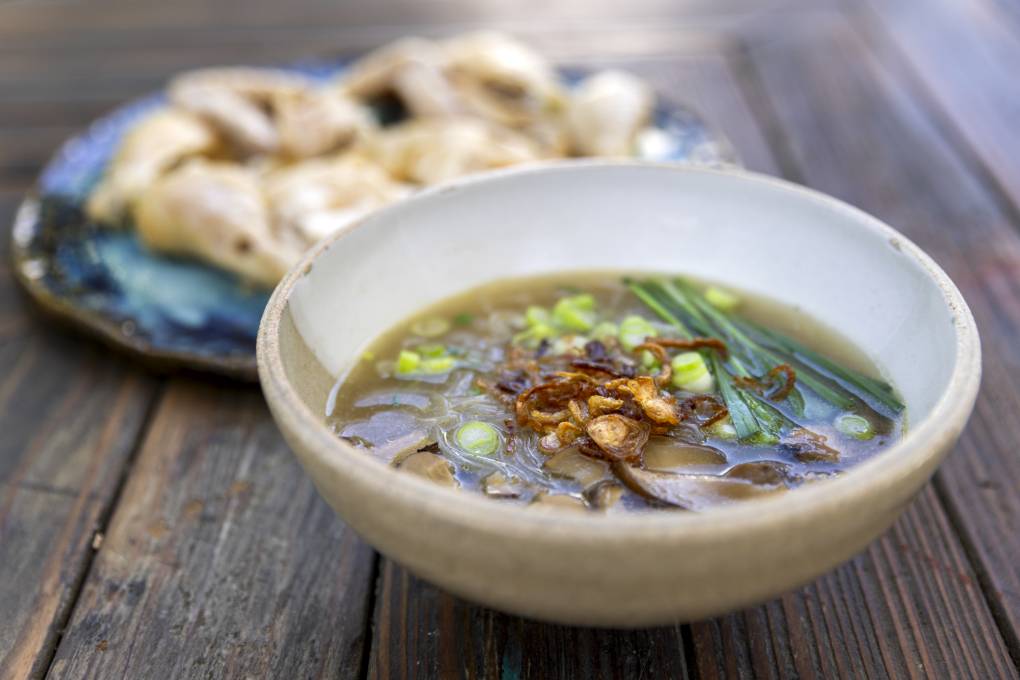
For One Vietnamese Family in LA, This Broth Is Rich With Memories of Life After War
Freshman Congressman Derek Tran on His Balancing Act in a Purple District
50 Years After the Fall of Saigon, How Can Vietnamese American Families Process the Past?
San José’s Vietnamese American Community Remembers 50 Years Since the Fall of Saigon
How ‘Paris by Night’ Became the Spirit of Vietnamese American Life
‘Beginning of Our Identity’: How San José Became Home for Betty Duong and Vietnamese Americans
An Evening at San Jose’s Story Road Night Market
In 2020, Mutual Aid Was in the Spotlight. How Are Organizers Holding Up in 2022?
‘Cultural Brokers for Our Families’: Young Vietnamese Americans Fight Online Misinformation for the Community
Sponsored
Player sponsored by
window.__IS_SSR__=true
window.__INITIAL_STATE__={
"attachmentsReducer": {
"audio_0": {
"type": "attachments",
"id": "audio_0",
"imgSizes": {
"kqedFullSize": {
"file": "https://ww2.kqed.org/news/wp-content/themes/KQED-unified/img/audio_bgs/background0.jpg"
}
}
},
"audio_1": {
"type": "attachments",
"id": "audio_1",
"imgSizes": {
"kqedFullSize": {
"file": "https://ww2.kqed.org/news/wp-content/themes/KQED-unified/img/audio_bgs/background1.jpg"
}
}
},
"audio_2": {
"type": "attachments",
"id": "audio_2",
"imgSizes": {
"kqedFullSize": {
"file": "https://ww2.kqed.org/news/wp-content/themes/KQED-unified/img/audio_bgs/background2.jpg"
}
}
},
"audio_3": {
"type": "attachments",
"id": "audio_3",
"imgSizes": {
"kqedFullSize": {
"file": "https://ww2.kqed.org/news/wp-content/themes/KQED-unified/img/audio_bgs/background3.jpg"
}
}
},
"audio_4": {
"type": "attachments",
"id": "audio_4",
"imgSizes": {
"kqedFullSize": {
"file": "https://ww2.kqed.org/news/wp-content/themes/KQED-unified/img/audio_bgs/background4.jpg"
}
}
},
"placeholder": {
"type": "attachments",
"id": "placeholder",
"imgSizes": {
"thumbnail": {
"file": "https://cdn.kqed.org/wp-content/uploads/2024/12/KQED-Default-Image-816638274-2000x1333-1-160x107.jpg",
"width": 160,
"height": 107,
"mimeType": "image/jpeg"
},
"medium": {
"file": "https://cdn.kqed.org/wp-content/uploads/2024/12/KQED-Default-Image-816638274-2000x1333-1-800x533.jpg",
"width": 800,
"height": 533,
"mimeType": "image/jpeg"
},
"medium_large": {
"file": "https://cdn.kqed.org/wp-content/uploads/2024/12/KQED-Default-Image-816638274-2000x1333-1-768x512.jpg",
"width": 768,
"height": 512,
"mimeType": "image/jpeg"
},
"large": {
"file": "https://cdn.kqed.org/wp-content/uploads/2024/12/KQED-Default-Image-816638274-2000x1333-1-1020x680.jpg",
"width": 1020,
"height": 680,
"mimeType": "image/jpeg"
},
"1536x1536": {
"file": "https://cdn.kqed.org/wp-content/uploads/2024/12/KQED-Default-Image-816638274-2000x1333-1-1536x1024.jpg",
"width": 1536,
"height": 1024,
"mimeType": "image/jpeg"
},
"fd-lrg": {
"file": "https://cdn.kqed.org/wp-content/uploads/2024/12/KQED-Default-Image-816638274-2000x1333-1-1536x1024.jpg",
"width": 1536,
"height": 1024,
"mimeType": "image/jpeg"
},
"fd-med": {
"file": "https://cdn.kqed.org/wp-content/uploads/2024/12/KQED-Default-Image-816638274-2000x1333-1-1020x680.jpg",
"width": 1020,
"height": 680,
"mimeType": "image/jpeg"
},
"fd-sm": {
"file": "https://cdn.kqed.org/wp-content/uploads/2024/12/KQED-Default-Image-816638274-2000x1333-1-800x533.jpg",
"width": 800,
"height": 533,
"mimeType": "image/jpeg"
},
"post-thumbnail": {
"file": "https://cdn.kqed.org/wp-content/uploads/2024/12/KQED-Default-Image-816638274-2000x1333-1-672x372.jpg",
"width": 672,
"height": 372,
"mimeType": "image/jpeg"
},
"twentyfourteen-full-width": {
"file": "https://cdn.kqed.org/wp-content/uploads/2024/12/KQED-Default-Image-816638274-2000x1333-1-1038x576.jpg",
"width": 1038,
"height": 576,
"mimeType": "image/jpeg"
},
"xxsmall": {
"file": "https://cdn.kqed.org/wp-content/uploads/2024/12/KQED-Default-Image-816638274-2000x1333-1-160x107.jpg",
"width": 160,
"height": 107,
"mimeType": "image/jpeg"
},
"xsmall": {
"file": "https://cdn.kqed.org/wp-content/uploads/2024/12/KQED-Default-Image-816638274-2000x1333-1-672x372.jpg",
"width": 672,
"height": 372,
"mimeType": "image/jpeg"
},
"small": {
"file": "https://cdn.kqed.org/wp-content/uploads/2024/12/KQED-Default-Image-816638274-2000x1333-1-672x372.jpg",
"width": 672,
"height": 372,
"mimeType": "image/jpeg"
},
"xlarge": {
"file": "https://cdn.kqed.org/wp-content/uploads/2024/12/KQED-Default-Image-816638274-2000x1333-1-1020x680.jpg",
"width": 1020,
"height": 680,
"mimeType": "image/jpeg"
},
"full-width": {
"file": "https://cdn.kqed.org/wp-content/uploads/2024/12/KQED-Default-Image-816638274-2000x1333-1-1920x1280.jpg",
"width": 1920,
"height": 1280,
"mimeType": "image/jpeg"
},
"guest-author-32": {
"file": "https://cdn.kqed.org/wp-content/uploads/2025/01/KQED-Default-Image-816638274-1333x1333-1-160x160.jpg",
"width": 32,
"height": 32,
"mimeType": "image/jpeg"
},
"guest-author-50": {
"file": "https://cdn.kqed.org/wp-content/uploads/2025/01/KQED-Default-Image-816638274-1333x1333-1-160x160.jpg",
"width": 50,
"height": 50,
"mimeType": "image/jpeg"
},
"guest-author-64": {
"file": "https://cdn.kqed.org/wp-content/uploads/2025/01/KQED-Default-Image-816638274-1333x1333-1-160x160.jpg",
"width": 64,
"height": 64,
"mimeType": "image/jpeg"
},
"guest-author-96": {
"file": "https://cdn.kqed.org/wp-content/uploads/2025/01/KQED-Default-Image-816638274-1333x1333-1-160x160.jpg",
"width": 96,
"height": 96,
"mimeType": "image/jpeg"
},
"guest-author-128": {
"file": "https://cdn.kqed.org/wp-content/uploads/2025/01/KQED-Default-Image-816638274-1333x1333-1-160x160.jpg",
"width": 128,
"height": 128,
"mimeType": "image/jpeg"
},
"detail": {
"file": "https://cdn.kqed.org/wp-content/uploads/2025/01/KQED-Default-Image-816638274-1333x1333-1-160x160.jpg",
"width": 160,
"height": 160,
"mimeType": "image/jpeg"
},
"kqedFullSize": {
"file": "https://cdn.kqed.org/wp-content/uploads/2024/12/KQED-Default-Image-816638274-2000x1333-1.jpg",
"width": 2000,
"height": 1333
}
}
},
"news_12036301": {
"type": "attachments",
"id": "news_12036301",
"meta": {
"index": "attachments_1716263798",
"site": "news",
"id": "12036301",
"found": true
},
"title": "Fall of Saigon: Mien Ga Memories",
"publishDate": 1744830602,
"status": "inherit",
"parent": 12037893,
"modified": 1745948854,
"caption": "A freshly cooked bowl of miến gà is pictured at Hong Pham’s home in South Pasadena on Saturday, April 12, 2025. Miến gà is a Vietnamese chicken and glass noodle soup, garnished with shiitake mushrooms, scallions, fresh chives and crispy fried shallots.",
"credit": "Alisha Jucevic for KQED",
"altTag": null,
"description": null,
"imgSizes": {
"medium": {
"file": "https://cdn.kqed.org/wp-content/uploads/sites/10/2025/04/20250412_MIENGAMEMORIES_23-KQED-800x533.jpg",
"width": 800,
"height": 533,
"mimeType": "image/jpeg"
},
"large": {
"file": "https://cdn.kqed.org/wp-content/uploads/sites/10/2025/04/20250412_MIENGAMEMORIES_23-KQED-1020x680.jpg",
"width": 1020,
"height": 680,
"mimeType": "image/jpeg"
},
"thumbnail": {
"file": "https://cdn.kqed.org/wp-content/uploads/sites/10/2025/04/20250412_MIENGAMEMORIES_23-KQED-160x107.jpg",
"width": 160,
"height": 107,
"mimeType": "image/jpeg"
},
"1536x1536": {
"file": "https://cdn.kqed.org/wp-content/uploads/sites/10/2025/04/20250412_MIENGAMEMORIES_23-KQED-1536x1024.jpg",
"width": 1536,
"height": 1024,
"mimeType": "image/jpeg"
},
"post-thumbnail": {
"file": "https://cdn.kqed.org/wp-content/uploads/sites/10/2025/04/20250412_MIENGAMEMORIES_23-KQED-672x372.jpg",
"width": 672,
"height": 372,
"mimeType": "image/jpeg"
},
"twentyfourteen-full-width": {
"file": "https://cdn.kqed.org/wp-content/uploads/sites/10/2025/04/20250412_MIENGAMEMORIES_23-KQED-1038x576.jpg",
"width": 1038,
"height": 576,
"mimeType": "image/jpeg"
},
"full-width": {
"file": "https://cdn.kqed.org/wp-content/uploads/sites/10/2025/04/20250412_MIENGAMEMORIES_23-KQED-1920x1280.jpg",
"width": 1920,
"height": 1280,
"mimeType": "image/jpeg"
},
"kqedFullSize": {
"file": "https://cdn.kqed.org/wp-content/uploads/sites/10/2025/04/20250412_MIENGAMEMORIES_23-KQED.jpg",
"width": 2000,
"height": 1333
}
},
"fetchFailed": false,
"isLoading": false
},
"news_12039787": {
"type": "attachments",
"id": "news_12039787",
"meta": {
"index": "attachments_1716263798",
"site": "news",
"id": "12039787",
"found": true
},
"title": "Derek Tran",
"publishDate": 1747078528,
"status": "inherit",
"parent": 12039783,
"modified": 1747078655,
"caption": "Congressman Derek Tran speaks with politics reporters Marisa Lagos and Scott Shafer for Political Breakdown at his Washington, D.C. office on May 8, 2025.",
"credit": "Izzy Bloom/KQED",
"altTag": null,
"description": "Congressman Derek Tran speaks with politics reporters Marisa Lagos and Scott Shafer for Political Breakdown at his Washington, D.C. office on May 8, 2025.",
"imgSizes": {
"medium": {
"file": "https://cdn.kqed.org/wp-content/uploads/sites/10/2025/05/FTG02482-800x533.jpg",
"width": 800,
"height": 533,
"mimeType": "image/jpeg"
},
"large": {
"file": "https://cdn.kqed.org/wp-content/uploads/sites/10/2025/05/FTG02482-1020x680.jpg",
"width": 1020,
"height": 680,
"mimeType": "image/jpeg"
},
"thumbnail": {
"file": "https://cdn.kqed.org/wp-content/uploads/sites/10/2025/05/FTG02482-160x107.jpg",
"width": 160,
"height": 107,
"mimeType": "image/jpeg"
},
"1536x1536": {
"file": "https://cdn.kqed.org/wp-content/uploads/sites/10/2025/05/FTG02482-1536x1024.jpg",
"width": 1536,
"height": 1024,
"mimeType": "image/jpeg"
},
"2048x2048": {
"file": "https://cdn.kqed.org/wp-content/uploads/sites/10/2025/05/FTG02482-2048x1365.jpg",
"width": 2048,
"height": 1365,
"mimeType": "image/jpeg"
},
"post-thumbnail": {
"file": "https://cdn.kqed.org/wp-content/uploads/sites/10/2025/05/FTG02482-672x372.jpg",
"width": 672,
"height": 372,
"mimeType": "image/jpeg"
},
"twentyfourteen-full-width": {
"file": "https://cdn.kqed.org/wp-content/uploads/sites/10/2025/05/FTG02482-1038x576.jpg",
"width": 1038,
"height": 576,
"mimeType": "image/jpeg"
},
"full-width": {
"file": "https://cdn.kqed.org/wp-content/uploads/sites/10/2025/05/FTG02482-1920x1280.jpg",
"width": 1920,
"height": 1280,
"mimeType": "image/jpeg"
},
"kqedFullSize": {
"file": "https://cdn.kqed.org/wp-content/uploads/sites/10/2025/05/FTG02482-scaled.jpg",
"width": 2560,
"height": 1707
}
},
"fetchFailed": false,
"isLoading": false
},
"news_12038197": {
"type": "attachments",
"id": "news_12038197",
"meta": {
"index": "attachments_1716263798",
"site": "news",
"id": "12038197",
"found": true
},
"title": "250429-FALLOFSAIGON-12-BL-KQED",
"publishDate": 1746032530,
"status": "inherit",
"parent": 0,
"modified": 1746135752,
"caption": "HaNhi Tran, senior manager at the Vietnamese American Service Center in San José, stands inside the center on April 29, 2025, where she leads a team providing health and social services to the Vietnamese American community.",
"credit": "Beth LaBerge/KQED",
"altTag": null,
"description": null,
"imgSizes": {
"medium": {
"file": "https://cdn.kqed.org/wp-content/uploads/sites/10/2025/04/250429-FALLOFSAIGON-12-BL-KQED-800x533.jpg",
"width": 800,
"height": 533,
"mimeType": "image/jpeg"
},
"large": {
"file": "https://cdn.kqed.org/wp-content/uploads/sites/10/2025/04/250429-FALLOFSAIGON-12-BL-KQED-1020x680.jpg",
"width": 1020,
"height": 680,
"mimeType": "image/jpeg"
},
"thumbnail": {
"file": "https://cdn.kqed.org/wp-content/uploads/sites/10/2025/04/250429-FALLOFSAIGON-12-BL-KQED-160x107.jpg",
"width": 160,
"height": 107,
"mimeType": "image/jpeg"
},
"1536x1536": {
"file": "https://cdn.kqed.org/wp-content/uploads/sites/10/2025/04/250429-FALLOFSAIGON-12-BL-KQED-1536x1024.jpg",
"width": 1536,
"height": 1024,
"mimeType": "image/jpeg"
},
"post-thumbnail": {
"file": "https://cdn.kqed.org/wp-content/uploads/sites/10/2025/04/250429-FALLOFSAIGON-12-BL-KQED-672x372.jpg",
"width": 672,
"height": 372,
"mimeType": "image/jpeg"
},
"twentyfourteen-full-width": {
"file": "https://cdn.kqed.org/wp-content/uploads/sites/10/2025/04/250429-FALLOFSAIGON-12-BL-KQED-1038x576.jpg",
"width": 1038,
"height": 576,
"mimeType": "image/jpeg"
},
"full-width": {
"file": "https://cdn.kqed.org/wp-content/uploads/sites/10/2025/04/250429-FALLOFSAIGON-12-BL-KQED-1920x1280.jpg",
"width": 1920,
"height": 1280,
"mimeType": "image/jpeg"
},
"kqedFullSize": {
"file": "https://cdn.kqed.org/wp-content/uploads/sites/10/2025/04/250429-FALLOFSAIGON-12-BL-KQED.jpg",
"width": 2000,
"height": 1333
}
},
"fetchFailed": false,
"isLoading": false
},
"news_12038435": {
"type": "attachments",
"id": "news_12038435",
"meta": {
"index": "attachments_1716263798",
"site": "news",
"id": "12038435",
"found": true
},
"title": "250430-BLACKAPRIL50-JG-2",
"publishDate": 1746131385,
"status": "inherit",
"parent": 12038401,
"modified": 1746134119,
"caption": "A flag of South Vietnam, or the Republic of Vietnam, is held up during the Vietnamese American Roundtable's Black April event, commemorating the 50th Anniversary of the Fall of Saigon in San José, Calif., on Wednesday, April 30, 2025.",
"credit": "KQED/Joseph Geha",
"altTag": null,
"description": null,
"imgSizes": {
"medium": {
"file": "https://cdn.kqed.org/wp-content/uploads/sites/10/2025/05/250430-BLACKAPRIL50-JG-2-800x533.jpg",
"width": 800,
"height": 533,
"mimeType": "image/jpeg"
},
"large": {
"file": "https://cdn.kqed.org/wp-content/uploads/sites/10/2025/05/250430-BLACKAPRIL50-JG-2-1020x680.jpg",
"width": 1020,
"height": 680,
"mimeType": "image/jpeg"
},
"thumbnail": {
"file": "https://cdn.kqed.org/wp-content/uploads/sites/10/2025/05/250430-BLACKAPRIL50-JG-2-160x107.jpg",
"width": 160,
"height": 107,
"mimeType": "image/jpeg"
},
"1536x1536": {
"file": "https://cdn.kqed.org/wp-content/uploads/sites/10/2025/05/250430-BLACKAPRIL50-JG-2-1536x1024.jpg",
"width": 1536,
"height": 1024,
"mimeType": "image/jpeg"
},
"2048x2048": {
"file": "https://cdn.kqed.org/wp-content/uploads/sites/10/2025/05/250430-BLACKAPRIL50-JG-2-2048x1365.jpg",
"width": 2048,
"height": 1365,
"mimeType": "image/jpeg"
},
"post-thumbnail": {
"file": "https://cdn.kqed.org/wp-content/uploads/sites/10/2025/05/250430-BLACKAPRIL50-JG-2-672x372.jpg",
"width": 672,
"height": 372,
"mimeType": "image/jpeg"
},
"twentyfourteen-full-width": {
"file": "https://cdn.kqed.org/wp-content/uploads/sites/10/2025/05/250430-BLACKAPRIL50-JG-2-1038x576.jpg",
"width": 1038,
"height": 576,
"mimeType": "image/jpeg"
},
"full-width": {
"file": "https://cdn.kqed.org/wp-content/uploads/sites/10/2025/05/250430-BLACKAPRIL50-JG-2-1920x1280.jpg",
"width": 1920,
"height": 1280,
"mimeType": "image/jpeg"
},
"kqedFullSize": {
"file": "https://cdn.kqed.org/wp-content/uploads/sites/10/2025/05/250430-BLACKAPRIL50-JG-2-scaled.jpg",
"width": 2560,
"height": 1707
}
},
"fetchFailed": false,
"isLoading": false
},
"news_12037950": {
"type": "attachments",
"id": "news_12037950",
"meta": {
"index": "attachments_1716263798",
"site": "news",
"id": "12037950",
"found": true
},
"title": "Paris-By-Night-Ilo_3",
"publishDate": 1745872938,
"status": "inherit",
"parent": 12037891,
"modified": 1745873008,
"caption": "Paris By Night is a Vietnamese variety show that became a central part of the Vietnamese diaspora. The author (left) and his grandmother in 2001; VHS cover; Paris By Night creator Tô Văn Lai (right).",
"credit": "Illustration by Darren Tu",
"altTag": null,
"description": null,
"imgSizes": {
"medium": {
"file": "https://cdn.kqed.org/wp-content/uploads/sites/10/2025/04/Paris-By-Night-Ilo_3-800x517.jpg",
"width": 800,
"height": 517,
"mimeType": "image/jpeg"
},
"large": {
"file": "https://cdn.kqed.org/wp-content/uploads/sites/10/2025/04/Paris-By-Night-Ilo_3-1020x659.jpg",
"width": 1020,
"height": 659,
"mimeType": "image/jpeg"
},
"thumbnail": {
"file": "https://cdn.kqed.org/wp-content/uploads/sites/10/2025/04/Paris-By-Night-Ilo_3-160x103.jpg",
"width": 160,
"height": 103,
"mimeType": "image/jpeg"
},
"1536x1536": {
"file": "https://cdn.kqed.org/wp-content/uploads/sites/10/2025/04/Paris-By-Night-Ilo_3-1536x992.jpg",
"width": 1536,
"height": 992,
"mimeType": "image/jpeg"
},
"post-thumbnail": {
"file": "https://cdn.kqed.org/wp-content/uploads/sites/10/2025/04/Paris-By-Night-Ilo_3-672x372.jpg",
"width": 672,
"height": 372,
"mimeType": "image/jpeg"
},
"twentyfourteen-full-width": {
"file": "https://cdn.kqed.org/wp-content/uploads/sites/10/2025/04/Paris-By-Night-Ilo_3-1038x576.jpg",
"width": 1038,
"height": 576,
"mimeType": "image/jpeg"
},
"kqedFullSize": {
"file": "https://cdn.kqed.org/wp-content/uploads/sites/10/2025/04/Paris-By-Night-Ilo_3.jpg",
"width": 1920,
"height": 1240
}
},
"fetchFailed": false,
"isLoading": false
},
"news_12034771": {
"type": "attachments",
"id": "news_12034771",
"meta": {
"index": "attachments_1716263798",
"site": "news",
"id": "12034771",
"found": true
},
"title": "20240403_BETTYDUONG_GC-12-KQED",
"publishDate": 1744051873,
"status": "inherit",
"parent": 0,
"modified": 1745623201,
"caption": "Betty Duong, Santa Clara County supervisor, poses for a photo at the Santa Clara County Administration Building in San José on April 3, 2025.",
"credit": "Gina Castro/KQED",
"altTag": null,
"description": null,
"imgSizes": {
"medium": {
"file": "https://cdn.kqed.org/wp-content/uploads/sites/10/2025/04/20240403_BETTYDUONG_GC-12-KQED-800x533.jpg",
"width": 800,
"height": 533,
"mimeType": "image/jpeg"
},
"large": {
"file": "https://cdn.kqed.org/wp-content/uploads/sites/10/2025/04/20240403_BETTYDUONG_GC-12-KQED-1020x680.jpg",
"width": 1020,
"height": 680,
"mimeType": "image/jpeg"
},
"thumbnail": {
"file": "https://cdn.kqed.org/wp-content/uploads/sites/10/2025/04/20240403_BETTYDUONG_GC-12-KQED-160x107.jpg",
"width": 160,
"height": 107,
"mimeType": "image/jpeg"
},
"1536x1536": {
"file": "https://cdn.kqed.org/wp-content/uploads/sites/10/2025/04/20240403_BETTYDUONG_GC-12-KQED-1536x1024.jpg",
"width": 1536,
"height": 1024,
"mimeType": "image/jpeg"
},
"post-thumbnail": {
"file": "https://cdn.kqed.org/wp-content/uploads/sites/10/2025/04/20240403_BETTYDUONG_GC-12-KQED-672x372.jpg",
"width": 672,
"height": 372,
"mimeType": "image/jpeg"
},
"twentyfourteen-full-width": {
"file": "https://cdn.kqed.org/wp-content/uploads/sites/10/2025/04/20240403_BETTYDUONG_GC-12-KQED-1038x576.jpg",
"width": 1038,
"height": 576,
"mimeType": "image/jpeg"
},
"full-width": {
"file": "https://cdn.kqed.org/wp-content/uploads/sites/10/2025/04/20240403_BETTYDUONG_GC-12-KQED-1920x1280.jpg",
"width": 1920,
"height": 1280,
"mimeType": "image/jpeg"
},
"kqedFullSize": {
"file": "https://cdn.kqed.org/wp-content/uploads/sites/10/2025/04/20240403_BETTYDUONG_GC-12-KQED.jpg",
"width": 2000,
"height": 1333
}
},
"fetchFailed": false,
"isLoading": false
},
"news_12009973": {
"type": "attachments",
"id": "news_12009973",
"meta": {
"index": "attachments_1716263798",
"site": "news",
"id": "12009973",
"found": true
},
"title": "IMG_4243 resized",
"publishDate": 1729210410,
"status": "inherit",
"parent": 12009871,
"modified": 1735578685,
"caption": "Customers crowd around a stand at the Story Road Night Market in San José. ",
"credit": "Courtesy of Moveable Feast",
"altTag": null,
"description": null,
"imgSizes": {
"medium": {
"file": "https://cdn.kqed.org/wp-content/uploads/sites/10/2024/10/IMG_4243-resized-800x450.jpg",
"width": 800,
"height": 450,
"mimeType": "image/jpeg"
},
"large": {
"file": "https://cdn.kqed.org/wp-content/uploads/sites/10/2024/10/IMG_4243-resized-1020x574.jpg",
"width": 1020,
"height": 574,
"mimeType": "image/jpeg"
},
"thumbnail": {
"file": "https://cdn.kqed.org/wp-content/uploads/sites/10/2024/10/IMG_4243-resized-160x90.jpg",
"width": 160,
"height": 90,
"mimeType": "image/jpeg"
},
"post-thumbnail": {
"file": "https://cdn.kqed.org/wp-content/uploads/sites/10/2024/10/IMG_4243-resized-672x372.jpg",
"width": 672,
"height": 372,
"mimeType": "image/jpeg"
},
"twentyfourteen-full-width": {
"file": "https://cdn.kqed.org/wp-content/uploads/sites/10/2024/10/IMG_4243-resized-1038x576.jpg",
"width": 1038,
"height": 576,
"mimeType": "image/jpeg"
},
"kqedFullSize": {
"file": "https://cdn.kqed.org/wp-content/uploads/sites/10/2024/10/IMG_4243-resized.jpg",
"width": 1440,
"height": 810
}
},
"fetchFailed": false,
"isLoading": false
},
"news_11911143": {
"type": "attachments",
"id": "news_11911143",
"meta": {
"index": "attachments_1716263798",
"site": "news",
"id": "11911143",
"found": true
},
"parent": 11909218,
"imgSizes": {
"twentyfourteen-full-width": {
"file": "https://ww2.kqed.org/app/uploads/sites/10/2022/04/RS54182_040_KQED_HomeyFoodDistribution_03052022-qut-1038x576.jpg",
"width": 1038,
"mimeType": "image/jpeg",
"height": 576
},
"thumbnail": {
"file": "https://ww2.kqed.org/app/uploads/sites/10/2022/04/RS54182_040_KQED_HomeyFoodDistribution_03052022-qut-160x107.jpg",
"width": 160,
"mimeType": "image/jpeg",
"height": 107
},
"post-thumbnail": {
"file": "https://ww2.kqed.org/app/uploads/sites/10/2022/04/RS54182_040_KQED_HomeyFoodDistribution_03052022-qut-672x372.jpg",
"width": 672,
"mimeType": "image/jpeg",
"height": 372
},
"kqedFullSize": {
"file": "https://ww2.kqed.org/app/uploads/sites/10/2022/04/RS54182_040_KQED_HomeyFoodDistribution_03052022-qut.jpg",
"width": 1920,
"height": 1280
},
"large": {
"file": "https://ww2.kqed.org/app/uploads/sites/10/2022/04/RS54182_040_KQED_HomeyFoodDistribution_03052022-qut-1020x680.jpg",
"width": 1020,
"mimeType": "image/jpeg",
"height": 680
},
"1536x1536": {
"file": "https://ww2.kqed.org/app/uploads/sites/10/2022/04/RS54182_040_KQED_HomeyFoodDistribution_03052022-qut-1536x1024.jpg",
"width": 1536,
"mimeType": "image/jpeg",
"height": 1024
},
"medium": {
"file": "https://ww2.kqed.org/app/uploads/sites/10/2022/04/RS54182_040_KQED_HomeyFoodDistribution_03052022-qut-800x533.jpg",
"width": 800,
"mimeType": "image/jpeg",
"height": 533
}
},
"publishDate": 1649971715,
"modified": 1650054010,
"caption": "Gabriela Alemán, co-founder of Mission Meals, works alongside a group of volunteers to pack bread, fruit, vegetables, eggs and milk into boxes during a Guerrer@s de la Ciudad food distribution event at Homey, a nonprofit focused on social and community justice issues in San Francisco's Mission District on March 5, 2022.",
"description": null,
"title": "RS54182_040_KQED_HomeyFoodDistribution_03052022-qut",
"credit": "Beth LaBerge/KQED",
"status": "inherit",
"altTag": "Gabriela Alemán, co-founder of Mission Meals, works alongside a group of volunteers to pack bread, fruit, vegetables, eggs and milk into boxes. A young Latina woman, she is wearing a pink shirt with a black puffy jacket over it, and looking over at a man wearing a neon orange work shirt in the foreground of the image.",
"fetchFailed": false,
"isLoading": false
},
"news_11873411": {
"type": "attachments",
"id": "news_11873411",
"meta": {
"index": "attachments_1716263798",
"site": "news",
"id": "11873411",
"found": true
},
"parent": 11872941,
"imgSizes": {
"twentyfourteen-full-width": {
"file": "https://ww2.kqed.org/app/uploads/sites/10/2021/05/1920_VAR-Facebook-photo-1038x576.jpg",
"width": 1038,
"mimeType": "image/jpeg",
"height": 576
},
"thumbnail": {
"file": "https://ww2.kqed.org/app/uploads/sites/10/2021/05/1920_VAR-Facebook-photo-160x90.jpg",
"width": 160,
"mimeType": "image/jpeg",
"height": 90
},
"post-thumbnail": {
"file": "https://ww2.kqed.org/app/uploads/sites/10/2021/05/1920_VAR-Facebook-photo-672x372.jpg",
"width": 672,
"mimeType": "image/jpeg",
"height": 372
},
"kqedFullSize": {
"file": "https://ww2.kqed.org/app/uploads/sites/10/2021/05/1920_VAR-Facebook-photo.jpg",
"width": 1416,
"height": 796
},
"large": {
"file": "https://ww2.kqed.org/app/uploads/sites/10/2021/05/1920_VAR-Facebook-photo-1020x573.jpg",
"width": 1020,
"mimeType": "image/jpeg",
"height": 573
},
"medium": {
"file": "https://ww2.kqed.org/app/uploads/sites/10/2021/05/1920_VAR-Facebook-photo-800x450.jpg",
"width": 800,
"mimeType": "image/jpeg",
"height": 450
}
},
"publishDate": 1620855071,
"modified": 1620860772,
"caption": "The Vietnamese American Roundtable is an organization based in the South Bay, focused on serving the Vietnamese American community in the Bay Area. Since the pandemic started, VAR has been hosting webinars to educate their more than 3,000 followers on how to stay safe from COVID-19.",
"description": null,
"title": "1920_VAR Facebook photo",
"credit": "Photo courtesy of VAR",
"status": "inherit",
"altTag": null,
"fetchFailed": false,
"isLoading": false
}
},
"audioPlayerReducer": {
"postId": "stream_live",
"isPaused": true,
"isPlaying": false,
"pfsActive": false,
"pledgeModalIsOpen": true,
"playerDrawerIsOpen": false
},
"authorsReducer": {
"scottshafer": {
"type": "authors",
"id": "255",
"meta": {
"index": "authors_1716337520",
"id": "255",
"found": true
},
"name": "Scott Shafer",
"firstName": "Scott",
"lastName": "Shafer",
"slug": "scottshafer",
"email": "sshafer@kqed.org",
"display_author_email": false,
"staff_mastheads": [
"news"
],
"title": "KQED Contributor",
"bio": "Scott Shafer is a senior editor with the KQED Politics and Government desk. He is co-host of Political Breakdown, the award-winning radio show and podcast with a personal take on the world of politics. Scott came to KQED in 1998 to host the statewide\u003cem> California Report\u003c/em>. Prior to that he had extended stints in politics and government\u003cem>.\u003c/em> He uses that inside experience at KQED in his, reporting, hosting and analysis for the politics desk. Scott collaborated \u003cem>Political Breakdown a\u003c/em>nd on \u003cem>The Political Mind of Jerry Brown, \u003c/em>an eight-part series about the life and extraordinary political career of the former governor. For fun, he plays water polo with the San Francisco Tsunami.",
"avatar": "https://secure.gravatar.com/avatar/a62ebae45b79d7aed1a39a0e3bf68104?s=600&d=blank&r=g",
"twitter": "scottshafer",
"facebook": null,
"instagram": null,
"linkedin": null,
"sites": [
{
"site": "news",
"roles": [
"editor"
]
},
{
"site": "stateofhealth",
"roles": [
"author"
]
},
{
"site": "science",
"roles": [
"author"
]
},
{
"site": "forum",
"roles": [
"subscriber"
]
}
],
"headData": {
"title": "Scott Shafer | KQED",
"description": "KQED Contributor",
"ogImgSrc": "https://secure.gravatar.com/avatar/a62ebae45b79d7aed1a39a0e3bf68104?s=600&d=blank&r=g",
"twImgSrc": "https://secure.gravatar.com/avatar/a62ebae45b79d7aed1a39a0e3bf68104?s=600&d=blank&r=g"
},
"isLoading": false,
"link": "/author/scottshafer"
},
"mlagos": {
"type": "authors",
"id": "3239",
"meta": {
"index": "authors_1716337520",
"id": "3239",
"found": true
},
"name": "Marisa Lagos",
"firstName": "Marisa",
"lastName": "Lagos",
"slug": "mlagos",
"email": "mlagos@kqed.org",
"display_author_email": false,
"staff_mastheads": [
"news"
],
"title": "KQED Contributor",
"bio": "\u003cspan style=\"font-weight: 400;\">Marisa Lagos is a correspondent for KQED’s California Politics and Government Desk and co-hosts a weekly show and podcast, \u003c/span>\u003ci>\u003cspan style=\"font-weight: 400;\">Political Breakdown.\u003c/span>\u003c/i> \u003cspan style=\"font-weight: 400;\">At KQED, Lagos conducts reporting, analysis and investigations into state, local and national politics for radio, TV and online. Every week, she and cohost Scott Shafer sit down with political insiders on \u003c/span>\u003ci>\u003cspan style=\"font-weight: 400;\">Political Breakdown\u003c/span>\u003c/i>\u003cspan style=\"font-weight: 400;\">, where they offer a peek into lives and personalities of those driving politics in California and beyond. \u003c/span>\r\n\r\n\u003cspan style=\"font-weight: 400;\">Previously, she worked for nine years at the San Francisco Chronicle covering San Francisco City Hall and state politics; and at the San Francisco Examiner and Los Angeles Time,. She has won awards for her work investigating the 2017 wildfires and her ongoing coverage of criminal justice issues in California. She lives in San Francisco with her two sons and husband.\u003c/span>",
"avatar": "https://secure.gravatar.com/avatar/a261a0d3696fc066871ef96b85b5e7d2?s=600&d=blank&r=g",
"twitter": "@mlagos",
"facebook": null,
"instagram": null,
"linkedin": null,
"sites": [
{
"site": "news",
"roles": [
"editor"
]
},
{
"site": "science",
"roles": [
"editor"
]
},
{
"site": "forum",
"roles": [
"author"
]
}
],
"headData": {
"title": "Marisa Lagos | KQED",
"description": "KQED Contributor",
"ogImgSrc": "https://secure.gravatar.com/avatar/a261a0d3696fc066871ef96b85b5e7d2?s=600&d=blank&r=g",
"twImgSrc": "https://secure.gravatar.com/avatar/a261a0d3696fc066871ef96b85b5e7d2?s=600&d=blank&r=g"
},
"isLoading": false,
"link": "/author/mlagos"
},
"ecruzguevarra": {
"type": "authors",
"id": "8654",
"meta": {
"index": "authors_1716337520",
"id": "8654",
"found": true
},
"name": "Ericka Cruz Guevarra",
"firstName": "Ericka",
"lastName": "Cruz Guevarra",
"slug": "ecruzguevarra",
"email": "ecruzguevarra@kqed.org",
"display_author_email": true,
"staff_mastheads": [
"news"
],
"title": "Producer, The Bay Podcast",
"bio": "Ericka Cruz Guevarra is host of \u003ca href=\"https://www.kqed.org/podcasts/thebay\">\u003cem>The Bay\u003c/em>\u003c/a> podcast at KQED. Before host, she was the show’s producer. Her work in that capacity includes a three-part reported series on policing in Vallejo, which won a 2020 excellence in journalism award from the Society of Professional Journalists. Ericka has worked as a breaking news reporter at Oregon Public Broadcasting, helped produce the Code Switch podcast, and was KQED’s inaugural Raul Ramirez Diversity Fund intern. She’s also an alumna of NPR’s Next Generation Radio program. Send her an email if you have strong feelings about whether Fairfield and Suisun City are the Bay. Ericka is represented by SAG-AFTRA.",
"avatar": "https://secure.gravatar.com/avatar/25e5ab8d3d53fad2dcc7bb2b5c506b1a?s=600&d=blank&r=g",
"twitter": "NotoriousECG",
"facebook": null,
"instagram": null,
"linkedin": null,
"sites": [
{
"site": "arts",
"roles": [
"subscriber"
]
},
{
"site": "news",
"roles": [
"editor",
"manage_categories"
]
},
{
"site": "futureofyou",
"roles": [
"subscriber"
]
},
{
"site": "stateofhealth",
"roles": [
"subscriber"
]
},
{
"site": "science",
"roles": [
"editor"
]
},
{
"site": "forum",
"roles": [
"subscriber"
]
}
],
"headData": {
"title": "Ericka Cruz Guevarra | KQED",
"description": "Producer, The Bay Podcast",
"ogImgSrc": "https://secure.gravatar.com/avatar/25e5ab8d3d53fad2dcc7bb2b5c506b1a?s=600&d=blank&r=g",
"twImgSrc": "https://secure.gravatar.com/avatar/25e5ab8d3d53fad2dcc7bb2b5c506b1a?s=600&d=blank&r=g"
},
"isLoading": false,
"link": "/author/ecruzguevarra"
},
"amontecillo": {
"type": "authors",
"id": "11649",
"meta": {
"index": "authors_1716337520",
"id": "11649",
"found": true
},
"name": "Alan Montecillo",
"firstName": "Alan",
"lastName": "Montecillo",
"slug": "amontecillo",
"email": "amontecillo@kqed.org",
"display_author_email": false,
"staff_mastheads": [
"news"
],
"title": "KQED Contributor",
"bio": "Alan Montecillo is the senior editor of \u003cem>\u003ca href=\"http://kqed.org/thebay\">The Bay\u003c/a>, \u003c/em> KQED's local news podcast. Before moving to the Bay Area, he worked as a senior talk show producer for WILL in Champaign-Urbana, Illinois and at Oregon Public Broadcasting in Portland, Oregon. He has won journalism awards from the Society of Professional Journalists Northern California, the Public Media Journalists Association, The Signal Awards, and has also received a regional Edward R. Murrow award. Alan is a Filipino American from Hong Kong and a graduate of Reed College.",
"avatar": "https://secure.gravatar.com/avatar/d5e4e7a76481969ccba76f4e2b5ccabc?s=600&d=blank&r=g",
"twitter": "alanmontecillo",
"facebook": null,
"instagram": null,
"linkedin": null,
"sites": [
{
"site": "",
"roles": [
"editor"
]
},
{
"site": "news",
"roles": [
"editor",
"manage_categories"
]
}
],
"headData": {
"title": "Alan Montecillo | KQED",
"description": "KQED Contributor",
"ogImgSrc": "https://secure.gravatar.com/avatar/d5e4e7a76481969ccba76f4e2b5ccabc?s=600&d=blank&r=g",
"twImgSrc": "https://secure.gravatar.com/avatar/d5e4e7a76481969ccba76f4e2b5ccabc?s=600&d=blank&r=g"
},
"isLoading": false,
"link": "/author/amontecillo"
},
"abandlamudi": {
"type": "authors",
"id": "11672",
"meta": {
"index": "authors_1716337520",
"id": "11672",
"found": true
},
"name": "Adhiti Bandlamudi",
"firstName": "Adhiti",
"lastName": "Bandlamudi",
"slug": "abandlamudi",
"email": "abandlamudi@kqed.org",
"display_author_email": false,
"staff_mastheads": [
"news"
],
"title": "KQED Housing Reporter",
"bio": "Adhiti Bandlamudi reports for KQED's Housing desk. She focuses on how housing gets built across the Bay Area. Before joining KQED in 2020, she reported for WUNC in Durham, North Carolina, WABE in Atlanta, Georgia and Capital Public Radio in Sacramento. In 2017, she was awarded a Kroc Fellowship at NPR where she reported on everything from sprinkles to the Golden State Killer's arrest. When she's not reporting, she's baking new recipes in her kitchen or watching movies with friends and family. She's originally from Georgia and has strong opinions about Great British Bake Off.",
"avatar": "https://secure.gravatar.com/avatar/868129c8b257bb99a3500e2c86a65400?s=600&d=mm&r=g",
"twitter": "oddity_adhiti",
"facebook": null,
"instagram": null,
"linkedin": null,
"sites": [
{
"site": "arts",
"roles": [
"author"
]
},
{
"site": "news",
"roles": [
"editor"
]
},
{
"site": "liveblog",
"roles": [
"author"
]
}
],
"headData": {
"title": "Adhiti Bandlamudi | KQED",
"description": "KQED Housing Reporter",
"ogImgSrc": "https://secure.gravatar.com/avatar/868129c8b257bb99a3500e2c86a65400?s=600&d=mm&r=g",
"twImgSrc": "https://secure.gravatar.com/avatar/868129c8b257bb99a3500e2c86a65400?s=600&d=mm&r=g"
},
"isLoading": false,
"link": "/author/abandlamudi"
},
"ccabreralomeli": {
"type": "authors",
"id": "11708",
"meta": {
"index": "authors_1716337520",
"id": "11708",
"found": true
},
"name": "Carlos Cabrera-Lomelí",
"firstName": "Carlos",
"lastName": "Cabrera-Lomelí",
"slug": "ccabreralomeli",
"email": "ccabreralomeli@KQED.org",
"display_author_email": true,
"staff_mastheads": [
"news"
],
"title": "Community Reporter",
"bio": "Carlos Cabrera-Lomelí is a community reporter with KQED's digital engagement team. He also reports and co-produces for KQED's bilingual news hub KQED en Español. He grew up in San Francisco's Mission District and has previously worked with Univision, 48 Hills and REFORMA in Mexico City.",
"avatar": "https://secure.gravatar.com/avatar/e95ff80bb2eaf18a8f2af4dcf7ffb54b?s=600&d=mm&r=g",
"twitter": "@LomeliCabrera",
"facebook": null,
"instagram": null,
"linkedin": null,
"sites": [
{
"site": "arts",
"roles": [
"editor"
]
},
{
"site": "news",
"roles": [
"editor"
]
},
{
"site": "about",
"roles": [
"editor"
]
},
{
"site": "science",
"roles": [
"editor"
]
},
{
"site": "perspectives",
"roles": [
"editor"
]
},
{
"site": "elections",
"roles": [
"editor"
]
},
{
"site": "liveblog",
"roles": [
"contributor"
]
}
],
"headData": {
"title": "Carlos Cabrera-Lomelí | KQED",
"description": "Community Reporter",
"ogImgSrc": "https://secure.gravatar.com/avatar/e95ff80bb2eaf18a8f2af4dcf7ffb54b?s=600&d=mm&r=g",
"twImgSrc": "https://secure.gravatar.com/avatar/e95ff80bb2eaf18a8f2af4dcf7ffb54b?s=600&d=mm&r=g"
},
"isLoading": false,
"link": "/author/ccabreralomeli"
},
"darrentu": {
"type": "authors",
"id": "11815",
"meta": {
"index": "authors_1716337520",
"id": "11815",
"found": true
},
"name": "Darren Tu",
"firstName": "Darren",
"lastName": "Tu",
"slug": "darrentu",
"email": "dtu@kqed.org",
"display_author_email": false,
"staff_mastheads": [],
"title": "KQED Contributor",
"bio": null,
"avatar": "https://secure.gravatar.com/avatar/5f368f6439dbd37516226ca0af17772d?s=600&d=blank&r=g",
"twitter": null,
"facebook": null,
"instagram": null,
"linkedin": null,
"sites": [
{
"site": "news",
"roles": [
"author",
"read_private_posts",
"edit_others_posts"
]
}
],
"headData": {
"title": "Darren Tu | KQED",
"description": "KQED Contributor",
"ogImgSrc": "https://secure.gravatar.com/avatar/5f368f6439dbd37516226ca0af17772d?s=600&d=blank&r=g",
"twImgSrc": "https://secure.gravatar.com/avatar/5f368f6439dbd37516226ca0af17772d?s=600&d=blank&r=g"
},
"isLoading": false,
"link": "/author/darrentu"
},
"daisynguyen": {
"type": "authors",
"id": "11829",
"meta": {
"index": "authors_1716337520",
"id": "11829",
"found": true
},
"name": "Daisy Nguyen",
"firstName": "Daisy",
"lastName": "Nguyen",
"slug": "daisynguyen",
"email": "daisynguyen@kqed.org",
"display_author_email": true,
"staff_mastheads": [
"news"
],
"title": "KQED Contributor",
"bio": "Daisy Nguyen covers early childhood education and care. She focuses on the shortage of child care and how that affect families and the economy; and solutions to the problem. Before joining KQED in 2022, she covered breaking news throughout California for The Associated Press. She grew up in San Francisco and lives in Oakland with her family.",
"avatar": "https://secure.gravatar.com/avatar/2da2127c27f7143b53ebd419800fd55f?s=600&d=blank&r=g",
"twitter": "@daisynguyen",
"facebook": null,
"instagram": null,
"linkedin": null,
"sites": [
{
"site": "news",
"roles": [
"author"
]
}
],
"headData": {
"title": "Daisy Nguyen | KQED",
"description": "KQED Contributor",
"ogImgSrc": "https://secure.gravatar.com/avatar/2da2127c27f7143b53ebd419800fd55f?s=600&d=blank&r=g",
"twImgSrc": "https://secure.gravatar.com/avatar/2da2127c27f7143b53ebd419800fd55f?s=600&d=blank&r=g"
},
"isLoading": false,
"link": "/author/daisynguyen"
},
"jessicakariisa": {
"type": "authors",
"id": "11831",
"meta": {
"index": "authors_1716337520",
"id": "11831",
"found": true
},
"name": "Jessica Kariisa",
"firstName": "Jessica",
"lastName": "Kariisa",
"slug": "jessicakariisa",
"email": "jkariisa@kqed.org",
"display_author_email": false,
"staff_mastheads": [
"news"
],
"title": "Producer, The Bay",
"bio": "Jessica Kariisa is the producer of The Bay. She first joined KQED as an intern for The California Report Magazine, after which she became an on-call producer. She reported a Bay Curious episode on the use of rap lyrics in criminal trials which won a Society of Professional Journalists award in 2023 for Excellence in Features Journalism and the 2023 Signal Award for Best Conversation Starter. She’s worked on podcasts for Snap Judgment and American Public Media. Before embarking on her audio career, she was a music journalist.\r\n\r\nJessica Kariisa is represented by SAG-AFTRA.",
"avatar": "https://secure.gravatar.com/avatar/4afd355fd24f5515aeab77fd6c72b671?s=600&d=blank&r=g",
"twitter": null,
"facebook": null,
"instagram": null,
"linkedin": null,
"sites": [
{
"site": "arts",
"roles": [
"author"
]
},
{
"site": "news",
"roles": [
"editor",
"manage_categories"
]
}
],
"headData": {
"title": "Jessica Kariisa | KQED",
"description": "Producer, The Bay",
"ogImgSrc": "https://secure.gravatar.com/avatar/4afd355fd24f5515aeab77fd6c72b671?s=600&d=blank&r=g",
"twImgSrc": "https://secure.gravatar.com/avatar/4afd355fd24f5515aeab77fd6c72b671?s=600&d=blank&r=g"
},
"isLoading": false,
"link": "/author/jessicakariisa"
},
"nkhan": {
"type": "authors",
"id": "11867",
"meta": {
"index": "authors_1716337520",
"id": "11867",
"found": true
},
"name": "Nisa Khan",
"firstName": "Nisa",
"lastName": "Khan",
"slug": "nkhan",
"email": "nkhan@kqed.org",
"display_author_email": false,
"staff_mastheads": [],
"title": "KQED Contributor",
"bio": "Nisa Khan is a reporter for KQED's Audience News Desk. She was formerly a data reporter at Michigan Radio. She earned a Bachelor of Science in Information from the University of Michigan and a Master of Arts in Communication from Stanford University.",
"avatar": "https://secure.gravatar.com/avatar/a3bf1efcfbe7658d13a434cc54d0b2e3?s=600&d=blank&r=g",
"twitter": "mnisakhan",
"facebook": null,
"instagram": null,
"linkedin": null,
"sites": [
{
"site": "arts",
"roles": [
"editor"
]
},
{
"site": "news",
"roles": [
"editor"
]
},
{
"site": "forum",
"roles": [
"editor"
]
},
{
"site": "liveblog",
"roles": [
"contributor"
]
}
],
"headData": {
"title": "Nisa Khan | KQED",
"description": "KQED Contributor",
"ogImgSrc": "https://secure.gravatar.com/avatar/a3bf1efcfbe7658d13a434cc54d0b2e3?s=600&d=blank&r=g",
"twImgSrc": "https://secure.gravatar.com/avatar/a3bf1efcfbe7658d13a434cc54d0b2e3?s=600&d=blank&r=g"
},
"isLoading": false,
"link": "/author/nkhan"
},
"jgeha": {
"type": "authors",
"id": "11906",
"meta": {
"index": "authors_1716337520",
"id": "11906",
"found": true
},
"name": "Joseph Geha",
"firstName": "Joseph",
"lastName": "Geha",
"slug": "jgeha",
"email": "jgeha@kqed.org",
"display_author_email": false,
"staff_mastheads": [
"news",
"science"
],
"title": "KQED Contributor",
"bio": null,
"avatar": "https://secure.gravatar.com/avatar/06334764312afacae9c3d6cd48fd9fd7?s=600&d=blank&r=g",
"twitter": null,
"facebook": null,
"instagram": null,
"linkedin": null,
"sites": [
{
"site": "news",
"roles": [
"editor"
]
},
{
"site": "liveblog",
"roles": [
"author"
]
}
],
"headData": {
"title": "Joseph Geha | KQED",
"description": "KQED Contributor",
"ogImgSrc": "https://secure.gravatar.com/avatar/06334764312afacae9c3d6cd48fd9fd7?s=600&d=blank&r=g",
"twImgSrc": "https://secure.gravatar.com/avatar/06334764312afacae9c3d6cd48fd9fd7?s=600&d=blank&r=g"
},
"isLoading": false,
"link": "/author/jgeha"
},
"mvelasquez": {
"type": "authors",
"id": "11939",
"meta": {
"index": "authors_1716337520",
"id": "11939",
"found": true
},
"name": "Mel Velasquez",
"firstName": "Mel",
"lastName": "Velasquez",
"slug": "mvelasquez",
"email": "mvelasquez@kqed.org",
"display_author_email": false,
"staff_mastheads": [],
"title": "KQED Contributor",
"bio": null,
"avatar": "https://secure.gravatar.com/avatar/409094312d56fab09fef4251e949ffa6?s=600&d=blank&r=g",
"twitter": null,
"facebook": null,
"instagram": null,
"linkedin": "www.linkedin.com/in/melanievelasquezz",
"sites": [
{
"site": "news",
"roles": [
"editor"
]
}
],
"headData": {
"title": "Mel Velasquez | KQED",
"description": "KQED Contributor",
"ogImgSrc": "https://secure.gravatar.com/avatar/409094312d56fab09fef4251e949ffa6?s=600&d=blank&r=g",
"twImgSrc": "https://secure.gravatar.com/avatar/409094312d56fab09fef4251e949ffa6?s=600&d=blank&r=g"
},
"isLoading": false,
"link": "/author/mvelasquez"
}
},
"breakingNewsReducer": {},
"pagesReducer": {},
"postsReducer": {
"stream_live": {
"type": "live",
"id": "stream_live",
"audioUrl": "https://streams.kqed.org/kqedradio",
"title": "Live Stream",
"excerpt": "Live Stream information currently unavailable.",
"link": "/radio",
"featImg": "",
"label": {
"name": "KQED Live",
"link": "/"
}
},
"stream_kqedNewscast": {
"type": "posts",
"id": "stream_kqedNewscast",
"audioUrl": "https://www.kqed.org/.stream/anon/radio/RDnews/newscast.mp3?_=1",
"title": "KQED Newscast",
"featImg": "",
"label": {
"name": "88.5 FM",
"link": "/"
}
},
"news_12037893": {
"type": "posts",
"id": "news_12037893",
"meta": {
"index": "posts_1716263798",
"site": "news",
"id": "12037893",
"score": null,
"sort": [
1747421407000
]
},
"guestAuthors": [],
"slug": "for-one-vietnamese-refugee-family-april-30-signifies-day-of-loss-rebirth",
"title": "For One Vietnamese Family in LA, This Broth Is Rich With Memories of Life After War",
"publishDate": 1747421407,
"format": "standard",
"headTitle": "For One Vietnamese Family in LA, This Broth Is Rich With Memories of Life After War | KQED",
"labelTerm": {},
"content": "\u003cp>Standing over a gas burner in his outdoor kitchen in South Pasadena, Hong Pham toasted an onion and a whole ginger root until they were smoky and black.\u003c/p>\n\u003cp>Every Vietnamese household needs a kitchen in their backyard or garage to do the “smelly cooking,” he joked, emphasizing that charring the aromatics is key to enhancing the flavor of \u003cem>miến gà\u003c/em>, a Vietnamese chicken and glass noodle soup.\u003c/p>\n\u003cp>The dish is comfort in a bowl — and special to Hong and his family, who are among the diaspora of people who fled Vietnam after the war ended a half century ago and \u003ca href=\"https://www.kqed.org/news/12037680/san-jose-became-home-betty-duong-vietnamese-americans\">settled in places like California\u003c/a>. \u003cem>Miến gà \u003c/em>was one of the first homemade meals his family had together after reuniting at a refugee camp.\u003c/p>\n\u003cp>[ad fullwidth]\u003c/p>\n\u003cp>I had a miserable cold this winter and was searching for a recipe for \u003cem>miến gà\u003c/em> when I found one posted by Hong and his wife, Kim Dao, on \u003ca href=\"https://theravenouscouple.com/2013/04/mien-ga-vietnamese-chicken-glass-noodle-soup.html\">The Ravenous Couple\u003c/a>, their popular food blog, YouTube videos and Instagram account.\u003c/p>\n\u003cp>Alongside the recipe, Hong shares a story his father, Tung, told him about the soup’s connection to April 30, the day Saigon fell to communist forces, and his life began to unravel.\u003c/p>\n\u003cp>Because he had served in the South Vietnamese Army, Tung was sent to a Viet Cong re-education camp as punishment for supporting the Americans’ war effort. He endured three years of starvation and hard labor, separated from his family.\u003c/p>\n\u003cfigure id=\"attachment_12036298\" class=\"wp-caption aligncenter\" style=\"max-width: 2000px\">\u003cimg loading=\"lazy\" decoding=\"async\" class=\"size-full wp-image-12036298\" src=\"https://cdn.kqed.org/wp-content/uploads/sites/10/2025/04/20250412_MIENGAMEMORIES_19-KQED.jpg\" alt=\"\" width=\"2000\" height=\"1333\" srcset=\"https://cdn.kqed.org/wp-content/uploads/sites/10/2025/04/20250412_MIENGAMEMORIES_19-KQED.jpg 2000w, https://cdn.kqed.org/wp-content/uploads/sites/10/2025/04/20250412_MIENGAMEMORIES_19-KQED-800x533.jpg 800w, https://cdn.kqed.org/wp-content/uploads/sites/10/2025/04/20250412_MIENGAMEMORIES_19-KQED-1020x680.jpg 1020w, https://cdn.kqed.org/wp-content/uploads/sites/10/2025/04/20250412_MIENGAMEMORIES_19-KQED-160x107.jpg 160w, https://cdn.kqed.org/wp-content/uploads/sites/10/2025/04/20250412_MIENGAMEMORIES_19-KQED-1536x1024.jpg 1536w, https://cdn.kqed.org/wp-content/uploads/sites/10/2025/04/20250412_MIENGAMEMORIES_19-KQED-1920x1280.jpg 1920w\" sizes=\"auto, (max-width: 2000px) 100vw, 2000px\">\u003cfigcaption class=\"wp-caption-text\">Hong Pham serves miến gà at his home in South Pasadena on Saturday, April 12, 2025. \u003ccite>(Alisha Jucevic for KQED)\u003c/cite>\u003c/figcaption>\u003c/figure>\n\u003cp>When he got out, Tung tried to make a living as a teacher, but he barely scraped by. In March 1980, he decided to escape, joining the exodus of \u003ca href=\"https://refugees.org/50-years-after-the-fall-of-saigon-refugee-stories-from-vietnam/\">Vietnamese refugees who fled their homeland\u003c/a> by boat. Because he could only afford three spots on an overcrowded fishing boat, Tung took his two eldest kids — Hong, who was almost 6 at the time, and his 9-year-old sister, Tam — and left behind his pregnant wife, Ly, and another daughter, Hong Ngoc, who was barely 2.\u003c/p>\n\u003cp>“My mom and dad were OK with splitting up the family, even though they had no idea when — how — at what point in the future, if ever, they would see each other again,” Hong said. “For them to make that decision [when they were] in their 30s was unimaginable to me.”\u003c/p>\n\u003cp>Hong and Kim started their blog 16 years ago when they were still dating. They were craving Vietnamese food and wanted to learn how to recreate the dishes their moms cooked for them. Hong’s mom cooked intuitively, using everyday kitchen tools like rice bowls to measure her ingredients, so he decided to write down her methods so he could follow her recipes precisely. Kim helped convert the amounts into the American system of cooking measurements.[aside postID=news_12037680 hero='https://cdn.kqed.org/wp-content/uploads/sites/10/2025/04/20240403_BETTYDUONG_GC-12-KQED-1020x680.jpg']This drew Hong closer to his mom, especially after he moved away from home in Michigan, where the family resettled after coming to America. He often calls her when he’s cooking to get her advice.\u003c/p>\n\u003cp>When he went to college and came home to visit during breaks, his mom often greeted him by asking, “Have you eaten?”\u003c/p>\n\u003cp>“I would just answer her yes or no, and didn’t think much about it. But now, as a parent, I know what she really meant. It was her way of nourishing us and showing her love and affection,” he said. “And so now that we both cook, we’re so much tighter because of our cooking.”\u003cem> \u003c/em>\u003c/p>\n\u003cp>As a daughter of Vietnamese immigrants, I can relate. My parents, brother and I traveled by plane to the United States in 1984 as part of a later wave of refugees who were admitted to the country under the Orderly Departure Program.\u003c/p>\n\u003cp>Whenever we call each other, my parents always first ask, “Have you eaten?”\u003c/p>\n\u003cp>I had been a longtime admirer of The Ravenous Couple and their culinary adventures. After finding the recipe for \u003cem>miến gà\u003c/em> and reading his dad’s story, I reached out to Hong. He was as open and friendly as he seemed online, and he invited me to come cook with him.\u003c/p>\n\u003cfigure id=\"attachment_12036304\" class=\"wp-caption aligncenter\" style=\"max-width: 2000px\">\u003cimg loading=\"lazy\" decoding=\"async\" class=\"wp-image-12036304 size-full\" src=\"https://cdn.kqed.org/wp-content/uploads/sites/10/2025/04/20250412_MienGaMemories_DIPTYCH-01.jpg\" alt=\"\" width=\"2000\" height=\"667\" srcset=\"https://cdn.kqed.org/wp-content/uploads/sites/10/2025/04/20250412_MienGaMemories_DIPTYCH-01.jpg 2000w, https://cdn.kqed.org/wp-content/uploads/sites/10/2025/04/20250412_MienGaMemories_DIPTYCH-01-800x267.jpg 800w, https://cdn.kqed.org/wp-content/uploads/sites/10/2025/04/20250412_MienGaMemories_DIPTYCH-01-1020x340.jpg 1020w, https://cdn.kqed.org/wp-content/uploads/sites/10/2025/04/20250412_MienGaMemories_DIPTYCH-01-160x53.jpg 160w, https://cdn.kqed.org/wp-content/uploads/sites/10/2025/04/20250412_MienGaMemories_DIPTYCH-01-1536x512.jpg 1536w, https://cdn.kqed.org/wp-content/uploads/sites/10/2025/04/20250412_MienGaMemories_DIPTYCH-01-1920x640.jpg 1920w\" sizes=\"auto, (max-width: 2000px) 100vw, 2000px\">\u003cfigcaption class=\"wp-caption-text\">Hong Pham picks fresh Chinese chives from his backyard herb garden as he prepares miến gà at his home in South Pasadena on Saturday, April 12, 2025. \u003ccite>(Alisha Jucevic for KQED)\u003c/cite>\u003c/figcaption>\u003c/figure>\n\u003cp>We moved from his backyard kitchen to his brightly lit indoor kitchen to continue making the soup. Hong called his mom on FaceTime at her home in suburban Detroit to ask how much dry bean thread noodles to use in the dish, because they quickly expand in water. I asked her to share her memories of her family’s flight from Vietnam.\u003c/p>\n\u003cp>Ly said in Vietnamese that after Tung left, she waited anxiously for news. Tung and the children went on a boat led by the same smuggling organization her other family members hired to get to a safer shore. The group was reputable, but there were reasons to worry: The journey was dangerous and an untold number of refugees lost their lives to dehydration, starvation, pirate attacks or rough seas.\u003c/p>\n\u003cp>About 10 days later, a man working for the leader of the smuggling operation came to her door. He said that during the journey to Thailand, Tung begged the leader to bring his wife and toddler on the next trip out of Vietnam, and he agreed.[aside postID=news_12037891 hero='https://cdn.kqed.org/wp-content/uploads/sites/10/2025/04/Paris-By-Night-Ilo_3-1020x659.jpg']Ly said she couldn’t afford to go, but the man urged her to quickly come up with a payment and leave while she was still five months pregnant.\u003c/p>\n\u003cp>“He told me if I refused to go, it was my fault because [the ringleader] was trying to keep his promise to my husband,” she said.\u003c/p>\n\u003cp>With her mom’s help, Ly borrowed enough gold — the most desirable currency in post-war Vietnam — from neighbors and friends to board a boat with about 90 other refugees, with Hong Ngoc on her lap.\u003c/p>\n\u003cp>Ly said the sea was calm and the boat was so overloaded that she could stretch her arm and touch the water. They quickly ran out of food and water, so she fed her daughter a citrus syrup she had made for the trip, so she wouldn’t cry from thirst and hunger.\u003c/p>\n\u003cp>They traveled for three days and two nights before landing on an island near the Thai-Cambodian border. Ly said authorities eventually transported her group to a refugee camp in Laem Sing, a district in eastern Thailand. She and Hong Ngoc arrived on April 30, 1980, five years after the Fall of Saigon. She recalled seeing Tung, Hong and Tam in the crowd of people rushing to welcome the latest load of survivors.\u003c/p>\n\u003cfigure id=\"attachment_12036305\" class=\"wp-caption aligncenter\" style=\"max-width: 2000px\">\u003cimg loading=\"lazy\" decoding=\"async\" class=\"wp-image-12036305 size-full\" src=\"https://cdn.kqed.org/wp-content/uploads/sites/10/2025/04/20250412_MienGaMemories_DIPTYCH-02.jpg\" alt=\"\" width=\"2000\" height=\"667\" srcset=\"https://cdn.kqed.org/wp-content/uploads/sites/10/2025/04/20250412_MienGaMemories_DIPTYCH-02.jpg 2000w, https://cdn.kqed.org/wp-content/uploads/sites/10/2025/04/20250412_MienGaMemories_DIPTYCH-02-800x267.jpg 800w, https://cdn.kqed.org/wp-content/uploads/sites/10/2025/04/20250412_MienGaMemories_DIPTYCH-02-1020x340.jpg 1020w, https://cdn.kqed.org/wp-content/uploads/sites/10/2025/04/20250412_MienGaMemories_DIPTYCH-02-160x53.jpg 160w, https://cdn.kqed.org/wp-content/uploads/sites/10/2025/04/20250412_MienGaMemories_DIPTYCH-02-1536x512.jpg 1536w, https://cdn.kqed.org/wp-content/uploads/sites/10/2025/04/20250412_MienGaMemories_DIPTYCH-02-1920x640.jpg 1920w\" sizes=\"auto, (max-width: 2000px) 100vw, 2000px\">\u003cfigcaption class=\"wp-caption-text\">Hong Pham chars ginger and onion over his outdoor stove to flavor the broth for miến gà, a Vietnamese chicken and glass noodle soup, at his home in South Pasadena on Saturday, April 12, 2025. \u003ccite>(Alisha Jucevic for KQED)\u003c/cite>\u003c/figcaption>\u003c/figure>\n\u003cp>“We were so overcome with emotions, we just hugged each other and cried,” she said.\u003c/p>\n\u003cp>Vietnamese refugees consider April 30 a day of mourning. They call it “Black April” because it was the day they lost their country. But for the Phams, it was also a day of rebirth.\u003c/p>\n\u003cp>“So many people were lost at sea … so for our family to be able to reunite like that was really a miracle,” Hong said.\u003c/p>\n\u003cp>Because of the secrecy surrounding the escape, they never learned the name of the smuggling operation’s leader. He was only known as “Anh Bo.” Hong and his sister, Tam, said they wish they could thank him for bringing their family together.\u003c/p>\n\u003cp>“He could have taken anybody, but he kept his word. Even to this day, that means a lot,” Tam said by phone from her home outside Detroit.\u003c/p>\n\u003cp>Once reunited, the family stayed in Thailand for several more months so Ly could give birth. Tung named their new baby girl Tudo, or \u003cem>tự do,\u003c/em> which means freedom in Vietnamese.\u003c/p>\n\u003cfigure id=\"attachment_12038139\" class=\"wp-caption aligncenter\" style=\"max-width: 2000px\">\u003cimg loading=\"lazy\" decoding=\"async\" class=\"size-full wp-image-12038139\" src=\"https://cdn.kqed.org/wp-content/uploads/sites/10/2025/04/250429-Mien-Ga-Memories-02-KQED.jpg\" alt=\"\" width=\"2000\" height=\"1962\" srcset=\"https://cdn.kqed.org/wp-content/uploads/sites/10/2025/04/250429-Mien-Ga-Memories-02-KQED.jpg 2000w, https://cdn.kqed.org/wp-content/uploads/sites/10/2025/04/250429-Mien-Ga-Memories-02-KQED-800x785.jpg 800w, https://cdn.kqed.org/wp-content/uploads/sites/10/2025/04/250429-Mien-Ga-Memories-02-KQED-1020x1001.jpg 1020w, https://cdn.kqed.org/wp-content/uploads/sites/10/2025/04/250429-Mien-Ga-Memories-02-KQED-160x157.jpg 160w, https://cdn.kqed.org/wp-content/uploads/sites/10/2025/04/250429-Mien-Ga-Memories-02-KQED-1536x1507.jpg 1536w, https://cdn.kqed.org/wp-content/uploads/sites/10/2025/04/250429-Mien-Ga-Memories-02-KQED-1920x1884.jpg 1920w\" sizes=\"auto, (max-width: 2000px) 100vw, 2000px\">\u003cfigcaption class=\"wp-caption-text\">A photo of the Pham family in the early 1980s after they were resettled in Michigan. \u003ccite>(Courtesy of Hong Pham)\u003c/cite>\u003c/figcaption>\u003c/figure>\n\u003cp>At the refugee camp, the family received daily rations of food. Ly said one day, each person received a piece of chicken, so she put everyone’s portion together to make \u003cem>miến gà\u003c/em>.\u003c/p>\n\u003cp>In the blog, Tung described feeling grateful to eat \u003cem>miến gà\u003c/em> with his family, reunited and free.\u003c/p>\n\u003cp>“Thinking what could have been and the remote odds of seeing my family together so soon, I ate this simple dish with such happiness,” he said. “It was the most satisfying and unforgettable meal I’ve ever experienced.”\u003c/p>\n\u003cp>Ly said she was thankful to her brother, who was the first in her family to arrive in the United States, for sending the money to the refugee camp so she could buy the noodles and other ingredients for the soup.\u003c/p>\n\u003cp>At home in South Pasadena, Hong used a whole chicken — head and feet intact — he bought from a fresh poultry store to make his version of \u003cem>miến gà\u003c/em>. He placed the chicken in a boiling pot of broth, threw in the charred onion and ginger and reduced the stock to a simmer. Once the chicken was cooked, about 30 minutes later, he lifted it out of the pot and submerged it in a bowl of ice water.\u003c/p>\n\u003cfigure id=\"attachment_12038059\" class=\"wp-caption aligncenter\" style=\"max-width: 2000px\">\u003cimg loading=\"lazy\" decoding=\"async\" class=\"wp-image-12038059 size-full\" src=\"https://cdn.kqed.org/wp-content/uploads/sites/10/2025/04/20250412_MienGaMemories_12_qed.jpg\" alt=\"\" width=\"2000\" height=\"1333\" srcset=\"https://cdn.kqed.org/wp-content/uploads/sites/10/2025/04/20250412_MienGaMemories_12_qed.jpg 2000w, https://cdn.kqed.org/wp-content/uploads/sites/10/2025/04/20250412_MienGaMemories_12_qed-800x533.jpg 800w, https://cdn.kqed.org/wp-content/uploads/sites/10/2025/04/20250412_MienGaMemories_12_qed-1020x680.jpg 1020w, https://cdn.kqed.org/wp-content/uploads/sites/10/2025/04/20250412_MienGaMemories_12_qed-160x107.jpg 160w, https://cdn.kqed.org/wp-content/uploads/sites/10/2025/04/20250412_MienGaMemories_12_qed-1536x1024.jpg 1536w, https://cdn.kqed.org/wp-content/uploads/sites/10/2025/04/20250412_MienGaMemories_12_qed-1920x1280.jpg 1920w\" sizes=\"auto, (max-width: 2000px) 100vw, 2000px\">\u003cfigcaption class=\"wp-caption-text\">Hong Pham cuts Chinese chives as he prepares miến gà at his home in South Pasadena on Saturday, April 12, 2025. A photo on the fridge shows Pham and his family at a refugee camp in Thailand in 1980 after they escaped Vietnam and before they resettled in the United States. \u003ccite>(Alisha Jucevic for KQED)\u003c/cite>\u003c/figcaption>\u003c/figure>\n\u003cp>Next, he placed the translucent noodles into a handmade ceramic bowl, ladled in the broth and seasoned it with pungent fish sauce. He garnished the soup with chicken, shiitake mushrooms, fried shallots, scallions and fresh chives picked from his herb garden.\u003c/p>\n\u003cp>He said his mom used to scoff at his precise plating technique and his insistence on pairing certain dishes with ceramic pieces that he made — a hobby he picked up during the pandemic — to make sure they “look pretty for the ‘Gram.”\u003c/p>\n\u003cp>It’s a generational difference, Hong said, because his mom had to cook for survival, whereas he has the luxury of consuming food “with more intention.” We gathered around his dining table and slurped \u003cem>miến gà \u003c/em>with Hong’s daughters, Mira and Emi. The noodles were slippery and the soup had an intense chicken flavor combined with the umami of shiitake mushrooms.\u003c/p>\n\u003cp>After Tudo was born, the Phams were admitted to the United States as refugees and resettled in Michigan with the support of a Catholic charity. They rented a house in suburban Detroit. Tung worked as a janitor and assembled machinery parts at a factory, while Ly stayed home.\u003c/p>\n\u003cp>“When I came here, I didn’t know one word of English, and I didn’t know how to drive. I didn’t know anything,” she said. “But I tried to raise my kids and teach them Vietnamese so they wouldn’t lose their cultural heritage.”\u003c/p>\n\u003cfigure id=\"attachment_12036300\" class=\"wp-caption aligncenter\" style=\"max-width: 2000px\">\u003cimg loading=\"lazy\" decoding=\"async\" class=\"wp-image-12036300 size-full\" src=\"https://cdn.kqed.org/wp-content/uploads/sites/10/2025/04/20250412_MIENGAMEMORIES_22-KQED.jpg\" alt=\"\" width=\"2000\" height=\"1333\" srcset=\"https://cdn.kqed.org/wp-content/uploads/sites/10/2025/04/20250412_MIENGAMEMORIES_22-KQED.jpg 2000w, https://cdn.kqed.org/wp-content/uploads/sites/10/2025/04/20250412_MIENGAMEMORIES_22-KQED-800x533.jpg 800w, https://cdn.kqed.org/wp-content/uploads/sites/10/2025/04/20250412_MIENGAMEMORIES_22-KQED-1020x680.jpg 1020w, https://cdn.kqed.org/wp-content/uploads/sites/10/2025/04/20250412_MIENGAMEMORIES_22-KQED-160x107.jpg 160w, https://cdn.kqed.org/wp-content/uploads/sites/10/2025/04/20250412_MIENGAMEMORIES_22-KQED-1536x1024.jpg 1536w, https://cdn.kqed.org/wp-content/uploads/sites/10/2025/04/20250412_MIENGAMEMORIES_22-KQED-1920x1280.jpg 1920w\" sizes=\"auto, (max-width: 2000px) 100vw, 2000px\">\u003cfigcaption class=\"wp-caption-text\">Mira Pham, 7, helps her dad, Hong Pham, set the table to eat miến gà at their home in South Pasadena on Saturday, April 12, 2025. \u003ccite>(Alisha Jucevic for KQED)\u003c/cite>\u003c/figcaption>\u003c/figure>\n\u003cp>When the children went to school full-time, she went back to work as a butcher, a trade she did in the wet markets of Vietnam, this time at a Jewish deli. She also volunteered at her Catholic church, often by making and selling Vietnamese food to raise money for various causes.\u003c/p>\n\u003cp>“My children didn’t understand why I spent so much time in church,” she said. “I explained that before we left, I prayed to God that if He delivers our family to safety, I would do everything I could to serve my faith.”\u003c/p>\n\u003cp>The family started over with almost nothing.\u003c/p>\n\u003cp>Hong remembers wearing secondhand clothes for years because his parents were saving money to pay back their debt. For their first Christmas, his parents wrapped empty boxes and put them under a donated tree because they couldn’t afford to buy gifts.\u003c/p>\n\u003cp>“My mom mentioned that when we first arrived, the [sponsor] families didn’t know what we liked to eat and so they would give us canned peas, canned corn and things like that — and a lot of mashed potato flakes and macaroni and cheese,” Hong said.\u003c/p>\n\u003cfigure id=\"attachment_12036299\" class=\"wp-caption aligncenter\" style=\"max-width: 2000px\">\u003cimg loading=\"lazy\" decoding=\"async\" class=\"wp-image-12036299 size-full\" src=\"https://cdn.kqed.org/wp-content/uploads/sites/10/2025/04/20250412_MIENGAMEMORIES_21-KQED.jpg\" alt=\"\" width=\"2000\" height=\"1333\" srcset=\"https://cdn.kqed.org/wp-content/uploads/sites/10/2025/04/20250412_MIENGAMEMORIES_21-KQED.jpg 2000w, https://cdn.kqed.org/wp-content/uploads/sites/10/2025/04/20250412_MIENGAMEMORIES_21-KQED-800x533.jpg 800w, https://cdn.kqed.org/wp-content/uploads/sites/10/2025/04/20250412_MIENGAMEMORIES_21-KQED-1020x680.jpg 1020w, https://cdn.kqed.org/wp-content/uploads/sites/10/2025/04/20250412_MIENGAMEMORIES_21-KQED-160x107.jpg 160w, https://cdn.kqed.org/wp-content/uploads/sites/10/2025/04/20250412_MIENGAMEMORIES_21-KQED-1536x1024.jpg 1536w, https://cdn.kqed.org/wp-content/uploads/sites/10/2025/04/20250412_MIENGAMEMORIES_21-KQED-1920x1280.jpg 1920w\" sizes=\"auto, (max-width: 2000px) 100vw, 2000px\">\u003cfigcaption class=\"wp-caption-text\">Hong Pham dishes out miến gà at his home in South Pasadena on Saturday, April 12, 2025. \u003ccite>(Alisha Jucevic for KQED)\u003c/cite>\u003c/figcaption>\u003c/figure>\n\u003cp>She didn’t know how to cook any of it, and instead used whatever she could find at American supermarkets to recreate Vietnamese food.\u003c/p>\n\u003cp>“I think that was the ingenuity of that generation. She used all these American ingredients, but it was all made in a Vietnamese way,” he said.\u003c/p>\n\u003cp>Along the way, small acts of kindness helped the family survive.\u003c/p>\n\u003cp>When someone noticed that Tung was taking the bus to get from one job to another, they offered him rides. Later, a sponsor gave him a used car and taught him to drive.\u003c/p>\n\u003cp>“It was a collective effort, a lot of generous people in the community helped us get through a tough time,” Hong said.\u003c/p>\n\u003cp>Hong said his parents constantly reminded him and his siblings how lucky they were to be in the land of opportunity and achieve their dreams. The four kids graduated from the University of Michigan and went on to earn graduate degrees. Hong became a doctor, Tam an engineer, Ngoc a public health expert, and Tudo an attorney.\u003c/p>\n\u003cp>Though he lives far away from his parents, Hong and his wife stay connected to their heritage by speaking Vietnamese to their daughters and by sharing food with their community. They host cooking parties in their backyard to help raise funds for charities. More recently, they made an inventive version of \u003cem>banh mi\u003c/em> with brisket and homemade pickles to support victims of the Eaton wildfire in nearby Altadena.\u003c/p>\n\u003cfigure id=\"attachment_12036302\" class=\"wp-caption aligncenter\" style=\"max-width: 2000px\">\u003cimg loading=\"lazy\" decoding=\"async\" class=\"wp-image-12036302 size-full\" src=\"https://cdn.kqed.org/wp-content/uploads/sites/10/2025/04/20250412_MIENGAMEMORIES_28-KQED.jpg\" alt=\"\" width=\"2000\" height=\"1333\" srcset=\"https://cdn.kqed.org/wp-content/uploads/sites/10/2025/04/20250412_MIENGAMEMORIES_28-KQED.jpg 2000w, https://cdn.kqed.org/wp-content/uploads/sites/10/2025/04/20250412_MIENGAMEMORIES_28-KQED-800x533.jpg 800w, https://cdn.kqed.org/wp-content/uploads/sites/10/2025/04/20250412_MIENGAMEMORIES_28-KQED-1020x680.jpg 1020w, https://cdn.kqed.org/wp-content/uploads/sites/10/2025/04/20250412_MIENGAMEMORIES_28-KQED-160x107.jpg 160w, https://cdn.kqed.org/wp-content/uploads/sites/10/2025/04/20250412_MIENGAMEMORIES_28-KQED-1536x1024.jpg 1536w, https://cdn.kqed.org/wp-content/uploads/sites/10/2025/04/20250412_MIENGAMEMORIES_28-KQED-1920x1280.jpg 1920w\" sizes=\"auto, (max-width: 2000px) 100vw, 2000px\">\u003cfigcaption class=\"wp-caption-text\">Emi Pham, 10, her sister Mira, 7, and their dad, Hong Pham, eat miến gà at their home in South Pasadena on Saturday, April 12, 2025. Miến gà is a Vietnamese chicken and glass noodle soup garnished with shiitake mushrooms, scallions, fresh chives and crispy fried shallots. \u003ccite>(Alisha Jucevic for KQED)\u003c/cite>\u003c/figcaption>\u003c/figure>\n\u003cp>Hong said Tung is 85 and no longer able to speak coherently due to a stroke. Ly takes care of him. Hong said he’s glad he recorded Tung’s memories of \u003cem>miến gà\u003c/em> years ago and regrets not doing more recordings while his dad was still able to speak. He said his dad was a great storyteller and had a knack for spotting Vietnam veterans wherever they went.\u003c/p>\n\u003cp>“He’d approach them really casually and thank them for their service, and next thing you know, they’ll have a long conversation,” Hong said. “He loved to share his stories and listen to other people’s stories as well.”\u003c/p>\n\u003cp>If his dad could speak, Hong said he would probably say that he’s “forever grateful to America for welcoming us as a family and as a whole community.”\u003c/p>\n\u003cp>He said he also thinks Tung would be sad about the country’s tough immigration policies under President Donald Trump.\u003c/p>\n\u003cp>“Part of me also would like to think he would be abhorrent about the current state of America, the freedoms that he escaped and risked his life and lives of his children for, slowly eroding away,” he said.\u003c/p>\n\u003cp>[ad floatright]\u003c/p>\n",
"blocks": [],
"excerpt": "Cooking miến gà, the comforting Vietnamese soup, in their California kitchen, they reflect on what they lost to the war and what they gained by fleeing to the United States.",
"status": "publish",
"parent": 0,
"modified": 1747421574,
"stats": {
"hasAudio": false,
"hasVideo": false,
"hasChartOrMap": false,
"iframeSrcs": [],
"hasGoogleForm": false,
"hasGallery": false,
"hasHearkenModule": false,
"hasPolis": false,
"paragraphCount": 56,
"wordCount": 2777
},
"headData": {
"title": "For One Vietnamese Family in LA, This Broth Is Rich With Memories of Life After War | KQED",
"description": "Cooking miến gà, the comforting Vietnamese soup, in their California kitchen, they reflect on what they lost to the war and what they gained by fleeing to the United States.",
"ogTitle": "",
"ogDescription": "",
"ogImgId": "",
"twTitle": "",
"twDescription": "",
"twImgId": "",
"schema": {
"@context": "https://schema.org",
"@type": "NewsArticle",
"headline": "For One Vietnamese Family in LA, This Broth Is Rich With Memories of Life After War",
"datePublished": "2025-05-16T11:50:07-07:00",
"dateModified": "2025-05-16T11:52:54-07:00",
"image": "https://cdn.kqed.org/wp-content/uploads/2020/02/KQED-OG-Image@1x.png",
"isAccessibleForFree": "True",
"publisher": {
"@type": "NewsMediaOrganization",
"@id": "https://www.kqed.org/#organization",
"name": "KQED",
"logo": "https://cdn.kqed.org/wp-content/uploads/2020/02/KQED-OG-Image@1x.png",
"url": "https://www.kqed.org",
"sameAs": [
"https://www.facebook.com/KQED",
"https://twitter.com/KQED",
"https://www.instagram.com/kqed/",
"https://www.tiktok.com/@kqedofficial",
"https://www.linkedin.com/company/kqed",
"https://www.youtube.com/channel/UCeC0IOo7i1P_61zVUWbJ4nw"
]
}
}
},
"source": "The California Report Magazine",
"audioUrl": "https://traffic.omny.fm/d/clips/0af137ef-751e-4b19-a055-aaef00d2d578/ffca7e9f-6831-41c5-bcaf-aaef00f5a073/637279aa-b5e5-41e2-bf40-b2de012768da/audio.mp3",
"sticky": false,
"nprStoryId": "kqed-12037893",
"templateType": "standard",
"featuredImageType": "standard",
"excludeFromSiteSearch": "Include",
"articleAge": "0",
"path": "/news/12037893/for-one-vietnamese-refugee-family-april-30-signifies-day-of-loss-rebirth",
"audioTrackLength": null,
"parsedContent": [
{
"type": "contentString",
"content": "\u003cdiv class=\"post-body\">\u003cp>\u003cp>Standing over a gas burner in his outdoor kitchen in South Pasadena, Hong Pham toasted an onion and a whole ginger root until they were smoky and black.\u003c/p>\n\u003cp>Every Vietnamese household needs a kitchen in their backyard or garage to do the “smelly cooking,” he joked, emphasizing that charring the aromatics is key to enhancing the flavor of \u003cem>miến gà\u003c/em>, a Vietnamese chicken and glass noodle soup.\u003c/p>\n\u003cp>The dish is comfort in a bowl — and special to Hong and his family, who are among the diaspora of people who fled Vietnam after the war ended a half century ago and \u003ca href=\"https://www.kqed.org/news/12037680/san-jose-became-home-betty-duong-vietnamese-americans\">settled in places like California\u003c/a>. \u003cem>Miến gà \u003c/em>was one of the first homemade meals his family had together after reuniting at a refugee camp.\u003c/p>\n\u003cp>\u003c/p>\u003c/div>",
"attributes": {
"named": {},
"numeric": []
}
},
{
"type": "component",
"content": "",
"name": "ad",
"attributes": {
"named": {
"label": "fullwidth"
},
"numeric": [
"fullwidth"
]
}
},
{
"type": "contentString",
"content": "\u003cdiv class=\"post-body\">\u003cp>\u003c/p>\n\u003cp>I had a miserable cold this winter and was searching for a recipe for \u003cem>miến gà\u003c/em> when I found one posted by Hong and his wife, Kim Dao, on \u003ca href=\"https://theravenouscouple.com/2013/04/mien-ga-vietnamese-chicken-glass-noodle-soup.html\">The Ravenous Couple\u003c/a>, their popular food blog, YouTube videos and Instagram account.\u003c/p>\n\u003cp>Alongside the recipe, Hong shares a story his father, Tung, told him about the soup’s connection to April 30, the day Saigon fell to communist forces, and his life began to unravel.\u003c/p>\n\u003cp>Because he had served in the South Vietnamese Army, Tung was sent to a Viet Cong re-education camp as punishment for supporting the Americans’ war effort. He endured three years of starvation and hard labor, separated from his family.\u003c/p>\n\u003cfigure id=\"attachment_12036298\" class=\"wp-caption aligncenter\" style=\"max-width: 2000px\">\u003cimg loading=\"lazy\" decoding=\"async\" class=\"size-full wp-image-12036298\" src=\"https://cdn.kqed.org/wp-content/uploads/sites/10/2025/04/20250412_MIENGAMEMORIES_19-KQED.jpg\" alt=\"\" width=\"2000\" height=\"1333\" srcset=\"https://cdn.kqed.org/wp-content/uploads/sites/10/2025/04/20250412_MIENGAMEMORIES_19-KQED.jpg 2000w, https://cdn.kqed.org/wp-content/uploads/sites/10/2025/04/20250412_MIENGAMEMORIES_19-KQED-800x533.jpg 800w, https://cdn.kqed.org/wp-content/uploads/sites/10/2025/04/20250412_MIENGAMEMORIES_19-KQED-1020x680.jpg 1020w, https://cdn.kqed.org/wp-content/uploads/sites/10/2025/04/20250412_MIENGAMEMORIES_19-KQED-160x107.jpg 160w, https://cdn.kqed.org/wp-content/uploads/sites/10/2025/04/20250412_MIENGAMEMORIES_19-KQED-1536x1024.jpg 1536w, https://cdn.kqed.org/wp-content/uploads/sites/10/2025/04/20250412_MIENGAMEMORIES_19-KQED-1920x1280.jpg 1920w\" sizes=\"auto, (max-width: 2000px) 100vw, 2000px\">\u003cfigcaption class=\"wp-caption-text\">Hong Pham serves miến gà at his home in South Pasadena on Saturday, April 12, 2025. \u003ccite>(Alisha Jucevic for KQED)\u003c/cite>\u003c/figcaption>\u003c/figure>\n\u003cp>When he got out, Tung tried to make a living as a teacher, but he barely scraped by. In March 1980, he decided to escape, joining the exodus of \u003ca href=\"https://refugees.org/50-years-after-the-fall-of-saigon-refugee-stories-from-vietnam/\">Vietnamese refugees who fled their homeland\u003c/a> by boat. Because he could only afford three spots on an overcrowded fishing boat, Tung took his two eldest kids — Hong, who was almost 6 at the time, and his 9-year-old sister, Tam — and left behind his pregnant wife, Ly, and another daughter, Hong Ngoc, who was barely 2.\u003c/p>\n\u003cp>“My mom and dad were OK with splitting up the family, even though they had no idea when — how — at what point in the future, if ever, they would see each other again,” Hong said. “For them to make that decision [when they were] in their 30s was unimaginable to me.”\u003c/p>\n\u003cp>Hong and Kim started their blog 16 years ago when they were still dating. They were craving Vietnamese food and wanted to learn how to recreate the dishes their moms cooked for them. Hong’s mom cooked intuitively, using everyday kitchen tools like rice bowls to measure her ingredients, so he decided to write down her methods so he could follow her recipes precisely. Kim helped convert the amounts into the American system of cooking measurements.\u003c/p>\u003c/div>",
"attributes": {
"named": {},
"numeric": []
}
},
{
"type": "component",
"content": "",
"name": "aside",
"attributes": {
"named": {
"postid": "news_12037680",
"hero": "https://cdn.kqed.org/wp-content/uploads/sites/10/2025/04/20240403_BETTYDUONG_GC-12-KQED-1020x680.jpg",
"label": ""
},
"numeric": []
}
},
{
"type": "contentString",
"content": "\u003cdiv class=\"post-body\">\u003cp>This drew Hong closer to his mom, especially after he moved away from home in Michigan, where the family resettled after coming to America. He often calls her when he’s cooking to get her advice.\u003c/p>\n\u003cp>When he went to college and came home to visit during breaks, his mom often greeted him by asking, “Have you eaten?”\u003c/p>\n\u003cp>“I would just answer her yes or no, and didn’t think much about it. But now, as a parent, I know what she really meant. It was her way of nourishing us and showing her love and affection,” he said. “And so now that we both cook, we’re so much tighter because of our cooking.”\u003cem> \u003c/em>\u003c/p>\n\u003cp>As a daughter of Vietnamese immigrants, I can relate. My parents, brother and I traveled by plane to the United States in 1984 as part of a later wave of refugees who were admitted to the country under the Orderly Departure Program.\u003c/p>\n\u003cp>Whenever we call each other, my parents always first ask, “Have you eaten?”\u003c/p>\n\u003cp>I had been a longtime admirer of The Ravenous Couple and their culinary adventures. After finding the recipe for \u003cem>miến gà\u003c/em> and reading his dad’s story, I reached out to Hong. He was as open and friendly as he seemed online, and he invited me to come cook with him.\u003c/p>\n\u003cfigure id=\"attachment_12036304\" class=\"wp-caption aligncenter\" style=\"max-width: 2000px\">\u003cimg loading=\"lazy\" decoding=\"async\" class=\"wp-image-12036304 size-full\" src=\"https://cdn.kqed.org/wp-content/uploads/sites/10/2025/04/20250412_MienGaMemories_DIPTYCH-01.jpg\" alt=\"\" width=\"2000\" height=\"667\" srcset=\"https://cdn.kqed.org/wp-content/uploads/sites/10/2025/04/20250412_MienGaMemories_DIPTYCH-01.jpg 2000w, https://cdn.kqed.org/wp-content/uploads/sites/10/2025/04/20250412_MienGaMemories_DIPTYCH-01-800x267.jpg 800w, https://cdn.kqed.org/wp-content/uploads/sites/10/2025/04/20250412_MienGaMemories_DIPTYCH-01-1020x340.jpg 1020w, https://cdn.kqed.org/wp-content/uploads/sites/10/2025/04/20250412_MienGaMemories_DIPTYCH-01-160x53.jpg 160w, https://cdn.kqed.org/wp-content/uploads/sites/10/2025/04/20250412_MienGaMemories_DIPTYCH-01-1536x512.jpg 1536w, https://cdn.kqed.org/wp-content/uploads/sites/10/2025/04/20250412_MienGaMemories_DIPTYCH-01-1920x640.jpg 1920w\" sizes=\"auto, (max-width: 2000px) 100vw, 2000px\">\u003cfigcaption class=\"wp-caption-text\">Hong Pham picks fresh Chinese chives from his backyard herb garden as he prepares miến gà at his home in South Pasadena on Saturday, April 12, 2025. \u003ccite>(Alisha Jucevic for KQED)\u003c/cite>\u003c/figcaption>\u003c/figure>\n\u003cp>We moved from his backyard kitchen to his brightly lit indoor kitchen to continue making the soup. Hong called his mom on FaceTime at her home in suburban Detroit to ask how much dry bean thread noodles to use in the dish, because they quickly expand in water. I asked her to share her memories of her family’s flight from Vietnam.\u003c/p>\n\u003cp>Ly said in Vietnamese that after Tung left, she waited anxiously for news. Tung and the children went on a boat led by the same smuggling organization her other family members hired to get to a safer shore. The group was reputable, but there were reasons to worry: The journey was dangerous and an untold number of refugees lost their lives to dehydration, starvation, pirate attacks or rough seas.\u003c/p>\n\u003cp>About 10 days later, a man working for the leader of the smuggling operation came to her door. He said that during the journey to Thailand, Tung begged the leader to bring his wife and toddler on the next trip out of Vietnam, and he agreed.\u003c/p>\u003c/div>",
"attributes": {
"named": {},
"numeric": []
}
},
{
"type": "component",
"content": "",
"name": "aside",
"attributes": {
"named": {
"postid": "news_12037891",
"hero": "https://cdn.kqed.org/wp-content/uploads/sites/10/2025/04/Paris-By-Night-Ilo_3-1020x659.jpg",
"label": ""
},
"numeric": []
}
},
{
"type": "contentString",
"content": "\u003cdiv class=\"post-body\">\u003cp>Ly said she couldn’t afford to go, but the man urged her to quickly come up with a payment and leave while she was still five months pregnant.\u003c/p>\n\u003cp>“He told me if I refused to go, it was my fault because [the ringleader] was trying to keep his promise to my husband,” she said.\u003c/p>\n\u003cp>With her mom’s help, Ly borrowed enough gold — the most desirable currency in post-war Vietnam — from neighbors and friends to board a boat with about 90 other refugees, with Hong Ngoc on her lap.\u003c/p>\n\u003cp>Ly said the sea was calm and the boat was so overloaded that she could stretch her arm and touch the water. They quickly ran out of food and water, so she fed her daughter a citrus syrup she had made for the trip, so she wouldn’t cry from thirst and hunger.\u003c/p>\n\u003cp>They traveled for three days and two nights before landing on an island near the Thai-Cambodian border. Ly said authorities eventually transported her group to a refugee camp in Laem Sing, a district in eastern Thailand. She and Hong Ngoc arrived on April 30, 1980, five years after the Fall of Saigon. She recalled seeing Tung, Hong and Tam in the crowd of people rushing to welcome the latest load of survivors.\u003c/p>\n\u003cfigure id=\"attachment_12036305\" class=\"wp-caption aligncenter\" style=\"max-width: 2000px\">\u003cimg loading=\"lazy\" decoding=\"async\" class=\"wp-image-12036305 size-full\" src=\"https://cdn.kqed.org/wp-content/uploads/sites/10/2025/04/20250412_MienGaMemories_DIPTYCH-02.jpg\" alt=\"\" width=\"2000\" height=\"667\" srcset=\"https://cdn.kqed.org/wp-content/uploads/sites/10/2025/04/20250412_MienGaMemories_DIPTYCH-02.jpg 2000w, https://cdn.kqed.org/wp-content/uploads/sites/10/2025/04/20250412_MienGaMemories_DIPTYCH-02-800x267.jpg 800w, https://cdn.kqed.org/wp-content/uploads/sites/10/2025/04/20250412_MienGaMemories_DIPTYCH-02-1020x340.jpg 1020w, https://cdn.kqed.org/wp-content/uploads/sites/10/2025/04/20250412_MienGaMemories_DIPTYCH-02-160x53.jpg 160w, https://cdn.kqed.org/wp-content/uploads/sites/10/2025/04/20250412_MienGaMemories_DIPTYCH-02-1536x512.jpg 1536w, https://cdn.kqed.org/wp-content/uploads/sites/10/2025/04/20250412_MienGaMemories_DIPTYCH-02-1920x640.jpg 1920w\" sizes=\"auto, (max-width: 2000px) 100vw, 2000px\">\u003cfigcaption class=\"wp-caption-text\">Hong Pham chars ginger and onion over his outdoor stove to flavor the broth for miến gà, a Vietnamese chicken and glass noodle soup, at his home in South Pasadena on Saturday, April 12, 2025. \u003ccite>(Alisha Jucevic for KQED)\u003c/cite>\u003c/figcaption>\u003c/figure>\n\u003cp>“We were so overcome with emotions, we just hugged each other and cried,” she said.\u003c/p>\n\u003cp>Vietnamese refugees consider April 30 a day of mourning. They call it “Black April” because it was the day they lost their country. But for the Phams, it was also a day of rebirth.\u003c/p>\n\u003cp>“So many people were lost at sea … so for our family to be able to reunite like that was really a miracle,” Hong said.\u003c/p>\n\u003cp>Because of the secrecy surrounding the escape, they never learned the name of the smuggling operation’s leader. He was only known as “Anh Bo.” Hong and his sister, Tam, said they wish they could thank him for bringing their family together.\u003c/p>\n\u003cp>“He could have taken anybody, but he kept his word. Even to this day, that means a lot,” Tam said by phone from her home outside Detroit.\u003c/p>\n\u003cp>Once reunited, the family stayed in Thailand for several more months so Ly could give birth. Tung named their new baby girl Tudo, or \u003cem>tự do,\u003c/em> which means freedom in Vietnamese.\u003c/p>\n\u003cfigure id=\"attachment_12038139\" class=\"wp-caption aligncenter\" style=\"max-width: 2000px\">\u003cimg loading=\"lazy\" decoding=\"async\" class=\"size-full wp-image-12038139\" src=\"https://cdn.kqed.org/wp-content/uploads/sites/10/2025/04/250429-Mien-Ga-Memories-02-KQED.jpg\" alt=\"\" width=\"2000\" height=\"1962\" srcset=\"https://cdn.kqed.org/wp-content/uploads/sites/10/2025/04/250429-Mien-Ga-Memories-02-KQED.jpg 2000w, https://cdn.kqed.org/wp-content/uploads/sites/10/2025/04/250429-Mien-Ga-Memories-02-KQED-800x785.jpg 800w, https://cdn.kqed.org/wp-content/uploads/sites/10/2025/04/250429-Mien-Ga-Memories-02-KQED-1020x1001.jpg 1020w, https://cdn.kqed.org/wp-content/uploads/sites/10/2025/04/250429-Mien-Ga-Memories-02-KQED-160x157.jpg 160w, https://cdn.kqed.org/wp-content/uploads/sites/10/2025/04/250429-Mien-Ga-Memories-02-KQED-1536x1507.jpg 1536w, https://cdn.kqed.org/wp-content/uploads/sites/10/2025/04/250429-Mien-Ga-Memories-02-KQED-1920x1884.jpg 1920w\" sizes=\"auto, (max-width: 2000px) 100vw, 2000px\">\u003cfigcaption class=\"wp-caption-text\">A photo of the Pham family in the early 1980s after they were resettled in Michigan. \u003ccite>(Courtesy of Hong Pham)\u003c/cite>\u003c/figcaption>\u003c/figure>\n\u003cp>At the refugee camp, the family received daily rations of food. Ly said one day, each person received a piece of chicken, so she put everyone’s portion together to make \u003cem>miến gà\u003c/em>.\u003c/p>\n\u003cp>In the blog, Tung described feeling grateful to eat \u003cem>miến gà\u003c/em> with his family, reunited and free.\u003c/p>\n\u003cp>“Thinking what could have been and the remote odds of seeing my family together so soon, I ate this simple dish with such happiness,” he said. “It was the most satisfying and unforgettable meal I’ve ever experienced.”\u003c/p>\n\u003cp>Ly said she was thankful to her brother, who was the first in her family to arrive in the United States, for sending the money to the refugee camp so she could buy the noodles and other ingredients for the soup.\u003c/p>\n\u003cp>At home in South Pasadena, Hong used a whole chicken — head and feet intact — he bought from a fresh poultry store to make his version of \u003cem>miến gà\u003c/em>. He placed the chicken in a boiling pot of broth, threw in the charred onion and ginger and reduced the stock to a simmer. Once the chicken was cooked, about 30 minutes later, he lifted it out of the pot and submerged it in a bowl of ice water.\u003c/p>\n\u003cfigure id=\"attachment_12038059\" class=\"wp-caption aligncenter\" style=\"max-width: 2000px\">\u003cimg loading=\"lazy\" decoding=\"async\" class=\"wp-image-12038059 size-full\" src=\"https://cdn.kqed.org/wp-content/uploads/sites/10/2025/04/20250412_MienGaMemories_12_qed.jpg\" alt=\"\" width=\"2000\" height=\"1333\" srcset=\"https://cdn.kqed.org/wp-content/uploads/sites/10/2025/04/20250412_MienGaMemories_12_qed.jpg 2000w, https://cdn.kqed.org/wp-content/uploads/sites/10/2025/04/20250412_MienGaMemories_12_qed-800x533.jpg 800w, https://cdn.kqed.org/wp-content/uploads/sites/10/2025/04/20250412_MienGaMemories_12_qed-1020x680.jpg 1020w, https://cdn.kqed.org/wp-content/uploads/sites/10/2025/04/20250412_MienGaMemories_12_qed-160x107.jpg 160w, https://cdn.kqed.org/wp-content/uploads/sites/10/2025/04/20250412_MienGaMemories_12_qed-1536x1024.jpg 1536w, https://cdn.kqed.org/wp-content/uploads/sites/10/2025/04/20250412_MienGaMemories_12_qed-1920x1280.jpg 1920w\" sizes=\"auto, (max-width: 2000px) 100vw, 2000px\">\u003cfigcaption class=\"wp-caption-text\">Hong Pham cuts Chinese chives as he prepares miến gà at his home in South Pasadena on Saturday, April 12, 2025. A photo on the fridge shows Pham and his family at a refugee camp in Thailand in 1980 after they escaped Vietnam and before they resettled in the United States. \u003ccite>(Alisha Jucevic for KQED)\u003c/cite>\u003c/figcaption>\u003c/figure>\n\u003cp>Next, he placed the translucent noodles into a handmade ceramic bowl, ladled in the broth and seasoned it with pungent fish sauce. He garnished the soup with chicken, shiitake mushrooms, fried shallots, scallions and fresh chives picked from his herb garden.\u003c/p>\n\u003cp>He said his mom used to scoff at his precise plating technique and his insistence on pairing certain dishes with ceramic pieces that he made — a hobby he picked up during the pandemic — to make sure they “look pretty for the ‘Gram.”\u003c/p>\n\u003cp>It’s a generational difference, Hong said, because his mom had to cook for survival, whereas he has the luxury of consuming food “with more intention.” We gathered around his dining table and slurped \u003cem>miến gà \u003c/em>with Hong’s daughters, Mira and Emi. The noodles were slippery and the soup had an intense chicken flavor combined with the umami of shiitake mushrooms.\u003c/p>\n\u003cp>After Tudo was born, the Phams were admitted to the United States as refugees and resettled in Michigan with the support of a Catholic charity. They rented a house in suburban Detroit. Tung worked as a janitor and assembled machinery parts at a factory, while Ly stayed home.\u003c/p>\n\u003cp>“When I came here, I didn’t know one word of English, and I didn’t know how to drive. I didn’t know anything,” she said. “But I tried to raise my kids and teach them Vietnamese so they wouldn’t lose their cultural heritage.”\u003c/p>\n\u003cfigure id=\"attachment_12036300\" class=\"wp-caption aligncenter\" style=\"max-width: 2000px\">\u003cimg loading=\"lazy\" decoding=\"async\" class=\"wp-image-12036300 size-full\" src=\"https://cdn.kqed.org/wp-content/uploads/sites/10/2025/04/20250412_MIENGAMEMORIES_22-KQED.jpg\" alt=\"\" width=\"2000\" height=\"1333\" srcset=\"https://cdn.kqed.org/wp-content/uploads/sites/10/2025/04/20250412_MIENGAMEMORIES_22-KQED.jpg 2000w, https://cdn.kqed.org/wp-content/uploads/sites/10/2025/04/20250412_MIENGAMEMORIES_22-KQED-800x533.jpg 800w, https://cdn.kqed.org/wp-content/uploads/sites/10/2025/04/20250412_MIENGAMEMORIES_22-KQED-1020x680.jpg 1020w, https://cdn.kqed.org/wp-content/uploads/sites/10/2025/04/20250412_MIENGAMEMORIES_22-KQED-160x107.jpg 160w, https://cdn.kqed.org/wp-content/uploads/sites/10/2025/04/20250412_MIENGAMEMORIES_22-KQED-1536x1024.jpg 1536w, https://cdn.kqed.org/wp-content/uploads/sites/10/2025/04/20250412_MIENGAMEMORIES_22-KQED-1920x1280.jpg 1920w\" sizes=\"auto, (max-width: 2000px) 100vw, 2000px\">\u003cfigcaption class=\"wp-caption-text\">Mira Pham, 7, helps her dad, Hong Pham, set the table to eat miến gà at their home in South Pasadena on Saturday, April 12, 2025. \u003ccite>(Alisha Jucevic for KQED)\u003c/cite>\u003c/figcaption>\u003c/figure>\n\u003cp>When the children went to school full-time, she went back to work as a butcher, a trade she did in the wet markets of Vietnam, this time at a Jewish deli. She also volunteered at her Catholic church, often by making and selling Vietnamese food to raise money for various causes.\u003c/p>\n\u003cp>“My children didn’t understand why I spent so much time in church,” she said. “I explained that before we left, I prayed to God that if He delivers our family to safety, I would do everything I could to serve my faith.”\u003c/p>\n\u003cp>The family started over with almost nothing.\u003c/p>\n\u003cp>Hong remembers wearing secondhand clothes for years because his parents were saving money to pay back their debt. For their first Christmas, his parents wrapped empty boxes and put them under a donated tree because they couldn’t afford to buy gifts.\u003c/p>\n\u003cp>“My mom mentioned that when we first arrived, the [sponsor] families didn’t know what we liked to eat and so they would give us canned peas, canned corn and things like that — and a lot of mashed potato flakes and macaroni and cheese,” Hong said.\u003c/p>\n\u003cfigure id=\"attachment_12036299\" class=\"wp-caption aligncenter\" style=\"max-width: 2000px\">\u003cimg loading=\"lazy\" decoding=\"async\" class=\"wp-image-12036299 size-full\" src=\"https://cdn.kqed.org/wp-content/uploads/sites/10/2025/04/20250412_MIENGAMEMORIES_21-KQED.jpg\" alt=\"\" width=\"2000\" height=\"1333\" srcset=\"https://cdn.kqed.org/wp-content/uploads/sites/10/2025/04/20250412_MIENGAMEMORIES_21-KQED.jpg 2000w, https://cdn.kqed.org/wp-content/uploads/sites/10/2025/04/20250412_MIENGAMEMORIES_21-KQED-800x533.jpg 800w, https://cdn.kqed.org/wp-content/uploads/sites/10/2025/04/20250412_MIENGAMEMORIES_21-KQED-1020x680.jpg 1020w, https://cdn.kqed.org/wp-content/uploads/sites/10/2025/04/20250412_MIENGAMEMORIES_21-KQED-160x107.jpg 160w, https://cdn.kqed.org/wp-content/uploads/sites/10/2025/04/20250412_MIENGAMEMORIES_21-KQED-1536x1024.jpg 1536w, https://cdn.kqed.org/wp-content/uploads/sites/10/2025/04/20250412_MIENGAMEMORIES_21-KQED-1920x1280.jpg 1920w\" sizes=\"auto, (max-width: 2000px) 100vw, 2000px\">\u003cfigcaption class=\"wp-caption-text\">Hong Pham dishes out miến gà at his home in South Pasadena on Saturday, April 12, 2025. \u003ccite>(Alisha Jucevic for KQED)\u003c/cite>\u003c/figcaption>\u003c/figure>\n\u003cp>She didn’t know how to cook any of it, and instead used whatever she could find at American supermarkets to recreate Vietnamese food.\u003c/p>\n\u003cp>“I think that was the ingenuity of that generation. She used all these American ingredients, but it was all made in a Vietnamese way,” he said.\u003c/p>\n\u003cp>Along the way, small acts of kindness helped the family survive.\u003c/p>\n\u003cp>When someone noticed that Tung was taking the bus to get from one job to another, they offered him rides. Later, a sponsor gave him a used car and taught him to drive.\u003c/p>\n\u003cp>“It was a collective effort, a lot of generous people in the community helped us get through a tough time,” Hong said.\u003c/p>\n\u003cp>Hong said his parents constantly reminded him and his siblings how lucky they were to be in the land of opportunity and achieve their dreams. The four kids graduated from the University of Michigan and went on to earn graduate degrees. Hong became a doctor, Tam an engineer, Ngoc a public health expert, and Tudo an attorney.\u003c/p>\n\u003cp>Though he lives far away from his parents, Hong and his wife stay connected to their heritage by speaking Vietnamese to their daughters and by sharing food with their community. They host cooking parties in their backyard to help raise funds for charities. More recently, they made an inventive version of \u003cem>banh mi\u003c/em> with brisket and homemade pickles to support victims of the Eaton wildfire in nearby Altadena.\u003c/p>\n\u003cfigure id=\"attachment_12036302\" class=\"wp-caption aligncenter\" style=\"max-width: 2000px\">\u003cimg loading=\"lazy\" decoding=\"async\" class=\"wp-image-12036302 size-full\" src=\"https://cdn.kqed.org/wp-content/uploads/sites/10/2025/04/20250412_MIENGAMEMORIES_28-KQED.jpg\" alt=\"\" width=\"2000\" height=\"1333\" srcset=\"https://cdn.kqed.org/wp-content/uploads/sites/10/2025/04/20250412_MIENGAMEMORIES_28-KQED.jpg 2000w, https://cdn.kqed.org/wp-content/uploads/sites/10/2025/04/20250412_MIENGAMEMORIES_28-KQED-800x533.jpg 800w, https://cdn.kqed.org/wp-content/uploads/sites/10/2025/04/20250412_MIENGAMEMORIES_28-KQED-1020x680.jpg 1020w, https://cdn.kqed.org/wp-content/uploads/sites/10/2025/04/20250412_MIENGAMEMORIES_28-KQED-160x107.jpg 160w, https://cdn.kqed.org/wp-content/uploads/sites/10/2025/04/20250412_MIENGAMEMORIES_28-KQED-1536x1024.jpg 1536w, https://cdn.kqed.org/wp-content/uploads/sites/10/2025/04/20250412_MIENGAMEMORIES_28-KQED-1920x1280.jpg 1920w\" sizes=\"auto, (max-width: 2000px) 100vw, 2000px\">\u003cfigcaption class=\"wp-caption-text\">Emi Pham, 10, her sister Mira, 7, and their dad, Hong Pham, eat miến gà at their home in South Pasadena on Saturday, April 12, 2025. Miến gà is a Vietnamese chicken and glass noodle soup garnished with shiitake mushrooms, scallions, fresh chives and crispy fried shallots. \u003ccite>(Alisha Jucevic for KQED)\u003c/cite>\u003c/figcaption>\u003c/figure>\n\u003cp>Hong said Tung is 85 and no longer able to speak coherently due to a stroke. Ly takes care of him. Hong said he’s glad he recorded Tung’s memories of \u003cem>miến gà\u003c/em> years ago and regrets not doing more recordings while his dad was still able to speak. He said his dad was a great storyteller and had a knack for spotting Vietnam veterans wherever they went.\u003c/p>\n\u003cp>“He’d approach them really casually and thank them for their service, and next thing you know, they’ll have a long conversation,” Hong said. “He loved to share his stories and listen to other people’s stories as well.”\u003c/p>\n\u003cp>If his dad could speak, Hong said he would probably say that he’s “forever grateful to America for welcoming us as a family and as a whole community.”\u003c/p>\n\u003cp>He said he also thinks Tung would be sad about the country’s tough immigration policies under President Donald Trump.\u003c/p>\n\u003cp>“Part of me also would like to think he would be abhorrent about the current state of America, the freedoms that he escaped and risked his life and lives of his children for, slowly eroding away,” he said.\u003c/p>\n\u003cp>\u003c/p>\u003c/div>",
"attributes": {
"named": {},
"numeric": []
}
},
{
"type": "component",
"content": "",
"name": "ad",
"attributes": {
"named": {
"label": "floatright"
},
"numeric": [
"floatright"
]
}
},
{
"type": "contentString",
"content": "\u003cdiv class=\"post-body\">\u003cp>\u003c/p>\n\u003c/div>\u003c/p>",
"attributes": {
"named": {},
"numeric": []
}
}
],
"link": "/news/12037893/for-one-vietnamese-refugee-family-april-30-signifies-day-of-loss-rebirth",
"authors": [
"11829"
],
"programs": [
"news_26731"
],
"categories": [
"news_223",
"news_31795",
"news_24114",
"news_8",
"news_34018"
],
"tags": [
"news_1386",
"news_18538",
"news_22973",
"news_27626",
"news_333",
"news_27993",
"news_2672",
"news_22018",
"news_21633",
"news_20043"
],
"featImg": "news_12036301",
"label": "source_news_12037893"
},
"news_12039783": {
"type": "posts",
"id": "news_12039783",
"meta": {
"index": "posts_1716263798",
"site": "news",
"id": "12039783",
"score": null,
"sort": [
1747179304000
]
},
"guestAuthors": [],
"slug": "freshman-congressman-derek-tran-on-his-balancing-act-in-a-purple-district",
"title": "Freshman Congressman Derek Tran on His Balancing Act in a Purple District",
"publishDate": 1747179304,
"format": "audio",
"headTitle": "Freshman Congressman Derek Tran on His Balancing Act in a Purple District | KQED",
"labelTerm": {},
"content": "\u003cp>In November, Orange County Congressman Derek Tran became the first Vietnamese American to represent Little Saigon in Washington, D.C. \u003cspan style=\"font-weight: 400\">Tran barely defeated Republican incumbent Michelle Steel, helping Democrats flip three California House seats from red to blue. Scott and Marisa talk with Tran about representing a very purple district and his father’s harrowing story as a refugee after the Vietnam War. \u003c/span>\u003c/p>\n\u003cp>[ad fullwidth]\u003c/p>\u003cp>\u003c/p>\n",
"blocks": [],
"excerpt": null,
"status": "publish",
"parent": 0,
"modified": 1747176554,
"stats": {
"hasAudio": false,
"hasVideo": false,
"hasChartOrMap": false,
"iframeSrcs": [],
"hasGoogleForm": false,
"hasGallery": false,
"hasHearkenModule": false,
"hasPolis": false,
"paragraphCount": 3,
"wordCount": 68
},
"headData": {
"title": "Freshman Congressman Derek Tran on His Balancing Act in a Purple District | KQED",
"description": "In November, Orange County Congressman Derek Tran became the first Vietnamese American to represent Little Saigon in Washington, D.C. Tran barely defeated Republican incumbent Michelle Steel, helping Democrats flip three California House seats from red to blue. Scott and Marisa talk with Tran about representing a very purple district and his father’s harrowing story as a",
"ogTitle": "",
"ogDescription": "",
"ogImgId": "",
"twTitle": "",
"twDescription": "",
"twImgId": "",
"schema": {
"@context": "https://schema.org",
"@type": "NewsArticle",
"headline": "Freshman Congressman Derek Tran on His Balancing Act in a Purple District",
"datePublished": "2025-05-13T16:35:04-07:00",
"dateModified": "2025-05-13T15:49:14-07:00",
"image": "https://cdn.kqed.org/wp-content/uploads/2020/02/KQED-OG-Image@1x.png",
"isAccessibleForFree": "True",
"publisher": {
"@type": "NewsMediaOrganization",
"@id": "https://www.kqed.org/#organization",
"name": "KQED",
"logo": "https://cdn.kqed.org/wp-content/uploads/2020/02/KQED-OG-Image@1x.png",
"url": "https://www.kqed.org",
"sameAs": [
"https://www.facebook.com/KQED",
"https://twitter.com/KQED",
"https://www.instagram.com/kqed/",
"https://www.tiktok.com/@kqedofficial",
"https://www.linkedin.com/company/kqed",
"https://www.youtube.com/channel/UCeC0IOo7i1P_61zVUWbJ4nw"
]
}
}
},
"source": "Political Breakdown",
"audioUrl": "https://www.podtrac.com/pts/redirect.mp3/chrt.fm/track/G6C7C3/traffic.megaphone.fm/KQINC5792128623.mp3?updated=1747110579",
"sticky": false,
"templateType": "standard",
"featuredImageType": "standard",
"excludeFromSiteSearch": "Include",
"articleAge": "0",
"path": "/news/12039783/freshman-congressman-derek-tran-on-his-balancing-act-in-a-purple-district",
"audioTrackLength": null,
"parsedContent": [
{
"type": "contentString",
"content": "\u003cdiv class=\"post-body\">\u003cp>\u003cp>In November, Orange County Congressman Derek Tran became the first Vietnamese American to represent Little Saigon in Washington, D.C. \u003cspan style=\"font-weight: 400\">Tran barely defeated Republican incumbent Michelle Steel, helping Democrats flip three California House seats from red to blue. Scott and Marisa talk with Tran about representing a very purple district and his father’s harrowing story as a refugee after the Vietnam War. \u003c/span>\u003c/p>\n\u003cp>\u003c/p>\u003c/div>",
"attributes": {
"named": {},
"numeric": []
}
},
{
"type": "component",
"content": "",
"name": "ad",
"attributes": {
"named": {
"label": "fullwidth"
},
"numeric": [
"fullwidth"
]
}
},
{
"type": "contentString",
"content": "\u003cdiv class=\"post-body\">\u003cp>\u003c/p>\u003cp>\u003c/p>\n\u003c/div>\u003c/p>",
"attributes": {
"named": {},
"numeric": []
}
}
],
"link": "/news/12039783/freshman-congressman-derek-tran-on-his-balancing-act-in-a-purple-district",
"authors": [
"255",
"3239"
],
"programs": [
"news_33544"
],
"categories": [
"news_8"
],
"tags": [
"news_35438",
"news_35439",
"news_22235",
"news_17968",
"news_34624",
"news_20043"
],
"featImg": "news_12039787",
"label": "source_news_12039783"
},
"news_12038447": {
"type": "posts",
"id": "news_12038447",
"meta": {
"index": "posts_1716263798",
"site": "news",
"id": "12038447",
"score": null,
"sort": [
1746183621000
]
},
"guestAuthors": [],
"slug": "50-years-after-the-fall-of-saigon-how-can-vietnamese-american-families-come-to-terms-with-the-past",
"title": "50 Years After the Fall of Saigon, How Can Vietnamese American Families Process the Past?",
"publishDate": 1746183621,
"format": "standard",
"headTitle": "50 Years After the Fall of Saigon, How Can Vietnamese American Families Process the Past? | KQED",
"labelTerm": {
"site": "news"
},
"content": "\u003cp>Growing up in Orange County’s Little Saigon, HaNhi Tran said she didn’t have time for many conversations with her parents about their past in Vietnam.\u003c/p>\n\u003cp>It wasn’t the norm to talk. They were focused on surviving and working. She was focused on school.\u003c/p>\n\u003cp>“We didn’t have a lot of time together,” Tran said. “I didn’t even know what to ask.”\u003c/p>\n\u003cp>But she knew the broad strokes around what happened to her family in \u003ca href=\"https://www.kqed.org/news/12037680/san-jose-became-home-betty-duong-vietnamese-americans\">April 1975\u003c/a>, or “Black April”: when American soldiers pulled out of South Vietnam and the decades-long war officially ended. Over those years, it’s estimated that approximately \u003ca href=\"https://www.theguardian.com/world/2025/apr/29/50-years-on-from-the-fall-of-saigon-and-the-end-of-the-vietnam-war\">2 million Vietnamese civilians\u003c/a> were killed.\u003c/p>\n\u003cp>[ad fullwidth]\u003c/p>\n\u003cp>Tran knew how harrowing the war was for her parents. Her father, who was in the South Vietnamese military, was imprisoned in a labor camp for years. After his release, he met her mother and the pair fled the country, just the two of them. They arrived in America as refugees by boat — a journey so dangerous \u003ca href=\"https://www.pbs.org/wgbh/americanexperience/lastdays/firstdaysstoryproject/slideshow/boat-peoples-journey/\">many people were lost at sea\u003c/a>.\u003c/p>\n\u003cp>Recalling her family’s story makes Tran tear up.\u003c/p>\n\u003cp>“I have so much gratitude that I’m not sure I knew to have back then,” she said. “I wouldn’t be able to go to school here, be a professional, be a lawyer and now giving back to the community in the way that I am, without that sacrifice.”\u003c/p>\n\u003ch2>\u003cstrong>Opening up conversations \u003c/strong>\u003c/h2>\n\u003cp>Tran is currently the senior manager at Santa Clara County’s \u003ca href=\"https://vasc.santaclaracounty.gov/home\">Vietnamese American Service Center\u003c/a>.\u003c/p>\n\u003cp>The county was a major place for refugees to settle after the war, and \u003ca href=\"https://www.sccoe.org/news/NR/Pages/NewModelCurriculumUnveiledtoEducators.aspx\">10% of San José residents identify\u003c/a> as Vietnamese American — making it the largest Vietnamese population for a single city outside of Vietnam.\u003c/p>\n\u003cp>\u003ca href=\"https://vasc.santaclaracounty.gov/about-us\">VASC was born in 2022 \u003c/a>out of \u003ca href=\"https://files.santaclaracounty.gov/migrated/vha-full-2011_0.pdf?VersionId=htyMDKO7wy0w3nfVLKUp6R3k3X4z17j8\">an earlier county health assessment\u003c/a> that found disparities in mental and physical health care for the Vietnamese population — as well as trouble accessing services due to language barriers. Tran described VASC as a “one stop shop,” helping people access \u003ca href=\"https://vasc.santaclaracounty.gov/services/find-healthcare-services\">resources as varied\u003c/a> as legal help to the senior nutrition programs and internal medicine, but also functioning as a community space where people — especially elders — gather for yoga, dancing and karaoke.\u003c/p>\n\u003cp>[aside postID=forum_2010101909727 hero='https://cdn.kqed.org/wp-content/uploads/sites/43/2025/04/GettyImages-515513498-1-1020x574.jpg']\u003c/p>\n\u003cp>“I am so proud to say in the three years that we’ve existed and operated, we’ve become a really trusted place for the community,” Tran said, adding that VASC also serves other communities like Spanish speakers.\u003c/p>\n\u003cp>Through the month of April, VASC held a series of events exploring the 50th anniversary of Black April. During these events, Tran saw that some seniors are eager to share their story with the younger generations.\u003c/p>\n\u003cp>“They’re worried … as we move farther and farther away from 1975, that what they experienced, it’s going to be forgotten,” Tran said.\u003c/p>\n\u003cp>The passing of this anniversary — which is \u003ca href=\"https://www.kqed.org/news/12037680/san-jose-became-home-betty-duong-vietnamese-americans\">complex within the diaspora itself\u003c/a> — and the attendant media coverage may be bringing up painful memories for many Vietnamese and Vietnamese Americans. But if you’re seeing this up-close, how can you sensitively talk about these complicated feelings and events?\u003c/p>\n\u003cp>“A lot of times, this is an experience many people don’t want to revisit.” said Justin Hu-Nguyen, the co-executive director of mobility justice at Bike East Bay who previously worked at the Southeast Asian Development Center in San Francisco. “They want to stay closed, but that is what makes it harder for them to process that trauma and really build forward on it … it seems like yesterday for a lot of them.”\u003c/p>\n\u003cp>KQED spoke to community leaders, activists and mental health experts on how to connect with older family and community members about this particular anniversary — balanced with the complexities of navigating your family’s history for your own mental health.\u003c/p>\n\u003cfigure id=\"attachment_12038198\" class=\"wp-caption aligncenter\" style=\"max-width: 2000px\">\u003cimg loading=\"lazy\" decoding=\"async\" class=\"size-full wp-image-12038198\" src=\"https://cdn.kqed.org/wp-content/uploads/sites/10/2025/04/250429-FALLOFSAIGON-16-BL-KQED.jpg\" alt=\"\" width=\"2000\" height=\"1333\" srcset=\"https://cdn.kqed.org/wp-content/uploads/sites/10/2025/04/250429-FALLOFSAIGON-16-BL-KQED.jpg 2000w, https://cdn.kqed.org/wp-content/uploads/sites/10/2025/04/250429-FALLOFSAIGON-16-BL-KQED-800x533.jpg 800w, https://cdn.kqed.org/wp-content/uploads/sites/10/2025/04/250429-FALLOFSAIGON-16-BL-KQED-1020x680.jpg 1020w, https://cdn.kqed.org/wp-content/uploads/sites/10/2025/04/250429-FALLOFSAIGON-16-BL-KQED-160x107.jpg 160w, https://cdn.kqed.org/wp-content/uploads/sites/10/2025/04/250429-FALLOFSAIGON-16-BL-KQED-1536x1024.jpg 1536w, https://cdn.kqed.org/wp-content/uploads/sites/10/2025/04/250429-FALLOFSAIGON-16-BL-KQED-1920x1280.jpg 1920w\" sizes=\"auto, (max-width: 2000px) 100vw, 2000px\">\u003cfigcaption class=\"wp-caption-text\">The Vietnamese American Service Center in San José, stands inside the center on April 29, 2025. \u003ccite>(Beth LaBerge/KQED)\u003c/cite>\u003c/figcaption>\u003c/figure>\n\u003ch2>\u003cstrong>Doing the research …\u003c/strong>\u003c/h2>\n\u003cp>Michelle Vo, \u003ca href=\"https://www.michellevolcsw.com/\">a social worker based in Cupertino\u003c/a> whose clients are majority Asian American, is herself is the daughter of Vietnamese immigrants — and suggested that \u003cem>before \u003c/em>starting a conversation with elders, younger generations in the diaspora should first try doing their own research about the Fall of Saigon, to put things into context.\u003c/p>\n\u003cp>“My dad was only 12. My mother was only 10,” Vo said — and knowing this, she said,“provides a very compassionate approach of, ‘They were just children trying to survive, or growing up, in such an unstable and traumatizing situation.’”\u003c/p>\n\u003cp>Tran said she became more familiar with the details about Black April — and thus about the context for her family’s history — through her involvement with the Vietnamese American community growing up, and helping with events about Black April.\u003c/p>\n\u003cp>“I learned so much that I didn’t know,” she said. “Because I didn’t even know \u003cem>what \u003c/em>questions to ask my parents.”\u003c/p>\n\u003cfigure id=\"attachment_12038193\" class=\"wp-caption aligncenter\" style=\"max-width: 2000px\">\u003cimg loading=\"lazy\" decoding=\"async\" class=\"size-full wp-image-12038193\" src=\"https://cdn.kqed.org/wp-content/uploads/sites/10/2025/04/250424-FALLOFSAIGON-02-BL-KQED.jpg\" alt=\"\" width=\"2000\" height=\"1333\" srcset=\"https://cdn.kqed.org/wp-content/uploads/sites/10/2025/04/250424-FALLOFSAIGON-02-BL-KQED.jpg 2000w, https://cdn.kqed.org/wp-content/uploads/sites/10/2025/04/250424-FALLOFSAIGON-02-BL-KQED-800x533.jpg 800w, https://cdn.kqed.org/wp-content/uploads/sites/10/2025/04/250424-FALLOFSAIGON-02-BL-KQED-1020x680.jpg 1020w, https://cdn.kqed.org/wp-content/uploads/sites/10/2025/04/250424-FALLOFSAIGON-02-BL-KQED-160x107.jpg 160w, https://cdn.kqed.org/wp-content/uploads/sites/10/2025/04/250424-FALLOFSAIGON-02-BL-KQED-1536x1024.jpg 1536w, https://cdn.kqed.org/wp-content/uploads/sites/10/2025/04/250424-FALLOFSAIGON-02-BL-KQED-1920x1280.jpg 1920w\" sizes=\"auto, (max-width: 2000px) 100vw, 2000px\">\u003cfigcaption class=\"wp-caption-text\">Therapist Michelle Vo stands outside of her office in Cupertino on April 24, 2025. \u003ccite>(Beth LaBerge/KQED)\u003c/cite>\u003c/figcaption>\u003c/figure>\n\u003cp>Knowing more about the circumstances also helped Tran understand the context of some of the decisions her parents made for her family — and let go of some lingering resentments.\u003c/p>\n\u003cp>“I think that’s just so important: to have a conversation with them where it’s truly about understanding,” she said. “Versus coming from a place of some of this generational trauma [and] defensiveness.”\u003c/p>\n\u003ch2>\u003cstrong>… while acknowledging the challenges for your own mental health\u003c/strong>\u003c/h2>\n\u003cp>Vo said many Asian American children “carry ancestral wounds” of elders who have survived or grown up during war. Guilt is a major emotion her clients struggle with — “guilt of the sacrifice of what our parents and elders did, and then the pressure to uphold and make them proud.”[aside postID=news_12037893 hero='https://cdn.kqed.org/wp-content/uploads/sites/10/2025/04/20250412_MIENGAMEMORIES_23-KQED-1020x680.jpg']But Vo said it is important for younger generations to know that they “are not responsible for healing their elders.”\u003c/p>\n\u003cp>“There’s a pressure to uphold these unspoken and direct expectations to fulfill the ‘filial piety’ — which is respecting our elders, caring for them,” she said.\u003c/p>\n\u003cp>However, this can be difficult in many Asian American households, who may have a more collectivist view of family, said Vo. “It’s definitely a privilege to learn from our heritage and the stories of suffering and resilience shared by our elders,” she said — but “it is also a privilege to be given the opportunity to take care of ourselves and forge a path because of their sacrifices.”\u003c/p>\n\u003cp>Hu-Nguyen also stressed the long-term role of intergenerational trauma for Vietnamese Americans — a phenomenon formally known as the “intergenerational transfer of trauma,” first recognized in the descendants of Holocaust survivors, in which \u003ca href=\"https://www.kqed.org/news/11616586/just-like-my-mother-how-we-inherit-our-parents-traits-and-tragedies\">trauma can literally be passed down genetically to the next generations\u003c/a>.\u003c/p>\n\u003cp>“Whether you are first generation or 1.5 or second generation, this generational trauma is something that we’re all growing with,” he said. “This is a long haul.”\u003c/p>\n\u003cfigure id=\"attachment_12038199\" class=\"wp-caption aligncenter\" style=\"max-width: 2000px\">\u003cimg loading=\"lazy\" decoding=\"async\" class=\"size-full wp-image-12038199\" src=\"https://cdn.kqed.org/wp-content/uploads/sites/10/2025/04/250429-FALLOFSAIGON-09-BL-KQED.jpg\" alt=\"\" width=\"2000\" height=\"1333\" srcset=\"https://cdn.kqed.org/wp-content/uploads/sites/10/2025/04/250429-FALLOFSAIGON-09-BL-KQED.jpg 2000w, https://cdn.kqed.org/wp-content/uploads/sites/10/2025/04/250429-FALLOFSAIGON-09-BL-KQED-800x533.jpg 800w, https://cdn.kqed.org/wp-content/uploads/sites/10/2025/04/250429-FALLOFSAIGON-09-BL-KQED-1020x680.jpg 1020w, https://cdn.kqed.org/wp-content/uploads/sites/10/2025/04/250429-FALLOFSAIGON-09-BL-KQED-160x107.jpg 160w, https://cdn.kqed.org/wp-content/uploads/sites/10/2025/04/250429-FALLOFSAIGON-09-BL-KQED-1536x1024.jpg 1536w, https://cdn.kqed.org/wp-content/uploads/sites/10/2025/04/250429-FALLOFSAIGON-09-BL-KQED-1920x1280.jpg 1920w\" sizes=\"auto, (max-width: 2000px) 100vw, 2000px\">\u003cfigcaption class=\"wp-caption-text\">Attendees participate in a yoga and dancercise class at the Vietnamese American Service Center in San José on April 29, 2025. \u003ccite>(Beth LaBerge/KQED)\u003c/cite>\u003c/figcaption>\u003c/figure>\n\u003cp>\u003ca href=\"https://files.santaclaracounty.gov/migrated/vha-full-2011_0.pdf?VersionId=htyMDKO7wy0w3nfVLKUp6R3k3X4z17j8\">The Santa Clara Vietnamese American health survey\u003c/a> that spurred the creation of VASC found that nearly 1 in 10 Vietnamese adults reported feeling like they might need to see a health professional due to issues with their mental health, emotions, nerves, or alcohol or drugs. Meanwhile, a higher percentage of the county’s Vietnamese middle and high school students reported symptoms of depression than all Asian and Pacific Islanders, white people and students in the county overall.\u003c/p>\n\u003cp>”Losing your home, losing your country, sometimes the chemical warfare used back then … is very impactful to generations and generations after,” said Hu-Nguyen.\u003c/p>\n\u003ch2>\u003cstrong>Learning to communicate, listen and watch for cues\u003c/strong>\u003c/h2>\n\u003cp>People can practice active learning skills, like nodding your head, validating comments and avoiding judgement, Vo said.\u003c/p>\n\u003cp>She said that younger generations can also allow loved ones to share at a “high level, without going into detail.” For example, they could ask holistic questions about their family’s favorite foods from Vietnam, or about their memories of school before the end of the war.[aside postID=news_11616586 hero='https://ww2.kqed.org/app/uploads/sites/10/2017/09/My-Linh-Le-packing-1180x885.jpg']“Concern about re-traumatization of ‘opening old wounds’ is a very natural worry during any type of anniversary, any grief anniversary, death anniversary,” Vo said. But family members are “not the mental health professionals, so we don’t need to ‘heal’ or ‘solve’ … just be active listeners, with ears perked up.”\u003c/p>\n\u003cp>During this conversation, Vo said that it helps to keep track of your elder’s physical cues — in case it’s time to pause and assess how they are feeling.\u003c/p>\n\u003cp>“Are they making eye contact?” Vo explained. “Are they breathing a different way? Are they pacing or kind of moving? Are they getting teary?”\u003c/p>\n\u003cp>She said many in the community find it difficult to express their feelings verbally, so it can be helpful to be lightly vigilant for family members giving any physical cues for hitting pause on a conversation that’s perhaps getting too intense for them.\u003c/p>\n\u003cp>“They might say, actually, ‘I’m hungry. Oh, Mom has a headache,’” Vo advised.\u003c/p>\n\u003ch2>\u003cstrong>Meeting people where they’re at — and decentering therapy\u003c/strong>\u003c/h2>\n\u003cp>Vo said one of the most important tips is meeting people “where they are” — and not insisting that elders immediately open up or go to therapy.\u003c/p>\n\u003cp>Mental health, she explained, is still “very much stigmatized” in \u003ca href=\"https://www.uclahealth.org/news/article/confronting-mental-health-barriers-asian-american-and-2\">Asian and Vietnamese communities\u003c/a>. “We might have our agenda to heal and support, but the best way that we can be compassionate is to be curious about where people would like to go,” she said. “And most importantly, meet people where they are, shoulder by shoulder: ‘I’m here with you.’”[aside postID=news_12037680 hero='https://cdn.kqed.org/wp-content/uploads/sites/10/2025/04/20240403_BETTYDUONG_GC-12-KQED-1020x680.jpg']Vo said people should think on how they’ve seen their elders manage their emotions or discuss vulnerable topics in the past. Younger generations should try asking themselves, “Is this something I even want to talk about? Is it healthy for us to do?”\u003c/p>\n\u003cp>“Talking about trauma can be, of course, important,” she said. “However, what is most important is that individuals who \u003cem>experience \u003c/em>that trauma have control over their reaction and emotional responses.”\u003c/p>\n\u003cp>This is where you can take the lead from your elders, Vo said. If they want to talk, listen attentively. If they don’t, you can reassure them that you are still interested and can perhaps nudge them to talk to someone else in their family.\u003c/p>\n\u003cp>“Elders also want to protect their young,” stressed Vo, “so talking about emotions can bring up feelings of shame. And because they have had such a different lived experience here in America, transferring that emotional burden to our children can also be very difficult for elders too.”\u003c/p>\n\u003cp>If you sense your family member is just not ready to talk with you, you can care for them in other ways, she said. On or around Black April, she said, you could suggest going on walks, having meals together as a family, going on errands or joining them on their favorite activities — just staying present.\u003c/p>\n\u003ch2>\u003cstrong>Knowing talk therapy may not be for everyone\u003c/strong>\u003c/h2>\n\u003cp>Hu-Nguyen notes that therapy “is a very Western way of seeing things.”\u003c/p>\n\u003cp>“How do we really give them the support and really feel included as a community and a way that they can find healing and restoration?” he said. “A lot of people feel, especially elders, [they] haven’t been talking about it. [They] feel that they’re alone in this hurt.\u003c/p>\n\u003cp>But “there’s a community there to help,” he said.\u003c/p>\n\u003cp>Vo added that not everyone “benefits from externally speaking and processing,” and that “some people and some cultures or generations benefit from a sense of belonging and security of having their families present with them without directly saying it.”\u003c/p>\n\u003cp>Hu-Nguyen said culturally, some people may find it hard to ask elders intrusive questions. There are ways he recommended to circumvent this feeling, by asking people to write down their stories, share a poem, \u003ca href=\"https://www.kqed.org/news/12037891/how-paris-by-night-became-the-spirit-of-vietnamese-american-life\">watch other stories around Vietnam\u003c/a> or immerse themselves in art projects.\u003c/p>\n\u003cp>“Those things are really important for sharing what’s on their heart and how to approach it — in a way that isn’t as direct or confrontational,” he said.\u003c/p>\n\u003ch2>\u003cstrong>‘Leveling expectations’ and finding other spaces\u003c/strong>\u003c/h2>\n\u003cp>Flooding someone’s feelings by asking many questions about the past, Vo said, can be “a lot for anyone to experience.” And some younger generations may need to acknowledge that “some people might not feel ready to speak about it, while some folks might not want to ever stop talking about it,” she said.\u003c/p>\n\u003cp>Vo said that as you prepare to speak with someone, “level your expectations” and “think about how they showed up in the past.”[aside postID=arts_13975100 hero='https://cdn.kqed.org/wp-content/uploads/sites/2/2025/04/tony-looking-at-urns-4-1020x574.jpeg']“Of course, we will feel disappointed when they don’t show up fully as warm or accepting,” Vo said. In these situations, she said, it’s important for younger generations not just to check their patience and learn “the skills to self-soothe,” but also to have “other spaces to allow us to open up fully.”\u003c/p>\n\u003cp>Other spaces could include Vietnamese American community centers and groups. Tran said at VASC, she noticed that some elders were willing to open up about their family history to younger generations \u003cem>not \u003c/em>in their family — especially those who are eager listeners.\u003c/p>\n\u003cp>“They’re more willing to share it because you don’t have the same complications or potential baggage sometimes that exists within a family,” she said. She added that staff members and other community members often work as “proxies” for their younger family members. And it works both ways — for the staff, elders may likely have a similar experience as their parents or grandparents.\u003c/p>\n\u003cp>“I hope that it’s two-way,” she said. “Learning their stories is healing for me and my generation.”\u003c/p>\n\u003cp>Tran said her connection to Vietnamese American communities gave her a “stronger sense of identity.”\u003c/p>\n\u003cp>“It makes me feel like you want to really honor our collective communities’ resilience,” she said, “but then in some ways it inspires me, and us, to think about other communities that may be facing challenges now — other refugee communities.”\u003c/p>\n\u003cp>That preservation of history — and connection to culture and traditions — is important, Hu-Nguyen said.\u003c/p>\n\u003cp>“There [was] a moment where I think a lot of the community wanted to close their eyes and not remember it,” he said. “But … here we are, we build our community up from so little to one where people are graduates. We have people in Congress … We have people in leadership roles, entrepreneurs. And that’s such a joy.\u003c/p>\n\u003cp>“Even more so with the context of where we are and who we are, and who our community was, and who our ancestors are,” he said. “And I think that’s lost if we become ahistorical.”\u003c/p>\n\u003ch2>\u003cstrong>How you can find more resources and support\u003c/strong>\u003c/h2>\n\u003cp>Having mental health support that is \u003ca href=\"https://www.kqed.org/arts/13881725/where-to-find-affordable-culturally-competent-therapy-in-bay-area-and-beyond\">culturally competent and familiar with a client’s background\u003c/a> can be a major way to build trust — especially with groups who historically have a stigma surrounding mental health.\u003c/p>\n\u003cp>When a person walks into VASC, “you’ll see that even though we provide behavioral health services, we don’t label it as such,” Tran said. “Because we don’t want them to feel, ‘Oh, my neighbor is going to know my business if I show up to that clinic that has a sign on it that has ‘behavior health.’”\u003c/p>\n\u003cp>She said that the connections VASC is able to make with programming — like exercise classes — allows staff members to build relationships with elders, and then nudge them to the clinic, if the time is right.\u003c/p>\n\u003cfigure id=\"attachment_12038194\" class=\"wp-caption aligncenter\" style=\"max-width: 2000px\">\u003cimg loading=\"lazy\" decoding=\"async\" class=\"size-full wp-image-12038194\" src=\"https://cdn.kqed.org/wp-content/uploads/sites/10/2025/04/250429-FALLOFSAIGON-02-BL-KQED.jpg\" alt=\"\" width=\"2000\" height=\"1333\" srcset=\"https://cdn.kqed.org/wp-content/uploads/sites/10/2025/04/250429-FALLOFSAIGON-02-BL-KQED.jpg 2000w, https://cdn.kqed.org/wp-content/uploads/sites/10/2025/04/250429-FALLOFSAIGON-02-BL-KQED-800x533.jpg 800w, https://cdn.kqed.org/wp-content/uploads/sites/10/2025/04/250429-FALLOFSAIGON-02-BL-KQED-1020x680.jpg 1020w, https://cdn.kqed.org/wp-content/uploads/sites/10/2025/04/250429-FALLOFSAIGON-02-BL-KQED-160x107.jpg 160w, https://cdn.kqed.org/wp-content/uploads/sites/10/2025/04/250429-FALLOFSAIGON-02-BL-KQED-1536x1024.jpg 1536w, https://cdn.kqed.org/wp-content/uploads/sites/10/2025/04/250429-FALLOFSAIGON-02-BL-KQED-1920x1280.jpg 1920w\" sizes=\"auto, (max-width: 2000px) 100vw, 2000px\">\u003cfigcaption class=\"wp-caption-text\">Attendees participate in a yoga and dancercise class at the Vietnamese American Service Center in San José on April 29, 2025. \u003ccite>(Beth LaBerge/KQED)\u003c/cite>\u003c/figcaption>\u003c/figure>\n\u003cp>According to the latest data from the American Psychological Association, only \u003ca href=\"https://www.apa.org/workforce/data-tools/demographics\">around 4% of active psychologists in the United States\u003c/a> identify as Asian, compared to 79% white psychologists.\u003c/p>\n\u003cp>Another major barrier for Asian American communities in accessing mental health and other resources in California is language — especially when those languages are as varied as, say, Khmer and Lao, Hu-Nguyen said. And without language access or culturally competent resources, people who “need it the most” will be missed entirely, he warned.\u003c/p>\n\u003cp>“I think the hard part is that the diaspora is so diasporic,” Hu-Nguyen said — not every Asian American population around the Bay Area is as dense as Santa Clara’s Vietnamese American community.\u003c/p>\n\u003cp>“Talking to your elected officials really helps find resources,” he advised. “Pushing for these community centers to have different language access is really important.”\u003c/p>\n\u003cp>Hu-Nguyen said another major way to fill these gaps is directly training young people of the diaspora — whether Cambodian or Burmese or Vietnamese — into mental health and community programs.\u003c/p>\n\u003cp>“Making sure the community can serve the community is really important,” he said. “They’re the ones that share a narrative with their elders and also carry that. And how do they help process together, as a community?”\u003c/p>\n\u003cp>Physical and mental health resources for Asian American communities in the Bay Area include:\u003c/p>\n\u003cul>\n\u003cli>\u003ca href=\"https://www.asianmhc.org/\">Asian Mental Health Collective\u003c/a>\u003c/li>\n\u003cli>\u003ca href=\"https://www.asianmentalhealthproject.com/\">Asian Mental Health Project\u003c/a>\u003c/li>\n\u003cli>\u003ca href=\"https://vasc.santaclaracounty.gov/home\">Vietnamese American Service Center\u003c/a>\u003c/li>\n\u003cli>\u003ca href=\"https://aaci.org/\">Asian Americans for Community Involvement\u003c/a>\u003c/li>\n\u003cli>Local churches and temples\u003c/li>\n\u003cli>Reaching out to a local nonprofit or community center focused on mental health\u003c/li>\n\u003cli>\u003ca href=\"https://www.vacceb.org/\">Vietnamese American Community Center of The East Bay\u003c/a>\u003c/li>\n\u003cli>\u003ca href=\"https://seadcenter.org/\">Southeast Asian Development Center\u003c/a>\u003c/li>\n\u003cli>\u003ca href=\"https://www.kqed.org/podcasts/778/how-to-do-therapy-with-sahaj-kohli\">Brown Girl Therapy\u003c/a>\u003c/li>\n\u003cli>\u003ca href=\"https://searac.org/\">Southeast Asian Community Center\u003c/a>\u003c/li>\n\u003cli>\u003ca href=\"https://www.viet-care.org/mental-health-outreach-services\">Viet Care\u003c/a>\u003c/li>\n\u003cli>\u003ca href=\"https://www.ocapica.org/shine.html\">Project SHINE-OC\u003c/a>\u003c/li>\n\u003c/ul>\n\u003cp>[ad floatright]\u003c/p>\n",
"blocks": [],
"excerpt": "The passing of this anniversary and the attendant media coverage may be bringing up painful memories for many Vietnamese Americans. Intergenerational dialogue could help cope with complex and often painful feelings in the Vietnamese diaspora 50 years on.",
"status": "publish",
"parent": 0,
"modified": 1746142785,
"stats": {
"hasAudio": false,
"hasVideo": false,
"hasChartOrMap": false,
"iframeSrcs": [],
"hasGoogleForm": false,
"hasGallery": false,
"hasHearkenModule": false,
"hasPolis": false,
"paragraphCount": 70,
"wordCount": 3245
},
"headData": {
"title": "50 Years After the Fall of Saigon, How Can Vietnamese American Families Process the Past? | KQED",
"description": "The passing of this anniversary and the attendant media coverage may be bringing up painful memories for many Vietnamese Americans. Intergenerational dialogue could help cope with complex and often painful feelings in the Vietnamese diaspora 50 years on.",
"ogTitle": "",
"ogDescription": "",
"ogImgId": "",
"twTitle": "",
"twDescription": "",
"twImgId": "",
"schema": {
"@context": "https://schema.org",
"@type": "NewsArticle",
"headline": "50 Years After the Fall of Saigon, How Can Vietnamese American Families Process the Past?",
"datePublished": "2025-05-02T04:00:21-07:00",
"dateModified": "2025-05-01T16:39:45-07:00",
"image": "https://cdn.kqed.org/wp-content/uploads/2020/02/KQED-OG-Image@1x.png",
"isAccessibleForFree": "True",
"publisher": {
"@type": "NewsMediaOrganization",
"@id": "https://www.kqed.org/#organization",
"name": "KQED",
"logo": "https://cdn.kqed.org/wp-content/uploads/2020/02/KQED-OG-Image@1x.png",
"url": "https://www.kqed.org",
"sameAs": [
"https://www.facebook.com/KQED",
"https://twitter.com/KQED",
"https://www.instagram.com/kqed/",
"https://www.tiktok.com/@kqedofficial",
"https://www.linkedin.com/company/kqed",
"https://www.youtube.com/channel/UCeC0IOo7i1P_61zVUWbJ4nw"
]
}
}
},
"sticky": false,
"templateType": "standard",
"featuredImageType": "standard",
"excludeFromSiteSearch": "Include",
"articleAge": "0",
"path": "/news/12038447/50-years-after-the-fall-of-saigon-how-can-vietnamese-american-families-come-to-terms-with-the-past",
"audioTrackLength": null,
"parsedContent": [
{
"type": "contentString",
"content": "\u003cdiv class=\"post-body\">\u003cp>\u003cp>Growing up in Orange County’s Little Saigon, HaNhi Tran said she didn’t have time for many conversations with her parents about their past in Vietnam.\u003c/p>\n\u003cp>It wasn’t the norm to talk. They were focused on surviving and working. She was focused on school.\u003c/p>\n\u003cp>“We didn’t have a lot of time together,” Tran said. “I didn’t even know what to ask.”\u003c/p>\n\u003cp>But she knew the broad strokes around what happened to her family in \u003ca href=\"https://www.kqed.org/news/12037680/san-jose-became-home-betty-duong-vietnamese-americans\">April 1975\u003c/a>, or “Black April”: when American soldiers pulled out of South Vietnam and the decades-long war officially ended. Over those years, it’s estimated that approximately \u003ca href=\"https://www.theguardian.com/world/2025/apr/29/50-years-on-from-the-fall-of-saigon-and-the-end-of-the-vietnam-war\">2 million Vietnamese civilians\u003c/a> were killed.\u003c/p>\n\u003cp>\u003c/p>\u003c/div>",
"attributes": {
"named": {},
"numeric": []
}
},
{
"type": "component",
"content": "",
"name": "ad",
"attributes": {
"named": {
"label": "fullwidth"
},
"numeric": [
"fullwidth"
]
}
},
{
"type": "contentString",
"content": "\u003cdiv class=\"post-body\">\u003cp>\u003c/p>\n\u003cp>Tran knew how harrowing the war was for her parents. Her father, who was in the South Vietnamese military, was imprisoned in a labor camp for years. After his release, he met her mother and the pair fled the country, just the two of them. They arrived in America as refugees by boat — a journey so dangerous \u003ca href=\"https://www.pbs.org/wgbh/americanexperience/lastdays/firstdaysstoryproject/slideshow/boat-peoples-journey/\">many people were lost at sea\u003c/a>.\u003c/p>\n\u003cp>Recalling her family’s story makes Tran tear up.\u003c/p>\n\u003cp>“I have so much gratitude that I’m not sure I knew to have back then,” she said. “I wouldn’t be able to go to school here, be a professional, be a lawyer and now giving back to the community in the way that I am, without that sacrifice.”\u003c/p>\n\u003ch2>\u003cstrong>Opening up conversations \u003c/strong>\u003c/h2>\n\u003cp>Tran is currently the senior manager at Santa Clara County’s \u003ca href=\"https://vasc.santaclaracounty.gov/home\">Vietnamese American Service Center\u003c/a>.\u003c/p>\n\u003cp>The county was a major place for refugees to settle after the war, and \u003ca href=\"https://www.sccoe.org/news/NR/Pages/NewModelCurriculumUnveiledtoEducators.aspx\">10% of San José residents identify\u003c/a> as Vietnamese American — making it the largest Vietnamese population for a single city outside of Vietnam.\u003c/p>\n\u003cp>\u003ca href=\"https://vasc.santaclaracounty.gov/about-us\">VASC was born in 2022 \u003c/a>out of \u003ca href=\"https://files.santaclaracounty.gov/migrated/vha-full-2011_0.pdf?VersionId=htyMDKO7wy0w3nfVLKUp6R3k3X4z17j8\">an earlier county health assessment\u003c/a> that found disparities in mental and physical health care for the Vietnamese population — as well as trouble accessing services due to language barriers. Tran described VASC as a “one stop shop,” helping people access \u003ca href=\"https://vasc.santaclaracounty.gov/services/find-healthcare-services\">resources as varied\u003c/a> as legal help to the senior nutrition programs and internal medicine, but also functioning as a community space where people — especially elders — gather for yoga, dancing and karaoke.\u003c/p>\n\u003cp>\u003c/p>\u003c/div>",
"attributes": {
"named": {},
"numeric": []
}
},
{
"type": "component",
"content": "",
"name": "aside",
"attributes": {
"named": {
"postid": "forum_2010101909727",
"hero": "https://cdn.kqed.org/wp-content/uploads/sites/43/2025/04/GettyImages-515513498-1-1020x574.jpg",
"label": ""
},
"numeric": []
}
},
{
"type": "contentString",
"content": "\u003cdiv class=\"post-body\">\u003cp>\u003c/p>\n\u003cp>“I am so proud to say in the three years that we’ve existed and operated, we’ve become a really trusted place for the community,” Tran said, adding that VASC also serves other communities like Spanish speakers.\u003c/p>\n\u003cp>Through the month of April, VASC held a series of events exploring the 50th anniversary of Black April. During these events, Tran saw that some seniors are eager to share their story with the younger generations.\u003c/p>\n\u003cp>“They’re worried … as we move farther and farther away from 1975, that what they experienced, it’s going to be forgotten,” Tran said.\u003c/p>\n\u003cp>The passing of this anniversary — which is \u003ca href=\"https://www.kqed.org/news/12037680/san-jose-became-home-betty-duong-vietnamese-americans\">complex within the diaspora itself\u003c/a> — and the attendant media coverage may be bringing up painful memories for many Vietnamese and Vietnamese Americans. But if you’re seeing this up-close, how can you sensitively talk about these complicated feelings and events?\u003c/p>\n\u003cp>“A lot of times, this is an experience many people don’t want to revisit.” said Justin Hu-Nguyen, the co-executive director of mobility justice at Bike East Bay who previously worked at the Southeast Asian Development Center in San Francisco. “They want to stay closed, but that is what makes it harder for them to process that trauma and really build forward on it … it seems like yesterday for a lot of them.”\u003c/p>\n\u003cp>KQED spoke to community leaders, activists and mental health experts on how to connect with older family and community members about this particular anniversary — balanced with the complexities of navigating your family’s history for your own mental health.\u003c/p>\n\u003cfigure id=\"attachment_12038198\" class=\"wp-caption aligncenter\" style=\"max-width: 2000px\">\u003cimg loading=\"lazy\" decoding=\"async\" class=\"size-full wp-image-12038198\" src=\"https://cdn.kqed.org/wp-content/uploads/sites/10/2025/04/250429-FALLOFSAIGON-16-BL-KQED.jpg\" alt=\"\" width=\"2000\" height=\"1333\" srcset=\"https://cdn.kqed.org/wp-content/uploads/sites/10/2025/04/250429-FALLOFSAIGON-16-BL-KQED.jpg 2000w, https://cdn.kqed.org/wp-content/uploads/sites/10/2025/04/250429-FALLOFSAIGON-16-BL-KQED-800x533.jpg 800w, https://cdn.kqed.org/wp-content/uploads/sites/10/2025/04/250429-FALLOFSAIGON-16-BL-KQED-1020x680.jpg 1020w, https://cdn.kqed.org/wp-content/uploads/sites/10/2025/04/250429-FALLOFSAIGON-16-BL-KQED-160x107.jpg 160w, https://cdn.kqed.org/wp-content/uploads/sites/10/2025/04/250429-FALLOFSAIGON-16-BL-KQED-1536x1024.jpg 1536w, https://cdn.kqed.org/wp-content/uploads/sites/10/2025/04/250429-FALLOFSAIGON-16-BL-KQED-1920x1280.jpg 1920w\" sizes=\"auto, (max-width: 2000px) 100vw, 2000px\">\u003cfigcaption class=\"wp-caption-text\">The Vietnamese American Service Center in San José, stands inside the center on April 29, 2025. \u003ccite>(Beth LaBerge/KQED)\u003c/cite>\u003c/figcaption>\u003c/figure>\n\u003ch2>\u003cstrong>Doing the research …\u003c/strong>\u003c/h2>\n\u003cp>Michelle Vo, \u003ca href=\"https://www.michellevolcsw.com/\">a social worker based in Cupertino\u003c/a> whose clients are majority Asian American, is herself is the daughter of Vietnamese immigrants — and suggested that \u003cem>before \u003c/em>starting a conversation with elders, younger generations in the diaspora should first try doing their own research about the Fall of Saigon, to put things into context.\u003c/p>\n\u003cp>“My dad was only 12. My mother was only 10,” Vo said — and knowing this, she said,“provides a very compassionate approach of, ‘They were just children trying to survive, or growing up, in such an unstable and traumatizing situation.’”\u003c/p>\n\u003cp>Tran said she became more familiar with the details about Black April — and thus about the context for her family’s history — through her involvement with the Vietnamese American community growing up, and helping with events about Black April.\u003c/p>\n\u003cp>“I learned so much that I didn’t know,” she said. “Because I didn’t even know \u003cem>what \u003c/em>questions to ask my parents.”\u003c/p>\n\u003cfigure id=\"attachment_12038193\" class=\"wp-caption aligncenter\" style=\"max-width: 2000px\">\u003cimg loading=\"lazy\" decoding=\"async\" class=\"size-full wp-image-12038193\" src=\"https://cdn.kqed.org/wp-content/uploads/sites/10/2025/04/250424-FALLOFSAIGON-02-BL-KQED.jpg\" alt=\"\" width=\"2000\" height=\"1333\" srcset=\"https://cdn.kqed.org/wp-content/uploads/sites/10/2025/04/250424-FALLOFSAIGON-02-BL-KQED.jpg 2000w, https://cdn.kqed.org/wp-content/uploads/sites/10/2025/04/250424-FALLOFSAIGON-02-BL-KQED-800x533.jpg 800w, https://cdn.kqed.org/wp-content/uploads/sites/10/2025/04/250424-FALLOFSAIGON-02-BL-KQED-1020x680.jpg 1020w, https://cdn.kqed.org/wp-content/uploads/sites/10/2025/04/250424-FALLOFSAIGON-02-BL-KQED-160x107.jpg 160w, https://cdn.kqed.org/wp-content/uploads/sites/10/2025/04/250424-FALLOFSAIGON-02-BL-KQED-1536x1024.jpg 1536w, https://cdn.kqed.org/wp-content/uploads/sites/10/2025/04/250424-FALLOFSAIGON-02-BL-KQED-1920x1280.jpg 1920w\" sizes=\"auto, (max-width: 2000px) 100vw, 2000px\">\u003cfigcaption class=\"wp-caption-text\">Therapist Michelle Vo stands outside of her office in Cupertino on April 24, 2025. \u003ccite>(Beth LaBerge/KQED)\u003c/cite>\u003c/figcaption>\u003c/figure>\n\u003cp>Knowing more about the circumstances also helped Tran understand the context of some of the decisions her parents made for her family — and let go of some lingering resentments.\u003c/p>\n\u003cp>“I think that’s just so important: to have a conversation with them where it’s truly about understanding,” she said. “Versus coming from a place of some of this generational trauma [and] defensiveness.”\u003c/p>\n\u003ch2>\u003cstrong>… while acknowledging the challenges for your own mental health\u003c/strong>\u003c/h2>\n\u003cp>Vo said many Asian American children “carry ancestral wounds” of elders who have survived or grown up during war. Guilt is a major emotion her clients struggle with — “guilt of the sacrifice of what our parents and elders did, and then the pressure to uphold and make them proud.”\u003c/p>\u003c/div>",
"attributes": {
"named": {},
"numeric": []
}
},
{
"type": "component",
"content": "",
"name": "aside",
"attributes": {
"named": {
"postid": "news_12037893",
"hero": "https://cdn.kqed.org/wp-content/uploads/sites/10/2025/04/20250412_MIENGAMEMORIES_23-KQED-1020x680.jpg",
"label": ""
},
"numeric": []
}
},
{
"type": "contentString",
"content": "\u003cdiv class=\"post-body\">\u003cp>But Vo said it is important for younger generations to know that they “are not responsible for healing their elders.”\u003c/p>\n\u003cp>“There’s a pressure to uphold these unspoken and direct expectations to fulfill the ‘filial piety’ — which is respecting our elders, caring for them,” she said.\u003c/p>\n\u003cp>However, this can be difficult in many Asian American households, who may have a more collectivist view of family, said Vo. “It’s definitely a privilege to learn from our heritage and the stories of suffering and resilience shared by our elders,” she said — but “it is also a privilege to be given the opportunity to take care of ourselves and forge a path because of their sacrifices.”\u003c/p>\n\u003cp>Hu-Nguyen also stressed the long-term role of intergenerational trauma for Vietnamese Americans — a phenomenon formally known as the “intergenerational transfer of trauma,” first recognized in the descendants of Holocaust survivors, in which \u003ca href=\"https://www.kqed.org/news/11616586/just-like-my-mother-how-we-inherit-our-parents-traits-and-tragedies\">trauma can literally be passed down genetically to the next generations\u003c/a>.\u003c/p>\n\u003cp>“Whether you are first generation or 1.5 or second generation, this generational trauma is something that we’re all growing with,” he said. “This is a long haul.”\u003c/p>\n\u003cfigure id=\"attachment_12038199\" class=\"wp-caption aligncenter\" style=\"max-width: 2000px\">\u003cimg loading=\"lazy\" decoding=\"async\" class=\"size-full wp-image-12038199\" src=\"https://cdn.kqed.org/wp-content/uploads/sites/10/2025/04/250429-FALLOFSAIGON-09-BL-KQED.jpg\" alt=\"\" width=\"2000\" height=\"1333\" srcset=\"https://cdn.kqed.org/wp-content/uploads/sites/10/2025/04/250429-FALLOFSAIGON-09-BL-KQED.jpg 2000w, https://cdn.kqed.org/wp-content/uploads/sites/10/2025/04/250429-FALLOFSAIGON-09-BL-KQED-800x533.jpg 800w, https://cdn.kqed.org/wp-content/uploads/sites/10/2025/04/250429-FALLOFSAIGON-09-BL-KQED-1020x680.jpg 1020w, https://cdn.kqed.org/wp-content/uploads/sites/10/2025/04/250429-FALLOFSAIGON-09-BL-KQED-160x107.jpg 160w, https://cdn.kqed.org/wp-content/uploads/sites/10/2025/04/250429-FALLOFSAIGON-09-BL-KQED-1536x1024.jpg 1536w, https://cdn.kqed.org/wp-content/uploads/sites/10/2025/04/250429-FALLOFSAIGON-09-BL-KQED-1920x1280.jpg 1920w\" sizes=\"auto, (max-width: 2000px) 100vw, 2000px\">\u003cfigcaption class=\"wp-caption-text\">Attendees participate in a yoga and dancercise class at the Vietnamese American Service Center in San José on April 29, 2025. \u003ccite>(Beth LaBerge/KQED)\u003c/cite>\u003c/figcaption>\u003c/figure>\n\u003cp>\u003ca href=\"https://files.santaclaracounty.gov/migrated/vha-full-2011_0.pdf?VersionId=htyMDKO7wy0w3nfVLKUp6R3k3X4z17j8\">The Santa Clara Vietnamese American health survey\u003c/a> that spurred the creation of VASC found that nearly 1 in 10 Vietnamese adults reported feeling like they might need to see a health professional due to issues with their mental health, emotions, nerves, or alcohol or drugs. Meanwhile, a higher percentage of the county’s Vietnamese middle and high school students reported symptoms of depression than all Asian and Pacific Islanders, white people and students in the county overall.\u003c/p>\n\u003cp>”Losing your home, losing your country, sometimes the chemical warfare used back then … is very impactful to generations and generations after,” said Hu-Nguyen.\u003c/p>\n\u003ch2>\u003cstrong>Learning to communicate, listen and watch for cues\u003c/strong>\u003c/h2>\n\u003cp>People can practice active learning skills, like nodding your head, validating comments and avoiding judgement, Vo said.\u003c/p>\n\u003cp>She said that younger generations can also allow loved ones to share at a “high level, without going into detail.” For example, they could ask holistic questions about their family’s favorite foods from Vietnam, or about their memories of school before the end of the war.\u003c/p>\u003c/div>",
"attributes": {
"named": {},
"numeric": []
}
},
{
"type": "component",
"content": "",
"name": "aside",
"attributes": {
"named": {
"postid": "news_11616586",
"hero": "https://ww2.kqed.org/app/uploads/sites/10/2017/09/My-Linh-Le-packing-1180x885.jpg",
"label": ""
},
"numeric": []
}
},
{
"type": "contentString",
"content": "\u003cdiv class=\"post-body\">\u003cp>“Concern about re-traumatization of ‘opening old wounds’ is a very natural worry during any type of anniversary, any grief anniversary, death anniversary,” Vo said. But family members are “not the mental health professionals, so we don’t need to ‘heal’ or ‘solve’ … just be active listeners, with ears perked up.”\u003c/p>\n\u003cp>During this conversation, Vo said that it helps to keep track of your elder’s physical cues — in case it’s time to pause and assess how they are feeling.\u003c/p>\n\u003cp>“Are they making eye contact?” Vo explained. “Are they breathing a different way? Are they pacing or kind of moving? Are they getting teary?”\u003c/p>\n\u003cp>She said many in the community find it difficult to express their feelings verbally, so it can be helpful to be lightly vigilant for family members giving any physical cues for hitting pause on a conversation that’s perhaps getting too intense for them.\u003c/p>\n\u003cp>“They might say, actually, ‘I’m hungry. Oh, Mom has a headache,’” Vo advised.\u003c/p>\n\u003ch2>\u003cstrong>Meeting people where they’re at — and decentering therapy\u003c/strong>\u003c/h2>\n\u003cp>Vo said one of the most important tips is meeting people “where they are” — and not insisting that elders immediately open up or go to therapy.\u003c/p>\n\u003cp>Mental health, she explained, is still “very much stigmatized” in \u003ca href=\"https://www.uclahealth.org/news/article/confronting-mental-health-barriers-asian-american-and-2\">Asian and Vietnamese communities\u003c/a>. “We might have our agenda to heal and support, but the best way that we can be compassionate is to be curious about where people would like to go,” she said. “And most importantly, meet people where they are, shoulder by shoulder: ‘I’m here with you.’”\u003c/p>\u003c/div>",
"attributes": {
"named": {},
"numeric": []
}
},
{
"type": "component",
"content": "",
"name": "aside",
"attributes": {
"named": {
"postid": "news_12037680",
"hero": "https://cdn.kqed.org/wp-content/uploads/sites/10/2025/04/20240403_BETTYDUONG_GC-12-KQED-1020x680.jpg",
"label": ""
},
"numeric": []
}
},
{
"type": "contentString",
"content": "\u003cdiv class=\"post-body\">\u003cp>Vo said people should think on how they’ve seen their elders manage their emotions or discuss vulnerable topics in the past. Younger generations should try asking themselves, “Is this something I even want to talk about? Is it healthy for us to do?”\u003c/p>\n\u003cp>“Talking about trauma can be, of course, important,” she said. “However, what is most important is that individuals who \u003cem>experience \u003c/em>that trauma have control over their reaction and emotional responses.”\u003c/p>\n\u003cp>This is where you can take the lead from your elders, Vo said. If they want to talk, listen attentively. If they don’t, you can reassure them that you are still interested and can perhaps nudge them to talk to someone else in their family.\u003c/p>\n\u003cp>“Elders also want to protect their young,” stressed Vo, “so talking about emotions can bring up feelings of shame. And because they have had such a different lived experience here in America, transferring that emotional burden to our children can also be very difficult for elders too.”\u003c/p>\n\u003cp>If you sense your family member is just not ready to talk with you, you can care for them in other ways, she said. On or around Black April, she said, you could suggest going on walks, having meals together as a family, going on errands or joining them on their favorite activities — just staying present.\u003c/p>\n\u003ch2>\u003cstrong>Knowing talk therapy may not be for everyone\u003c/strong>\u003c/h2>\n\u003cp>Hu-Nguyen notes that therapy “is a very Western way of seeing things.”\u003c/p>\n\u003cp>“How do we really give them the support and really feel included as a community and a way that they can find healing and restoration?” he said. “A lot of people feel, especially elders, [they] haven’t been talking about it. [They] feel that they’re alone in this hurt.\u003c/p>\n\u003cp>But “there’s a community there to help,” he said.\u003c/p>\n\u003cp>Vo added that not everyone “benefits from externally speaking and processing,” and that “some people and some cultures or generations benefit from a sense of belonging and security of having their families present with them without directly saying it.”\u003c/p>\n\u003cp>Hu-Nguyen said culturally, some people may find it hard to ask elders intrusive questions. There are ways he recommended to circumvent this feeling, by asking people to write down their stories, share a poem, \u003ca href=\"https://www.kqed.org/news/12037891/how-paris-by-night-became-the-spirit-of-vietnamese-american-life\">watch other stories around Vietnam\u003c/a> or immerse themselves in art projects.\u003c/p>\n\u003cp>“Those things are really important for sharing what’s on their heart and how to approach it — in a way that isn’t as direct or confrontational,” he said.\u003c/p>\n\u003ch2>\u003cstrong>‘Leveling expectations’ and finding other spaces\u003c/strong>\u003c/h2>\n\u003cp>Flooding someone’s feelings by asking many questions about the past, Vo said, can be “a lot for anyone to experience.” And some younger generations may need to acknowledge that “some people might not feel ready to speak about it, while some folks might not want to ever stop talking about it,” she said.\u003c/p>\n\u003cp>Vo said that as you prepare to speak with someone, “level your expectations” and “think about how they showed up in the past.”\u003c/p>\u003c/div>",
"attributes": {
"named": {},
"numeric": []
}
},
{
"type": "component",
"content": "",
"name": "aside",
"attributes": {
"named": {
"postid": "arts_13975100",
"hero": "https://cdn.kqed.org/wp-content/uploads/sites/2/2025/04/tony-looking-at-urns-4-1020x574.jpeg",
"label": ""
},
"numeric": []
}
},
{
"type": "contentString",
"content": "\u003cdiv class=\"post-body\">\u003cp>“Of course, we will feel disappointed when they don’t show up fully as warm or accepting,” Vo said. In these situations, she said, it’s important for younger generations not just to check their patience and learn “the skills to self-soothe,” but also to have “other spaces to allow us to open up fully.”\u003c/p>\n\u003cp>Other spaces could include Vietnamese American community centers and groups. Tran said at VASC, she noticed that some elders were willing to open up about their family history to younger generations \u003cem>not \u003c/em>in their family — especially those who are eager listeners.\u003c/p>\n\u003cp>“They’re more willing to share it because you don’t have the same complications or potential baggage sometimes that exists within a family,” she said. She added that staff members and other community members often work as “proxies” for their younger family members. And it works both ways — for the staff, elders may likely have a similar experience as their parents or grandparents.\u003c/p>\n\u003cp>“I hope that it’s two-way,” she said. “Learning their stories is healing for me and my generation.”\u003c/p>\n\u003cp>Tran said her connection to Vietnamese American communities gave her a “stronger sense of identity.”\u003c/p>\n\u003cp>“It makes me feel like you want to really honor our collective communities’ resilience,” she said, “but then in some ways it inspires me, and us, to think about other communities that may be facing challenges now — other refugee communities.”\u003c/p>\n\u003cp>That preservation of history — and connection to culture and traditions — is important, Hu-Nguyen said.\u003c/p>\n\u003cp>“There [was] a moment where I think a lot of the community wanted to close their eyes and not remember it,” he said. “But … here we are, we build our community up from so little to one where people are graduates. We have people in Congress … We have people in leadership roles, entrepreneurs. And that’s such a joy.\u003c/p>\n\u003cp>“Even more so with the context of where we are and who we are, and who our community was, and who our ancestors are,” he said. “And I think that’s lost if we become ahistorical.”\u003c/p>\n\u003ch2>\u003cstrong>How you can find more resources and support\u003c/strong>\u003c/h2>\n\u003cp>Having mental health support that is \u003ca href=\"https://www.kqed.org/arts/13881725/where-to-find-affordable-culturally-competent-therapy-in-bay-area-and-beyond\">culturally competent and familiar with a client’s background\u003c/a> can be a major way to build trust — especially with groups who historically have a stigma surrounding mental health.\u003c/p>\n\u003cp>When a person walks into VASC, “you’ll see that even though we provide behavioral health services, we don’t label it as such,” Tran said. “Because we don’t want them to feel, ‘Oh, my neighbor is going to know my business if I show up to that clinic that has a sign on it that has ‘behavior health.’”\u003c/p>\n\u003cp>She said that the connections VASC is able to make with programming — like exercise classes — allows staff members to build relationships with elders, and then nudge them to the clinic, if the time is right.\u003c/p>\n\u003cfigure id=\"attachment_12038194\" class=\"wp-caption aligncenter\" style=\"max-width: 2000px\">\u003cimg loading=\"lazy\" decoding=\"async\" class=\"size-full wp-image-12038194\" src=\"https://cdn.kqed.org/wp-content/uploads/sites/10/2025/04/250429-FALLOFSAIGON-02-BL-KQED.jpg\" alt=\"\" width=\"2000\" height=\"1333\" srcset=\"https://cdn.kqed.org/wp-content/uploads/sites/10/2025/04/250429-FALLOFSAIGON-02-BL-KQED.jpg 2000w, https://cdn.kqed.org/wp-content/uploads/sites/10/2025/04/250429-FALLOFSAIGON-02-BL-KQED-800x533.jpg 800w, https://cdn.kqed.org/wp-content/uploads/sites/10/2025/04/250429-FALLOFSAIGON-02-BL-KQED-1020x680.jpg 1020w, https://cdn.kqed.org/wp-content/uploads/sites/10/2025/04/250429-FALLOFSAIGON-02-BL-KQED-160x107.jpg 160w, https://cdn.kqed.org/wp-content/uploads/sites/10/2025/04/250429-FALLOFSAIGON-02-BL-KQED-1536x1024.jpg 1536w, https://cdn.kqed.org/wp-content/uploads/sites/10/2025/04/250429-FALLOFSAIGON-02-BL-KQED-1920x1280.jpg 1920w\" sizes=\"auto, (max-width: 2000px) 100vw, 2000px\">\u003cfigcaption class=\"wp-caption-text\">Attendees participate in a yoga and dancercise class at the Vietnamese American Service Center in San José on April 29, 2025. \u003ccite>(Beth LaBerge/KQED)\u003c/cite>\u003c/figcaption>\u003c/figure>\n\u003cp>According to the latest data from the American Psychological Association, only \u003ca href=\"https://www.apa.org/workforce/data-tools/demographics\">around 4% of active psychologists in the United States\u003c/a> identify as Asian, compared to 79% white psychologists.\u003c/p>\n\u003cp>Another major barrier for Asian American communities in accessing mental health and other resources in California is language — especially when those languages are as varied as, say, Khmer and Lao, Hu-Nguyen said. And without language access or culturally competent resources, people who “need it the most” will be missed entirely, he warned.\u003c/p>\n\u003cp>“I think the hard part is that the diaspora is so diasporic,” Hu-Nguyen said — not every Asian American population around the Bay Area is as dense as Santa Clara’s Vietnamese American community.\u003c/p>\n\u003cp>“Talking to your elected officials really helps find resources,” he advised. “Pushing for these community centers to have different language access is really important.”\u003c/p>\n\u003cp>Hu-Nguyen said another major way to fill these gaps is directly training young people of the diaspora — whether Cambodian or Burmese or Vietnamese — into mental health and community programs.\u003c/p>\n\u003cp>“Making sure the community can serve the community is really important,” he said. “They’re the ones that share a narrative with their elders and also carry that. And how do they help process together, as a community?”\u003c/p>\n\u003cp>Physical and mental health resources for Asian American communities in the Bay Area include:\u003c/p>\n\u003cul>\n\u003cli>\u003ca href=\"https://www.asianmhc.org/\">Asian Mental Health Collective\u003c/a>\u003c/li>\n\u003cli>\u003ca href=\"https://www.asianmentalhealthproject.com/\">Asian Mental Health Project\u003c/a>\u003c/li>\n\u003cli>\u003ca href=\"https://vasc.santaclaracounty.gov/home\">Vietnamese American Service Center\u003c/a>\u003c/li>\n\u003cli>\u003ca href=\"https://aaci.org/\">Asian Americans for Community Involvement\u003c/a>\u003c/li>\n\u003cli>Local churches and temples\u003c/li>\n\u003cli>Reaching out to a local nonprofit or community center focused on mental health\u003c/li>\n\u003cli>\u003ca href=\"https://www.vacceb.org/\">Vietnamese American Community Center of The East Bay\u003c/a>\u003c/li>\n\u003cli>\u003ca href=\"https://seadcenter.org/\">Southeast Asian Development Center\u003c/a>\u003c/li>\n\u003cli>\u003ca href=\"https://www.kqed.org/podcasts/778/how-to-do-therapy-with-sahaj-kohli\">Brown Girl Therapy\u003c/a>\u003c/li>\n\u003cli>\u003ca href=\"https://searac.org/\">Southeast Asian Community Center\u003c/a>\u003c/li>\n\u003cli>\u003ca href=\"https://www.viet-care.org/mental-health-outreach-services\">Viet Care\u003c/a>\u003c/li>\n\u003cli>\u003ca href=\"https://www.ocapica.org/shine.html\">Project SHINE-OC\u003c/a>\u003c/li>\n\u003c/ul>\n\u003cp>\u003c/p>\u003c/div>",
"attributes": {
"named": {},
"numeric": []
}
},
{
"type": "component",
"content": "",
"name": "ad",
"attributes": {
"named": {
"label": "floatright"
},
"numeric": [
"floatright"
]
}
},
{
"type": "contentString",
"content": "\u003cdiv class=\"post-body\">\u003cp>\u003c/p>\n\u003c/div>\u003c/p>",
"attributes": {
"named": {},
"numeric": []
}
}
],
"link": "/news/12038447/50-years-after-the-fall-of-saigon-how-can-vietnamese-american-families-come-to-terms-with-the-past",
"authors": [
"11867"
],
"categories": [
"news_457",
"news_1169",
"news_8"
],
"tags": [
"news_24788",
"news_32707",
"news_27626",
"news_20202",
"news_2109",
"news_2138",
"news_235",
"news_5067",
"news_20043"
],
"featImg": "news_12038197",
"label": "news"
},
"news_12038401": {
"type": "posts",
"id": "news_12038401",
"meta": {
"index": "posts_1716263798",
"site": "news",
"id": "12038401",
"score": null,
"sort": [
1746180018000
]
},
"guestAuthors": [],
"slug": "san-joses-vietnamese-american-community-remembers-50-years-since-the-fall-of-saigon",
"title": "San José’s Vietnamese American Community Remembers 50 Years Since the Fall of Saigon",
"publishDate": 1746180018,
"format": "audio",
"headTitle": "San José’s Vietnamese American Community Remembers 50 Years Since the Fall of Saigon | KQED",
"labelTerm": {},
"content": "\u003cp>Wednesday marked 50 years since the end of the Vietnam War. As a result of the north’s victory, an estimated 120,000 Vietnamese refugees fled to communities all over the U.S. — including to San José. Today, it’s hard to imagine San José without the Vietnamese American community.\u003c/p>\n\u003cp>\u003c!-- iframe plugin v.4.3 wordpress.org/plugins/iframe/ -->\u003cbr>\n\u003ciframe loading=\"lazy\" frameborder=\"0\" height=\"200\" scrolling=\"no\" src=\"https://playlist.megaphone.fm?e=KQINC5499242058\" width=\"100%\" class=\"iframe-class\">\u003c/iframe>\u003c/p>\n\u003cp>\u003cem>\u003ci>Some members of the KQED podcast team are represented by The Screen Actors Guild, American Federation of Television and Radio Artists. San Francisco Northern California Local.\u003c/i>\u003c/em>\u003c/p>\n\u003cp>\u003cem>This is a computer-generated transcript. While our team has reviewed it, there may be errors.\u003c/em>\u003c/p>\n\u003cp>\u003cstrong>Joseph Geha \u003c/strong>[00:01:25] The whole identity of San Jose is very much, you know, influenced by the Vietnamese American community at this point.\u003c/p>\n\u003cp>[ad fullwidth]\u003c/p>\n\u003cp>\u003cstrong>Ericka Cruz Guevarra \u003c/strong>[00:01:34] Joseph Geha is a South Bay reporter for KQED.\u003c/p>\n\u003cp>\u003cstrong>Joseph Geha \u003c/strong>[00:01:41] San Jose has become one of the main loci of Vietnamese-Americans in the country. The latest U.S. Census five-year American Community Survey data, we’re looking at about 122,000 people in San Jose proper that identify as Vietnamese-American or of Vietnamese descent. And within the Santa Clara County as a whole, about 150,000 plus.\u003c/p>\n\u003cp>\u003cstrong>Ericka Cruz Guevarra \u003c/strong>[00:02:08] As you’ve just been talking about, Joseph, that wasn’t always the case. And Wednesday marked 50 years since the fall of Saigon. How did that moment begin to lay the groundwork for the community that exists in the South Bay now?\u003c/p>\n\u003cp>\u003cstrong>Joseph Geha \u003c/strong>[00:02:26] Yeah, I mean, it was a very intense time. You had an initial drawdown of American troops happening already in Vietnam in the years before 1975 through the Paris Peace Accords. But on April 30th, 1975, that was the last American military presence to be removed out of Vietnam or being pulled out of Vietnam.\u003c/p>\n\u003cp>\u003cstrong>Joseph Geha \u003c/strong>[00:02:54] And that is when Northern Vietnamese communist forces took Saigon, and that kind of represented the formal ending of the war. So you’ve got an untold number, really, but at least 130,000 some odd Vietnamese refugees who were concerned that their anti-communist sentiments and work potentially with U.S. Forces would get them into severe trouble, possibly even injured or killed, put into like a reeducation camp by the communist forces if they were to stay. And so those people, with some assistance from the U.S. And other forces, were able to get airlifted out of Vietnam right at the fall of Saigon or shortly thereafter. Their journey was not a simple one. They were often put at different military bases in the Southern Pacific and different island nations where the US had military bases and then eventually transferred to America and dispersed there. There was a lot of steps along the way. Santa Clara County was one of the first places to kind of establish at the county level a formal refugee resettlement program.\u003c/p>\n\u003cp>\u003cstrong>Ericka Cruz Guevarra \u003c/strong>[00:03:58] And one of the families who arrived to Santa Clara County under this resettlement program was the family of Betty Duong, the first Vietnamese American county supervisor in Santa Clara. What is her family’s immigration story? And also, why did you wanna talk with her?\u003c/p>\n\u003cp>\u003cstrong>Joseph Geha \u003c/strong>[00:04:19] Yeah, well, as you noted, she is the first Vietnamese-American supervisor in Santa Clara County. She was just elected in last year’s election. I felt that she has a very good perspective to share with people because she grew up in San Jose, because her parents fled Vietnam, and because she has a daughter that she’s raising in San José.\u003c/p>\n\u003cp>\u003cstrong>Betty Duong \u003c/strong>[00:04:37] I feel a huge sense of pride that our families are so much part of the fabric of this community.\u003c/p>\n\u003cp>\u003cstrong>Joseph Geha \u003c/strong>[00:04:49] So her parents had recently been married. They were living in Saigon, and they fled the country in 1977, just a couple years after the fall of Saigon. And her mother at the time was only 22 years old.\u003c/p>\n\u003cp>\u003cstrong>Betty Duong \u003c/strong>[00:05:04] They left in the middle of the night, they pushed off on a fishing boat, and then they were out at sea.\u003c/p>\n\u003cp>\u003cstrong>Joseph Geha \u003c/strong>[00:05:12] And just nearby on like another boat, she was able to see her brother, you know, this is Betty Duong’s uncle.\u003c/p>\n\u003cp>\u003cstrong>Betty Duong \u003c/strong>[00:05:19] And she saw the boat that her brother was on be taken by pirates. So for years, for years she didn’t know what happened to her brother.\u003c/p>\n\u003cp>\u003cstrong>Joseph Geha \u003c/strong>[00:05:31] He ended up surviving, but her family didn’t know that until years later.\u003c/p>\n\u003cp>\u003cstrong>Betty Duong \u003c/strong>[00:05:37] On day three or four, the boat ran out of gas. It’s now just floating on the open seas. And then on day five…\u003c/p>\n\u003cp>\u003cstrong>Joseph Geha \u003c/strong>[00:05:45] A container ship picks up the people on that boat with Betty Duong’s parents and takes them to an island nation before they are resettled in the U.S. And eventually San Jose, where Betty Duong was born a short time later.\u003c/p>\n\u003cp>\u003cstrong>Ericka Cruz Guevarra \u003c/strong>[00:06:04] So Santa Clara County is one of the few places to open its doors to refugees like Betty Duong’s family. Where does she grow up and did her family feel welcomed where they were?\u003c/p>\n\u003cp>\u003cstrong>Joseph Geha \u003c/strong>[00:06:19] Betty Duong grew up in and around downtown San Jose. She said she lived in section eight housing for a time right across from San Jose State University. And she kind of believed as a young girl that the whole world looked like the five block radius around her apartment, right? With lots of Vietnamese and Latino families living side by side.\u003c/p>\n\u003cp>\u003cstrong>Betty Duong \u003c/strong>[00:06:40] The door was always left open because no one had air conditioning, music, Vietnamese music was blasting like from 7 a.m. In the morning throughout the whole weekend, and that’s where we grew up relying on county services.\u003c/p>\n\u003cp>\u003cstrong>Joseph Geha \u003c/strong>[00:06:55] But as far as feeling welcome, I mean, her family experienced a lot of racism and a lot of bigotry here.\u003c/p>\n\u003cp>\u003cstrong>Betty Duong \u003c/strong>[00:07:02] In my childhood, it was very normal for someone to shout at us on the street, like go back home to your country ch***.\u003c/p>\n\u003cp>\u003cstrong>Joseph Geha \u003c/strong>[00:07:09] People were berating them for not knowing English, her parents, at medical appointments or even out in public and at restaurants.\u003c/p>\n\u003cp>\u003cstrong>Betty Duong \u003c/strong>[00:07:19] It just kind of always made you feel like your identity was under attack or that your family was under attack.\u003c/p>\n\u003cp>\u003cstrong>Joseph Geha \u003c/strong>[00:07:26] Certainly there was, you know, at a very generous interpretation, a mixed feeling about refugees here even in Santa Clara County, and her parents experienced that firsthand, and so did she.\u003c/p>\n\u003cp>\u003cstrong>Ericka Cruz Guevarra \u003c/strong>[00:07:45] Yeah, I mean, what was the political context in the US at this time, especially around immigrants and immigration?\u003c/p>\n\u003cp>\u003cstrong>Joseph Geha \u003c/strong>[00:07:53] First of all, the U.S. and its residents were very divided about the war in Vietnam, right? Whether it was a good or bad war to be fighting is a very simple way of saying it, whether or not we needed to be there or should have been there. And also very divided over whether to accept refugees. Just the year before the fall of Saigon, you had President Richard Nixon leaving office over the Watergate scandal. And all of this is kind of laid on top of this background of skyrocketing on unemployment and inflation and kind of an economic crisis. So it was a very fraught time when Vietnamese refugees started arriving in waves to America.\u003c/p>\n\u003cp>\u003cstrong>Professor Hien Duc Do \u003c/strong>[00:08:34] Vietnamese refugees came at a time when it was pretty contradictory or conflicting.\u003c/p>\n\u003cp>\u003cstrong>Joseph Geha \u003c/strong>[00:08:41] I also spoke to Professor Hien Duc Do, and he’s a professor of sociology and Asian-American studies at San Jose State University. He’s essentially saying that these refugees were arriving at a time that was very difficult for Americans already. And the question of whether to accept refugees from this, you know, very controversial war effort that America had gotten itself involved in was a tough one.\u003c/p>\n\u003cp>\u003cstrong>Professor Hien Duc Do \u003c/strong>[00:09:09] A lot of them came literally without anything but the clothes on their backs and you know as a young teenager it’s very it was very uncertain times right it’s just as it was for a lot of people.\u003c/p>\n\u003cp>\u003cstrong>Ericka Cruz Guevarra \u003c/strong>[00:09:25] I mean, that said, how does Betty Duong describe life as a child of refugees growing up in San Jose and Santa Clara County?\u003c/p>\n\u003cp>\u003cstrong>Joseph Geha \u003c/strong>[00:09:35] She has a lot of gratitude for the county welcoming her family and others like her family here, but there were a lot challenges for her family, and others here. The county services that her family relied on, they weren’t always implemented in a very culturally appropriate way, or they were implemented in ways that just didn’t really understand or consider the daily realities for people like her parents.\u003c/p>\n\u003cp>\u003cstrong>Betty Duong \u003c/strong>[00:10:01] It always kind of felt short and it always added like a sense of chaos. It seemed like it was always someone else’s decision. It was always somebody else’s call. What we were going to eat, how we were gonna eat, where we were gonna live, how are we gonna live.\u003c/p>\n\u003cp>\u003cstrong>Joseph Geha \u003c/strong>[00:10:15] People like her family and others who live nearby receive food assistance boxes from food banks in the county, and a lot of times it would include a large block or several rations of what’s known as government cheese.\u003c/p>\n\u003cp>\u003cstrong>Betty Duong \u003c/strong>[00:10:28] People lovingly reference government cheese, right? But for a population that’s like 90% lactose intolerant, that was just not a viable option. It’s not part of the culture. It’s not part of culture.\u003c/p>\n\u003cp>\u003cstrong>Joseph Geha \u003c/strong>[00:10:39] Also things like health care. Her mother and father needed health care appointments like everybody else, and sometimes she’d have to go with her mom to these medical appointments or consultations, and they’re spread out around the city, and her mom was using public transit, so she’d be taking several different bus trips around different parts of the city or the county to get from one appointment to the next. So there just wasn’t this consideration of how difficult that might be for somebody without a lot of money or resources or a daily car to use.\u003c/p>\n\u003cp>\u003cstrong>Ericka Cruz Guevarra \u003c/strong>[00:11:05] And she’s joining them because as a child, she’s also translating for her parents, right? Which as I know is a very common experience for many children of immigrants in the US.\u003c/p>\n\u003cp>\u003cstrong>Joseph Geha \u003c/strong>[00:11:16] Yeah, children of immigrants, children of refugees, this is a common experience, exactly. And Betty Duong was learning English at the same time as her parents. She was growing up in public schools in San Jose and learning English, but she had also learned Vietnamese at home. So English was technically a second language for her.\u003c/p>\n\u003cp>\u003cstrong>Betty Duong \u003c/strong>[00:11:33] Neighbors would come over with their kids’ enrollment papers, like, can your daughter help me out with this? Or new prospective tenants were coming to try to rent an apartment, and if they spoke only Vietnamese, the landlord asked my mom if I could help.\u003c/p>\n\u003cp>\u003cstrong>Joseph Geha \u003c/strong>[00:11:50] And she even talked about serious situations, like if the police showed up on her block and needed to talk to somebody in her apartment building, she might have to translate through a police officer. And that’s something, you know, she reflects on now is something that no child should ever have to go through.\u003c/p>\n\u003cp>\u003cstrong>Betty Duong \u003c/strong>[00:12:05] There’s many little memories of just good policy, but with bad implementation, right? Or good intentions, government programs, or support programs, but it just kind of fell short because it didn’t take into account what is it that folks were really challenged with. And I felt that really defined my childhood.\u003c/p>\n\u003cp>\u003cstrong>Ericka Cruz Guevarra \u003c/strong>[00:12:47] I mean, it sounds like throughout her childhood, Betty Duong is really picking up on all the ways that the systems in place were sort of failing Vietnamese refugees like our family, despite being open to them. And then I feel like this knowledge and this feeling really comes to a head in the summer of 2003, what happened?\u003c/p>\n\u003cp>\u003cstrong>Joseph Geha \u003c/strong>[00:13:12] Yeah, in July 2003, there was a fatal police shooting of a young Vietnamese-American woman, Bich Cau Thi Tran. She’s a young, Vietnamese- American woman with two boys, and she had struggled with her mental health. And she was fatally shot by San Jose police officer Chad Marshall. Essentially, police got called out by a neighbor who was worried about, like, a domestic issue at the apartment complex there where Ms. Tran lived. And when the officers arrived you know, they found her in the kitchen and she was holding a Vietnamese style vegetable peeler, which the officer would later say he thought was a large knife and he thought, you know he was going to be killed by Ms. Tran and he shot her.\u003c/p>\n\u003cp>\u003cstrong>Betty Duong \u003c/strong>[00:13:53] When the story first broke, we were hearing on TV that this woman attacked the officer with a butcher knife. And then when we saw there was the same vegetable peeler that’s in every single Asian household, right? It was just some really heartbreaking that this woman, she was killed by a police officer in front of her children.\u003c/p>\n\u003cp>\u003cstrong>Joseph Geha \u003c/strong>[00:14:20] So this shooting happened in July of 2003, and it really shook up the community. Betty Duong said she was at community college at the time, but she remembers it vividly. I mean, the moment I asked her about this woman in this shooting, she immediately became emotional, because even 22 years later, she said it was a defining moment for her in her life and in the community\u003c/p>\n\u003cp>\u003cstrong>Betty Duong \u003c/strong>[00:14:44] One of the rare times that my very Republican, very conservative dad and I, like, had full agreement, right, that something was wrong. And this is where he and I really agreed that significant missteps, that inherent biases, camouflaged racism, like these were all at play.\u003c/p>\n\u003cp>\u003cstrong>Joseph Geha \u003c/strong>[00:15:03] And, you know, that killing really, really motivated the community to organize.\u003c/p>\n\u003cp>\u003cstrong>Tam Nguyen \u003c/strong>[00:15:13] That woke people up, that we need to stand up. We need to raise our voice.\u003c/p>\n\u003cp>\u003cstrong>Joseph Geha \u003c/strong>[00:15:17] We had spoken to Tam Nguyen. He’s a former city council member who was elected in 2014. He’s also an attorney and a community advocate. And he essentially told us that this was a wake-up call.\u003c/p>\n\u003cp>\u003cstrong>Tam Nguyen \u003c/strong>[00:15:30] We need to get our act together, get our votes together, so people learn that the power, the political, and then resource and benefit come through your votes.\u003c/p>\n\u003cp>\u003cstrong>Ericka Cruz Guevarra \u003c/strong>[00:15:42] What are some of the things that the Vietnamese American community really pushes for and also wins in the years since the shooting in 2003?\u003c/p>\n\u003cp>\u003cstrong>Joseph Geha \u003c/strong>[00:15:51] There were desires for more cultural sensitivity training for police officers and language training, right? To avoid this horrible outcome from happening again, but also there, in the years following that and since then, there have been bigger asks for continued increases in representation, for language access across a series of services and programs, not just at the county level, but at the city level for small business programs, for council meetings. The protests, the marches, the demonstrations, and the demands for better representation. You know, it helped propel Madison Nguyen, who would be the very first person elected to San Jose City Council of this community. It helped propels her into that seat. As many immigrant and refugee communities in the South Bay have also advocated for, the Vietnamese-American community also wanted to see more opportunities for business owners to get a piece of the pie in the South Bay, right? San Jose’s a large city with a big budget. And we’ve heard from people like Tam Nguyen and others that there still isn’t really enough representation of business owners getting contracts in San Jose and the South Bay.\u003c/p>\n\u003cp>\u003cstrong>Ericka Cruz Guevarra \u003c/strong>[00:17:01] So it sounds like this is like the beginning of not just the sort of existence of Vietnamese Americans in the South Bay, but really like the integration of them into the fabric of the community as business owners, as people who are politically active and engaged.\u003c/p>\n\u003cp>\u003cstrong>Joseph Geha \u003c/strong>[00:17:18] Absolutely, and for, you know, for working continually as so many people in the South Bay are to erase the structures of the past that have put communities of color lower in the rankings for a variety of services, opportunities, etc.\u003c/p>\n\u003cp>\u003cstrong>Ericka Cruz Guevarra \u003c/strong>[00:17:39] And of course, we’re talking about all this, Joseph, because Wednesday was the 50th anniversary of the fall of Saigon, and I feel like so much of this story is about how this moment in time has really shaped San Jose as we know it today. I mean, how is the community reflecting on this moment? Like, what have you seen in San Jose?\u003c/p>\n\u003cp>\u003cstrong>Joseph Geha \u003c/strong>[00:18:05] When I spoke with Betty Duong about this, she told us that, you know, for her parents’ generation, it’s essentially a day of national mourning.\u003c/p>\n\u003cp>\u003cstrong>Betty Duong \u003c/strong>[00:18:14] When I talk to my elders, they say it’s the day we lost our country. It’s the we lost home. It’s a day of national regret.\u003c/p>\n\u003cp>\u003cstrong>Joseph Geha \u003c/strong>[00:18:21] But for people of her generation, they’re still very connected to their parents’ stories and to that first generation’s stories. But as second-generation people here in the county and in the city of San Jose, they are working to kind of create a new and better future here in the South Bay. And they’re also raising their kids, their third generation, like Betty Duong’s kids, and they have to decide, as many immigrants or refugee families do, how to raise their kids and what to teach them and what emphasize and what kind of hold back on. So that the traumas of the past are a lesson that will be learned and absorbed, but also that they, you know, so that they don’t affect too harshly the path of these future generations.\u003c/p>\n\u003cp>\u003cstrong>Ericka Cruz Guevarra \u003c/strong>[00:19:08] Well Joseph, thank you so much for sharing your reporting with us, I appreciate it.\u003c/p>\n\u003cp>[ad floatright]\u003c/p>\n\u003cp>\u003cstrong>Joseph Geha \u003c/strong>[00:19:13] Thank you for having me.\u003c/p>\n\n",
"blocks": [],
"excerpt": "Today, it's hard to imagine San José without the Vietnamese American community.",
"status": "publish",
"parent": 0,
"modified": 1746210928,
"stats": {
"hasAudio": true,
"hasVideo": false,
"hasChartOrMap": false,
"iframeSrcs": [],
"hasGoogleForm": false,
"hasGallery": false,
"hasHearkenModule": false,
"hasPolis": false,
"paragraphCount": 65,
"wordCount": 3285
},
"headData": {
"title": "San José’s Vietnamese American Community Remembers 50 Years Since the Fall of Saigon | KQED",
"description": "Today, it's hard to imagine San José without the Vietnamese American community.",
"ogTitle": "",
"ogDescription": "",
"ogImgId": "",
"twTitle": "",
"twDescription": "",
"twImgId": "",
"schema": {
"@context": "https://schema.org",
"@type": "NewsArticle",
"headline": "San José’s Vietnamese American Community Remembers 50 Years Since the Fall of Saigon",
"datePublished": "2025-05-02T03:00:18-07:00",
"dateModified": "2025-05-02T11:35:28-07:00",
"image": "https://cdn.kqed.org/wp-content/uploads/2020/02/KQED-OG-Image@1x.png",
"isAccessibleForFree": "True",
"publisher": {
"@type": "NewsMediaOrganization",
"@id": "https://www.kqed.org/#organization",
"name": "KQED",
"logo": "https://cdn.kqed.org/wp-content/uploads/2020/02/KQED-OG-Image@1x.png",
"url": "https://www.kqed.org",
"sameAs": [
"https://www.facebook.com/KQED",
"https://twitter.com/KQED",
"https://www.instagram.com/kqed/",
"https://www.tiktok.com/@kqedofficial",
"https://www.linkedin.com/company/kqed",
"https://www.youtube.com/channel/UCeC0IOo7i1P_61zVUWbJ4nw"
]
}
}
},
"source": "The Bay",
"sourceUrl": "https://www.kqed.org/podcasts/thebay",
"audioUrl": "https://www.podtrac.com/pts/redirect.mp3/chrt.fm/track/G6C7C3/traffic.megaphone.fm/KQINC5499242058.mp3?updated=1746131980",
"sticky": false,
"nprStoryId": "kqed-12038401",
"templateType": "standard",
"featuredImageType": "standard",
"excludeFromSiteSearch": "Include",
"articleAge": "0",
"path": "/news/12038401/san-joses-vietnamese-american-community-remembers-50-years-since-the-fall-of-saigon",
"audioTrackLength": null,
"parsedContent": [
{
"type": "contentString",
"content": "\u003cdiv class=\"post-body\">\u003cp>\u003cp>Wednesday marked 50 years since the end of the Vietnam War. As a result of the north’s victory, an estimated 120,000 Vietnamese refugees fled to communities all over the U.S. — including to San José. Today, it’s hard to imagine San José without the Vietnamese American community.\u003c/p>\n\u003cp>\u003c!-- iframe plugin v.4.3 wordpress.org/plugins/iframe/ -->\u003cbr>\n\u003ciframe loading=\"lazy\" frameborder=\"0\" height=\"200\" scrolling=\"no\" src=\"https://playlist.megaphone.fm?e=KQINC5499242058\" width=\"100%\" class=\"iframe-class\">\u003c/iframe>\u003c/p>\n\u003cp>\u003cem>\u003ci>Some members of the KQED podcast team are represented by The Screen Actors Guild, American Federation of Television and Radio Artists. San Francisco Northern California Local.\u003c/i>\u003c/em>\u003c/p>\n\u003cp>\u003cem>This is a computer-generated transcript. While our team has reviewed it, there may be errors.\u003c/em>\u003c/p>\n\u003cp>\u003cstrong>Joseph Geha \u003c/strong>[00:01:25] The whole identity of San Jose is very much, you know, influenced by the Vietnamese American community at this point.\u003c/p>\n\u003cp>\u003c/p>\u003c/div>",
"attributes": {
"named": {},
"numeric": []
}
},
{
"type": "component",
"content": "",
"name": "ad",
"attributes": {
"named": {
"label": "fullwidth"
},
"numeric": [
"fullwidth"
]
}
},
{
"type": "contentString",
"content": "\u003cdiv class=\"post-body\">\u003cp>\u003c/p>\n\u003cp>\u003cstrong>Ericka Cruz Guevarra \u003c/strong>[00:01:34] Joseph Geha is a South Bay reporter for KQED.\u003c/p>\n\u003cp>\u003cstrong>Joseph Geha \u003c/strong>[00:01:41] San Jose has become one of the main loci of Vietnamese-Americans in the country. The latest U.S. Census five-year American Community Survey data, we’re looking at about 122,000 people in San Jose proper that identify as Vietnamese-American or of Vietnamese descent. And within the Santa Clara County as a whole, about 150,000 plus.\u003c/p>\n\u003cp>\u003cstrong>Ericka Cruz Guevarra \u003c/strong>[00:02:08] As you’ve just been talking about, Joseph, that wasn’t always the case. And Wednesday marked 50 years since the fall of Saigon. How did that moment begin to lay the groundwork for the community that exists in the South Bay now?\u003c/p>\n\u003cp>\u003cstrong>Joseph Geha \u003c/strong>[00:02:26] Yeah, I mean, it was a very intense time. You had an initial drawdown of American troops happening already in Vietnam in the years before 1975 through the Paris Peace Accords. But on April 30th, 1975, that was the last American military presence to be removed out of Vietnam or being pulled out of Vietnam.\u003c/p>\n\u003cp>\u003cstrong>Joseph Geha \u003c/strong>[00:02:54] And that is when Northern Vietnamese communist forces took Saigon, and that kind of represented the formal ending of the war. So you’ve got an untold number, really, but at least 130,000 some odd Vietnamese refugees who were concerned that their anti-communist sentiments and work potentially with U.S. Forces would get them into severe trouble, possibly even injured or killed, put into like a reeducation camp by the communist forces if they were to stay. And so those people, with some assistance from the U.S. And other forces, were able to get airlifted out of Vietnam right at the fall of Saigon or shortly thereafter. Their journey was not a simple one. They were often put at different military bases in the Southern Pacific and different island nations where the US had military bases and then eventually transferred to America and dispersed there. There was a lot of steps along the way. Santa Clara County was one of the first places to kind of establish at the county level a formal refugee resettlement program.\u003c/p>\n\u003cp>\u003cstrong>Ericka Cruz Guevarra \u003c/strong>[00:03:58] And one of the families who arrived to Santa Clara County under this resettlement program was the family of Betty Duong, the first Vietnamese American county supervisor in Santa Clara. What is her family’s immigration story? And also, why did you wanna talk with her?\u003c/p>\n\u003cp>\u003cstrong>Joseph Geha \u003c/strong>[00:04:19] Yeah, well, as you noted, she is the first Vietnamese-American supervisor in Santa Clara County. She was just elected in last year’s election. I felt that she has a very good perspective to share with people because she grew up in San Jose, because her parents fled Vietnam, and because she has a daughter that she’s raising in San José.\u003c/p>\n\u003cp>\u003cstrong>Betty Duong \u003c/strong>[00:04:37] I feel a huge sense of pride that our families are so much part of the fabric of this community.\u003c/p>\n\u003cp>\u003cstrong>Joseph Geha \u003c/strong>[00:04:49] So her parents had recently been married. They were living in Saigon, and they fled the country in 1977, just a couple years after the fall of Saigon. And her mother at the time was only 22 years old.\u003c/p>\n\u003cp>\u003cstrong>Betty Duong \u003c/strong>[00:05:04] They left in the middle of the night, they pushed off on a fishing boat, and then they were out at sea.\u003c/p>\n\u003cp>\u003cstrong>Joseph Geha \u003c/strong>[00:05:12] And just nearby on like another boat, she was able to see her brother, you know, this is Betty Duong’s uncle.\u003c/p>\n\u003cp>\u003cstrong>Betty Duong \u003c/strong>[00:05:19] And she saw the boat that her brother was on be taken by pirates. So for years, for years she didn’t know what happened to her brother.\u003c/p>\n\u003cp>\u003cstrong>Joseph Geha \u003c/strong>[00:05:31] He ended up surviving, but her family didn’t know that until years later.\u003c/p>\n\u003cp>\u003cstrong>Betty Duong \u003c/strong>[00:05:37] On day three or four, the boat ran out of gas. It’s now just floating on the open seas. And then on day five…\u003c/p>\n\u003cp>\u003cstrong>Joseph Geha \u003c/strong>[00:05:45] A container ship picks up the people on that boat with Betty Duong’s parents and takes them to an island nation before they are resettled in the U.S. And eventually San Jose, where Betty Duong was born a short time later.\u003c/p>\n\u003cp>\u003cstrong>Ericka Cruz Guevarra \u003c/strong>[00:06:04] So Santa Clara County is one of the few places to open its doors to refugees like Betty Duong’s family. Where does she grow up and did her family feel welcomed where they were?\u003c/p>\n\u003cp>\u003cstrong>Joseph Geha \u003c/strong>[00:06:19] Betty Duong grew up in and around downtown San Jose. She said she lived in section eight housing for a time right across from San Jose State University. And she kind of believed as a young girl that the whole world looked like the five block radius around her apartment, right? With lots of Vietnamese and Latino families living side by side.\u003c/p>\n\u003cp>\u003cstrong>Betty Duong \u003c/strong>[00:06:40] The door was always left open because no one had air conditioning, music, Vietnamese music was blasting like from 7 a.m. In the morning throughout the whole weekend, and that’s where we grew up relying on county services.\u003c/p>\n\u003cp>\u003cstrong>Joseph Geha \u003c/strong>[00:06:55] But as far as feeling welcome, I mean, her family experienced a lot of racism and a lot of bigotry here.\u003c/p>\n\u003cp>\u003cstrong>Betty Duong \u003c/strong>[00:07:02] In my childhood, it was very normal for someone to shout at us on the street, like go back home to your country ch***.\u003c/p>\n\u003cp>\u003cstrong>Joseph Geha \u003c/strong>[00:07:09] People were berating them for not knowing English, her parents, at medical appointments or even out in public and at restaurants.\u003c/p>\n\u003cp>\u003cstrong>Betty Duong \u003c/strong>[00:07:19] It just kind of always made you feel like your identity was under attack or that your family was under attack.\u003c/p>\n\u003cp>\u003cstrong>Joseph Geha \u003c/strong>[00:07:26] Certainly there was, you know, at a very generous interpretation, a mixed feeling about refugees here even in Santa Clara County, and her parents experienced that firsthand, and so did she.\u003c/p>\n\u003cp>\u003cstrong>Ericka Cruz Guevarra \u003c/strong>[00:07:45] Yeah, I mean, what was the political context in the US at this time, especially around immigrants and immigration?\u003c/p>\n\u003cp>\u003cstrong>Joseph Geha \u003c/strong>[00:07:53] First of all, the U.S. and its residents were very divided about the war in Vietnam, right? Whether it was a good or bad war to be fighting is a very simple way of saying it, whether or not we needed to be there or should have been there. And also very divided over whether to accept refugees. Just the year before the fall of Saigon, you had President Richard Nixon leaving office over the Watergate scandal. And all of this is kind of laid on top of this background of skyrocketing on unemployment and inflation and kind of an economic crisis. So it was a very fraught time when Vietnamese refugees started arriving in waves to America.\u003c/p>\n\u003cp>\u003cstrong>Professor Hien Duc Do \u003c/strong>[00:08:34] Vietnamese refugees came at a time when it was pretty contradictory or conflicting.\u003c/p>\n\u003cp>\u003cstrong>Joseph Geha \u003c/strong>[00:08:41] I also spoke to Professor Hien Duc Do, and he’s a professor of sociology and Asian-American studies at San Jose State University. He’s essentially saying that these refugees were arriving at a time that was very difficult for Americans already. And the question of whether to accept refugees from this, you know, very controversial war effort that America had gotten itself involved in was a tough one.\u003c/p>\n\u003cp>\u003cstrong>Professor Hien Duc Do \u003c/strong>[00:09:09] A lot of them came literally without anything but the clothes on their backs and you know as a young teenager it’s very it was very uncertain times right it’s just as it was for a lot of people.\u003c/p>\n\u003cp>\u003cstrong>Ericka Cruz Guevarra \u003c/strong>[00:09:25] I mean, that said, how does Betty Duong describe life as a child of refugees growing up in San Jose and Santa Clara County?\u003c/p>\n\u003cp>\u003cstrong>Joseph Geha \u003c/strong>[00:09:35] She has a lot of gratitude for the county welcoming her family and others like her family here, but there were a lot challenges for her family, and others here. The county services that her family relied on, they weren’t always implemented in a very culturally appropriate way, or they were implemented in ways that just didn’t really understand or consider the daily realities for people like her parents.\u003c/p>\n\u003cp>\u003cstrong>Betty Duong \u003c/strong>[00:10:01] It always kind of felt short and it always added like a sense of chaos. It seemed like it was always someone else’s decision. It was always somebody else’s call. What we were going to eat, how we were gonna eat, where we were gonna live, how are we gonna live.\u003c/p>\n\u003cp>\u003cstrong>Joseph Geha \u003c/strong>[00:10:15] People like her family and others who live nearby receive food assistance boxes from food banks in the county, and a lot of times it would include a large block or several rations of what’s known as government cheese.\u003c/p>\n\u003cp>\u003cstrong>Betty Duong \u003c/strong>[00:10:28] People lovingly reference government cheese, right? But for a population that’s like 90% lactose intolerant, that was just not a viable option. It’s not part of the culture. It’s not part of culture.\u003c/p>\n\u003cp>\u003cstrong>Joseph Geha \u003c/strong>[00:10:39] Also things like health care. Her mother and father needed health care appointments like everybody else, and sometimes she’d have to go with her mom to these medical appointments or consultations, and they’re spread out around the city, and her mom was using public transit, so she’d be taking several different bus trips around different parts of the city or the county to get from one appointment to the next. So there just wasn’t this consideration of how difficult that might be for somebody without a lot of money or resources or a daily car to use.\u003c/p>\n\u003cp>\u003cstrong>Ericka Cruz Guevarra \u003c/strong>[00:11:05] And she’s joining them because as a child, she’s also translating for her parents, right? Which as I know is a very common experience for many children of immigrants in the US.\u003c/p>\n\u003cp>\u003cstrong>Joseph Geha \u003c/strong>[00:11:16] Yeah, children of immigrants, children of refugees, this is a common experience, exactly. And Betty Duong was learning English at the same time as her parents. She was growing up in public schools in San Jose and learning English, but she had also learned Vietnamese at home. So English was technically a second language for her.\u003c/p>\n\u003cp>\u003cstrong>Betty Duong \u003c/strong>[00:11:33] Neighbors would come over with their kids’ enrollment papers, like, can your daughter help me out with this? Or new prospective tenants were coming to try to rent an apartment, and if they spoke only Vietnamese, the landlord asked my mom if I could help.\u003c/p>\n\u003cp>\u003cstrong>Joseph Geha \u003c/strong>[00:11:50] And she even talked about serious situations, like if the police showed up on her block and needed to talk to somebody in her apartment building, she might have to translate through a police officer. And that’s something, you know, she reflects on now is something that no child should ever have to go through.\u003c/p>\n\u003cp>\u003cstrong>Betty Duong \u003c/strong>[00:12:05] There’s many little memories of just good policy, but with bad implementation, right? Or good intentions, government programs, or support programs, but it just kind of fell short because it didn’t take into account what is it that folks were really challenged with. And I felt that really defined my childhood.\u003c/p>\n\u003cp>\u003cstrong>Ericka Cruz Guevarra \u003c/strong>[00:12:47] I mean, it sounds like throughout her childhood, Betty Duong is really picking up on all the ways that the systems in place were sort of failing Vietnamese refugees like our family, despite being open to them. And then I feel like this knowledge and this feeling really comes to a head in the summer of 2003, what happened?\u003c/p>\n\u003cp>\u003cstrong>Joseph Geha \u003c/strong>[00:13:12] Yeah, in July 2003, there was a fatal police shooting of a young Vietnamese-American woman, Bich Cau Thi Tran. She’s a young, Vietnamese- American woman with two boys, and she had struggled with her mental health. And she was fatally shot by San Jose police officer Chad Marshall. Essentially, police got called out by a neighbor who was worried about, like, a domestic issue at the apartment complex there where Ms. Tran lived. And when the officers arrived you know, they found her in the kitchen and she was holding a Vietnamese style vegetable peeler, which the officer would later say he thought was a large knife and he thought, you know he was going to be killed by Ms. Tran and he shot her.\u003c/p>\n\u003cp>\u003cstrong>Betty Duong \u003c/strong>[00:13:53] When the story first broke, we were hearing on TV that this woman attacked the officer with a butcher knife. And then when we saw there was the same vegetable peeler that’s in every single Asian household, right? It was just some really heartbreaking that this woman, she was killed by a police officer in front of her children.\u003c/p>\n\u003cp>\u003cstrong>Joseph Geha \u003c/strong>[00:14:20] So this shooting happened in July of 2003, and it really shook up the community. Betty Duong said she was at community college at the time, but she remembers it vividly. I mean, the moment I asked her about this woman in this shooting, she immediately became emotional, because even 22 years later, she said it was a defining moment for her in her life and in the community\u003c/p>\n\u003cp>\u003cstrong>Betty Duong \u003c/strong>[00:14:44] One of the rare times that my very Republican, very conservative dad and I, like, had full agreement, right, that something was wrong. And this is where he and I really agreed that significant missteps, that inherent biases, camouflaged racism, like these were all at play.\u003c/p>\n\u003cp>\u003cstrong>Joseph Geha \u003c/strong>[00:15:03] And, you know, that killing really, really motivated the community to organize.\u003c/p>\n\u003cp>\u003cstrong>Tam Nguyen \u003c/strong>[00:15:13] That woke people up, that we need to stand up. We need to raise our voice.\u003c/p>\n\u003cp>\u003cstrong>Joseph Geha \u003c/strong>[00:15:17] We had spoken to Tam Nguyen. He’s a former city council member who was elected in 2014. He’s also an attorney and a community advocate. And he essentially told us that this was a wake-up call.\u003c/p>\n\u003cp>\u003cstrong>Tam Nguyen \u003c/strong>[00:15:30] We need to get our act together, get our votes together, so people learn that the power, the political, and then resource and benefit come through your votes.\u003c/p>\n\u003cp>\u003cstrong>Ericka Cruz Guevarra \u003c/strong>[00:15:42] What are some of the things that the Vietnamese American community really pushes for and also wins in the years since the shooting in 2003?\u003c/p>\n\u003cp>\u003cstrong>Joseph Geha \u003c/strong>[00:15:51] There were desires for more cultural sensitivity training for police officers and language training, right? To avoid this horrible outcome from happening again, but also there, in the years following that and since then, there have been bigger asks for continued increases in representation, for language access across a series of services and programs, not just at the county level, but at the city level for small business programs, for council meetings. The protests, the marches, the demonstrations, and the demands for better representation. You know, it helped propel Madison Nguyen, who would be the very first person elected to San Jose City Council of this community. It helped propels her into that seat. As many immigrant and refugee communities in the South Bay have also advocated for, the Vietnamese-American community also wanted to see more opportunities for business owners to get a piece of the pie in the South Bay, right? San Jose’s a large city with a big budget. And we’ve heard from people like Tam Nguyen and others that there still isn’t really enough representation of business owners getting contracts in San Jose and the South Bay.\u003c/p>\n\u003cp>\u003cstrong>Ericka Cruz Guevarra \u003c/strong>[00:17:01] So it sounds like this is like the beginning of not just the sort of existence of Vietnamese Americans in the South Bay, but really like the integration of them into the fabric of the community as business owners, as people who are politically active and engaged.\u003c/p>\n\u003cp>\u003cstrong>Joseph Geha \u003c/strong>[00:17:18] Absolutely, and for, you know, for working continually as so many people in the South Bay are to erase the structures of the past that have put communities of color lower in the rankings for a variety of services, opportunities, etc.\u003c/p>\n\u003cp>\u003cstrong>Ericka Cruz Guevarra \u003c/strong>[00:17:39] And of course, we’re talking about all this, Joseph, because Wednesday was the 50th anniversary of the fall of Saigon, and I feel like so much of this story is about how this moment in time has really shaped San Jose as we know it today. I mean, how is the community reflecting on this moment? Like, what have you seen in San Jose?\u003c/p>\n\u003cp>\u003cstrong>Joseph Geha \u003c/strong>[00:18:05] When I spoke with Betty Duong about this, she told us that, you know, for her parents’ generation, it’s essentially a day of national mourning.\u003c/p>\n\u003cp>\u003cstrong>Betty Duong \u003c/strong>[00:18:14] When I talk to my elders, they say it’s the day we lost our country. It’s the we lost home. It’s a day of national regret.\u003c/p>\n\u003cp>\u003cstrong>Joseph Geha \u003c/strong>[00:18:21] But for people of her generation, they’re still very connected to their parents’ stories and to that first generation’s stories. But as second-generation people here in the county and in the city of San Jose, they are working to kind of create a new and better future here in the South Bay. And they’re also raising their kids, their third generation, like Betty Duong’s kids, and they have to decide, as many immigrants or refugee families do, how to raise their kids and what to teach them and what emphasize and what kind of hold back on. So that the traumas of the past are a lesson that will be learned and absorbed, but also that they, you know, so that they don’t affect too harshly the path of these future generations.\u003c/p>\n\u003cp>\u003cstrong>Ericka Cruz Guevarra \u003c/strong>[00:19:08] Well Joseph, thank you so much for sharing your reporting with us, I appreciate it.\u003c/p>\n\u003cp>\u003c/p>\u003c/div>",
"attributes": {
"named": {},
"numeric": []
}
},
{
"type": "component",
"content": "",
"name": "ad",
"attributes": {
"named": {
"label": "floatright"
},
"numeric": [
"floatright"
]
}
},
{
"type": "contentString",
"content": "\u003cdiv class=\"post-body\">\u003cp>\u003c/p>\n\u003cp>\u003cstrong>Joseph Geha \u003c/strong>[00:19:13] Thank you for having me.\u003c/p>\n\n\u003c/div>\u003c/p>",
"attributes": {
"named": {},
"numeric": []
}
}
],
"link": "/news/12038401/san-joses-vietnamese-american-community-remembers-50-years-since-the-fall-of-saigon",
"authors": [
"8654",
"11906",
"11831",
"11939",
"11649"
],
"categories": [
"news_8"
],
"tags": [
"news_33812",
"news_18541",
"news_22598",
"news_5067",
"news_20043"
],
"featImg": "news_12038435",
"label": "source_news_12038401"
},
"news_12037891": {
"type": "posts",
"id": "news_12037891",
"meta": {
"index": "posts_1716263798",
"site": "news",
"id": "12037891",
"score": null,
"sort": [
1745935256000
]
},
"guestAuthors": [],
"slug": "how-paris-by-night-became-the-spirit-of-vietnamese-american-life",
"title": "How ‘Paris by Night’ Became the Spirit of Vietnamese American Life",
"publishDate": 1745935256,
"format": "standard",
"headTitle": "How ‘Paris by Night’ Became the Spirit of Vietnamese American Life | KQED",
"labelTerm": {
"site": "news"
},
"content": "\u003cp>\u003cem>Updated 10:26 a.m. Tuesday\u003c/em>\u003c/p>\n\u003cp>In the days before smartphones and personalized feeds, every family had their regular shows they watched on the living room TV.\u003c/p>\n\u003cp>Some sat down to watch the nightly news, others tuned in to a game show or rooted for the winning basketball team. However, if your family is Vietnamese, one show has always played for everyone in practically every household: \u003cem>Paris By Night\u003c/em>.\u003c/p>\n\u003cp>Growing up in East San José, my grandma’s house was the center for all family functions. My extended family would show up in droves, bringing platters of egg rolls, roasted pork, fried rice and more.\u003c/p>\n\u003cp>[ad fullwidth]\u003c/p>\n\u003cp>While the aunts and uncles gleefully hollered over food and gossip, \u003cem>Paris by Night\u003c/em> consistently permeated through the clamor. And that’s a common experience.\u003c/p>\n\u003cp>“Oh my God, that was the soundtrack of my life; it still is,” Santa Clara County Supervisor Betty Duong said. “As a kid, it was the only time that you saw cool Asians on TV,” adding that there was excitement in her entire family about getting the latest episode. “It was, like, religious. Any time the newest \u003cem>Paris by Night\u003c/em> came out, when the VHS tape dropped, that was a day that was marked on the calendar.”[aside postID=news_12037893 hero='https://cdn.kqed.org/wp-content/uploads/sites/10/2025/04/20250412_MIENGAMEMORIES_19-KQED-1020x680.jpg']What did we see?\u003c/p>\n\u003cp>A Vietnamese folk singer belting out a ballad with gravitas or a euro-dance pop number booming through the big living room TV speakers.\u003c/p>\n\u003cp>Occasionally, the “grown-ups” would pause their conversation to listen in and reminisce.\u003c/p>\n\u003cp>Elders, like my grandma, would have a front-row seat, tuning out the buzz and tuning into this larger-than-life display of Vietnamese culture.\u003c/p>\n\u003cp>\u003cem>Paris By Night \u003c/em>is a flashy variety show with musical acts, dance numbers, interviews and vaudeville-style comedy skits. For many decades, it was the cultural anchor for “Viet Kieu,” or Vietnamese people who had fled their homeland.\u003c/p>\n\u003cp>And that’s the purpose of \u003cem>Paris By Night\u003c/em>: to reconnect the Vietnamese diaspora, like my grandma, to the culture that was left behind.\u003c/p>\n\u003ch2>Fleeing to Paris, recreating Vietnam in California\u003c/h2>\n\u003cp>The show’s beginnings can be traced back to Tô Văn Lai, who \u003ca href=\"https://saigoneer.com/saigon-music-art/25830-a-brief-history-of-paris-by-night,-the-anchor-of-vietnamese-culture-abroad\">sold cassette tapes in their Saigon record shop of local singers\u003c/a>, like Thaí Thanh.\u003c/p>\n\u003cp>When he and his wife Thuy \u003ca href=\"https://thesmartlocal.com/vietnam/to-van-lai/\">fled to Paris\u003c/a> in 1976, they brought their collection of tapes and records to remind them of Vietnam.\u003c/p>\n\u003cp>Under the Paris night skies, Tô, who deeply missed his homeland, dreamt of recapturing the melodies that would bring him the warmth of Vietnam. And so, \u003cem>Paris By Night\u003c/em> was conceived.\u003c/p>\n\u003cfigure id=\"attachment_12037955\" class=\"wp-caption aligncenter\" style=\"max-width: 960px\">\u003cimg loading=\"lazy\" decoding=\"async\" class=\"size-full wp-image-12037955\" src=\"https://cdn.kqed.org/wp-content/uploads/sites/10/2025/04/Thuy.jpg\" alt=\"\" width=\"960\" height=\"613\" srcset=\"https://cdn.kqed.org/wp-content/uploads/sites/10/2025/04/Thuy.jpg 960w, https://cdn.kqed.org/wp-content/uploads/sites/10/2025/04/Thuy-800x511.jpg 800w, https://cdn.kqed.org/wp-content/uploads/sites/10/2025/04/Thuy-160x102.jpg 160w\" sizes=\"auto, (max-width: 960px) 100vw, 960px\">\u003cfigcaption class=\"wp-caption-text\">Photo of Thuy taken by Lai at the Saigon Zoo and Botanical Garden. \u003ccite>(Courtesy of Marie Tô)\u003c/cite>\u003c/figcaption>\u003c/figure>\n\u003cfigure id=\"attachment_12037956\" class=\"wp-caption aligncenter\" style=\"max-width: 960px\">\u003cimg loading=\"lazy\" decoding=\"async\" class=\"size-full wp-image-12037956\" src=\"https://cdn.kqed.org/wp-content/uploads/sites/10/2025/04/To-Van-Lai.jpg\" alt=\"\" width=\"960\" height=\"651\" srcset=\"https://cdn.kqed.org/wp-content/uploads/sites/10/2025/04/To-Van-Lai.jpg 960w, https://cdn.kqed.org/wp-content/uploads/sites/10/2025/04/To-Van-Lai-800x543.jpg 800w, https://cdn.kqed.org/wp-content/uploads/sites/10/2025/04/To-Van-Lai-160x109.jpg 160w\" sizes=\"auto, (max-width: 960px) 100vw, 960px\">\u003cfigcaption class=\"wp-caption-text\">Photo of Tô Văn Lai in Saigon in front of the Central Post Office. \u003ccite>(Courtesy of Marie Tô)\u003c/cite>\u003c/figcaption>\u003c/figure>\n\u003cfigure id=\"attachment_12037957\" class=\"wp-caption aligncenter\" style=\"max-width: 2000px\">\u003cimg loading=\"lazy\" decoding=\"async\" class=\"size-full wp-image-12037957\" src=\"https://cdn.kqed.org/wp-content/uploads/sites/10/2025/04/To-Van-Lai-Thuy-Marie.jpg\" alt=\"\" width=\"2000\" height=\"1448\" srcset=\"https://cdn.kqed.org/wp-content/uploads/sites/10/2025/04/To-Van-Lai-Thuy-Marie.jpg 2000w, https://cdn.kqed.org/wp-content/uploads/sites/10/2025/04/To-Van-Lai-Thuy-Marie-800x579.jpg 800w, https://cdn.kqed.org/wp-content/uploads/sites/10/2025/04/To-Van-Lai-Thuy-Marie-1020x738.jpg 1020w, https://cdn.kqed.org/wp-content/uploads/sites/10/2025/04/To-Van-Lai-Thuy-Marie-160x116.jpg 160w, https://cdn.kqed.org/wp-content/uploads/sites/10/2025/04/To-Van-Lai-Thuy-Marie-1536x1112.jpg 1536w, https://cdn.kqed.org/wp-content/uploads/sites/10/2025/04/To-Van-Lai-Thuy-Marie-1920x1390.jpg 1920w\" sizes=\"auto, (max-width: 2000px) 100vw, 2000px\">\u003cfigcaption class=\"wp-caption-text\">Lai and Thuy with their daughter Marie in Saigon. \u003ccite>(Courtesy of Marie Tô)\u003c/cite>\u003c/figcaption>\u003c/figure>\n\u003cp>Nearly 22 episodes of the show were produced for the Vietnamese community in France before expanding internationally and relocating to \u003ca href=\"https://saigoneer.com/saigon-music-art/25830-a-brief-history-of-paris-by-night,-the-anchor-of-vietnamese-culture-abroad\">Orange County, California\u003c/a>. Tô and Thuy’s daughter, Marie Tô Ngoc Thuy, now serves as the executive producer with her husband, Paul Huynh, at Thuy Nga Productions, the company that owns \u003cem>Paris By Night\u003c/em>.\u003c/p>\n\u003cp>“In \u003cem>Paris by Night\u003c/em>, we have 138 volumes. And then beside that, we produce comedies, live concerts, so anything related to Vietnamese music,” Marie Tô said, not to mention the 600 CDs they have produced.\u003c/p>\n\u003cfigure id=\"attachment_12037958\" class=\"wp-caption aligncenter\" style=\"max-width: 1593px\">\u003cimg loading=\"lazy\" decoding=\"async\" class=\"wp-image-12037958 size-full\" src=\"https://cdn.kqed.org/wp-content/uploads/sites/10/2025/04/Marie-To-and-husband-Paul-Huynh-with-singer-Thanh-Ha-in-Paris-for-the-70th-episode.jpg\" alt=\"\" width=\"1593\" height=\"1196\" srcset=\"https://cdn.kqed.org/wp-content/uploads/sites/10/2025/04/Marie-To-and-husband-Paul-Huynh-with-singer-Thanh-Ha-in-Paris-for-the-70th-episode.jpg 1593w, https://cdn.kqed.org/wp-content/uploads/sites/10/2025/04/Marie-To-and-husband-Paul-Huynh-with-singer-Thanh-Ha-in-Paris-for-the-70th-episode-800x601.jpg 800w, https://cdn.kqed.org/wp-content/uploads/sites/10/2025/04/Marie-To-and-husband-Paul-Huynh-with-singer-Thanh-Ha-in-Paris-for-the-70th-episode-1020x766.jpg 1020w, https://cdn.kqed.org/wp-content/uploads/sites/10/2025/04/Marie-To-and-husband-Paul-Huynh-with-singer-Thanh-Ha-in-Paris-for-the-70th-episode-160x120.jpg 160w, https://cdn.kqed.org/wp-content/uploads/sites/10/2025/04/Marie-To-and-husband-Paul-Huynh-with-singer-Thanh-Ha-in-Paris-for-the-70th-episode-1536x1153.jpg 1536w\" sizes=\"auto, (max-width: 1593px) 100vw, 1593px\">\u003cfigcaption class=\"wp-caption-text\">Marie Tô and her husband, Paul Huynh, with singer Thanh Hà in Paris for the 70th episode. \u003ccite>(Courtesy of Marie Tô)\u003c/cite>\u003c/figcaption>\u003c/figure>\n\u003cp>Back when videotapes and DVDs were a hot commodity, \u003cem>Paris By Night\u003c/em> flourished. The shift from France to Southern California also proved to be the right business move since there was a pool of Hollywood producers, designers and choreographers next door. As a result, production levels soared and became more sophisticated.\u003c/p>\n\u003cp>Shanda Sawyer was one of those Hollywood choreographers who came into \u003cem>Paris By Night\u003c/em>. Sawyer is an L.A.-based creative director and choreographer and works closely with Marie Tô to come up with set pieces and musical numbers.\u003c/p>\n\u003cp>“It’s such a long creative relationship, but we really create well together,” said Sawyer, who has been with \u003cem>Paris By Night \u003c/em>for over 20 years.\u003c/p>\n\u003cp>Before every show is filmed, Sawyer has two weeks to work with the Vietnamese artists and backup dancers to rehearse their numbers. She said, “I was able to really connect with the Vietnamese artists in a way that I could help them not only realize their individual songs, but recreate a lot of the culture that had been lost.”\u003c/p>\n\u003cfigure id=\"attachment_12037959\" class=\"wp-caption aligncenter\" style=\"max-width: 2000px\">\u003cimg loading=\"lazy\" decoding=\"async\" class=\"wp-image-12037959 size-full\" src=\"https://cdn.kqed.org/wp-content/uploads/sites/10/2025/04/Nhu-Quynh.jpg\" alt=\"\" width=\"2000\" height=\"1086\" srcset=\"https://cdn.kqed.org/wp-content/uploads/sites/10/2025/04/Nhu-Quynh.jpg 2000w, https://cdn.kqed.org/wp-content/uploads/sites/10/2025/04/Nhu-Quynh-800x434.jpg 800w, https://cdn.kqed.org/wp-content/uploads/sites/10/2025/04/Nhu-Quynh-1020x554.jpg 1020w, https://cdn.kqed.org/wp-content/uploads/sites/10/2025/04/Nhu-Quynh-160x87.jpg 160w, https://cdn.kqed.org/wp-content/uploads/sites/10/2025/04/Nhu-Quynh-1536x834.jpg 1536w, https://cdn.kqed.org/wp-content/uploads/sites/10/2025/04/Nhu-Quynh-1920x1043.jpg 1920w\" sizes=\"auto, (max-width: 2000px) 100vw, 2000px\">\u003cfigcaption class=\"wp-caption-text\">Singer Như Quỳnh performs at the 129th episode of “Paris By Night.” Shanda Sawyer is the creative director and choreographer behind this and many other performances. \u003ccite>(\"Paris By Night\" Official YouTube)\u003c/cite>\u003c/figcaption>\u003c/figure>\n\u003cp>In addition to creating videos, the company performed live in multiple cities, including San José in 2003, and cemented the household name it is today.\u003c/p>\n\u003cp>My parents attended that show, and when I asked my mom about it, she paused in a daze, trying to remember those long-ago memories. She said watching it live was so much better than viewing it at home on DVDs. She also recalled the music, dancing, choreography, the banners and even her favorite singers, Ý Lan and Khánh Ly.\u003c/p>\n\u003cp>https://www.youtube.com/watch?v=RRlHV9V4Ip0\u003c/p>\n\u003cp>Duong told KQED that her mother would wait in line at the Lion Plaza in San José to get the newest videotapes and her whole family would excitedly sit down to watch them on repeat.\u003c/p>\n\u003cp>“On Saturdays and Sundays, it would just play in the background nonstop,” she said. “For my parents, the more classical songs would give them a sense of home.”\u003c/p>\n\u003ch2>A contrast to representation in American media\u003c/h2>\n\u003cp>For the Vietnamese diaspora, \u003cem>Paris By Night\u003c/em> was a welcome contrast to how we were represented in Western visual media. Most depictions of Vietnam have centered around the war, typically from the perspective of American soldiers, like \u003cem>Platoon\u003c/em>, \u003cem>The Deer Hunter\u003c/em> and \u003cem>Casualties of War\u003c/em>.\u003c/p>\n\u003cp>Rarely has there been a piece of visual media about the Vietnam War (also known in Vietnam as the American War) that has centered on the Vietnamese perspective. That is, until last year’s HBO mini-series, \u003cem>The Sympathizer\u003c/em>, based on the Pulitzer Prize-winning book of the same title written by Viet Thanh Nguyen, who fled Vietnam when he was 4 years old.\u003c/p>\n\u003cfigure id=\"attachment_12037960\" class=\"wp-caption alignright\" style=\"max-width: 800px\">\u003cimg loading=\"lazy\" decoding=\"async\" class=\"size-medium wp-image-12037960\" src=\"https://cdn.kqed.org/wp-content/uploads/sites/10/2025/04/The-Sympathizer-Poster-800x1185.jpg\" alt=\"\" width=\"800\" height=\"1185\" srcset=\"https://cdn.kqed.org/wp-content/uploads/sites/10/2025/04/The-Sympathizer-Poster-800x1185.jpg 800w, https://cdn.kqed.org/wp-content/uploads/sites/10/2025/04/The-Sympathizer-Poster-160x237.jpg 160w, https://cdn.kqed.org/wp-content/uploads/sites/10/2025/04/The-Sympathizer-Poster.jpg 1000w\" sizes=\"auto, (max-width: 800px) 100vw, 800px\">\u003cfigcaption class=\"wp-caption-text\">“The Sympathizer” poster. \u003ccite>(HBO Max)\u003c/cite>\u003c/figcaption>\u003c/figure>\n\u003cp>“It’s a war that continues to need to be grappled with, but it’s also exhausting that everything is concentrated so much around this horrific experience of colonialism and war,” explained Nguyen. “It’s something that we should remember, but we shouldn’t pass on. How do we do that? That’s a balancing act.”\u003c/p>\n\u003cp>For a lot of the Vietnamese diaspora, we wanted to find a representation of home that didn’t just depict graphic violence or Asian stereotypes of a war-torn country, but rather showcased our joy, resilience, nostalgia, music, performing arts, comedy, etc. Paris By Night was able to fill that tall order — weaving this complicated tapestry of emotions and politics into an at-home experience.\u003c/p>\n\u003cp>Nguyen explained that his parents were culturally conservative, but still found \u003cem>Paris by Night\u003c/em> entertaining. He called it the Hollywood of the Vietnamese diaspora.\u003c/p>\n\u003cp>“I wasn’t particularly infatuated with \u003cem>Paris by Night\u003c/em>, but I knew it. I knew who they were,” he remarked. “I knew the music that they were singing and somehow that rubbed off on me.”\u003c/p>\n\u003cp>Which meant that even if you weren’t into the show, it still influenced the burgeoning Vietnamese American culture in unexpected ways, such as knowing how to do outdated dances from the late 1980s.\u003c/p>\n\u003cp>“When I went to college, I learned how to do the cha-cha,” he told me. “You could do the cha-cha if you’re a Vietnamese American,” Nguyen said. “This was all wrapped up with the idea of\u003cem> Paris by Night \u003c/em>that we had a distinct Vietnamese American youth culture, pop culture and subculture.”\u003c/p>\n\u003ch2>Full circle to Vietnam\u003c/h2>\n\u003cp>By the late 1990s and early 2000s, counterfeit DVDs and videotapes helped \u003cem>Paris by Night\u003c/em> reach a wider audience, including viewers in Vietnam, but the illegal copies also undermined the show’s ability to make a profit. \u003ca href=\"https://www.ocregister.com/2015/07/29/sold-out-shows-and-thousands-of-dvds-sold-so-why-is-little-saigons-popular-paris-by-night-fighting-to-survive/\">Bootlegs were sold in the thousands at video stores. \u003c/a>\u003c/p>\n\u003cp>\u003ca href=\"https://www.rajraf.org/article/paris-by-nightand-the-making-of-vietnamese-american-music/1162\">In Vietnam, official merchandise of \u003cem>Paris By Night\u003c/em> is banned due to its occasional political messaging\u003c/a>; however, the underground piracy market allowed locals to access the show, and they have expressed gratitude and excitement for its cultural impact. In a full-circle moment, \u003cem>Paris by Night\u003c/em> still manages to reach Vietnamese audiences not only internationally, but also in the homeland — the longing for which inspired the show.\u003c/p>\n\u003cfigure id=\"attachment_12037954\" class=\"wp-caption alignleft\" style=\"max-width: 500px\">\u003cimg loading=\"lazy\" decoding=\"async\" class=\"size-full wp-image-12037954\" src=\"https://cdn.kqed.org/wp-content/uploads/sites/10/2025/04/Paris-By-Night-100-e1745875653968.jpg\" alt=\"\" width=\"500\" height=\"723\">\u003cfigcaption class=\"wp-caption-text\">Poster of the 100th episode of “Paris By Night.” \u003ccite>(Thuy Nga \"Paris By Night\" Fandom Encyclopedia)\u003c/cite>\u003c/figcaption>\u003c/figure>\n\u003cp>One time, when Tô was traveling in Da Nang, a taxi driver recognized her as “chị Thuy” (sister Thuy) and expressed his gratitude. “They thank us for preserving the culture, preserving the song, that all those \u003cem>Paris by Night\u003c/em> would be the success,” Tô added about the people she met in Vietnam. “That was the happiest moment for them, watching with their family.”\u003c/p>\n\u003cp>Through music and performing, the Vietnamese diaspora felt more united. “There’s this beautiful connection of all of the artists who left Vietnam paying homage to their culture and then that culture returning to Vietnam,” Sawyer said.\u003c/p>\n\u003cp>Some of the piracy troubles nearly put the company \u003ca href=\"https://www.pressenterprise.com/2015/08/02/media-vietnamese-juggernaut-paris-by-night-struggles-to-survive/\">out of business in 2010\u003c/a>, but community support and new business strategies managed to salvage it. However, operating the company is still a struggle, and Tô has to find a way to reach a new generation of audiences.\u003c/p>\n\u003cp>“Because this is the digital era, the income from all the digital platforms are not enough for you to produce a quality show,” Marie Tô said. “Our talented singers, now they’re getting older … I think if we want to continue \u003cem>Paris by Night\u003c/em>, we have to renew our blood, like do a talent show, looking for new singers. So we have to start a new road again.”\u003c/p>\n\u003cp>In an effort to fight piracy and achieve a larger digital reach, Thuy Nga archived many of \u003cem>Paris By Night\u003c/em>’s older episodes on its official YouTube channel. While I was watching \u003cem>Paris By Night \u003c/em>episodes on YouTube, I noticed that most, if not all, of the comments are in Vietnamese.\u003c/p>\n\u003cp>https://www.youtube.com/watch?v=M6_y55GpOq8\u003c/p>\n\u003cp>The comments under the Têt-themed episode ranged from nostalgic, like, “I miss my family, I miss my hometown, I miss my grandparents, I miss old memories when my family was still full,” to curious, “I’m 10 years old, but I really like Vietnamese Tet. I’m trying to learn Vietnamese and preserve Vietnamese culture.”\u003c/p>\n\u003cp>It appears that the older generation is still seeking out cultural comfort, while some in the younger generation feel connected to the show.\u003c/p>\n\u003cp>Even Marie Tô gets nostalgic for \u003cem>Paris By Night\u003c/em>, thinking about the opening song in the 40th Anniversary of the “Fall of Saigon” episode (#114) in 2015. “I watched that performance the other day, and I had tears in my eyes,” she said. “That’s the sweetest memory for me. Because that, I think, tells what \u003cem>Paris By Night\u003c/em> wants to achieve.”\u003c/p>\n\u003cp>https://www.youtube.com/watch?v=F0UJkbyzJ2E\u003c/p>\n\u003ch2>\u003cem>Paris by Night\u003c/em> for the next generations\u003c/h2>\n\u003cp>For Vietnamese Americans like me who grew up primarily in the U.S., language barriers still exist.\u003c/p>\n\u003cp>I have a basic understanding of the language — I can ask grandma what she ate that morning and if she slept well the previous night — but going deeper and asking about her childhood is a challenge.\u003c/p>\n\u003cp>Watching \u003cem>Paris By Night\u003c/em>, there was a lot I didn’t quite grasp. Like, why did this MC make a joke that had my family falling out of their seats, while I was sitting there feeling left out? Or, when a musical performance would make references to an old folktale, I’d have to ask my aunt for a full backstory.[aside postID=news_12037680 hero='https://cdn.kqed.org/wp-content/uploads/sites/10/2025/04/20240403_BETTYDUONG_GC-12-KQED-1020x680.jpg']In my mind, this show has been something for the “grown-ups.” This was made for my parents’ generation, by my parents’ generation.\u003c/p>\n\u003cp>Older generations are still tuning in as new episodes become available on DVD or drop on the Thuy Nga YouTube channel. My mom and aunts will gossip about which singer on the show recently got divorced with the same fervor as when my friends and I talk about the latest \u003cem>The White Lotus\u003c/em> episode. As our parents’ generation ages, so does the show, but \u003cem>Paris By Night \u003c/em>isn’t something that could be passed down the same way an heirloom might when a relative dies.\u003c/p>\n\u003cp>These days, I find myself wondering how I will continue to engage in my own culture. It might be the food I make, the Viet pop songs I listen to every now and then or the phrases I’d say when my cat is stinky (con mèo thúi). I think a lot of us are still trying to reconnect with what was left behind — or, in my case, something I’ve never fully known.\u003c/p>\n\u003cp>\u003cem>Paris By Night \u003c/em>was built on memories over many decades and continues to be a cultural throughline for a lot of the Vietnamese diaspora.\u003c/p>\n\u003cp>No matter where we live, my whole family still gravitates to my grandma’s house every year during Têt. Of course, \u003cem>Paris By Night \u003c/em>still plays on the big living room TV, as if to remind us that this is home, in so many ways. And that’s when I feel the same warmth that Tô yearned for way back when in Paris, right here in my grandma’s home in San José.\u003c/p>\n\u003cp>[ad floatright]\u003c/p>\n",
"blocks": [],
"excerpt": "If your family’s Vietnamese, one show has always played for everyone in practically every household: Paris By Night, a variety show that became the cultural anchor for the diasporic experience. ",
"status": "publish",
"parent": 0,
"modified": 1746219767,
"stats": {
"hasAudio": false,
"hasVideo": true,
"hasChartOrMap": false,
"iframeSrcs": [],
"hasGoogleForm": false,
"hasGallery": false,
"hasHearkenModule": false,
"hasPolis": false,
"paragraphCount": 51,
"wordCount": 2478
},
"headData": {
"title": "How ‘Paris by Night’ Became the Spirit of Vietnamese American Life | KQED",
"description": "If your family’s Vietnamese, one show has always played for everyone in practically every household: Paris By Night, a variety show that became the cultural anchor for the diasporic experience. ",
"ogTitle": "",
"ogDescription": "",
"ogImgId": "",
"twTitle": "",
"twDescription": "",
"twImgId": "",
"schema": {
"@context": "https://schema.org",
"@type": "NewsArticle",
"headline": "How ‘Paris by Night’ Became the Spirit of Vietnamese American Life",
"datePublished": "2025-04-29T07:00:56-07:00",
"dateModified": "2025-05-02T14:02:47-07:00",
"image": "https://cdn.kqed.org/wp-content/uploads/2020/02/KQED-OG-Image@1x.png",
"isAccessibleForFree": "True",
"publisher": {
"@type": "NewsMediaOrganization",
"@id": "https://www.kqed.org/#organization",
"name": "KQED",
"logo": "https://cdn.kqed.org/wp-content/uploads/2020/02/KQED-OG-Image@1x.png",
"url": "https://www.kqed.org",
"sameAs": [
"https://www.facebook.com/KQED",
"https://twitter.com/KQED",
"https://www.instagram.com/kqed/",
"https://www.tiktok.com/@kqedofficial",
"https://www.linkedin.com/company/kqed",
"https://www.youtube.com/channel/UCeC0IOo7i1P_61zVUWbJ4nw"
]
}
}
},
"audioUrl": "https://traffic.omny.fm/d/clips/0af137ef-751e-4b19-a055-aaef00d2d578/ffca7e9f-6831-41c5-bcaf-aaef00f5a073/6668ebe4-56ff-470f-aab7-b2d101127034/audio.mp3",
"sticky": false,
"nprStoryId": "kqed-12037891",
"templateType": "standard",
"featuredImageType": "standard",
"excludeFromSiteSearch": "Include",
"articleAge": "0",
"path": "/news/12037891/how-paris-by-night-became-the-spirit-of-vietnamese-american-life",
"audioTrackLength": null,
"parsedContent": [
{
"type": "contentString",
"content": "\u003cdiv class=\"post-body\">\u003cp>\u003cp>\u003cem>Updated 10:26 a.m. Tuesday\u003c/em>\u003c/p>\n\u003cp>In the days before smartphones and personalized feeds, every family had their regular shows they watched on the living room TV.\u003c/p>\n\u003cp>Some sat down to watch the nightly news, others tuned in to a game show or rooted for the winning basketball team. However, if your family is Vietnamese, one show has always played for everyone in practically every household: \u003cem>Paris By Night\u003c/em>.\u003c/p>\n\u003cp>Growing up in East San José, my grandma’s house was the center for all family functions. My extended family would show up in droves, bringing platters of egg rolls, roasted pork, fried rice and more.\u003c/p>\n\u003cp>\u003c/p>\u003c/div>",
"attributes": {
"named": {},
"numeric": []
}
},
{
"type": "component",
"content": "",
"name": "ad",
"attributes": {
"named": {
"label": "fullwidth"
},
"numeric": [
"fullwidth"
]
}
},
{
"type": "contentString",
"content": "\u003cdiv class=\"post-body\">\u003cp>\u003c/p>\n\u003cp>While the aunts and uncles gleefully hollered over food and gossip, \u003cem>Paris by Night\u003c/em> consistently permeated through the clamor. And that’s a common experience.\u003c/p>\n\u003cp>“Oh my God, that was the soundtrack of my life; it still is,” Santa Clara County Supervisor Betty Duong said. “As a kid, it was the only time that you saw cool Asians on TV,” adding that there was excitement in her entire family about getting the latest episode. “It was, like, religious. Any time the newest \u003cem>Paris by Night\u003c/em> came out, when the VHS tape dropped, that was a day that was marked on the calendar.”\u003c/p>\u003c/div>",
"attributes": {
"named": {},
"numeric": []
}
},
{
"type": "component",
"content": "",
"name": "aside",
"attributes": {
"named": {
"postid": "news_12037893",
"hero": "https://cdn.kqed.org/wp-content/uploads/sites/10/2025/04/20250412_MIENGAMEMORIES_19-KQED-1020x680.jpg",
"label": ""
},
"numeric": []
}
},
{
"type": "contentString",
"content": "\u003cdiv class=\"post-body\">\u003cp>What did we see?\u003c/p>\n\u003cp>A Vietnamese folk singer belting out a ballad with gravitas or a euro-dance pop number booming through the big living room TV speakers.\u003c/p>\n\u003cp>Occasionally, the “grown-ups” would pause their conversation to listen in and reminisce.\u003c/p>\n\u003cp>Elders, like my grandma, would have a front-row seat, tuning out the buzz and tuning into this larger-than-life display of Vietnamese culture.\u003c/p>\n\u003cp>\u003cem>Paris By Night \u003c/em>is a flashy variety show with musical acts, dance numbers, interviews and vaudeville-style comedy skits. For many decades, it was the cultural anchor for “Viet Kieu,” or Vietnamese people who had fled their homeland.\u003c/p>\n\u003cp>And that’s the purpose of \u003cem>Paris By Night\u003c/em>: to reconnect the Vietnamese diaspora, like my grandma, to the culture that was left behind.\u003c/p>\n\u003ch2>Fleeing to Paris, recreating Vietnam in California\u003c/h2>\n\u003cp>The show’s beginnings can be traced back to Tô Văn Lai, who \u003ca href=\"https://saigoneer.com/saigon-music-art/25830-a-brief-history-of-paris-by-night,-the-anchor-of-vietnamese-culture-abroad\">sold cassette tapes in their Saigon record shop of local singers\u003c/a>, like Thaí Thanh.\u003c/p>\n\u003cp>When he and his wife Thuy \u003ca href=\"https://thesmartlocal.com/vietnam/to-van-lai/\">fled to Paris\u003c/a> in 1976, they brought their collection of tapes and records to remind them of Vietnam.\u003c/p>\n\u003cp>Under the Paris night skies, Tô, who deeply missed his homeland, dreamt of recapturing the melodies that would bring him the warmth of Vietnam. And so, \u003cem>Paris By Night\u003c/em> was conceived.\u003c/p>\n\u003cfigure id=\"attachment_12037955\" class=\"wp-caption aligncenter\" style=\"max-width: 960px\">\u003cimg loading=\"lazy\" decoding=\"async\" class=\"size-full wp-image-12037955\" src=\"https://cdn.kqed.org/wp-content/uploads/sites/10/2025/04/Thuy.jpg\" alt=\"\" width=\"960\" height=\"613\" srcset=\"https://cdn.kqed.org/wp-content/uploads/sites/10/2025/04/Thuy.jpg 960w, https://cdn.kqed.org/wp-content/uploads/sites/10/2025/04/Thuy-800x511.jpg 800w, https://cdn.kqed.org/wp-content/uploads/sites/10/2025/04/Thuy-160x102.jpg 160w\" sizes=\"auto, (max-width: 960px) 100vw, 960px\">\u003cfigcaption class=\"wp-caption-text\">Photo of Thuy taken by Lai at the Saigon Zoo and Botanical Garden. \u003ccite>(Courtesy of Marie Tô)\u003c/cite>\u003c/figcaption>\u003c/figure>\n\u003cfigure id=\"attachment_12037956\" class=\"wp-caption aligncenter\" style=\"max-width: 960px\">\u003cimg loading=\"lazy\" decoding=\"async\" class=\"size-full wp-image-12037956\" src=\"https://cdn.kqed.org/wp-content/uploads/sites/10/2025/04/To-Van-Lai.jpg\" alt=\"\" width=\"960\" height=\"651\" srcset=\"https://cdn.kqed.org/wp-content/uploads/sites/10/2025/04/To-Van-Lai.jpg 960w, https://cdn.kqed.org/wp-content/uploads/sites/10/2025/04/To-Van-Lai-800x543.jpg 800w, https://cdn.kqed.org/wp-content/uploads/sites/10/2025/04/To-Van-Lai-160x109.jpg 160w\" sizes=\"auto, (max-width: 960px) 100vw, 960px\">\u003cfigcaption class=\"wp-caption-text\">Photo of Tô Văn Lai in Saigon in front of the Central Post Office. \u003ccite>(Courtesy of Marie Tô)\u003c/cite>\u003c/figcaption>\u003c/figure>\n\u003cfigure id=\"attachment_12037957\" class=\"wp-caption aligncenter\" style=\"max-width: 2000px\">\u003cimg loading=\"lazy\" decoding=\"async\" class=\"size-full wp-image-12037957\" src=\"https://cdn.kqed.org/wp-content/uploads/sites/10/2025/04/To-Van-Lai-Thuy-Marie.jpg\" alt=\"\" width=\"2000\" height=\"1448\" srcset=\"https://cdn.kqed.org/wp-content/uploads/sites/10/2025/04/To-Van-Lai-Thuy-Marie.jpg 2000w, https://cdn.kqed.org/wp-content/uploads/sites/10/2025/04/To-Van-Lai-Thuy-Marie-800x579.jpg 800w, https://cdn.kqed.org/wp-content/uploads/sites/10/2025/04/To-Van-Lai-Thuy-Marie-1020x738.jpg 1020w, https://cdn.kqed.org/wp-content/uploads/sites/10/2025/04/To-Van-Lai-Thuy-Marie-160x116.jpg 160w, https://cdn.kqed.org/wp-content/uploads/sites/10/2025/04/To-Van-Lai-Thuy-Marie-1536x1112.jpg 1536w, https://cdn.kqed.org/wp-content/uploads/sites/10/2025/04/To-Van-Lai-Thuy-Marie-1920x1390.jpg 1920w\" sizes=\"auto, (max-width: 2000px) 100vw, 2000px\">\u003cfigcaption class=\"wp-caption-text\">Lai and Thuy with their daughter Marie in Saigon. \u003ccite>(Courtesy of Marie Tô)\u003c/cite>\u003c/figcaption>\u003c/figure>\n\u003cp>Nearly 22 episodes of the show were produced for the Vietnamese community in France before expanding internationally and relocating to \u003ca href=\"https://saigoneer.com/saigon-music-art/25830-a-brief-history-of-paris-by-night,-the-anchor-of-vietnamese-culture-abroad\">Orange County, California\u003c/a>. Tô and Thuy’s daughter, Marie Tô Ngoc Thuy, now serves as the executive producer with her husband, Paul Huynh, at Thuy Nga Productions, the company that owns \u003cem>Paris By Night\u003c/em>.\u003c/p>\n\u003cp>“In \u003cem>Paris by Night\u003c/em>, we have 138 volumes. And then beside that, we produce comedies, live concerts, so anything related to Vietnamese music,” Marie Tô said, not to mention the 600 CDs they have produced.\u003c/p>\n\u003cfigure id=\"attachment_12037958\" class=\"wp-caption aligncenter\" style=\"max-width: 1593px\">\u003cimg loading=\"lazy\" decoding=\"async\" class=\"wp-image-12037958 size-full\" src=\"https://cdn.kqed.org/wp-content/uploads/sites/10/2025/04/Marie-To-and-husband-Paul-Huynh-with-singer-Thanh-Ha-in-Paris-for-the-70th-episode.jpg\" alt=\"\" width=\"1593\" height=\"1196\" srcset=\"https://cdn.kqed.org/wp-content/uploads/sites/10/2025/04/Marie-To-and-husband-Paul-Huynh-with-singer-Thanh-Ha-in-Paris-for-the-70th-episode.jpg 1593w, https://cdn.kqed.org/wp-content/uploads/sites/10/2025/04/Marie-To-and-husband-Paul-Huynh-with-singer-Thanh-Ha-in-Paris-for-the-70th-episode-800x601.jpg 800w, https://cdn.kqed.org/wp-content/uploads/sites/10/2025/04/Marie-To-and-husband-Paul-Huynh-with-singer-Thanh-Ha-in-Paris-for-the-70th-episode-1020x766.jpg 1020w, https://cdn.kqed.org/wp-content/uploads/sites/10/2025/04/Marie-To-and-husband-Paul-Huynh-with-singer-Thanh-Ha-in-Paris-for-the-70th-episode-160x120.jpg 160w, https://cdn.kqed.org/wp-content/uploads/sites/10/2025/04/Marie-To-and-husband-Paul-Huynh-with-singer-Thanh-Ha-in-Paris-for-the-70th-episode-1536x1153.jpg 1536w\" sizes=\"auto, (max-width: 1593px) 100vw, 1593px\">\u003cfigcaption class=\"wp-caption-text\">Marie Tô and her husband, Paul Huynh, with singer Thanh Hà in Paris for the 70th episode. \u003ccite>(Courtesy of Marie Tô)\u003c/cite>\u003c/figcaption>\u003c/figure>\n\u003cp>Back when videotapes and DVDs were a hot commodity, \u003cem>Paris By Night\u003c/em> flourished. The shift from France to Southern California also proved to be the right business move since there was a pool of Hollywood producers, designers and choreographers next door. As a result, production levels soared and became more sophisticated.\u003c/p>\n\u003cp>Shanda Sawyer was one of those Hollywood choreographers who came into \u003cem>Paris By Night\u003c/em>. Sawyer is an L.A.-based creative director and choreographer and works closely with Marie Tô to come up with set pieces and musical numbers.\u003c/p>\n\u003cp>“It’s such a long creative relationship, but we really create well together,” said Sawyer, who has been with \u003cem>Paris By Night \u003c/em>for over 20 years.\u003c/p>\n\u003cp>Before every show is filmed, Sawyer has two weeks to work with the Vietnamese artists and backup dancers to rehearse their numbers. She said, “I was able to really connect with the Vietnamese artists in a way that I could help them not only realize their individual songs, but recreate a lot of the culture that had been lost.”\u003c/p>\n\u003cfigure id=\"attachment_12037959\" class=\"wp-caption aligncenter\" style=\"max-width: 2000px\">\u003cimg loading=\"lazy\" decoding=\"async\" class=\"wp-image-12037959 size-full\" src=\"https://cdn.kqed.org/wp-content/uploads/sites/10/2025/04/Nhu-Quynh.jpg\" alt=\"\" width=\"2000\" height=\"1086\" srcset=\"https://cdn.kqed.org/wp-content/uploads/sites/10/2025/04/Nhu-Quynh.jpg 2000w, https://cdn.kqed.org/wp-content/uploads/sites/10/2025/04/Nhu-Quynh-800x434.jpg 800w, https://cdn.kqed.org/wp-content/uploads/sites/10/2025/04/Nhu-Quynh-1020x554.jpg 1020w, https://cdn.kqed.org/wp-content/uploads/sites/10/2025/04/Nhu-Quynh-160x87.jpg 160w, https://cdn.kqed.org/wp-content/uploads/sites/10/2025/04/Nhu-Quynh-1536x834.jpg 1536w, https://cdn.kqed.org/wp-content/uploads/sites/10/2025/04/Nhu-Quynh-1920x1043.jpg 1920w\" sizes=\"auto, (max-width: 2000px) 100vw, 2000px\">\u003cfigcaption class=\"wp-caption-text\">Singer Như Quỳnh performs at the 129th episode of “Paris By Night.” Shanda Sawyer is the creative director and choreographer behind this and many other performances. \u003ccite>(\"Paris By Night\" Official YouTube)\u003c/cite>\u003c/figcaption>\u003c/figure>\n\u003cp>In addition to creating videos, the company performed live in multiple cities, including San José in 2003, and cemented the household name it is today.\u003c/p>\n\u003cp>My parents attended that show, and when I asked my mom about it, she paused in a daze, trying to remember those long-ago memories. She said watching it live was so much better than viewing it at home on DVDs. She also recalled the music, dancing, choreography, the banners and even her favorite singers, Ý Lan and Khánh Ly.\u003c/p>\u003c/p>\u003cp>\u003cspan class='utils-parseShortcode-shortcodes-__youtubeShortcode__embedYoutube'>\n \u003cspan class='utils-parseShortcode-shortcodes-__youtubeShortcode__embedYoutubeInside'>\n \u003ciframe\n loading='lazy'\n class='utils-parseShortcode-shortcodes-__youtubeShortcode__youtubePlayer'\n type='text/html'\n src='//www.youtube.com/embed/RRlHV9V4Ip0'\n title='//www.youtube.com/embed/RRlHV9V4Ip0'\n allowfullscreen='true'\n style='border:0;'>\u003c/iframe>\n \u003c/span>\n \u003c/span>\u003c/p>\u003cp>\u003cp>Duong told KQED that her mother would wait in line at the Lion Plaza in San José to get the newest videotapes and her whole family would excitedly sit down to watch them on repeat.\u003c/p>\n\u003cp>“On Saturdays and Sundays, it would just play in the background nonstop,” she said. “For my parents, the more classical songs would give them a sense of home.”\u003c/p>\n\u003ch2>A contrast to representation in American media\u003c/h2>\n\u003cp>For the Vietnamese diaspora, \u003cem>Paris By Night\u003c/em> was a welcome contrast to how we were represented in Western visual media. Most depictions of Vietnam have centered around the war, typically from the perspective of American soldiers, like \u003cem>Platoon\u003c/em>, \u003cem>The Deer Hunter\u003c/em> and \u003cem>Casualties of War\u003c/em>.\u003c/p>\n\u003cp>Rarely has there been a piece of visual media about the Vietnam War (also known in Vietnam as the American War) that has centered on the Vietnamese perspective. That is, until last year’s HBO mini-series, \u003cem>The Sympathizer\u003c/em>, based on the Pulitzer Prize-winning book of the same title written by Viet Thanh Nguyen, who fled Vietnam when he was 4 years old.\u003c/p>\n\u003cfigure id=\"attachment_12037960\" class=\"wp-caption alignright\" style=\"max-width: 800px\">\u003cimg loading=\"lazy\" decoding=\"async\" class=\"size-medium wp-image-12037960\" src=\"https://cdn.kqed.org/wp-content/uploads/sites/10/2025/04/The-Sympathizer-Poster-800x1185.jpg\" alt=\"\" width=\"800\" height=\"1185\" srcset=\"https://cdn.kqed.org/wp-content/uploads/sites/10/2025/04/The-Sympathizer-Poster-800x1185.jpg 800w, https://cdn.kqed.org/wp-content/uploads/sites/10/2025/04/The-Sympathizer-Poster-160x237.jpg 160w, https://cdn.kqed.org/wp-content/uploads/sites/10/2025/04/The-Sympathizer-Poster.jpg 1000w\" sizes=\"auto, (max-width: 800px) 100vw, 800px\">\u003cfigcaption class=\"wp-caption-text\">“The Sympathizer” poster. \u003ccite>(HBO Max)\u003c/cite>\u003c/figcaption>\u003c/figure>\n\u003cp>“It’s a war that continues to need to be grappled with, but it’s also exhausting that everything is concentrated so much around this horrific experience of colonialism and war,” explained Nguyen. “It’s something that we should remember, but we shouldn’t pass on. How do we do that? That’s a balancing act.”\u003c/p>\n\u003cp>For a lot of the Vietnamese diaspora, we wanted to find a representation of home that didn’t just depict graphic violence or Asian stereotypes of a war-torn country, but rather showcased our joy, resilience, nostalgia, music, performing arts, comedy, etc. Paris By Night was able to fill that tall order — weaving this complicated tapestry of emotions and politics into an at-home experience.\u003c/p>\n\u003cp>Nguyen explained that his parents were culturally conservative, but still found \u003cem>Paris by Night\u003c/em> entertaining. He called it the Hollywood of the Vietnamese diaspora.\u003c/p>\n\u003cp>“I wasn’t particularly infatuated with \u003cem>Paris by Night\u003c/em>, but I knew it. I knew who they were,” he remarked. “I knew the music that they were singing and somehow that rubbed off on me.”\u003c/p>\n\u003cp>Which meant that even if you weren’t into the show, it still influenced the burgeoning Vietnamese American culture in unexpected ways, such as knowing how to do outdated dances from the late 1980s.\u003c/p>\n\u003cp>“When I went to college, I learned how to do the cha-cha,” he told me. “You could do the cha-cha if you’re a Vietnamese American,” Nguyen said. “This was all wrapped up with the idea of\u003cem> Paris by Night \u003c/em>that we had a distinct Vietnamese American youth culture, pop culture and subculture.”\u003c/p>\n\u003ch2>Full circle to Vietnam\u003c/h2>\n\u003cp>By the late 1990s and early 2000s, counterfeit DVDs and videotapes helped \u003cem>Paris by Night\u003c/em> reach a wider audience, including viewers in Vietnam, but the illegal copies also undermined the show’s ability to make a profit. \u003ca href=\"https://www.ocregister.com/2015/07/29/sold-out-shows-and-thousands-of-dvds-sold-so-why-is-little-saigons-popular-paris-by-night-fighting-to-survive/\">Bootlegs were sold in the thousands at video stores. \u003c/a>\u003c/p>\n\u003cp>\u003ca href=\"https://www.rajraf.org/article/paris-by-nightand-the-making-of-vietnamese-american-music/1162\">In Vietnam, official merchandise of \u003cem>Paris By Night\u003c/em> is banned due to its occasional political messaging\u003c/a>; however, the underground piracy market allowed locals to access the show, and they have expressed gratitude and excitement for its cultural impact. In a full-circle moment, \u003cem>Paris by Night\u003c/em> still manages to reach Vietnamese audiences not only internationally, but also in the homeland — the longing for which inspired the show.\u003c/p>\n\u003cfigure id=\"attachment_12037954\" class=\"wp-caption alignleft\" style=\"max-width: 500px\">\u003cimg loading=\"lazy\" decoding=\"async\" class=\"size-full wp-image-12037954\" src=\"https://cdn.kqed.org/wp-content/uploads/sites/10/2025/04/Paris-By-Night-100-e1745875653968.jpg\" alt=\"\" width=\"500\" height=\"723\">\u003cfigcaption class=\"wp-caption-text\">Poster of the 100th episode of “Paris By Night.” \u003ccite>(Thuy Nga \"Paris By Night\" Fandom Encyclopedia)\u003c/cite>\u003c/figcaption>\u003c/figure>\n\u003cp>One time, when Tô was traveling in Da Nang, a taxi driver recognized her as “chị Thuy” (sister Thuy) and expressed his gratitude. “They thank us for preserving the culture, preserving the song, that all those \u003cem>Paris by Night\u003c/em> would be the success,” Tô added about the people she met in Vietnam. “That was the happiest moment for them, watching with their family.”\u003c/p>\n\u003cp>Through music and performing, the Vietnamese diaspora felt more united. “There’s this beautiful connection of all of the artists who left Vietnam paying homage to their culture and then that culture returning to Vietnam,” Sawyer said.\u003c/p>\n\u003cp>Some of the piracy troubles nearly put the company \u003ca href=\"https://www.pressenterprise.com/2015/08/02/media-vietnamese-juggernaut-paris-by-night-struggles-to-survive/\">out of business in 2010\u003c/a>, but community support and new business strategies managed to salvage it. However, operating the company is still a struggle, and Tô has to find a way to reach a new generation of audiences.\u003c/p>\n\u003cp>“Because this is the digital era, the income from all the digital platforms are not enough for you to produce a quality show,” Marie Tô said. “Our talented singers, now they’re getting older … I think if we want to continue \u003cem>Paris by Night\u003c/em>, we have to renew our blood, like do a talent show, looking for new singers. So we have to start a new road again.”\u003c/p>\n\u003cp>In an effort to fight piracy and achieve a larger digital reach, Thuy Nga archived many of \u003cem>Paris By Night\u003c/em>’s older episodes on its official YouTube channel. While I was watching \u003cem>Paris By Night \u003c/em>episodes on YouTube, I noticed that most, if not all, of the comments are in Vietnamese.\u003c/p>\u003c/p>\u003cp>\u003cspan class='utils-parseShortcode-shortcodes-__youtubeShortcode__embedYoutube'>\n \u003cspan class='utils-parseShortcode-shortcodes-__youtubeShortcode__embedYoutubeInside'>\n \u003ciframe\n loading='lazy'\n class='utils-parseShortcode-shortcodes-__youtubeShortcode__youtubePlayer'\n type='text/html'\n src='//www.youtube.com/embed/M6_y55GpOq8'\n title='//www.youtube.com/embed/M6_y55GpOq8'\n allowfullscreen='true'\n style='border:0;'>\u003c/iframe>\n \u003c/span>\n \u003c/span>\u003c/p>\u003cp>\u003cp>The comments under the Têt-themed episode ranged from nostalgic, like, “I miss my family, I miss my hometown, I miss my grandparents, I miss old memories when my family was still full,” to curious, “I’m 10 years old, but I really like Vietnamese Tet. I’m trying to learn Vietnamese and preserve Vietnamese culture.”\u003c/p>\n\u003cp>It appears that the older generation is still seeking out cultural comfort, while some in the younger generation feel connected to the show.\u003c/p>\n\u003cp>Even Marie Tô gets nostalgic for \u003cem>Paris By Night\u003c/em>, thinking about the opening song in the 40th Anniversary of the “Fall of Saigon” episode (#114) in 2015. “I watched that performance the other day, and I had tears in my eyes,” she said. “That’s the sweetest memory for me. Because that, I think, tells what \u003cem>Paris By Night\u003c/em> wants to achieve.”\u003c/p>\u003c/p>\u003cp>\u003cspan class='utils-parseShortcode-shortcodes-__youtubeShortcode__embedYoutube'>\n \u003cspan class='utils-parseShortcode-shortcodes-__youtubeShortcode__embedYoutubeInside'>\n \u003ciframe\n loading='lazy'\n class='utils-parseShortcode-shortcodes-__youtubeShortcode__youtubePlayer'\n type='text/html'\n src='//www.youtube.com/embed/F0UJkbyzJ2E'\n title='//www.youtube.com/embed/F0UJkbyzJ2E'\n allowfullscreen='true'\n style='border:0;'>\u003c/iframe>\n \u003c/span>\n \u003c/span>\u003c/p>\u003cp>\u003ch2>\u003cem>Paris by Night\u003c/em> for the next generations\u003c/h2>\n\u003cp>For Vietnamese Americans like me who grew up primarily in the U.S., language barriers still exist.\u003c/p>\n\u003cp>I have a basic understanding of the language — I can ask grandma what she ate that morning and if she slept well the previous night — but going deeper and asking about her childhood is a challenge.\u003c/p>\n\u003cp>Watching \u003cem>Paris By Night\u003c/em>, there was a lot I didn’t quite grasp. Like, why did this MC make a joke that had my family falling out of their seats, while I was sitting there feeling left out? Or, when a musical performance would make references to an old folktale, I’d have to ask my aunt for a full backstory.\u003c/p>\u003c/div>",
"attributes": {
"named": {},
"numeric": []
}
},
{
"type": "component",
"content": "",
"name": "aside",
"attributes": {
"named": {
"postid": "news_12037680",
"hero": "https://cdn.kqed.org/wp-content/uploads/sites/10/2025/04/20240403_BETTYDUONG_GC-12-KQED-1020x680.jpg",
"label": ""
},
"numeric": []
}
},
{
"type": "contentString",
"content": "\u003cdiv class=\"post-body\">\u003cp>In my mind, this show has been something for the “grown-ups.” This was made for my parents’ generation, by my parents’ generation.\u003c/p>\n\u003cp>Older generations are still tuning in as new episodes become available on DVD or drop on the Thuy Nga YouTube channel. My mom and aunts will gossip about which singer on the show recently got divorced with the same fervor as when my friends and I talk about the latest \u003cem>The White Lotus\u003c/em> episode. As our parents’ generation ages, so does the show, but \u003cem>Paris By Night \u003c/em>isn’t something that could be passed down the same way an heirloom might when a relative dies.\u003c/p>\n\u003cp>These days, I find myself wondering how I will continue to engage in my own culture. It might be the food I make, the Viet pop songs I listen to every now and then or the phrases I’d say when my cat is stinky (con mèo thúi). I think a lot of us are still trying to reconnect with what was left behind — or, in my case, something I’ve never fully known.\u003c/p>\n\u003cp>\u003cem>Paris By Night \u003c/em>was built on memories over many decades and continues to be a cultural throughline for a lot of the Vietnamese diaspora.\u003c/p>\n\u003cp>No matter where we live, my whole family still gravitates to my grandma’s house every year during Têt. Of course, \u003cem>Paris By Night \u003c/em>still plays on the big living room TV, as if to remind us that this is home, in so many ways. And that’s when I feel the same warmth that Tô yearned for way back when in Paris, right here in my grandma’s home in San José.\u003c/p>\n\u003cp>\u003c/p>\u003c/div>",
"attributes": {
"named": {},
"numeric": []
}
},
{
"type": "component",
"content": "",
"name": "ad",
"attributes": {
"named": {
"label": "floatright"
},
"numeric": [
"floatright"
]
}
},
{
"type": "contentString",
"content": "\u003cdiv class=\"post-body\">\u003cp>\u003c/p>\n\u003c/div>\u003c/p>",
"attributes": {
"named": {},
"numeric": []
}
}
],
"link": "/news/12037891/how-paris-by-night-became-the-spirit-of-vietnamese-american-life",
"authors": [
"11815"
],
"categories": [
"news_223",
"news_31795",
"news_8"
],
"tags": [
"news_1386",
"news_18538",
"news_22973",
"news_20043"
],
"featImg": "news_12037950",
"label": "news"
},
"news_12037680": {
"type": "posts",
"id": "news_12037680",
"meta": {
"index": "posts_1716263798",
"site": "news",
"id": "12037680",
"score": null,
"sort": [
1745848847000
]
},
"guestAuthors": [],
"slug": "san-jose-became-home-betty-duong-vietnamese-americans",
"title": "‘Beginning of Our Identity’: How San José Became Home for Betty Duong and Vietnamese Americans",
"publishDate": 1745848847,
"format": "standard",
"headTitle": "‘Beginning of Our Identity’: How San José Became Home for Betty Duong and Vietnamese Americans | KQED",
"labelTerm": {
"site": "news"
},
"content": "\u003cp>\u003ca href=\"https://www.kqed.org/news/12017754/meet-betty-duong-santa-clara-countys-first-vietnamese-american-supervisor\">Betty Duong\u003c/a> said that everyone she speaks with in her Vietnamese American community has a different feeling about April 30, 1975, when American soldiers pulled out of South Vietnam and the war officially ended. But they all agree on its significance.\u003c/p>\n\u003cp>Just two years after that day, Duong’s recently married mother fled Vietnam in the middle of the night with her husband on a fishing boat packed with people. She watched helplessly as her brother, who was on board a different vessel, was captured by pirates. Their survival was uncertain.\u003c/p>\n\u003cp>“It’s still a very painful part of time in their lives, that I don’t know if they’ve completely gotten past or processed fully,” Duong, 44, said of her family.\u003c/p>\n\u003cp>[ad fullwidth]\u003c/p>\n\u003cp>For her parents’ generation, that day marks the loss of their home country and a day of mourning. Duong’s peers see it somewhat differently.\u003c/p>\n\u003cp>“When I talk to my second-generation colleagues and counterparts, they say it was the beginning of our identity as a diaspora,” she said. “It’s how we end up here in America.”\u003c/p>\n\u003cp>Today, Duong stands as an example of the growth and influence of the Vietnamese American diaspora in San José. Beginning with the arrival of tens of thousands of refugees in the years after the war, the community has grown, along with its political power, spurred by a need for cultural understanding and by critical events, like the police killing of a Vietnamese American mother.\u003c/p>\n\u003cfigure id=\"attachment_12034774\" class=\"wp-caption aligncenter\" style=\"max-width: 2000px\">\u003cimg loading=\"lazy\" decoding=\"async\" class=\"wp-image-12034774 size-full\" src=\"https://cdn.kqed.org/wp-content/uploads/sites/10/2025/04/20240403_BETTYDUONG_GC-20-KQED.jpg\" alt=\"\" width=\"2000\" height=\"1333\" srcset=\"https://cdn.kqed.org/wp-content/uploads/sites/10/2025/04/20240403_BETTYDUONG_GC-20-KQED.jpg 2000w, https://cdn.kqed.org/wp-content/uploads/sites/10/2025/04/20240403_BETTYDUONG_GC-20-KQED-800x533.jpg 800w, https://cdn.kqed.org/wp-content/uploads/sites/10/2025/04/20240403_BETTYDUONG_GC-20-KQED-1020x680.jpg 1020w, https://cdn.kqed.org/wp-content/uploads/sites/10/2025/04/20240403_BETTYDUONG_GC-20-KQED-160x107.jpg 160w, https://cdn.kqed.org/wp-content/uploads/sites/10/2025/04/20240403_BETTYDUONG_GC-20-KQED-1536x1024.jpg 1536w, https://cdn.kqed.org/wp-content/uploads/sites/10/2025/04/20240403_BETTYDUONG_GC-20-KQED-1920x1280.jpg 1920w\" sizes=\"auto, (max-width: 2000px) 100vw, 2000px\">\u003cfigcaption class=\"wp-caption-text\">From left, Betty Duong holding her daughter, Harper, and her marriage photo with her husband, Khai, are displayed in her office at the Santa Clara County Administration Building in San José on April 3, 2025. \u003ccite>(Gina Castro/KQED)\u003c/cite>\u003c/figcaption>\u003c/figure>\n\u003cp>Duong grew up in the city and attended local schools before going on to UC Berkeley and Davis. After graduating, she became an attorney and then began work in the public sector for the county.\u003c/p>\n\u003cp>Last November, she became the first Vietnamese American elected to the office of Santa Clara County Supervisor. Her success, some say, is rooted in her ability to connect with varied voting groups, developed through her own upbringing in the community and her reliance on public services.\u003c/p>\n\u003cp>Duong was born in San José after her parents arrived here with the help of Santa Clara County’s refugee resettlement program; her uncle, after escaping from the pirates, eventually ended up in Australia.\u003c/p>\n\u003cp>She learned English in school, picking it up faster than her parents, and she often found herself translating for them at parent-teacher conferences, medical appointments and the DMV, an experience children of many immigrants and refugees are familiar with.\u003c/p>\n\u003cfigure id=\"attachment_12037737\" class=\"wp-caption alignright\" style=\"max-width: 400px\">\u003cimg loading=\"lazy\" decoding=\"async\" class=\"wp-image-12037737 size-full\" src=\"https://cdn.kqed.org/wp-content/uploads/sites/10/2025/04/ECEFCE9F-8AED-48FC-8C07-64265BE40EB9_KQED-1.jpg\" alt=\"\" width=\"400\" height=\"508\" srcset=\"https://cdn.kqed.org/wp-content/uploads/sites/10/2025/04/ECEFCE9F-8AED-48FC-8C07-64265BE40EB9_KQED-1.jpg 400w, https://cdn.kqed.org/wp-content/uploads/sites/10/2025/04/ECEFCE9F-8AED-48FC-8C07-64265BE40EB9_KQED-1-160x203.jpg 160w\" sizes=\"auto, (max-width: 400px) 100vw, 400px\">\u003cfigcaption class=\"wp-caption-text\">Betty Duong as a baby, being held by her father, Thông Dương, and her sister, Kathy, being held by her mother, Ngọc Từ, outside of San José State University. \u003ccite>(Courtesy of Betty Duong)\u003c/cite>\u003c/figcaption>\u003c/figure>\n\u003cp>“This was also during the time when police officers and first responders didn’t have a language line or language access, so when 911 was called, I was also volunteered to help translate these very serious situations,” Duong said, something she feels a child should never have to do.\u003c/p>\n\u003cp>Growing up in Section 8 housing in downtown San José, Duong thought the whole world looked like the five-block radius around her, made up largely of Vietnamese and Latino families, with doors left open all day in the warmer months for lack of air conditioning. Many families were reliant on county services to help make ends meet, put food on the table and access medical care.\u003c/p>\n\u003cp>Duong sings the praises of the county for welcoming Vietnamese refugees with open arms and offering support to her family at a critical time.\u003c/p>\n\u003cp>However, her work in public service has been shaped by her family’s experience with poorly implemented or culturally insensitive safety net programs that didn’t consider the different ways people might need assistance.\u003c/p>\n\u003cp>“It always kind of fell short, and it always added a sense of chaos to the world,” she said of the services she received. “It was always somebody else’s call what we were going to eat, how we were going to eat, where we were going to live, how are we going to live and what that entailed.”\u003c/p>\n\u003cp>Today, Vietnamese American culture helps define San José and the region, and politicians have understood for many years the value of the group as a coveted voting bloc. About 122,000 residents identify as Vietnamese American, representing more than 10% of the city’s population, according to the U.S. Census Bureau.\u003c/p>\n\u003cp>But Vietnamese Americans had to make major strides to overcome ignorance, racism, systemic exclusion and cultural and language access barriers along the way.\u003c/p>\n\u003ch2>“We weren’t wanted”\u003c/h2>\n\u003cp>When Duong was growing up, her family experienced blunt racism and bigotry, with people directing slurs at her parents, or telling her father to learn English or go back to his country.\u003c/p>\n\u003cp>Vietnamese refugees arrived in America at a fraught time. The country was in an economic recession, and the war itself was causing division, according to Hien Duc Do, a professor of sociology and Asian American studies at San José State University.\u003c/p>\n\u003cfigure id=\"attachment_12037728\" class=\"wp-caption aligncenter\" style=\"max-width: 1600px\">\u003cimg loading=\"lazy\" decoding=\"async\" class=\"wp-image-12037728 size-full\" src=\"https://cdn.kqed.org/wp-content/uploads/sites/10/2025/04/Photo_2025-03-19_151258-2.jpeg\" alt=\"\" width=\"1600\" height=\"1072\" srcset=\"https://cdn.kqed.org/wp-content/uploads/sites/10/2025/04/Photo_2025-03-19_151258-2.jpeg 1600w, https://cdn.kqed.org/wp-content/uploads/sites/10/2025/04/Photo_2025-03-19_151258-2-800x536.jpeg 800w, https://cdn.kqed.org/wp-content/uploads/sites/10/2025/04/Photo_2025-03-19_151258-2-1020x683.jpeg 1020w, https://cdn.kqed.org/wp-content/uploads/sites/10/2025/04/Photo_2025-03-19_151258-2-160x107.jpeg 160w, https://cdn.kqed.org/wp-content/uploads/sites/10/2025/04/Photo_2025-03-19_151258-2-1536x1029.jpeg 1536w\" sizes=\"auto, (max-width: 1600px) 100vw, 1600px\">\u003cfigcaption class=\"wp-caption-text\">Betty Duong as a toddler with her mom, Ngọc Từ, standing outside an apartment complex on South Fifth Street where they lived at the time, across from San José State University. \u003ccite>(Courtesy of Betty Duong)\u003c/cite>\u003c/figcaption>\u003c/figure>\n\u003cp>“There were people who were happy with the refugees. There were people who weren’t happy with refugees,” said Do, who has written extensively about Vietnamese Americans. “ You have about 100,000 people or so coming from a war-torn country and a lot of them came literally without anything but the clothes on their backs. So for them, it was a very traumatic experience.”\u003c/p>\n\u003cp>President Gerald Ford, in his attempt to avoid “ghettoism,” ordered the initial waves of refugees from Vietnam to be dispersed into different areas in the U.S.\u003c/p>\n\u003cp>Do said that broke apart networks of extended families and people who had come to know each other in refugee camps, making it harder for them to find stability. Ford’s plan didn’t last long, as groups of refugees eventually coalesced around warm weather areas such as Orange County, the Bay Area, and Texas, according to the Immigration Policy Center.\u003c/p>\n\u003cp>“There are all these laws that were passed against people like us when we first came, because we weren’t wanted, in the same way that every community had gone through that,” Do said. “And sometimes people tend to forget that. Sometimes, success breeds this idea that America is this land of meritocracy, it’s this open society, when in fact it is not. It could be, but it’s not quite there yet.”\u003c/p>\n\u003ch2>Government cheese\u003c/h2>\n\u003cp>Duong recalls how she and other low-income families received so-called “government cheese” from food banks. “But for a population that’s like 90% lactose intolerant, that was just not a viable option,” Duong said of her family and other Vietnamese Americans.\u003c/p>\n\u003cp>It’s just one example of the sometimes ham-fisted approaches to public welfare that she experienced growing up. She learned that building effective safety net programs requires collective input and designing empathetically for the unique needs of people with different backgrounds and experiences.\u003c/p>\n\u003cfigure id=\"attachment_12037745\" class=\"wp-caption aligncenter\" style=\"max-width: 2184px\">\u003cimg loading=\"lazy\" decoding=\"async\" class=\"wp-image-12037745 size-full\" src=\"https://cdn.kqed.org/wp-content/uploads/sites/10/2025/04/Photo_2024-11-02_190608_Original-2.jpg\" alt=\"\" width=\"2184\" height=\"1536\" srcset=\"https://cdn.kqed.org/wp-content/uploads/sites/10/2025/04/Photo_2024-11-02_190608_Original-2.jpg 2184w, https://cdn.kqed.org/wp-content/uploads/sites/10/2025/04/Photo_2024-11-02_190608_Original-2-800x563.jpg 800w, https://cdn.kqed.org/wp-content/uploads/sites/10/2025/04/Photo_2024-11-02_190608_Original-2-1020x717.jpg 1020w, https://cdn.kqed.org/wp-content/uploads/sites/10/2025/04/Photo_2024-11-02_190608_Original-2-160x113.jpg 160w, https://cdn.kqed.org/wp-content/uploads/sites/10/2025/04/Photo_2024-11-02_190608_Original-2-1536x1080.jpg 1536w, https://cdn.kqed.org/wp-content/uploads/sites/10/2025/04/Photo_2024-11-02_190608_Original-2-2048x1440.jpg 2048w, https://cdn.kqed.org/wp-content/uploads/sites/10/2025/04/Photo_2024-11-02_190608_Original-2-1920x1350.jpg 1920w\" sizes=\"auto, (max-width: 2184px) 100vw, 2184px\">\u003cfigcaption class=\"wp-caption-text\">Betty Duong’s parents, Thông Dương and Ngọc Từ, seen in front of the old Hammer Theater in San José. \u003ccite>(Courtesy of Betty Duong)\u003c/cite>\u003c/figcaption>\u003c/figure>\n\u003cp>To receive health care, her mother often had to make elaborate public transit plans, seeing a primary doctor in one area of San José and then being sent to see a specialist across the city.\u003c/p>\n\u003cp>She wasn’t alone. Decades later, a 2012 county study showed that Vietnamese Americans still faced physical and mental health challenges, as well as intergenerational conflict and difficulty in navigating county services, according to the county.[aside postID=news_12017754 hero='https://cdn.kqed.org/wp-content/uploads/sites/10/2024/12/Betty-and-Community-Member-1020x680.jpg']To help address those needs, former Santa Clara County Supervisors Dave Cortese and Cindy Chavez, for whom Duong served as chief of staff, helped spearhead the opening of the Vietnamese American Services Center in 2021 on Senter Road, close to Vietnamese American neighborhoods and businesses.\u003c/p>\n\u003cp>The center is meant to be a one-stop shop, with culturally competent services for mental and behavioral health, a general health center, dental clinic, pharmacy, social services and nutrition programs for older adults. Duong was the project’s lead for the county.\u003c/p>\n\u003cp>“Why does it take this long for us to have this?” Duong said of equitable services and centers.\u003c/p>\n\u003cp>“There needs to be more Vietnamese representation. There needs to be more Latino representation. There needs to be more South Asian representation. Our elected bodies don’t look like our communities yet, quite yet,” she said.\u003c/p>\n\u003cp>For Duong and so much of the Vietnamese American community, the need for that representation became more urgent about two decades ago.\u003c/p>\n\u003ch2>Police killing of Bich Cau Thi Tran\u003c/h2>\n\u003cp>In the summer of 2003, Duong was attending De Anza College when she, like many others in the community, was shaken by the fatal police shooting of a Vietnamese American woman who was experiencing a mental health crisis in her San José home.\u003c/p>\n\u003cp>Bich Cau Thi Tran was a small woman weighing less than 100 pounds, and a mother of two young boys who struggled with her mental health. She was killed by San José Police Officer Chad Marshall when he responded to a call about a domestic concern at Tran’s apartment in the Northside neighborhood.\u003c/p>\n\u003cp>Tran was holding a Vietnamese-style vegetable peeler, known as a dao bào. Marshall said later he thought it was a knife, and he thought she was going to kill him. Seconds after confronting Tran, he shot her in the chest, and she died on her kitchen floor.\u003c/p>\n\u003cfigure id=\"attachment_12034770\" class=\"wp-caption aligncenter\" style=\"max-width: 2000px\">\u003cimg loading=\"lazy\" decoding=\"async\" class=\"wp-image-12034770 size-full\" src=\"https://cdn.kqed.org/wp-content/uploads/sites/10/2025/04/20240403_BETTYDUONG_GC-4-KQED.jpg\" alt=\"\" width=\"2000\" height=\"1333\" srcset=\"https://cdn.kqed.org/wp-content/uploads/sites/10/2025/04/20240403_BETTYDUONG_GC-4-KQED.jpg 2000w, https://cdn.kqed.org/wp-content/uploads/sites/10/2025/04/20240403_BETTYDUONG_GC-4-KQED-800x533.jpg 800w, https://cdn.kqed.org/wp-content/uploads/sites/10/2025/04/20240403_BETTYDUONG_GC-4-KQED-1020x680.jpg 1020w, https://cdn.kqed.org/wp-content/uploads/sites/10/2025/04/20240403_BETTYDUONG_GC-4-KQED-160x107.jpg 160w, https://cdn.kqed.org/wp-content/uploads/sites/10/2025/04/20240403_BETTYDUONG_GC-4-KQED-1536x1024.jpg 1536w, https://cdn.kqed.org/wp-content/uploads/sites/10/2025/04/20240403_BETTYDUONG_GC-4-KQED-1920x1280.jpg 1920w\" sizes=\"auto, (max-width: 2000px) 100vw, 2000px\">\u003cfigcaption class=\"wp-caption-text\">Betty Duong, Santa Clara County Supervisor, speaks to KQED reporter Joseph Geha for an interview at the Santa Clara County Administration Building in San José on April 3, 2025. \u003ccite>(Gina Castro/KQED)\u003c/cite>\u003c/figcaption>\u003c/figure>\n\u003cp>“When the story first broke, we were hearing on TV that this woman attacked the officer with a butcher knife,” Duong said. It was only through testimony in a rare open grand jury proceeding that more details were revealed.\u003c/p>\n\u003cp>“And then, when we saw that it was the same vegetable peeler that’s in every single Asian household … it was just really heartbreaking,” Duong said.\u003c/p>\n\u003cp>The killing touched off protests, marches and a reckoning within the community about how police treat residents in American communities. It helped propel Madison Nguyen into a San José City Council seat in 2005, becoming the first Vietnamese American person elected in the city.\u003c/p>\n\u003cp>Tam Nguyen, a 45-year resident of San José, attorney and former council member, said before Tran’s killing, the Vietnamese American community was less engaged in local politics, and often treated as an afterthought by power brokers and the establishment in City Hall.\u003c/p>\n\u003cp>“Because we were poor, we were busy earning a living, we didn’t know about politics or civic engagement. So out of ignorance, out of economic and cultural disadvantage, and also because of the system and how it was designed, to keep Asian people quiet,” Nguyen said. “That was the mentality, and how things were going during the 80s and 90s.”\u003c/p>\n\u003cfigure id=\"attachment_12037760\" class=\"wp-caption aligncenter\" style=\"max-width: 1804px\">\u003cimg loading=\"lazy\" decoding=\"async\" class=\"wp-image-12037760 size-full\" src=\"https://cdn.kqed.org/wp-content/uploads/sites/10/2025/04/GettyImages-1408373497.jpg\" alt=\"\" width=\"1804\" height=\"1145\" srcset=\"https://cdn.kqed.org/wp-content/uploads/sites/10/2025/04/GettyImages-1408373497.jpg 1804w, https://cdn.kqed.org/wp-content/uploads/sites/10/2025/04/GettyImages-1408373497-800x508.jpg 800w, https://cdn.kqed.org/wp-content/uploads/sites/10/2025/04/GettyImages-1408373497-1020x647.jpg 1020w, https://cdn.kqed.org/wp-content/uploads/sites/10/2025/04/GettyImages-1408373497-160x102.jpg 160w, https://cdn.kqed.org/wp-content/uploads/sites/10/2025/04/GettyImages-1408373497-1536x975.jpg 1536w\" sizes=\"auto, (max-width: 1804px) 100vw, 1804px\">\u003cfigcaption class=\"wp-caption-text\">Protesters marched to the civic center about a mile away from Bich Cau Thi Tran’s home. The Vietnamese community and others from around the Santa Clara Valley turned out in force for a vigil and march on City Hall on July 16, 2003, in San José to denounce the fatal police shooting of the single mother. \u003ccite>(Paul Chinn/The San Francisco Chronicle via Getty Images)\u003c/cite>\u003c/figcaption>\u003c/figure>\n\u003cp>He recalls being on Mayor Tom McEnery’s Advisory Group on Minority Affairs, which amounted to monthly meetings where the mayor told the group things were going well, but didn’t seek their input.\u003c/p>\n\u003cp>In the 1990s, Nguyen said the community began clamoring about the lack of Vietnamese American representation on the city council and in city staffing ranks, and the lack of a clear path to apply for city contracts or grants. In response, a city hall emissary was sent to tell the community they were being heard, but not to “burden yourself” by putting up a Vietnamese American candidate for office, and not to confuse “equal rights for equal representation,” Nguyen said.\u003c/p>\n\u003cp>“It’s always been that things don’t change until people speak out, get together and act with their votes,” he said. Tran’s killing “woke people up, that we need to stand up, we need to raise our voice, we need to get our act together, get our votes together.”\u003c/p>\n\u003cp>Richard Konda, the executive director of the Asian Law Alliance, also helped form the Coalition for Justice and Accountability in the wake of Tran’s killing, calling for greater cultural sensitivity in San José’s policing.\u003c/p>\n\u003cp>Konda said the shooting shifted the sole focus of many in the Vietnamese American community in San José away from the issues in their home country, which were still looming large in the collective consciousness.\u003c/p>\n\u003cfigure id=\"attachment_12037773\" class=\"wp-caption aligncenter\" style=\"max-width: 1999px\">\u003cimg loading=\"lazy\" decoding=\"async\" class=\"size-full wp-image-12037773\" src=\"https://cdn.kqed.org/wp-content/uploads/sites/10/2025/04/20230801-SJCityHall-04-JY_qed.jpg\" alt=\"\" width=\"1999\" height=\"1333\" srcset=\"https://cdn.kqed.org/wp-content/uploads/sites/10/2025/04/20230801-SJCityHall-04-JY_qed.jpg 1999w, https://cdn.kqed.org/wp-content/uploads/sites/10/2025/04/20230801-SJCityHall-04-JY_qed-800x533.jpg 800w, https://cdn.kqed.org/wp-content/uploads/sites/10/2025/04/20230801-SJCityHall-04-JY_qed-1020x680.jpg 1020w, https://cdn.kqed.org/wp-content/uploads/sites/10/2025/04/20230801-SJCityHall-04-JY_qed-160x107.jpg 160w, https://cdn.kqed.org/wp-content/uploads/sites/10/2025/04/20230801-SJCityHall-04-JY_qed-1536x1024.jpg 1536w, https://cdn.kqed.org/wp-content/uploads/sites/10/2025/04/20230801-SJCityHall-04-JY_qed-1920x1280.jpg 1920w\" sizes=\"auto, (max-width: 1999px) 100vw, 1999px\">\u003cfigcaption class=\"wp-caption-text\">Flags at City Hall in San José, California, on Aug. 1, 2023. \u003ccite>(Juliana Yamada/KQED)\u003c/cite>\u003c/figcaption>\u003c/figure>\n\u003cp>“For many of them, they weren’t really looking inward in terms of the politics of local or state government,” Konda said. “This may have been, I don’t know if you want to call it a triggering point, but something that maybe caused some people to kind of think about, ‘Hey, we need to maybe get more involved locally.’”\u003c/p>\n\u003cp>Duong called Tran’s death a “defining moment” for herself and her community, and she still becomes emotional when speaking about her.\u003c/p>\n\u003cp>“Ms. Tran’s killing — that was the first time that we were faced with this reality that, as a whole, as a community, it was really undeniable at that point that there is a problem, a challenge. There is a rift between police and community in this country,” she said.\u003c/p>\n\u003cp>Duong, who translated for her community in police interactions as a child, said those experiences inspired her to help develop language access policies in 2014. The county built on that, establishing a dedicated language access unit in 2020.\u003c/p>\n\u003cp>She said it was a rare moment that she and her father saw eye to eye on law enforcement during that time.\u003c/p>\n\u003cp>“My dad has been very, very, very pro-police, very pro-law and order,” Duong said. However, as more details emerged about the killing, “he and I really agreed that significant missteps, inherent biases, camouflaged racism — these were all at play.”\u003c/p>\n\u003ch2>More representation\u003c/h2>\n\u003cp>Since then, the community has grown in power and influence, and for decades now, politicians and city and county officials have courted Vietnamese American voters. They often show up to celebrations or events near the Grand Century Mall and the Vietnam Town shopping center in Little Saigon to talk with residents. Some wear traditional Vietnamese clothing known as an ao dai, or carry the flag of South Vietnam, and learn short phrases in Vietnamese to show solidarity.\u003c/p>\n\u003cp>But having a seat at the table is a recent accomplishment.\u003c/p>\n\u003cp>Only five Vietnamese Americans have been elected to the San José City Council in 50 years, and Duong is the first to become a county supervisor.\u003c/p>\n\u003cfigure id=\"attachment_12037727\" class=\"wp-caption aligncenter\" style=\"max-width: 1024px\">\u003cimg loading=\"lazy\" decoding=\"async\" class=\"wp-image-12037727 size-full\" src=\"https://cdn.kqed.org/wp-content/uploads/sites/10/2025/04/IMG_9346.jpg\" alt=\"\" width=\"1024\" height=\"768\" srcset=\"https://cdn.kqed.org/wp-content/uploads/sites/10/2025/04/IMG_9346.jpg 1024w, https://cdn.kqed.org/wp-content/uploads/sites/10/2025/04/IMG_9346-800x600.jpg 800w, https://cdn.kqed.org/wp-content/uploads/sites/10/2025/04/IMG_9346-1020x765.jpg 1020w, https://cdn.kqed.org/wp-content/uploads/sites/10/2025/04/IMG_9346-160x120.jpg 160w\" sizes=\"auto, (max-width: 1024px) 100vw, 1024px\">\u003cfigcaption class=\"wp-caption-text\">The Duong family at Betty Duong’s Santa Clara County Supervisor swearing-in ceremony in January 2025. \u003ccite>(Courtesy of Betty Duong)\u003c/cite>\u003c/figcaption>\u003c/figure>\n\u003cp>Do, the San José State professor, credits Duong’s election victory to her ability to appeal to the common humanity across many different constituencies, not just Vietnamese Americans, which he said represents a maturation for politicians from the community.\u003c/p>\n\u003cp>“She was able to build this coalition that she’s not only seen as this great, amazing, young politician, but one that really understands how to work the system to benefit all of us, not just her own Vietnamese American community, because that would not have been enough to elect her,” he said. “She really can bridge a lot of these amazing stories from different communities.”\u003c/p>\n\u003ch2>Looking forward, looking back\u003c/h2>\n\u003cp>This year marks half a century as a Vietnamese American community for so many in San José. As the culture continues to change, newer generations keep the memories and feelings of their elders close at heart, but also hold different concerns, like how to best honor the past.\u003c/p>\n\u003cp>Duong, like so many Vietnamese Americans, said she faces a “constant negotiation” about how to share her Vietnamese American identity with her young, third-generation daughter, and what to reinforce and what to let go.\u003c/p>\n\u003cfigure id=\"attachment_12017798\" class=\"wp-caption aligncenter\" style=\"max-width: 2000px\">\u003cimg loading=\"lazy\" decoding=\"async\" class=\"size-full wp-image-12017798\" src=\"https://cdn.kqed.org/wp-content/uploads/sites/10/2024/12/Betty-and-Community-Member-scaled-e1745619585830.jpg\" alt=\"\" width=\"2000\" height=\"1334\">\u003cfigcaption class=\"wp-caption-text\">Betty Duong won the election to represent Santa Clara County’s District 2, which includes San José, Alum Rock and the East Foothills. \u003ccite>(Photo courtesy of Betty Duong)\u003c/cite>\u003c/figcaption>\u003c/figure>\n\u003cp>“Our ancestors, our heritage, why we eat certain foods, why we do certain things, our cultural traditions and ceremonies — that originated in a country called Vietnam,” she said, as she tells her daughter.\u003c/p>\n\u003cp>“I hope that my daughter will learn as much as possible, know as much as I do about her grandparents’ journey to America and how that translates to why we need to take care of each other in community,” Duong said.\u003c/p>\n\u003cp>Do noted that over the decades, as groups hold annual remembrances for the Fall of Saigon, there has at times been tension between the generations, or a disconnect about what they experienced. He attributed that to a lack of education in American schools about the war, and that elders may sometimes be hesitant to share details about their trauma, guilt and memories because they want to protect youth from it.\u003c/p>\n\u003cp>So many Vietnamese refugees who ended up in San José were forced to start over professionally, facing major setbacks. Even if they were business professionals, educators or high-ranking military officers in Vietnam, in America, some had to learn new skills to become engineers or assembly line workers, others became janitors and dishwashers, while some opened restaurants and grocery stores, some of which proliferated widely, like Lee’s Sandwiches.\u003c/p>\n\u003cp>The remembrances are important, especially for older generations, “to renew their friendship, to be in community together, to eat together, to cry together, to just to be in a space where they don’t have to explain to people how and why they feel the way that they feel,” Do said.\u003c/p>\n\u003cfigure id=\"attachment_11299999\" class=\"wp-caption aligncenter\" style=\"max-width: 1920px\">\u003cimg loading=\"lazy\" decoding=\"async\" class=\"size-full wp-image-11299999\" src=\"https://cdn.kqed.org/wp-content/uploads/sites/10/2017/02/Viet-Thanh-Nguyen-1.jpg\" alt=\"\" width=\"1920\" height=\"1280\" srcset=\"https://cdn.kqed.org/wp-content/uploads/sites/10/2017/02/Viet-Thanh-Nguyen-1.jpg 1920w, https://cdn.kqed.org/wp-content/uploads/sites/10/2017/02/Viet-Thanh-Nguyen-1-160x107.jpg 160w, https://cdn.kqed.org/wp-content/uploads/sites/10/2017/02/Viet-Thanh-Nguyen-1-800x533.jpg 800w, https://cdn.kqed.org/wp-content/uploads/sites/10/2017/02/Viet-Thanh-Nguyen-1-1020x680.jpg 1020w, https://cdn.kqed.org/wp-content/uploads/sites/10/2017/02/Viet-Thanh-Nguyen-1-1180x787.jpg 1180w, https://cdn.kqed.org/wp-content/uploads/sites/10/2017/02/Viet-Thanh-Nguyen-1-960x640.jpg 960w, https://cdn.kqed.org/wp-content/uploads/sites/10/2017/02/Viet-Thanh-Nguyen-1-240x160.jpg 240w, https://cdn.kqed.org/wp-content/uploads/sites/10/2017/02/Viet-Thanh-Nguyen-1-375x250.jpg 375w, https://cdn.kqed.org/wp-content/uploads/sites/10/2017/02/Viet-Thanh-Nguyen-1-520x347.jpg 520w\" sizes=\"auto, (max-width: 1920px) 100vw, 1920px\">\u003cfigcaption class=\"wp-caption-text\">Pulitzer Prize-winning author Viet Thanh Nguyen signs copies of his new collection of short stories, “The Refugees.” Nguyen came to the United States with his family as a refugee from Vietnam after the end of the Vietnam War in 1975. \u003ccite>(Sasha Khokha/KQED)\u003c/cite>\u003c/figcaption>\u003c/figure>\n\u003cp>Viet Thanh Nguyen, a Pulitzer Prize-winning author and professor who grew up in San José after fleeing Vietnam with his parents at a young age, also spoke of the difficulties Vietnamese Americans face in trying to ensure younger generations know the history of their elders and the war, while allowing them enough freedom from horrific experiences to create their own paths.\u003c/p>\n\u003cp>He drew inspiration from the conclusion of Toni Morrison’s novel about slavery, Beloved, in which she wrote, “This is not a story to pass on.”\u003c/p>\n\u003cp>“This is not a story that we should avoid, but it’s also not a story that we should pass on to another generation. These two things are contradictory, but they exist simultaneously because we haven’t escaped from history yet,” Nguyen said. “And I think that’s true for the Vietnam War. It’s something that we should remember, but it’s also something that we shouldn’t pass on. How do we do that?” he said. “That’s a balancing act that I think is part of our challenge.”\u003c/p>\n\u003cp>What is undeniable is the growth of the Vietnamese American community in Santa Clara County in political and cultural prominence, which may have been tough to see in the beginning years after the Fall of Saigon.\u003c/p>\n\u003cp>“From my childhood to my adulthood, something shifted at some point where now we were welcomed,” Duong said.\u003c/p>\n\u003cp>“It’s night and day. I wish I could go back and tell my younger self that this world gets better, it changes. This life becomes more integrated and surrounded with joy and you would be proud to be Vietnamese American,” she said.\u003c/p>\n\u003cp>[ad floatright]\u003c/p>\n",
"blocks": [],
"excerpt": "Half a century removed from the Fall of Saigon, Vietnamese American culture is woven into the fabric of San José. However, the group faced a rocky path in the South Bay as it grew in influence and political power. ",
"status": "publish",
"parent": 0,
"modified": 1745625791,
"stats": {
"hasAudio": false,
"hasVideo": false,
"hasChartOrMap": false,
"iframeSrcs": [],
"hasGoogleForm": false,
"hasGallery": false,
"hasHearkenModule": false,
"hasPolis": false,
"paragraphCount": 70,
"wordCount": 3576
},
"headData": {
"title": "‘Beginning of Our Identity’: How San José Became Home for Betty Duong and Vietnamese Americans | KQED",
"description": "Half a century removed from the Fall of Saigon, Vietnamese American culture is woven into the fabric of San José. However, the group faced a rocky path in the South Bay as it grew in influence and political power. ",
"ogTitle": "",
"ogDescription": "",
"ogImgId": "",
"twTitle": "",
"twDescription": "",
"twImgId": "",
"schema": {
"@context": "https://schema.org",
"@type": "NewsArticle",
"headline": "‘Beginning of Our Identity’: How San José Became Home for Betty Duong and Vietnamese Americans",
"datePublished": "2025-04-28T07:00:47-07:00",
"dateModified": "2025-04-25T17:03:11-07:00",
"image": "https://cdn.kqed.org/wp-content/uploads/2020/02/KQED-OG-Image@1x.png",
"isAccessibleForFree": "True",
"publisher": {
"@type": "NewsMediaOrganization",
"@id": "https://www.kqed.org/#organization",
"name": "KQED",
"logo": "https://cdn.kqed.org/wp-content/uploads/2020/02/KQED-OG-Image@1x.png",
"url": "https://www.kqed.org",
"sameAs": [
"https://www.facebook.com/KQED",
"https://twitter.com/KQED",
"https://www.instagram.com/kqed/",
"https://www.tiktok.com/@kqedofficial",
"https://www.linkedin.com/company/kqed",
"https://www.youtube.com/channel/UCeC0IOo7i1P_61zVUWbJ4nw"
]
}
}
},
"sticky": false,
"templateType": "standard",
"featuredImageType": "standard",
"excludeFromSiteSearch": "Include",
"articleAge": "0",
"path": "/news/12037680/san-jose-became-home-betty-duong-vietnamese-americans",
"audioTrackLength": null,
"parsedContent": [
{
"type": "contentString",
"content": "\u003cdiv class=\"post-body\">\u003cp>\u003cp>\u003ca href=\"https://www.kqed.org/news/12017754/meet-betty-duong-santa-clara-countys-first-vietnamese-american-supervisor\">Betty Duong\u003c/a> said that everyone she speaks with in her Vietnamese American community has a different feeling about April 30, 1975, when American soldiers pulled out of South Vietnam and the war officially ended. But they all agree on its significance.\u003c/p>\n\u003cp>Just two years after that day, Duong’s recently married mother fled Vietnam in the middle of the night with her husband on a fishing boat packed with people. She watched helplessly as her brother, who was on board a different vessel, was captured by pirates. Their survival was uncertain.\u003c/p>\n\u003cp>“It’s still a very painful part of time in their lives, that I don’t know if they’ve completely gotten past or processed fully,” Duong, 44, said of her family.\u003c/p>\n\u003cp>\u003c/p>\u003c/div>",
"attributes": {
"named": {},
"numeric": []
}
},
{
"type": "component",
"content": "",
"name": "ad",
"attributes": {
"named": {
"label": "fullwidth"
},
"numeric": [
"fullwidth"
]
}
},
{
"type": "contentString",
"content": "\u003cdiv class=\"post-body\">\u003cp>\u003c/p>\n\u003cp>For her parents’ generation, that day marks the loss of their home country and a day of mourning. Duong’s peers see it somewhat differently.\u003c/p>\n\u003cp>“When I talk to my second-generation colleagues and counterparts, they say it was the beginning of our identity as a diaspora,” she said. “It’s how we end up here in America.”\u003c/p>\n\u003cp>Today, Duong stands as an example of the growth and influence of the Vietnamese American diaspora in San José. Beginning with the arrival of tens of thousands of refugees in the years after the war, the community has grown, along with its political power, spurred by a need for cultural understanding and by critical events, like the police killing of a Vietnamese American mother.\u003c/p>\n\u003cfigure id=\"attachment_12034774\" class=\"wp-caption aligncenter\" style=\"max-width: 2000px\">\u003cimg loading=\"lazy\" decoding=\"async\" class=\"wp-image-12034774 size-full\" src=\"https://cdn.kqed.org/wp-content/uploads/sites/10/2025/04/20240403_BETTYDUONG_GC-20-KQED.jpg\" alt=\"\" width=\"2000\" height=\"1333\" srcset=\"https://cdn.kqed.org/wp-content/uploads/sites/10/2025/04/20240403_BETTYDUONG_GC-20-KQED.jpg 2000w, https://cdn.kqed.org/wp-content/uploads/sites/10/2025/04/20240403_BETTYDUONG_GC-20-KQED-800x533.jpg 800w, https://cdn.kqed.org/wp-content/uploads/sites/10/2025/04/20240403_BETTYDUONG_GC-20-KQED-1020x680.jpg 1020w, https://cdn.kqed.org/wp-content/uploads/sites/10/2025/04/20240403_BETTYDUONG_GC-20-KQED-160x107.jpg 160w, https://cdn.kqed.org/wp-content/uploads/sites/10/2025/04/20240403_BETTYDUONG_GC-20-KQED-1536x1024.jpg 1536w, https://cdn.kqed.org/wp-content/uploads/sites/10/2025/04/20240403_BETTYDUONG_GC-20-KQED-1920x1280.jpg 1920w\" sizes=\"auto, (max-width: 2000px) 100vw, 2000px\">\u003cfigcaption class=\"wp-caption-text\">From left, Betty Duong holding her daughter, Harper, and her marriage photo with her husband, Khai, are displayed in her office at the Santa Clara County Administration Building in San José on April 3, 2025. \u003ccite>(Gina Castro/KQED)\u003c/cite>\u003c/figcaption>\u003c/figure>\n\u003cp>Duong grew up in the city and attended local schools before going on to UC Berkeley and Davis. After graduating, she became an attorney and then began work in the public sector for the county.\u003c/p>\n\u003cp>Last November, she became the first Vietnamese American elected to the office of Santa Clara County Supervisor. Her success, some say, is rooted in her ability to connect with varied voting groups, developed through her own upbringing in the community and her reliance on public services.\u003c/p>\n\u003cp>Duong was born in San José after her parents arrived here with the help of Santa Clara County’s refugee resettlement program; her uncle, after escaping from the pirates, eventually ended up in Australia.\u003c/p>\n\u003cp>She learned English in school, picking it up faster than her parents, and she often found herself translating for them at parent-teacher conferences, medical appointments and the DMV, an experience children of many immigrants and refugees are familiar with.\u003c/p>\n\u003cfigure id=\"attachment_12037737\" class=\"wp-caption alignright\" style=\"max-width: 400px\">\u003cimg loading=\"lazy\" decoding=\"async\" class=\"wp-image-12037737 size-full\" src=\"https://cdn.kqed.org/wp-content/uploads/sites/10/2025/04/ECEFCE9F-8AED-48FC-8C07-64265BE40EB9_KQED-1.jpg\" alt=\"\" width=\"400\" height=\"508\" srcset=\"https://cdn.kqed.org/wp-content/uploads/sites/10/2025/04/ECEFCE9F-8AED-48FC-8C07-64265BE40EB9_KQED-1.jpg 400w, https://cdn.kqed.org/wp-content/uploads/sites/10/2025/04/ECEFCE9F-8AED-48FC-8C07-64265BE40EB9_KQED-1-160x203.jpg 160w\" sizes=\"auto, (max-width: 400px) 100vw, 400px\">\u003cfigcaption class=\"wp-caption-text\">Betty Duong as a baby, being held by her father, Thông Dương, and her sister, Kathy, being held by her mother, Ngọc Từ, outside of San José State University. \u003ccite>(Courtesy of Betty Duong)\u003c/cite>\u003c/figcaption>\u003c/figure>\n\u003cp>“This was also during the time when police officers and first responders didn’t have a language line or language access, so when 911 was called, I was also volunteered to help translate these very serious situations,” Duong said, something she feels a child should never have to do.\u003c/p>\n\u003cp>Growing up in Section 8 housing in downtown San José, Duong thought the whole world looked like the five-block radius around her, made up largely of Vietnamese and Latino families, with doors left open all day in the warmer months for lack of air conditioning. Many families were reliant on county services to help make ends meet, put food on the table and access medical care.\u003c/p>\n\u003cp>Duong sings the praises of the county for welcoming Vietnamese refugees with open arms and offering support to her family at a critical time.\u003c/p>\n\u003cp>However, her work in public service has been shaped by her family’s experience with poorly implemented or culturally insensitive safety net programs that didn’t consider the different ways people might need assistance.\u003c/p>\n\u003cp>“It always kind of fell short, and it always added a sense of chaos to the world,” she said of the services she received. “It was always somebody else’s call what we were going to eat, how we were going to eat, where we were going to live, how are we going to live and what that entailed.”\u003c/p>\n\u003cp>Today, Vietnamese American culture helps define San José and the region, and politicians have understood for many years the value of the group as a coveted voting bloc. About 122,000 residents identify as Vietnamese American, representing more than 10% of the city’s population, according to the U.S. Census Bureau.\u003c/p>\n\u003cp>But Vietnamese Americans had to make major strides to overcome ignorance, racism, systemic exclusion and cultural and language access barriers along the way.\u003c/p>\n\u003ch2>“We weren’t wanted”\u003c/h2>\n\u003cp>When Duong was growing up, her family experienced blunt racism and bigotry, with people directing slurs at her parents, or telling her father to learn English or go back to his country.\u003c/p>\n\u003cp>Vietnamese refugees arrived in America at a fraught time. The country was in an economic recession, and the war itself was causing division, according to Hien Duc Do, a professor of sociology and Asian American studies at San José State University.\u003c/p>\n\u003cfigure id=\"attachment_12037728\" class=\"wp-caption aligncenter\" style=\"max-width: 1600px\">\u003cimg loading=\"lazy\" decoding=\"async\" class=\"wp-image-12037728 size-full\" src=\"https://cdn.kqed.org/wp-content/uploads/sites/10/2025/04/Photo_2025-03-19_151258-2.jpeg\" alt=\"\" width=\"1600\" height=\"1072\" srcset=\"https://cdn.kqed.org/wp-content/uploads/sites/10/2025/04/Photo_2025-03-19_151258-2.jpeg 1600w, https://cdn.kqed.org/wp-content/uploads/sites/10/2025/04/Photo_2025-03-19_151258-2-800x536.jpeg 800w, https://cdn.kqed.org/wp-content/uploads/sites/10/2025/04/Photo_2025-03-19_151258-2-1020x683.jpeg 1020w, https://cdn.kqed.org/wp-content/uploads/sites/10/2025/04/Photo_2025-03-19_151258-2-160x107.jpeg 160w, https://cdn.kqed.org/wp-content/uploads/sites/10/2025/04/Photo_2025-03-19_151258-2-1536x1029.jpeg 1536w\" sizes=\"auto, (max-width: 1600px) 100vw, 1600px\">\u003cfigcaption class=\"wp-caption-text\">Betty Duong as a toddler with her mom, Ngọc Từ, standing outside an apartment complex on South Fifth Street where they lived at the time, across from San José State University. \u003ccite>(Courtesy of Betty Duong)\u003c/cite>\u003c/figcaption>\u003c/figure>\n\u003cp>“There were people who were happy with the refugees. There were people who weren’t happy with refugees,” said Do, who has written extensively about Vietnamese Americans. “ You have about 100,000 people or so coming from a war-torn country and a lot of them came literally without anything but the clothes on their backs. So for them, it was a very traumatic experience.”\u003c/p>\n\u003cp>President Gerald Ford, in his attempt to avoid “ghettoism,” ordered the initial waves of refugees from Vietnam to be dispersed into different areas in the U.S.\u003c/p>\n\u003cp>Do said that broke apart networks of extended families and people who had come to know each other in refugee camps, making it harder for them to find stability. Ford’s plan didn’t last long, as groups of refugees eventually coalesced around warm weather areas such as Orange County, the Bay Area, and Texas, according to the Immigration Policy Center.\u003c/p>\n\u003cp>“There are all these laws that were passed against people like us when we first came, because we weren’t wanted, in the same way that every community had gone through that,” Do said. “And sometimes people tend to forget that. Sometimes, success breeds this idea that America is this land of meritocracy, it’s this open society, when in fact it is not. It could be, but it’s not quite there yet.”\u003c/p>\n\u003ch2>Government cheese\u003c/h2>\n\u003cp>Duong recalls how she and other low-income families received so-called “government cheese” from food banks. “But for a population that’s like 90% lactose intolerant, that was just not a viable option,” Duong said of her family and other Vietnamese Americans.\u003c/p>\n\u003cp>It’s just one example of the sometimes ham-fisted approaches to public welfare that she experienced growing up. She learned that building effective safety net programs requires collective input and designing empathetically for the unique needs of people with different backgrounds and experiences.\u003c/p>\n\u003cfigure id=\"attachment_12037745\" class=\"wp-caption aligncenter\" style=\"max-width: 2184px\">\u003cimg loading=\"lazy\" decoding=\"async\" class=\"wp-image-12037745 size-full\" src=\"https://cdn.kqed.org/wp-content/uploads/sites/10/2025/04/Photo_2024-11-02_190608_Original-2.jpg\" alt=\"\" width=\"2184\" height=\"1536\" srcset=\"https://cdn.kqed.org/wp-content/uploads/sites/10/2025/04/Photo_2024-11-02_190608_Original-2.jpg 2184w, https://cdn.kqed.org/wp-content/uploads/sites/10/2025/04/Photo_2024-11-02_190608_Original-2-800x563.jpg 800w, https://cdn.kqed.org/wp-content/uploads/sites/10/2025/04/Photo_2024-11-02_190608_Original-2-1020x717.jpg 1020w, https://cdn.kqed.org/wp-content/uploads/sites/10/2025/04/Photo_2024-11-02_190608_Original-2-160x113.jpg 160w, https://cdn.kqed.org/wp-content/uploads/sites/10/2025/04/Photo_2024-11-02_190608_Original-2-1536x1080.jpg 1536w, https://cdn.kqed.org/wp-content/uploads/sites/10/2025/04/Photo_2024-11-02_190608_Original-2-2048x1440.jpg 2048w, https://cdn.kqed.org/wp-content/uploads/sites/10/2025/04/Photo_2024-11-02_190608_Original-2-1920x1350.jpg 1920w\" sizes=\"auto, (max-width: 2184px) 100vw, 2184px\">\u003cfigcaption class=\"wp-caption-text\">Betty Duong’s parents, Thông Dương and Ngọc Từ, seen in front of the old Hammer Theater in San José. \u003ccite>(Courtesy of Betty Duong)\u003c/cite>\u003c/figcaption>\u003c/figure>\n\u003cp>To receive health care, her mother often had to make elaborate public transit plans, seeing a primary doctor in one area of San José and then being sent to see a specialist across the city.\u003c/p>\n\u003cp>She wasn’t alone. Decades later, a 2012 county study showed that Vietnamese Americans still faced physical and mental health challenges, as well as intergenerational conflict and difficulty in navigating county services, according to the county.\u003c/p>\u003c/div>",
"attributes": {
"named": {},
"numeric": []
}
},
{
"type": "component",
"content": "",
"name": "aside",
"attributes": {
"named": {
"postid": "news_12017754",
"hero": "https://cdn.kqed.org/wp-content/uploads/sites/10/2024/12/Betty-and-Community-Member-1020x680.jpg",
"label": ""
},
"numeric": []
}
},
{
"type": "contentString",
"content": "\u003cdiv class=\"post-body\">\u003cp>To help address those needs, former Santa Clara County Supervisors Dave Cortese and Cindy Chavez, for whom Duong served as chief of staff, helped spearhead the opening of the Vietnamese American Services Center in 2021 on Senter Road, close to Vietnamese American neighborhoods and businesses.\u003c/p>\n\u003cp>The center is meant to be a one-stop shop, with culturally competent services for mental and behavioral health, a general health center, dental clinic, pharmacy, social services and nutrition programs for older adults. Duong was the project’s lead for the county.\u003c/p>\n\u003cp>“Why does it take this long for us to have this?” Duong said of equitable services and centers.\u003c/p>\n\u003cp>“There needs to be more Vietnamese representation. There needs to be more Latino representation. There needs to be more South Asian representation. Our elected bodies don’t look like our communities yet, quite yet,” she said.\u003c/p>\n\u003cp>For Duong and so much of the Vietnamese American community, the need for that representation became more urgent about two decades ago.\u003c/p>\n\u003ch2>Police killing of Bich Cau Thi Tran\u003c/h2>\n\u003cp>In the summer of 2003, Duong was attending De Anza College when she, like many others in the community, was shaken by the fatal police shooting of a Vietnamese American woman who was experiencing a mental health crisis in her San José home.\u003c/p>\n\u003cp>Bich Cau Thi Tran was a small woman weighing less than 100 pounds, and a mother of two young boys who struggled with her mental health. She was killed by San José Police Officer Chad Marshall when he responded to a call about a domestic concern at Tran’s apartment in the Northside neighborhood.\u003c/p>\n\u003cp>Tran was holding a Vietnamese-style vegetable peeler, known as a dao bào. Marshall said later he thought it was a knife, and he thought she was going to kill him. Seconds after confronting Tran, he shot her in the chest, and she died on her kitchen floor.\u003c/p>\n\u003cfigure id=\"attachment_12034770\" class=\"wp-caption aligncenter\" style=\"max-width: 2000px\">\u003cimg loading=\"lazy\" decoding=\"async\" class=\"wp-image-12034770 size-full\" src=\"https://cdn.kqed.org/wp-content/uploads/sites/10/2025/04/20240403_BETTYDUONG_GC-4-KQED.jpg\" alt=\"\" width=\"2000\" height=\"1333\" srcset=\"https://cdn.kqed.org/wp-content/uploads/sites/10/2025/04/20240403_BETTYDUONG_GC-4-KQED.jpg 2000w, https://cdn.kqed.org/wp-content/uploads/sites/10/2025/04/20240403_BETTYDUONG_GC-4-KQED-800x533.jpg 800w, https://cdn.kqed.org/wp-content/uploads/sites/10/2025/04/20240403_BETTYDUONG_GC-4-KQED-1020x680.jpg 1020w, https://cdn.kqed.org/wp-content/uploads/sites/10/2025/04/20240403_BETTYDUONG_GC-4-KQED-160x107.jpg 160w, https://cdn.kqed.org/wp-content/uploads/sites/10/2025/04/20240403_BETTYDUONG_GC-4-KQED-1536x1024.jpg 1536w, https://cdn.kqed.org/wp-content/uploads/sites/10/2025/04/20240403_BETTYDUONG_GC-4-KQED-1920x1280.jpg 1920w\" sizes=\"auto, (max-width: 2000px) 100vw, 2000px\">\u003cfigcaption class=\"wp-caption-text\">Betty Duong, Santa Clara County Supervisor, speaks to KQED reporter Joseph Geha for an interview at the Santa Clara County Administration Building in San José on April 3, 2025. \u003ccite>(Gina Castro/KQED)\u003c/cite>\u003c/figcaption>\u003c/figure>\n\u003cp>“When the story first broke, we were hearing on TV that this woman attacked the officer with a butcher knife,” Duong said. It was only through testimony in a rare open grand jury proceeding that more details were revealed.\u003c/p>\n\u003cp>“And then, when we saw that it was the same vegetable peeler that’s in every single Asian household … it was just really heartbreaking,” Duong said.\u003c/p>\n\u003cp>The killing touched off protests, marches and a reckoning within the community about how police treat residents in American communities. It helped propel Madison Nguyen into a San José City Council seat in 2005, becoming the first Vietnamese American person elected in the city.\u003c/p>\n\u003cp>Tam Nguyen, a 45-year resident of San José, attorney and former council member, said before Tran’s killing, the Vietnamese American community was less engaged in local politics, and often treated as an afterthought by power brokers and the establishment in City Hall.\u003c/p>\n\u003cp>“Because we were poor, we were busy earning a living, we didn’t know about politics or civic engagement. So out of ignorance, out of economic and cultural disadvantage, and also because of the system and how it was designed, to keep Asian people quiet,” Nguyen said. “That was the mentality, and how things were going during the 80s and 90s.”\u003c/p>\n\u003cfigure id=\"attachment_12037760\" class=\"wp-caption aligncenter\" style=\"max-width: 1804px\">\u003cimg loading=\"lazy\" decoding=\"async\" class=\"wp-image-12037760 size-full\" src=\"https://cdn.kqed.org/wp-content/uploads/sites/10/2025/04/GettyImages-1408373497.jpg\" alt=\"\" width=\"1804\" height=\"1145\" srcset=\"https://cdn.kqed.org/wp-content/uploads/sites/10/2025/04/GettyImages-1408373497.jpg 1804w, https://cdn.kqed.org/wp-content/uploads/sites/10/2025/04/GettyImages-1408373497-800x508.jpg 800w, https://cdn.kqed.org/wp-content/uploads/sites/10/2025/04/GettyImages-1408373497-1020x647.jpg 1020w, https://cdn.kqed.org/wp-content/uploads/sites/10/2025/04/GettyImages-1408373497-160x102.jpg 160w, https://cdn.kqed.org/wp-content/uploads/sites/10/2025/04/GettyImages-1408373497-1536x975.jpg 1536w\" sizes=\"auto, (max-width: 1804px) 100vw, 1804px\">\u003cfigcaption class=\"wp-caption-text\">Protesters marched to the civic center about a mile away from Bich Cau Thi Tran’s home. The Vietnamese community and others from around the Santa Clara Valley turned out in force for a vigil and march on City Hall on July 16, 2003, in San José to denounce the fatal police shooting of the single mother. \u003ccite>(Paul Chinn/The San Francisco Chronicle via Getty Images)\u003c/cite>\u003c/figcaption>\u003c/figure>\n\u003cp>He recalls being on Mayor Tom McEnery’s Advisory Group on Minority Affairs, which amounted to monthly meetings where the mayor told the group things were going well, but didn’t seek their input.\u003c/p>\n\u003cp>In the 1990s, Nguyen said the community began clamoring about the lack of Vietnamese American representation on the city council and in city staffing ranks, and the lack of a clear path to apply for city contracts or grants. In response, a city hall emissary was sent to tell the community they were being heard, but not to “burden yourself” by putting up a Vietnamese American candidate for office, and not to confuse “equal rights for equal representation,” Nguyen said.\u003c/p>\n\u003cp>“It’s always been that things don’t change until people speak out, get together and act with their votes,” he said. Tran’s killing “woke people up, that we need to stand up, we need to raise our voice, we need to get our act together, get our votes together.”\u003c/p>\n\u003cp>Richard Konda, the executive director of the Asian Law Alliance, also helped form the Coalition for Justice and Accountability in the wake of Tran’s killing, calling for greater cultural sensitivity in San José’s policing.\u003c/p>\n\u003cp>Konda said the shooting shifted the sole focus of many in the Vietnamese American community in San José away from the issues in their home country, which were still looming large in the collective consciousness.\u003c/p>\n\u003cfigure id=\"attachment_12037773\" class=\"wp-caption aligncenter\" style=\"max-width: 1999px\">\u003cimg loading=\"lazy\" decoding=\"async\" class=\"size-full wp-image-12037773\" src=\"https://cdn.kqed.org/wp-content/uploads/sites/10/2025/04/20230801-SJCityHall-04-JY_qed.jpg\" alt=\"\" width=\"1999\" height=\"1333\" srcset=\"https://cdn.kqed.org/wp-content/uploads/sites/10/2025/04/20230801-SJCityHall-04-JY_qed.jpg 1999w, https://cdn.kqed.org/wp-content/uploads/sites/10/2025/04/20230801-SJCityHall-04-JY_qed-800x533.jpg 800w, https://cdn.kqed.org/wp-content/uploads/sites/10/2025/04/20230801-SJCityHall-04-JY_qed-1020x680.jpg 1020w, https://cdn.kqed.org/wp-content/uploads/sites/10/2025/04/20230801-SJCityHall-04-JY_qed-160x107.jpg 160w, https://cdn.kqed.org/wp-content/uploads/sites/10/2025/04/20230801-SJCityHall-04-JY_qed-1536x1024.jpg 1536w, https://cdn.kqed.org/wp-content/uploads/sites/10/2025/04/20230801-SJCityHall-04-JY_qed-1920x1280.jpg 1920w\" sizes=\"auto, (max-width: 1999px) 100vw, 1999px\">\u003cfigcaption class=\"wp-caption-text\">Flags at City Hall in San José, California, on Aug. 1, 2023. \u003ccite>(Juliana Yamada/KQED)\u003c/cite>\u003c/figcaption>\u003c/figure>\n\u003cp>“For many of them, they weren’t really looking inward in terms of the politics of local or state government,” Konda said. “This may have been, I don’t know if you want to call it a triggering point, but something that maybe caused some people to kind of think about, ‘Hey, we need to maybe get more involved locally.’”\u003c/p>\n\u003cp>Duong called Tran’s death a “defining moment” for herself and her community, and she still becomes emotional when speaking about her.\u003c/p>\n\u003cp>“Ms. Tran’s killing — that was the first time that we were faced with this reality that, as a whole, as a community, it was really undeniable at that point that there is a problem, a challenge. There is a rift between police and community in this country,” she said.\u003c/p>\n\u003cp>Duong, who translated for her community in police interactions as a child, said those experiences inspired her to help develop language access policies in 2014. The county built on that, establishing a dedicated language access unit in 2020.\u003c/p>\n\u003cp>She said it was a rare moment that she and her father saw eye to eye on law enforcement during that time.\u003c/p>\n\u003cp>“My dad has been very, very, very pro-police, very pro-law and order,” Duong said. However, as more details emerged about the killing, “he and I really agreed that significant missteps, inherent biases, camouflaged racism — these were all at play.”\u003c/p>\n\u003ch2>More representation\u003c/h2>\n\u003cp>Since then, the community has grown in power and influence, and for decades now, politicians and city and county officials have courted Vietnamese American voters. They often show up to celebrations or events near the Grand Century Mall and the Vietnam Town shopping center in Little Saigon to talk with residents. Some wear traditional Vietnamese clothing known as an ao dai, or carry the flag of South Vietnam, and learn short phrases in Vietnamese to show solidarity.\u003c/p>\n\u003cp>But having a seat at the table is a recent accomplishment.\u003c/p>\n\u003cp>Only five Vietnamese Americans have been elected to the San José City Council in 50 years, and Duong is the first to become a county supervisor.\u003c/p>\n\u003cfigure id=\"attachment_12037727\" class=\"wp-caption aligncenter\" style=\"max-width: 1024px\">\u003cimg loading=\"lazy\" decoding=\"async\" class=\"wp-image-12037727 size-full\" src=\"https://cdn.kqed.org/wp-content/uploads/sites/10/2025/04/IMG_9346.jpg\" alt=\"\" width=\"1024\" height=\"768\" srcset=\"https://cdn.kqed.org/wp-content/uploads/sites/10/2025/04/IMG_9346.jpg 1024w, https://cdn.kqed.org/wp-content/uploads/sites/10/2025/04/IMG_9346-800x600.jpg 800w, https://cdn.kqed.org/wp-content/uploads/sites/10/2025/04/IMG_9346-1020x765.jpg 1020w, https://cdn.kqed.org/wp-content/uploads/sites/10/2025/04/IMG_9346-160x120.jpg 160w\" sizes=\"auto, (max-width: 1024px) 100vw, 1024px\">\u003cfigcaption class=\"wp-caption-text\">The Duong family at Betty Duong’s Santa Clara County Supervisor swearing-in ceremony in January 2025. \u003ccite>(Courtesy of Betty Duong)\u003c/cite>\u003c/figcaption>\u003c/figure>\n\u003cp>Do, the San José State professor, credits Duong’s election victory to her ability to appeal to the common humanity across many different constituencies, not just Vietnamese Americans, which he said represents a maturation for politicians from the community.\u003c/p>\n\u003cp>“She was able to build this coalition that she’s not only seen as this great, amazing, young politician, but one that really understands how to work the system to benefit all of us, not just her own Vietnamese American community, because that would not have been enough to elect her,” he said. “She really can bridge a lot of these amazing stories from different communities.”\u003c/p>\n\u003ch2>Looking forward, looking back\u003c/h2>\n\u003cp>This year marks half a century as a Vietnamese American community for so many in San José. As the culture continues to change, newer generations keep the memories and feelings of their elders close at heart, but also hold different concerns, like how to best honor the past.\u003c/p>\n\u003cp>Duong, like so many Vietnamese Americans, said she faces a “constant negotiation” about how to share her Vietnamese American identity with her young, third-generation daughter, and what to reinforce and what to let go.\u003c/p>\n\u003cfigure id=\"attachment_12017798\" class=\"wp-caption aligncenter\" style=\"max-width: 2000px\">\u003cimg loading=\"lazy\" decoding=\"async\" class=\"size-full wp-image-12017798\" src=\"https://cdn.kqed.org/wp-content/uploads/sites/10/2024/12/Betty-and-Community-Member-scaled-e1745619585830.jpg\" alt=\"\" width=\"2000\" height=\"1334\">\u003cfigcaption class=\"wp-caption-text\">Betty Duong won the election to represent Santa Clara County’s District 2, which includes San José, Alum Rock and the East Foothills. \u003ccite>(Photo courtesy of Betty Duong)\u003c/cite>\u003c/figcaption>\u003c/figure>\n\u003cp>“Our ancestors, our heritage, why we eat certain foods, why we do certain things, our cultural traditions and ceremonies — that originated in a country called Vietnam,” she said, as she tells her daughter.\u003c/p>\n\u003cp>“I hope that my daughter will learn as much as possible, know as much as I do about her grandparents’ journey to America and how that translates to why we need to take care of each other in community,” Duong said.\u003c/p>\n\u003cp>Do noted that over the decades, as groups hold annual remembrances for the Fall of Saigon, there has at times been tension between the generations, or a disconnect about what they experienced. He attributed that to a lack of education in American schools about the war, and that elders may sometimes be hesitant to share details about their trauma, guilt and memories because they want to protect youth from it.\u003c/p>\n\u003cp>So many Vietnamese refugees who ended up in San José were forced to start over professionally, facing major setbacks. Even if they were business professionals, educators or high-ranking military officers in Vietnam, in America, some had to learn new skills to become engineers or assembly line workers, others became janitors and dishwashers, while some opened restaurants and grocery stores, some of which proliferated widely, like Lee’s Sandwiches.\u003c/p>\n\u003cp>The remembrances are important, especially for older generations, “to renew their friendship, to be in community together, to eat together, to cry together, to just to be in a space where they don’t have to explain to people how and why they feel the way that they feel,” Do said.\u003c/p>\n\u003cfigure id=\"attachment_11299999\" class=\"wp-caption aligncenter\" style=\"max-width: 1920px\">\u003cimg loading=\"lazy\" decoding=\"async\" class=\"size-full wp-image-11299999\" src=\"https://cdn.kqed.org/wp-content/uploads/sites/10/2017/02/Viet-Thanh-Nguyen-1.jpg\" alt=\"\" width=\"1920\" height=\"1280\" srcset=\"https://cdn.kqed.org/wp-content/uploads/sites/10/2017/02/Viet-Thanh-Nguyen-1.jpg 1920w, https://cdn.kqed.org/wp-content/uploads/sites/10/2017/02/Viet-Thanh-Nguyen-1-160x107.jpg 160w, https://cdn.kqed.org/wp-content/uploads/sites/10/2017/02/Viet-Thanh-Nguyen-1-800x533.jpg 800w, https://cdn.kqed.org/wp-content/uploads/sites/10/2017/02/Viet-Thanh-Nguyen-1-1020x680.jpg 1020w, https://cdn.kqed.org/wp-content/uploads/sites/10/2017/02/Viet-Thanh-Nguyen-1-1180x787.jpg 1180w, https://cdn.kqed.org/wp-content/uploads/sites/10/2017/02/Viet-Thanh-Nguyen-1-960x640.jpg 960w, https://cdn.kqed.org/wp-content/uploads/sites/10/2017/02/Viet-Thanh-Nguyen-1-240x160.jpg 240w, https://cdn.kqed.org/wp-content/uploads/sites/10/2017/02/Viet-Thanh-Nguyen-1-375x250.jpg 375w, https://cdn.kqed.org/wp-content/uploads/sites/10/2017/02/Viet-Thanh-Nguyen-1-520x347.jpg 520w\" sizes=\"auto, (max-width: 1920px) 100vw, 1920px\">\u003cfigcaption class=\"wp-caption-text\">Pulitzer Prize-winning author Viet Thanh Nguyen signs copies of his new collection of short stories, “The Refugees.” Nguyen came to the United States with his family as a refugee from Vietnam after the end of the Vietnam War in 1975. \u003ccite>(Sasha Khokha/KQED)\u003c/cite>\u003c/figcaption>\u003c/figure>\n\u003cp>Viet Thanh Nguyen, a Pulitzer Prize-winning author and professor who grew up in San José after fleeing Vietnam with his parents at a young age, also spoke of the difficulties Vietnamese Americans face in trying to ensure younger generations know the history of their elders and the war, while allowing them enough freedom from horrific experiences to create their own paths.\u003c/p>\n\u003cp>He drew inspiration from the conclusion of Toni Morrison’s novel about slavery, Beloved, in which she wrote, “This is not a story to pass on.”\u003c/p>\n\u003cp>“This is not a story that we should avoid, but it’s also not a story that we should pass on to another generation. These two things are contradictory, but they exist simultaneously because we haven’t escaped from history yet,” Nguyen said. “And I think that’s true for the Vietnam War. It’s something that we should remember, but it’s also something that we shouldn’t pass on. How do we do that?” he said. “That’s a balancing act that I think is part of our challenge.”\u003c/p>\n\u003cp>What is undeniable is the growth of the Vietnamese American community in Santa Clara County in political and cultural prominence, which may have been tough to see in the beginning years after the Fall of Saigon.\u003c/p>\n\u003cp>“From my childhood to my adulthood, something shifted at some point where now we were welcomed,” Duong said.\u003c/p>\n\u003cp>“It’s night and day. I wish I could go back and tell my younger self that this world gets better, it changes. This life becomes more integrated and surrounded with joy and you would be proud to be Vietnamese American,” she said.\u003c/p>\n\u003cp>\u003c/p>\u003c/div>",
"attributes": {
"named": {},
"numeric": []
}
},
{
"type": "component",
"content": "",
"name": "ad",
"attributes": {
"named": {
"label": "floatright"
},
"numeric": [
"floatright"
]
}
},
{
"type": "contentString",
"content": "\u003cdiv class=\"post-body\">\u003cp>\u003c/p>\n\u003c/div>\u003c/p>",
"attributes": {
"named": {},
"numeric": []
}
}
],
"link": "/news/12037680/san-jose-became-home-betty-duong-vietnamese-americans",
"authors": [
"11906"
],
"categories": [
"news_31795",
"news_28250",
"news_8",
"news_13"
],
"tags": [
"news_18538",
"news_27626",
"news_34377",
"news_17968",
"news_18541",
"news_18188",
"news_25766",
"news_21285",
"news_235",
"news_21633",
"news_5067",
"news_20043"
],
"featImg": "news_12034771",
"label": "news"
},
"news_12009871": {
"type": "posts",
"id": "news_12009871",
"meta": {
"index": "posts_1716263798",
"site": "news",
"id": "12009871",
"score": null,
"sort": [
1729245628000
]
},
"guestAuthors": [],
"slug": "an-evening-at-san-joses-story-road-night-market",
"title": "An Evening at San Jose’s Story Road Night Market",
"publishDate": 1729245628,
"format": "audio",
"headTitle": "An Evening at San Jose’s Story Road Night Market | KQED",
"labelTerm": {},
"content": "\u003cp>\u003cspan style=\"font-weight: 400\">Night markets have exploded in popularity over the past few years in the Bay Area. Many local downtowns and shopping districts have invested in night markets as a way to regain the foot traffic of the pre-pandemic years. \u003c/span>\u003c/p>\n\u003cp>\u003cspan style=\"font-weight: 400\">In this episode, we go to the Story Road Night Market in San Jose’s Little Saigon neighborhood to eat some delicious food and talk about whether night markets are here to stay.\u003c/span>\u003c/p>\n\u003cp>\u003c!-- iframe plugin v.4.3 wordpress.org/plugins/iframe/ -->\u003cbr>\n\u003ciframe loading=\"lazy\" frameborder=\"0\" height=\"200\" scrolling=\"no\" src=\"https://playlist.megaphone.fm?e=KQINC6287890509&light=true\" width=\"100%\" class=\"iframe-class\">\u003c/iframe>\u003c/p>\n\u003cp>\u003cem>This is a transcript of the episode.\u003c/em>\u003cb>\u003c/b>\u003c/p>\n\u003cp>\u003cstrong>Ericka Cruz Guevarra: \u003c/strong>I’m Ericka Cruz Guevarra and welcome to The Bay. Local news to keep you rooted. And today, we’re going to the night market.\u003c/p>\n\u003cp>[ad fullwidth]\u003c/p>\n\u003cp>\u003cstrong>Thien Pham:\u003c/strong> To me it seems like a farmer’s market almost, but at night. Right? And I guess really what a night market is, is a farmer’s market at night.\u003c/p>\n\u003cp>\u003cstrong>Ericka Cruz Guevarra :\u003c/strong> Night markets have popped up all around the Bay Area in the last two years. And organizers and local officials are hoping that they can bring more life into some of the neighborhoods hit hardest by the pandemic.\u003c/p>\n\u003cp>\u003cstrong>Luke Tsai: \u003c/strong> Especially in the Bay Area, and especially when you’re talking about some of the Asian American communities. Nothing is going to bring people out like the promise of delicious free food.\u003c/p>\n\u003cp>\u003cstrong>Ericka Cruz Guevarra: \u003c/strong>So today we’re taking you to the Story Road Night Market, right in the heart of San Jose’s Little Saigon neighborhood, to see what these night markets are all about.\u003c/p>\n\u003cp>\u003cem>Sponsor Message\u003c/em>\u003c/p>\n\u003cp>\u003cstrong>Ericka Cruz Guevarra: \u003c/strong>And we are here in San Jose on Story Road. And I’m here with..\u003c/p>\n\u003cp>\u003cstrong>Luke Tsai: \u003c/strong>Luke Tsai food editor for KQED.\u003c/p>\n\u003cp>\u003cstrong>Thien Pham: \u003c/strong>And Thien Pham, a graphic novelist and an educator based in Oakland.\u003c/p>\n\u003cp>\u003cstrong>Ericka Cruz Guevarra: \u003c/strong>And we are here at this Story Road Night Market, which is a mostly Vietnamese night market at this strip mall. Thien, can you tell us a little bit more about where we are right now?\u003c/p>\n\u003cp>\u003cstrong>Thien Pham: \u003c/strong>Yeah. So this strip of San Jose has always been kind of like Little Saigon. But they opened this big place called the Grand Century. And it was supposed to be like \u003cem>the\u003c/em> Vietnamese mall, you know, like it had all the Vietnamese food, all the restaurants were here. And then, like a couple of years later, this giant lot next to Grand Century opened up. It was called Vietnam Town, the hub of like, Vietnamese culture in San Jose.\u003c/p>\n\u003cp>\u003cstrong>Ericka Cruz Guevarra: \u003c/strong>We’re kind of here to explore, Luke as you wrote about, a growing sort of night market scene in the Bay Area, right?\u003c/p>\n\u003cp>\u003cstrong>Luke Tsai : \u003c/strong>Yeah, totally, I think. You know, I grew up going to night markets when I would travel to Taiwan with my family. You know, as a kid eating stinky tofu, eating like giant chicken cutlets the size of my head. And so that was something I grew up with and something that after I moved to the Bay Area, I never really found. But just in the past few years and really like in the past year or two, we’ve seen this kind of explosion in night markets.\u003c/p>\n\u003cp>With the pandemic, there were so many neighborhoods that just sort of shut down. A lot of these areas were struggling. And so what a lot of sort of community organizers, community groups, local governments, kind of when they put their heads together, a lot of them looked to the night market as kind of a potentially successful model. And I think especially in the Bay Area and especially when you’re talking about some of the Asian-American communities, nothing is going to bring people out like the promise of delicious street food. And I think that’s that’s mostly why we’re here tonight to check that out.\u003c/p>\n\u003cp>\u003cstrong>Ericka Cruz Guevarra: \u003c/strong>Yeah. And people are out. People are out.\u003c/p>\n\u003cp>\u003cstrong>Luke Tsai: \u003c/strong>We’re going to get, we’re going to try the chicken hand pie and the charcoal grilled ribs.\u003c/p>\n\u003cp>\u003cstrong>Ericka Cruz Guevarra:\u003c/strong> Can I get the steamed tofu?\u003c/p>\n\u003cp>\u003cstrong>Ryan Sebastian: \u003c/strong>Speaking as someone who was born and raised in East San Jose. Like, there is always a feeling that when I would travel to other places and I would say, “Why can’t we have that?”\u003c/p>\n\u003cp>My name is Ryan Sebastian and I run Moveable Feast. We started doing food truck events here based out of San Jose. Our whole goal for the whole summer was, or the whole series, was to get 20,000 people. And we saw by backed by cell phone data that the first weekend we had 22,000 people.\u003c/p>\n\u003cp>You know, Story Road for many reasons, particularly in the Vietnamese community and the like Mexican-American community is so, so key. To have this in San Jose, to have it in a place that maybe isn’t always like shown in the most positive light, is incredibly important.\u003c/p>\n\u003cp>\u003cstrong>Thien Pham: \u003c/strong>Family style. We’re family style.\u003c/p>\n\u003cp>\u003cstrong>Ericka Cruz Guevarra: \u003c/strong>Okay. And what do we got here, Thien?\u003c/p>\n\u003cp>\u003cstrong>Thien Pham: \u003c/strong>We got some lobster like fried in a rice coating. Green rice, which is like a gelatinous rice. And then we have here, ee have a hand pie that has a chicken curry in it.\u003c/p>\n\u003cp>\u003cstrong>Luke Tsai: \u003c/strong>These are the pork ribs that have some sort of, like, herb fish sauce, calamansi, sort of a little dressing, kind of garnish on top.\u003c/p>\n\u003cp>\u003cstrong>Thien Pham: \u003c/strong>All right. Let’s go.\u003c/p>\n\u003cp>\u003cstrong>Ericka Cruz Guevarra: \u003c/strong>These ribs are so good.\u003c/p>\n\u003cp>\u003cstrong>Luke Tsai: \u003c/strong>So it’s got that little bit of tanginess on top, but the ribs are super, super tender and juicy.\u003c/p>\n\u003cp>\u003cstrong>Thien Pham: \u003c/strong>Oh my god. So good. In my phone, I just have so much of just Luke, like, eating. He’s such a, like, profane eater. It’s, like, disgusting to watch him eat. But I’m also, like, I really also love it.\u003c/p>\n\u003cp>\u003cstrong>Luke Tsai: \u003c/strong>So what’s, what’s what’s this? This is like a tofu sandwich.\u003c/p>\n\u003cp>\u003cstrong>Ericka Cruz Guevarra: \u003c/strong>Yeah, it’s like a tofu sandwiches with some pork inside. And then it looks like…\u003c/p>\n\u003cp>\u003cstrong>Luke Tsai: \u003c/strong>Is that like pork floss?\u003c/p>\n\u003cp>\u003cstrong>Ericka Cruz Guevarra: \u003c/strong>Yeah. Yeah.\u003c/p>\n\u003cp>\u003cstrong>Luke Tsai: \u003c/strong>Vietnamese people eat pork floss?\u003c/p>\n\u003cp>\u003cstrong>Thien Pham: \u003c/strong>That’s our thing! We came up with pork floss, bro!\u003c/p>\n\u003cp>\u003cstrong>Luke Tsai: \u003c/strong>Come on! I’m always like, this is a Chinese thing, and Thien is always like, “No, the Vietnamese invented that.”\u003c/p>\n\u003cp>\u003cstrong>Thien Pham: \u003c/strong>The Vietnamese invented that for sure! Chinese took that from us.\u003c/p>\n\u003cp>\u003cstrong>Mori Nguyen: \u003c/strong>My name is Mori. Last name is Nguyen. I feel like there’s a healthy amount of vendors, so and a lot of like, I don’t know what they’re called but like cool little shops that people have or like small businesses. So I like it so far.\u003c/p>\n\u003cp>I ordered grilled squid satay. It’s really good. It’s a little on the saltier side, but I like it because I think it’s, I want to say it’s a Vietnamese style, and I really like Vietnamese style squid.\u003c/p>\n\u003cp>\u003cstrong>Luke Tsai: \u003c/strong>And I mean, I think the other thing I really like when you walk past is you have all these sort of like retail vendors that are mixed in also. And I think there are other markets that have that component or like, you know, one day festivals where it’ll be like, okay, we’re going to have food, but we’re also going to have people selling like crafts, or we’re also going to have people selling like clothing or jewelry. You know, where it doesn’t feel like it’s some like, fancy artisan who has like parachuted in from outside of the community to, like, promote their art.\u003c/p>\n\u003cp>You know, it feels more like, these are just like people from the community. Maybe they have a shop in this mall, selling like jewelry or selling like little trinkets or gifts. And so they set up a stall outside. And so it just has that very– it just feels very natural, feels very good just to walk around and see everybody checking out all the little stalls while they’re eating their their food. Yeah.\u003c/p>\n\u003cp>\u003cstrong>Shanaya: \u003c/strong>I’m Shanaya. I’m the creator of Naya’s Desk. So I sell original art through stickers. And I also hand make all of these at home, sticker sheets. I’ve been a San Jose native all my life, so this is my second time here at the Story Road Night Market. This one is really great because I love the Asian diversity here, and the community here is really good. Really good food and a lot of other cool artists here.\u003c/p>\n\u003cp>\u003cstrong>Thien Pham: \u003c/strong>Snails! I found the snails! Should I go get it? Or do you guys want to come?\u003c/p>\n\u003cp>\u003cstrong>Luke Tsai: \u003c/strong>The sea snails, the grilled sea snails.\u003c/p>\n\u003cp>\u003cstrong>Ericka Cruz Guevarra: \u003c/strong>Oh! That’s what you wanted.\u003c/p>\n\u003cp>\u003cstrong>Luke Tsai: \u003c/strong>That’s what we wanted. Yeah. Should we go get the snails?\u003c/p>\n\u003cp>\u003cstrong>Thien Pham: \u003c/strong>You want to go try? Yeah. Yeah. It’s amazing. So right now, we’re going across the parking lot to the next mall, which is called Vietnam Town. There’s only one stall, but they got a lot of attention.\u003c/p>\n\u003cp>\u003cstrong>Ericka Cruz Guevarra: \u003c/strong>This is actually insane. Okay. So there is literally a deejay spinning EDM in the background. And in the forefront, with this, just like, YouTube lighting, are these Vietnamese aunties pouring sugarcane juice, selling snails. An uncle is grilling. I am, I’m stunned. I think it’s the lights. It’s the lights and the music, for sure.\u003c/p>\n\u003cp>\u003cstrong>Ericka Cruz Guevarra: \u003c/strong>Okay, so Thien just ordered. He has a snail in his hand.\u003c/p>\n\u003cp>\u003cstrong>Thien Pham: \u003c/strong> And then you grab it with a toothpick. Because the snail has, like, a you know, like the shell is, like, circular. So you got to, like, kind of spin it while you open it, and you grab it. And you’ve got to dip it in this sauce. The sauce is it. And then, oh my God, they have this thing called rau răm, which I think the English title is Vietnamese Coriander.\u003c/p>\n\u003cp>Oh my god. It’s so good you guys. Oh my god. So this really brings me home to my mom because, you know, we didn’t have a lot of money when we came to America. So my mom would go to the market. My mom would just have this huge pot of it and me and my mom would just sit there and just do this and eat there. And it would just be like our bonding. We never really talked, you know, it’s one of those things that is just like, oh man, this is like, my mom, you know, this is like, like my mom. Yeah. Oh my god.\u003c/p>\n\u003cp>\u003cstrong>Ericka Cruz Guevarra: \u003c/strong>I’m curious what you all, just your impressions of the night market so far, especially Luke, compared to some of the other ones that you’ve been to around the Bay Area.\u003c/p>\n\u003cp>\u003cstrong>Luke Tsai: \u003c/strong>I mean, one of the things I really appreciate about here is just when you’re walking through and you smell the smell of that charcoal, right? And you just know it’s going to be good. And I was reading, I think Soleil Ho for The Chronicle wrote this opinion piece basically saying how it was really awesome that San Francisco has a whole bunch of night markets now, but that at a lot of them the food they said was like kind of mid. And it wasn’t because the food vendors aren’t good, but because the regulations and the fees are such that most vendors can’t afford to pay all the fees to be able to, like grill on the street to actually cook hot food. I mean, that’s one of the hallmarks of a night market is like you have, you have the fire going, you smell that charcoal. So I really appreciate that about here.\u003c/p>\n\u003cp>\u003cstrong>Ericka Cruz Guevarra: \u003c/strong>Like we’re literally standing–\u003c/p>\n\u003cp>\u003cstrong>Luke Tsai: \u003c/strong>Watching them make it. They’ve got like a little bamboo fan that they’re like fanning it every so often. Like, that’s like old school cooking, right? Old school street food cooking. And I do think, like, with anything else, that it requires some like know how. You know, and it requires some, like, actual outreach and connection to the community.\u003c/p>\n\u003cp>\u003cstrong>Ericka Cruz Guevarra: \u003c/strong>I am curious for both of you and I guess starting with you first, Luke, is this the kind of thing you both would want to see more of?\u003c/p>\n\u003cp>\u003cstrong>Luke Tsai:\u003c/strong> Yeah, totally. Yeah. I think it just feels so comfortable just strolling through here. The smells, the sights. It’s such a warm kind of community feeling for for folks in San Jose. If you had this every week, you know, or at least you had it like once or twice a month, I feel like people would come out, you know, especially especially in San Jose and a lot of other neighborhoods, too. I think people would come out.\u003c/p>\n\u003cp>\u003cstrong>Ericka Cruz Guevarra: \u003c/strong>You seem very at home here, Thien.\u003c/p>\n\u003cp>\u003cstrong>Thien Pham: \u003c/strong>I love it. This type of thing we didn’t have when we were growing up. And so now when I walk around and sometimes when I speak about it, it’s like really moving to me. Because it’s like so many years of growing up and just kind of like hiding your culture or just like experiencing it with your family. And for me, I can go to my American friends or my friends of all cultures, “Hey, let’s go to this this Vietnamese street fair.” And they will be fine with it. And every single one of this food here can be enjoyed by everybody. Like every time me and Luke go anywhere, like in the Bay Area nowadays and we see this huge, diverse crowd, we’re like always moved by it. It’s always so, feels so nice. It feels so nice to like to like have this, you know, like, and I think that’s part of the reason why we live here. Why we pay the prices that we pay to live here, you know.\u003c/p>\n\u003cp>\u003cstrong>Luke Tsai:\u003c/strong>100%. Yeah.\u003c/p>\n\u003cp>\u003cstrong>Ericka Cruz Guevarra: \u003c/strong>Okay. So I don’t know about you all, but I’m full. I’m very full.\u003c/p>\n\u003cp>\u003cstrong>Luke Tsai: \u003c/strong>We have, you can’t see, but we have like two giant bags of leftovers.\u003c/p>\n\u003cp>\u003cstrong>Thien Pham: \u003c/strong>Ericka’s just holding the nước mía. I hope, I hope someone at home likes sugar cane juice.\u003c/p>\n\u003cp>\u003cstrong>Ericka Cruz Guevarra: \u003c/strong>Just double fisting this sugar cane juice. This was so much fun, you guys. Thank you so much for doing this. I really appreciate it.\u003c/p>\n\u003cp>\u003cstrong>Luke Tsai: \u003c/strong>Thanks so much for having us here. Cheers!\u003c/p>\n\u003cp>\u003cstrong>Ericka Cruz Guevarra: \u003c/strong>Special thanks to KQED food editor Luke Tsai and Thien Pham for being our guides of the Story Road Night Market. The Story Road Night Market is done for the year, but there are still a handful of night markets to still check out around the Bay Area. We’re going to leave you a link to Luke’s list of Bay Area night markets in our show notes.\u003c/p>\n\u003cp>[ad floatright]\u003c/p>\n\u003cp>This episode was cut down and edited by me and senior editor Alan Montecillo. It was produced by Jessica Kariisa. We get extra support from Jen Chien, Katie Sprenger, Maha Sanad and Holly Kernan. Music Courtesy of Audio Network. The Bay is a production of KQED in San Francisco, I’m Ericka Cruz Guevarra, thanks for listening.\u003c/p>\n\n",
"blocks": [],
"excerpt": "Night markets have exploded in popularity over the past few years in the Bay Area. We visit one in San Jose to find out why they are so popular and if they are here to stay. ",
"status": "publish",
"parent": 0,
"modified": 1729272779,
"stats": {
"hasAudio": true,
"hasVideo": false,
"hasChartOrMap": false,
"iframeSrcs": [],
"hasGoogleForm": false,
"hasGallery": false,
"hasHearkenModule": false,
"hasPolis": false,
"paragraphCount": 72,
"wordCount": 2752
},
"headData": {
"title": "An Evening at San Jose’s Story Road Night Market | KQED",
"description": "Night markets have exploded in popularity over the past few years in the Bay Area. We visit one in San Jose to find out why they are so popular and if they are here to stay. ",
"ogTitle": "",
"ogDescription": "",
"ogImgId": "",
"twTitle": "",
"twDescription": "",
"twImgId": "",
"schema": {
"@context": "https://schema.org",
"@type": "NewsArticle",
"headline": "An Evening at San Jose’s Story Road Night Market",
"datePublished": "2024-10-18T03:00:28-07:00",
"dateModified": "2024-10-18T10:32:59-07:00",
"image": "https://cdn.kqed.org/wp-content/uploads/2020/02/KQED-OG-Image@1x.png",
"isAccessibleForFree": "True",
"publisher": {
"@type": "NewsMediaOrganization",
"@id": "https://www.kqed.org/#organization",
"name": "KQED",
"logo": "https://cdn.kqed.org/wp-content/uploads/2020/02/KQED-OG-Image@1x.png",
"url": "https://www.kqed.org",
"sameAs": [
"https://www.facebook.com/KQED",
"https://twitter.com/KQED",
"https://www.instagram.com/kqed/",
"https://www.tiktok.com/@kqedofficial",
"https://www.linkedin.com/company/kqed",
"https://www.youtube.com/channel/UCeC0IOo7i1P_61zVUWbJ4nw"
]
}
}
},
"source": "The Bay",
"sourceUrl": "https://www.kqed.org/podcasts/thebay",
"audioUrl": "https://www.podtrac.com/pts/redirect.mp3/chrt.fm/track/G6C7C3/traffic.megaphone.fm/KQINC6287890509.mp3?updated=1729207260",
"sticky": false,
"nprStoryId": "kqed-12009871",
"excludeFromSiteSearch": "Include",
"articleAge": "0",
"path": "/news/12009871/an-evening-at-san-joses-story-road-night-market",
"audioTrackLength": null,
"parsedContent": [
{
"type": "contentString",
"content": "\u003cdiv class=\"post-body\">\u003cp>\u003cp>\u003cspan style=\"font-weight: 400\">Night markets have exploded in popularity over the past few years in the Bay Area. Many local downtowns and shopping districts have invested in night markets as a way to regain the foot traffic of the pre-pandemic years. \u003c/span>\u003c/p>\n\u003cp>\u003cspan style=\"font-weight: 400\">In this episode, we go to the Story Road Night Market in San Jose’s Little Saigon neighborhood to eat some delicious food and talk about whether night markets are here to stay.\u003c/span>\u003c/p>\n\u003cp>\u003c!-- iframe plugin v.4.3 wordpress.org/plugins/iframe/ -->\u003cbr>\n\u003ciframe loading=\"lazy\" frameborder=\"0\" height=\"200\" scrolling=\"no\" src=\"https://playlist.megaphone.fm?e=KQINC6287890509&light=true\" width=\"100%\" class=\"iframe-class\">\u003c/iframe>\u003c/p>\n\u003cp>\u003cem>This is a transcript of the episode.\u003c/em>\u003cb>\u003c/b>\u003c/p>\n\u003cp>\u003cstrong>Ericka Cruz Guevarra: \u003c/strong>I’m Ericka Cruz Guevarra and welcome to The Bay. Local news to keep you rooted. And today, we’re going to the night market.\u003c/p>\n\u003cp>\u003c/p>\u003c/div>",
"attributes": {
"named": {},
"numeric": []
}
},
{
"type": "component",
"content": "",
"name": "ad",
"attributes": {
"named": {
"label": "fullwidth"
},
"numeric": [
"fullwidth"
]
}
},
{
"type": "contentString",
"content": "\u003cdiv class=\"post-body\">\u003cp>\u003c/p>\n\u003cp>\u003cstrong>Thien Pham:\u003c/strong> To me it seems like a farmer’s market almost, but at night. Right? And I guess really what a night market is, is a farmer’s market at night.\u003c/p>\n\u003cp>\u003cstrong>Ericka Cruz Guevarra :\u003c/strong> Night markets have popped up all around the Bay Area in the last two years. And organizers and local officials are hoping that they can bring more life into some of the neighborhoods hit hardest by the pandemic.\u003c/p>\n\u003cp>\u003cstrong>Luke Tsai: \u003c/strong> Especially in the Bay Area, and especially when you’re talking about some of the Asian American communities. Nothing is going to bring people out like the promise of delicious free food.\u003c/p>\n\u003cp>\u003cstrong>Ericka Cruz Guevarra: \u003c/strong>So today we’re taking you to the Story Road Night Market, right in the heart of San Jose’s Little Saigon neighborhood, to see what these night markets are all about.\u003c/p>\n\u003cp>\u003cem>Sponsor Message\u003c/em>\u003c/p>\n\u003cp>\u003cstrong>Ericka Cruz Guevarra: \u003c/strong>And we are here in San Jose on Story Road. And I’m here with..\u003c/p>\n\u003cp>\u003cstrong>Luke Tsai: \u003c/strong>Luke Tsai food editor for KQED.\u003c/p>\n\u003cp>\u003cstrong>Thien Pham: \u003c/strong>And Thien Pham, a graphic novelist and an educator based in Oakland.\u003c/p>\n\u003cp>\u003cstrong>Ericka Cruz Guevarra: \u003c/strong>And we are here at this Story Road Night Market, which is a mostly Vietnamese night market at this strip mall. Thien, can you tell us a little bit more about where we are right now?\u003c/p>\n\u003cp>\u003cstrong>Thien Pham: \u003c/strong>Yeah. So this strip of San Jose has always been kind of like Little Saigon. But they opened this big place called the Grand Century. And it was supposed to be like \u003cem>the\u003c/em> Vietnamese mall, you know, like it had all the Vietnamese food, all the restaurants were here. And then, like a couple of years later, this giant lot next to Grand Century opened up. It was called Vietnam Town, the hub of like, Vietnamese culture in San Jose.\u003c/p>\n\u003cp>\u003cstrong>Ericka Cruz Guevarra: \u003c/strong>We’re kind of here to explore, Luke as you wrote about, a growing sort of night market scene in the Bay Area, right?\u003c/p>\n\u003cp>\u003cstrong>Luke Tsai : \u003c/strong>Yeah, totally, I think. You know, I grew up going to night markets when I would travel to Taiwan with my family. You know, as a kid eating stinky tofu, eating like giant chicken cutlets the size of my head. And so that was something I grew up with and something that after I moved to the Bay Area, I never really found. But just in the past few years and really like in the past year or two, we’ve seen this kind of explosion in night markets.\u003c/p>\n\u003cp>With the pandemic, there were so many neighborhoods that just sort of shut down. A lot of these areas were struggling. And so what a lot of sort of community organizers, community groups, local governments, kind of when they put their heads together, a lot of them looked to the night market as kind of a potentially successful model. And I think especially in the Bay Area and especially when you’re talking about some of the Asian-American communities, nothing is going to bring people out like the promise of delicious street food. And I think that’s that’s mostly why we’re here tonight to check that out.\u003c/p>\n\u003cp>\u003cstrong>Ericka Cruz Guevarra: \u003c/strong>Yeah. And people are out. People are out.\u003c/p>\n\u003cp>\u003cstrong>Luke Tsai: \u003c/strong>We’re going to get, we’re going to try the chicken hand pie and the charcoal grilled ribs.\u003c/p>\n\u003cp>\u003cstrong>Ericka Cruz Guevarra:\u003c/strong> Can I get the steamed tofu?\u003c/p>\n\u003cp>\u003cstrong>Ryan Sebastian: \u003c/strong>Speaking as someone who was born and raised in East San Jose. Like, there is always a feeling that when I would travel to other places and I would say, “Why can’t we have that?”\u003c/p>\n\u003cp>My name is Ryan Sebastian and I run Moveable Feast. We started doing food truck events here based out of San Jose. Our whole goal for the whole summer was, or the whole series, was to get 20,000 people. And we saw by backed by cell phone data that the first weekend we had 22,000 people.\u003c/p>\n\u003cp>You know, Story Road for many reasons, particularly in the Vietnamese community and the like Mexican-American community is so, so key. To have this in San Jose, to have it in a place that maybe isn’t always like shown in the most positive light, is incredibly important.\u003c/p>\n\u003cp>\u003cstrong>Thien Pham: \u003c/strong>Family style. We’re family style.\u003c/p>\n\u003cp>\u003cstrong>Ericka Cruz Guevarra: \u003c/strong>Okay. And what do we got here, Thien?\u003c/p>\n\u003cp>\u003cstrong>Thien Pham: \u003c/strong>We got some lobster like fried in a rice coating. Green rice, which is like a gelatinous rice. And then we have here, ee have a hand pie that has a chicken curry in it.\u003c/p>\n\u003cp>\u003cstrong>Luke Tsai: \u003c/strong>These are the pork ribs that have some sort of, like, herb fish sauce, calamansi, sort of a little dressing, kind of garnish on top.\u003c/p>\n\u003cp>\u003cstrong>Thien Pham: \u003c/strong>All right. Let’s go.\u003c/p>\n\u003cp>\u003cstrong>Ericka Cruz Guevarra: \u003c/strong>These ribs are so good.\u003c/p>\n\u003cp>\u003cstrong>Luke Tsai: \u003c/strong>So it’s got that little bit of tanginess on top, but the ribs are super, super tender and juicy.\u003c/p>\n\u003cp>\u003cstrong>Thien Pham: \u003c/strong>Oh my god. So good. In my phone, I just have so much of just Luke, like, eating. He’s such a, like, profane eater. It’s, like, disgusting to watch him eat. But I’m also, like, I really also love it.\u003c/p>\n\u003cp>\u003cstrong>Luke Tsai: \u003c/strong>So what’s, what’s what’s this? This is like a tofu sandwich.\u003c/p>\n\u003cp>\u003cstrong>Ericka Cruz Guevarra: \u003c/strong>Yeah, it’s like a tofu sandwiches with some pork inside. And then it looks like…\u003c/p>\n\u003cp>\u003cstrong>Luke Tsai: \u003c/strong>Is that like pork floss?\u003c/p>\n\u003cp>\u003cstrong>Ericka Cruz Guevarra: \u003c/strong>Yeah. Yeah.\u003c/p>\n\u003cp>\u003cstrong>Luke Tsai: \u003c/strong>Vietnamese people eat pork floss?\u003c/p>\n\u003cp>\u003cstrong>Thien Pham: \u003c/strong>That’s our thing! We came up with pork floss, bro!\u003c/p>\n\u003cp>\u003cstrong>Luke Tsai: \u003c/strong>Come on! I’m always like, this is a Chinese thing, and Thien is always like, “No, the Vietnamese invented that.”\u003c/p>\n\u003cp>\u003cstrong>Thien Pham: \u003c/strong>The Vietnamese invented that for sure! Chinese took that from us.\u003c/p>\n\u003cp>\u003cstrong>Mori Nguyen: \u003c/strong>My name is Mori. Last name is Nguyen. I feel like there’s a healthy amount of vendors, so and a lot of like, I don’t know what they’re called but like cool little shops that people have or like small businesses. So I like it so far.\u003c/p>\n\u003cp>I ordered grilled squid satay. It’s really good. It’s a little on the saltier side, but I like it because I think it’s, I want to say it’s a Vietnamese style, and I really like Vietnamese style squid.\u003c/p>\n\u003cp>\u003cstrong>Luke Tsai: \u003c/strong>And I mean, I think the other thing I really like when you walk past is you have all these sort of like retail vendors that are mixed in also. And I think there are other markets that have that component or like, you know, one day festivals where it’ll be like, okay, we’re going to have food, but we’re also going to have people selling like crafts, or we’re also going to have people selling like clothing or jewelry. You know, where it doesn’t feel like it’s some like, fancy artisan who has like parachuted in from outside of the community to, like, promote their art.\u003c/p>\n\u003cp>You know, it feels more like, these are just like people from the community. Maybe they have a shop in this mall, selling like jewelry or selling like little trinkets or gifts. And so they set up a stall outside. And so it just has that very– it just feels very natural, feels very good just to walk around and see everybody checking out all the little stalls while they’re eating their their food. Yeah.\u003c/p>\n\u003cp>\u003cstrong>Shanaya: \u003c/strong>I’m Shanaya. I’m the creator of Naya’s Desk. So I sell original art through stickers. And I also hand make all of these at home, sticker sheets. I’ve been a San Jose native all my life, so this is my second time here at the Story Road Night Market. This one is really great because I love the Asian diversity here, and the community here is really good. Really good food and a lot of other cool artists here.\u003c/p>\n\u003cp>\u003cstrong>Thien Pham: \u003c/strong>Snails! I found the snails! Should I go get it? Or do you guys want to come?\u003c/p>\n\u003cp>\u003cstrong>Luke Tsai: \u003c/strong>The sea snails, the grilled sea snails.\u003c/p>\n\u003cp>\u003cstrong>Ericka Cruz Guevarra: \u003c/strong>Oh! That’s what you wanted.\u003c/p>\n\u003cp>\u003cstrong>Luke Tsai: \u003c/strong>That’s what we wanted. Yeah. Should we go get the snails?\u003c/p>\n\u003cp>\u003cstrong>Thien Pham: \u003c/strong>You want to go try? Yeah. Yeah. It’s amazing. So right now, we’re going across the parking lot to the next mall, which is called Vietnam Town. There’s only one stall, but they got a lot of attention.\u003c/p>\n\u003cp>\u003cstrong>Ericka Cruz Guevarra: \u003c/strong>This is actually insane. Okay. So there is literally a deejay spinning EDM in the background. And in the forefront, with this, just like, YouTube lighting, are these Vietnamese aunties pouring sugarcane juice, selling snails. An uncle is grilling. I am, I’m stunned. I think it’s the lights. It’s the lights and the music, for sure.\u003c/p>\n\u003cp>\u003cstrong>Ericka Cruz Guevarra: \u003c/strong>Okay, so Thien just ordered. He has a snail in his hand.\u003c/p>\n\u003cp>\u003cstrong>Thien Pham: \u003c/strong> And then you grab it with a toothpick. Because the snail has, like, a you know, like the shell is, like, circular. So you got to, like, kind of spin it while you open it, and you grab it. And you’ve got to dip it in this sauce. The sauce is it. And then, oh my God, they have this thing called rau răm, which I think the English title is Vietnamese Coriander.\u003c/p>\n\u003cp>Oh my god. It’s so good you guys. Oh my god. So this really brings me home to my mom because, you know, we didn’t have a lot of money when we came to America. So my mom would go to the market. My mom would just have this huge pot of it and me and my mom would just sit there and just do this and eat there. And it would just be like our bonding. We never really talked, you know, it’s one of those things that is just like, oh man, this is like, my mom, you know, this is like, like my mom. Yeah. Oh my god.\u003c/p>\n\u003cp>\u003cstrong>Ericka Cruz Guevarra: \u003c/strong>I’m curious what you all, just your impressions of the night market so far, especially Luke, compared to some of the other ones that you’ve been to around the Bay Area.\u003c/p>\n\u003cp>\u003cstrong>Luke Tsai: \u003c/strong>I mean, one of the things I really appreciate about here is just when you’re walking through and you smell the smell of that charcoal, right? And you just know it’s going to be good. And I was reading, I think Soleil Ho for The Chronicle wrote this opinion piece basically saying how it was really awesome that San Francisco has a whole bunch of night markets now, but that at a lot of them the food they said was like kind of mid. And it wasn’t because the food vendors aren’t good, but because the regulations and the fees are such that most vendors can’t afford to pay all the fees to be able to, like grill on the street to actually cook hot food. I mean, that’s one of the hallmarks of a night market is like you have, you have the fire going, you smell that charcoal. So I really appreciate that about here.\u003c/p>\n\u003cp>\u003cstrong>Ericka Cruz Guevarra: \u003c/strong>Like we’re literally standing–\u003c/p>\n\u003cp>\u003cstrong>Luke Tsai: \u003c/strong>Watching them make it. They’ve got like a little bamboo fan that they’re like fanning it every so often. Like, that’s like old school cooking, right? Old school street food cooking. And I do think, like, with anything else, that it requires some like know how. You know, and it requires some, like, actual outreach and connection to the community.\u003c/p>\n\u003cp>\u003cstrong>Ericka Cruz Guevarra: \u003c/strong>I am curious for both of you and I guess starting with you first, Luke, is this the kind of thing you both would want to see more of?\u003c/p>\n\u003cp>\u003cstrong>Luke Tsai:\u003c/strong> Yeah, totally. Yeah. I think it just feels so comfortable just strolling through here. The smells, the sights. It’s such a warm kind of community feeling for for folks in San Jose. If you had this every week, you know, or at least you had it like once or twice a month, I feel like people would come out, you know, especially especially in San Jose and a lot of other neighborhoods, too. I think people would come out.\u003c/p>\n\u003cp>\u003cstrong>Ericka Cruz Guevarra: \u003c/strong>You seem very at home here, Thien.\u003c/p>\n\u003cp>\u003cstrong>Thien Pham: \u003c/strong>I love it. This type of thing we didn’t have when we were growing up. And so now when I walk around and sometimes when I speak about it, it’s like really moving to me. Because it’s like so many years of growing up and just kind of like hiding your culture or just like experiencing it with your family. And for me, I can go to my American friends or my friends of all cultures, “Hey, let’s go to this this Vietnamese street fair.” And they will be fine with it. And every single one of this food here can be enjoyed by everybody. Like every time me and Luke go anywhere, like in the Bay Area nowadays and we see this huge, diverse crowd, we’re like always moved by it. It’s always so, feels so nice. It feels so nice to like to like have this, you know, like, and I think that’s part of the reason why we live here. Why we pay the prices that we pay to live here, you know.\u003c/p>\n\u003cp>\u003cstrong>Luke Tsai:\u003c/strong>100%. Yeah.\u003c/p>\n\u003cp>\u003cstrong>Ericka Cruz Guevarra: \u003c/strong>Okay. So I don’t know about you all, but I’m full. I’m very full.\u003c/p>\n\u003cp>\u003cstrong>Luke Tsai: \u003c/strong>We have, you can’t see, but we have like two giant bags of leftovers.\u003c/p>\n\u003cp>\u003cstrong>Thien Pham: \u003c/strong>Ericka’s just holding the nước mía. I hope, I hope someone at home likes sugar cane juice.\u003c/p>\n\u003cp>\u003cstrong>Ericka Cruz Guevarra: \u003c/strong>Just double fisting this sugar cane juice. This was so much fun, you guys. Thank you so much for doing this. I really appreciate it.\u003c/p>\n\u003cp>\u003cstrong>Luke Tsai: \u003c/strong>Thanks so much for having us here. Cheers!\u003c/p>\n\u003cp>\u003cstrong>Ericka Cruz Guevarra: \u003c/strong>Special thanks to KQED food editor Luke Tsai and Thien Pham for being our guides of the Story Road Night Market. The Story Road Night Market is done for the year, but there are still a handful of night markets to still check out around the Bay Area. We’re going to leave you a link to Luke’s list of Bay Area night markets in our show notes.\u003c/p>\n\u003cp>\u003c/p>\u003c/div>",
"attributes": {
"named": {},
"numeric": []
}
},
{
"type": "component",
"content": "",
"name": "ad",
"attributes": {
"named": {
"label": "floatright"
},
"numeric": [
"floatright"
]
}
},
{
"type": "contentString",
"content": "\u003cdiv class=\"post-body\">\u003cp>\u003c/p>\n\u003cp>This episode was cut down and edited by me and senior editor Alan Montecillo. It was produced by Jessica Kariisa. We get extra support from Jen Chien, Katie Sprenger, Maha Sanad and Holly Kernan. Music Courtesy of Audio Network. The Bay is a production of KQED in San Francisco, I’m Ericka Cruz Guevarra, thanks for listening.\u003c/p>\n\n\u003c/div>\u003c/p>",
"attributes": {
"named": {},
"numeric": []
}
}
],
"link": "/news/12009871/an-evening-at-san-joses-story-road-night-market",
"authors": [
"8654",
"11649",
"11831"
],
"categories": [
"news_8"
],
"tags": [
"news_33812",
"news_32915",
"news_18541",
"news_34675",
"news_34676",
"news_22598",
"news_20043"
],
"featImg": "news_12009973",
"label": "source_news_12009871"
},
"news_11909218": {
"type": "posts",
"id": "news_11909218",
"meta": {
"index": "posts_1716263798",
"site": "news",
"id": "11909218",
"score": null,
"sort": [
1650027947000
]
},
"guestAuthors": [],
"slug": "in-2020-mutual-aid-was-in-the-spotlight-how-are-organizers-holding-up-in-2022",
"title": "In 2020, Mutual Aid Was in the Spotlight. How Are Organizers Holding Up in 2022?",
"publishDate": 1650027947,
"format": "image",
"headTitle": "In 2020, Mutual Aid Was in the Spotlight. How Are Organizers Holding Up in 2022? | KQED",
"labelTerm": {
"site": "news"
},
"content": "\u003cp>Ngûyen Pham remembers where he was on March 16, 2020.\u003c/p>\n\u003cp>He was at his house in San José when he got a call from his workplace. “I was told to stay home and work from home,” he said. Santa Clara County had just ordered all residents to shelter in place for the next few weeks.\u003c/p>\n\u003cp>Pham works with the \u003ca href=\"https://varoundtable.org/\">Vietnamese American Roundtable\u003c/a>, a group that promotes workers’ rights and cultural programs for the Vietnamese community in the South Bay — \u003ca href=\"https://en.wikipedia.org/wiki/List_of_U.S._cities_with_large_Vietnamese-American_populations#Cities_with_more_than_10,000_Vietnamese_Americans\">one of the biggest Vietnamese enclaves in the country\u003c/a>.\u003c/p>\n\u003cp>As nonprofits, churches and libraries closed their physical doors and turned online to keep operating, Pham realized that thousands in his community could potentially lose access to food and other essential services these places provided them with. And he knew elders in the Vietnamese community with limited access to the internet were especially vulnerable to losing this aid when they needed it most.\u003c/p>\n\u003cp>He started making calls. He reached out to friends and old colleagues he knew from years of being involved in social work across Santa Clara County to figure out exactly what families and elderly neighbors would need during lockdown, and how to get these services out in the spirit of mutual aid.\u003c/p>\n\u003cp>People responded.\u003c/p>\n\u003cp>Friends were delivering hot meals to the elderly and translating critical information about the coronavirus into Vietnamese. They were even collecting funds to build coffins, for those who lost their lives to COVID-19 but whose families had limited financial resources.\u003c/p>\n\u003cfigure id=\"attachment_11911164\" class=\"wp-caption alignnone\" style=\"max-width: 1920px\">\u003cimg loading=\"lazy\" decoding=\"async\" class=\"size-full wp-image-11911164\" src=\"https://ww2.kqed.org/app/uploads/sites/10/2022/04/RS55311_RS54092_VASC_MutualAid-11-qut-qut.jpg\" alt=\"\" width=\"1920\" height=\"1280\" srcset=\"https://cdn.kqed.org/wp-content/uploads/sites/10/2022/04/RS55311_RS54092_VASC_MutualAid-11-qut-qut.jpg 1920w, https://cdn.kqed.org/wp-content/uploads/sites/10/2022/04/RS55311_RS54092_VASC_MutualAid-11-qut-qut-800x533.jpg 800w, https://cdn.kqed.org/wp-content/uploads/sites/10/2022/04/RS55311_RS54092_VASC_MutualAid-11-qut-qut-1020x680.jpg 1020w, https://cdn.kqed.org/wp-content/uploads/sites/10/2022/04/RS55311_RS54092_VASC_MutualAid-11-qut-qut-160x107.jpg 160w, https://cdn.kqed.org/wp-content/uploads/sites/10/2022/04/RS55311_RS54092_VASC_MutualAid-11-qut-qut-1536x1024.jpg 1536w\" sizes=\"(max-width: 1920px) 100vw, 1920px\">\u003cfigcaption class=\"wp-caption-text\">Ngûyen Pham pictured at a desk in the Vietnamese American Service Center on March 4, 2022. \u003ccite>(Amaya Edwards/KQED)\u003c/cite>\u003c/figcaption>\u003c/figure>\n\u003cp>“Mutual aid, historically — it’s been there in the community,” Pham said. And in the Vietnamese community, he notes, “the mutual aid effort really started out from helping underprivileged folks here and in Vietnam.”\u003c/p>\n\u003cp>After North Vietnamese forces took control in Vietnam in 1975, the Bay Area saw an influx of Vietnamese migrants. But traditional financial institutions like banks made it difficult for recent arrivals to access credit when they needed it the most.\u003c/p>\n\u003cp>“Small groups would … put money together to fundraise,” said Pham. “They would request from members a donation monthly and would use that money for scholarships, to build houses and things like that.”\u003c/p>\n\u003cp>These strategies employed by Vietnamese families to survive tough times in the U.S. served as the blueprint for young people like Pham to organize at the start of the pandemic — a time when the Bay Area saw many mutual aid efforts spring up.\u003c/p>\n\u003cp>The jarring nature of a global pandemic, paired with an economic downturn that left millions unemployed and unable to pay for basic necessities, left many to turn to mutual aid when local, state and federal governments fell short of providing the kind of support they needed. Many of these efforts received widespread media attention and subsequent financial support throughout 2020.\u003c/p>\n\u003cp>“The pandemic really taught us a lesson that everybody really needs to rely on one another,” Pham said. “When one person is hurt, the rest of the community is in pain.”\u003c/p>\n\u003cp>As time went on, though, organizers say that mainstream coverage — and funding — slowly started to fizzle out in many ways. But those involved in mutual aid work, like Pham and his friends, haven’t stopped organizing.\u003c/p>\n\u003ch2>‘Romanticized’ vs. reality\u003c/h2>\n\u003cp>Mutual aid is work.\u003c/p>\n\u003cp>Organizers invest countless hours each week to raise funds, find food and other essential goods, and maintain an online presence to let folks know what resources are available.\u003c/p>\n\u003cfigure id=\"attachment_11911145\" class=\"wp-caption alignnone\" style=\"max-width: 1920px\">\u003cimg loading=\"lazy\" decoding=\"async\" class=\"size-full wp-image-11911145\" src=\"https://ww2.kqed.org/app/uploads/sites/10/2022/04/RS54181_038_KQED_HomeyFoodDistribution_03052022-qut.jpg\" alt=\"\" width=\"1920\" height=\"1280\" srcset=\"https://cdn.kqed.org/wp-content/uploads/sites/10/2022/04/RS54181_038_KQED_HomeyFoodDistribution_03052022-qut.jpg 1920w, https://cdn.kqed.org/wp-content/uploads/sites/10/2022/04/RS54181_038_KQED_HomeyFoodDistribution_03052022-qut-800x533.jpg 800w, https://cdn.kqed.org/wp-content/uploads/sites/10/2022/04/RS54181_038_KQED_HomeyFoodDistribution_03052022-qut-1020x680.jpg 1020w, https://cdn.kqed.org/wp-content/uploads/sites/10/2022/04/RS54181_038_KQED_HomeyFoodDistribution_03052022-qut-160x107.jpg 160w, https://cdn.kqed.org/wp-content/uploads/sites/10/2022/04/RS54181_038_KQED_HomeyFoodDistribution_03052022-qut-1536x1024.jpg 1536w\" sizes=\"(max-width: 1920px) 100vw, 1920px\">\u003cfigcaption class=\"wp-caption-text\">Gabriela Alemán, alongside a group of volunteers, packs bread, fruit, vegetables, eggs and milk into boxes during a Guerrer@s de la Ciudad food distribution event at Homey, a nonprofit focused on social and community justice issues in San Francisco’s Mission District on March 5, 2022. \u003ccite>(Beth LaBerge/KQED)\u003c/cite>\u003c/figcaption>\u003c/figure>\n\u003cp>No one knows that as well Gabriela Alemán, co-founder of the \u003ca href=\"https://missionmealscoalition.org/\">Mission Meals Coalition\u003c/a> (MMC), a mutual aid network created in San Francisco’s Mission District a few weeks after city officials announced its shelter-in-place order in March 2020.\u003c/p>\n\u003cp>“People see the pictures and they like to hear the updates. But the reality is mutual aid is really, really hard,” she said.\u003c/p>\n\u003cp>Alemán, along with her sister Xiomara and her friend María Castro Noboa, began MMC by connecting immigrant families and seniors across the Bay Area to free warm meals and fresh groceries.\u003c/p>\n\u003cp>They later opened up \u003ca href=\"https://www.kqed.org/news/11853703/support-is-the-force-at-family-led-mission-meals-coalition-serving-the-community-runs-deep\">a free fridge in the Mission where residents could drop off food so others could take what they needed\u003c/a> — at a time when many residents had lost their jobs, and were struggling to keep up with expenses.\u003c/p>\n\u003cp>The group started MMC while they were holding down full-time jobs. They were doing all of this in their free time.\u003c/p>\n\u003cp>Soon after the fridge opened, news outlets across the region — including KQED — were drawn to MMC. Alemán acknowledges that media coverage played a big role in spreading the word about the group, but says there’s a lot more to the story.\u003c/p>\n\u003cp>“Mutual aid was really romanticized, especially with the fridge program,” she said. “Across the country, people were covering these fridges. They had gorgeous images of the fridges.”\u003c/p>\n\u003cp>“But the reality is it’s really hard to maintain a free fridge. There’s so many safety concerns around fridges — and I like to use that kind of as a metaphor for what mutual aid is,” said Alemán.\u003c/p>\n\u003cp>While the group still operates the fridge, they’ve grown to now distribute boxes of food to hundreds of families and workers in San Francisco and the North Bay. This also includes boxes catered specifically to folks with diabetes or prediabetes; baby food for new parents; and dental kits to promote oral health.\u003c/p>\n\u003cfigure id=\"attachment_11911147\" class=\"wp-caption alignnone\" style=\"max-width: 1920px\">\u003cimg loading=\"lazy\" decoding=\"async\" class=\"size-full wp-image-11911147\" src=\"https://ww2.kqed.org/app/uploads/sites/10/2022/04/RS54171_028_KQED_HomeyFoodDistribution_03052022-qut.jpg\" alt=\"\" width=\"1920\" height=\"1280\" srcset=\"https://cdn.kqed.org/wp-content/uploads/sites/10/2022/04/RS54171_028_KQED_HomeyFoodDistribution_03052022-qut.jpg 1920w, https://cdn.kqed.org/wp-content/uploads/sites/10/2022/04/RS54171_028_KQED_HomeyFoodDistribution_03052022-qut-800x533.jpg 800w, https://cdn.kqed.org/wp-content/uploads/sites/10/2022/04/RS54171_028_KQED_HomeyFoodDistribution_03052022-qut-1020x680.jpg 1020w, https://cdn.kqed.org/wp-content/uploads/sites/10/2022/04/RS54171_028_KQED_HomeyFoodDistribution_03052022-qut-160x107.jpg 160w, https://cdn.kqed.org/wp-content/uploads/sites/10/2022/04/RS54171_028_KQED_HomeyFoodDistribution_03052022-qut-1536x1024.jpg 1536w\" sizes=\"(max-width: 1920px) 100vw, 1920px\">\u003cfigcaption class=\"wp-caption-text\">Community members repack food boxes into bags they can carry home during a Guerrer@s de la Ciudad food distribution event at Homey, a nonprofit focused on social and community justice issues, in San Francisco’s Mission District on March 5, 2022. \u003ccite>(Beth LaBerge/KQED)\u003c/cite>\u003c/figcaption>\u003c/figure>\n\u003cp>Food justice goes beyond providing a single meal, Alemán explains. While folks could signal what their food needs are by what they take from the fridge, there’s a lot groups like MMC could miss. Who doesn’t have access to a kitchen? Who doesn’t have time to cook a healthy meal because they work two or three jobs to make rent?\u003c/p>\n\u003cp>This is where the preestablished connections within the community came in. “Our community engagement comes from our señoras,” she said. “The relationships they have built across the neighborhood and WhatsApp groups is incredible. You can’t find that anywhere else.\u003c/p>\n\u003cp>That’s some of the critical work that was left out during the flurry of media coverage in 2020, says Alemán. And it hasn’t gotten better since.\u003c/p>\n\u003cp>“I feel like people have moved on from the pandemic, from talking about food equity and food work,” she said.\u003c/p>\n\u003ch2>‘An undying love for our people’\u003c/h2>\n\u003cp>Mutual aid must also be a revolutionary act.\u003c/p>\n\u003cp>That’s according to Yemi Belachew, director of operations for \u003ca href=\"https://www.peoplesprograms.com/\">People’s Programs\u003c/a> — a West Oakland-based group founded by Delency Parham and Blake Simons in 2017 that provides free meals, organizes political education workshops and organizes bail funds for detained Black protesters.\u003c/p>\n\u003cp>When many homeless shelters closed at the start of the pandemic, \u003ca href=\"https://www.kqed.org/bayareabites/137476/for-peoples-breakfast-black-liberation-food-access-and-bail-funds-intersect\">People’s Programs quickly organized to get food, shelter supplies and other goods to unhoused residents across the East Bay\u003c/a>.\u003c/p>\n\u003cfigure id=\"attachment_11911169\" class=\"wp-caption alignnone\" style=\"max-width: 1170px\">\u003cimg loading=\"lazy\" decoding=\"async\" class=\"size-full wp-image-11911169\" src=\"https://ww2.kqed.org/app/uploads/sites/10/2022/04/RS55312_Image-from-iOS-23-qut.jpg\" alt=\"\" width=\"1170\" height=\"1162\" srcset=\"https://cdn.kqed.org/wp-content/uploads/sites/10/2022/04/RS55312_Image-from-iOS-23-qut.jpg 1170w, https://cdn.kqed.org/wp-content/uploads/sites/10/2022/04/RS55312_Image-from-iOS-23-qut-800x795.jpg 800w, https://cdn.kqed.org/wp-content/uploads/sites/10/2022/04/RS55312_Image-from-iOS-23-qut-1020x1013.jpg 1020w, https://cdn.kqed.org/wp-content/uploads/sites/10/2022/04/RS55312_Image-from-iOS-23-qut-160x159.jpg 160w\" sizes=\"(max-width: 1170px) 100vw, 1170px\">\u003cfigcaption class=\"wp-caption-text\">Members of the West Oakland-based mutual aid organization People’s Programs. \u003ccite>(Courtesy Yemi Belachew)\u003c/cite>\u003c/figcaption>\u003c/figure>\n\u003cp>“We’re organizing for independence,” Belachew said. And each of the resources offered by People’s Programs plays a role in the group’s goal of securing Black liberation in Oakland.\u003c/p>\n\u003cp>“Yes, there are people who are hungry. Yes, there are people who need these material needs,” she explained. “But we’re doing that with a political objective.”\u003c/p>\n\u003cp>The People’s Programs’ efforts to bail out Black people arrested in the summer of 2020 during protests following the murder of George Floyd by a Minneapolis police officer garnered \u003ca href=\"https://www.npr.org/local/305/2020/09/18/914028936/local-mutual-aid-groups-face-dwindling-funds-and-burnout-months-into-the-pandemic\">widespread attention across social media\u003c/a>. That visibility helped raise awareness about the food distribution work the group was doing — and folks outside of West Oakland started volunteering.\u003c/p>\n\u003cp>Volunteers and donations from outside the community have shifted in the past two years, but Belachew says that the support from within West Oakland among residents has stayed strong.\u003c/p>\n\u003cp>“When you build with us, you’re not here for one summer, one event, one moment. You’re here for the entirety of the organization,” she said. “And we’re investing in you as well.”\u003c/p>\n\u003cp>From the beginning, People’s Programs has envisioned creating permanent support networks for Black people in the Bay Area, Belachew says. And the media buzz around mutual aid efforts during 2020 — amplified by protests after George Floyd’s murder and the accompanying reckoning with racial justice in the country — did introduce this work to a wider audience.\u003c/p>\n\u003cfigure id=\"attachment_11911171\" class=\"wp-caption alignnone\" style=\"max-width: 1170px\">\u003cimg loading=\"lazy\" decoding=\"async\" class=\"size-full wp-image-11911171\" src=\"https://ww2.kqed.org/app/uploads/sites/10/2022/04/RS55313_Image-from-iOS-22-qut.jpg\" alt=\"\" width=\"1170\" height=\"1166\" srcset=\"https://cdn.kqed.org/wp-content/uploads/sites/10/2022/04/RS55313_Image-from-iOS-22-qut.jpg 1170w, https://cdn.kqed.org/wp-content/uploads/sites/10/2022/04/RS55313_Image-from-iOS-22-qut-800x797.jpg 800w, https://cdn.kqed.org/wp-content/uploads/sites/10/2022/04/RS55313_Image-from-iOS-22-qut-1020x1017.jpg 1020w, https://cdn.kqed.org/wp-content/uploads/sites/10/2022/04/RS55313_Image-from-iOS-22-qut-160x159.jpg 160w\" sizes=\"(max-width: 1170px) 100vw, 1170px\">\u003cfigcaption class=\"wp-caption-text\">Members of the West Oakland-based mutual aid organization People’s Programs. \u003ccite>(Courtesy Yemi Belachew)\u003c/cite>\u003c/figcaption>\u003c/figure>\n\u003cp>But Belachew says that this profile also made it easier for institutions like governments and corporations to appropriate the term, and use it for purposes that weren’t necessarily rooted in community.\u003c/p>\n\u003cp>[aside postID=\"bayareabites_139183\" hero=\"https://ww2.kqed.org/app/uploads/sites/24/2020/10/iStock-1165146004-1020x574.jpg\"]“Mutual aid as a concept has been co-opted by the state, by the media and other organizations,” she said. “Originally, the idea of mutual aid was that we were creating systems of support outside of this genocidal government — that we were supporting each other.”\u003c/p>\n\u003cp>She says that she’s continuing to learn what mutual aid can look like from other folks doing the work on the ground around the Bay Area and the country. Ultimately, a love for one’s people is why you do this work, said Belachew.\u003c/p>\n\u003cp>“An undying love for our people and our people’s liberation. It fuels you in times where your body might not,” she said.\u003c/p>\n\u003ch2>Adapting — and partnering — to survive\u003c/h2>\n\u003cp>As inflation rapidly drives up the cost of food and \u003ca href=\"https://www.kqed.org/news/11908640\">COVID-19 public benefits like eviction protections and unemployment benefits come to an end\u003c/a>, the need for mutual aid keeps growing.\u003c/p>\n\u003cp>Many families in San Francisco are turning to Mission Meals as they once again have to decide between buying groceries or making rent. Alemán makes it clear that the collective will always find a way to fill these needs — but stresses that with limited budgets, it’s not easy keeping up with the growing needs of the community.\u003c/p>\n\u003cfigure id=\"attachment_11911146\" class=\"wp-caption alignnone\" style=\"max-width: 1920px\">\u003cimg loading=\"lazy\" decoding=\"async\" class=\"size-full wp-image-11911146\" src=\"https://ww2.kqed.org/app/uploads/sites/10/2022/04/RS54175_032_KQED_HomeyFoodDistribution_03052022-qut.jpg\" alt=\"\" width=\"1920\" height=\"1280\" srcset=\"https://cdn.kqed.org/wp-content/uploads/sites/10/2022/04/RS54175_032_KQED_HomeyFoodDistribution_03052022-qut.jpg 1920w, https://cdn.kqed.org/wp-content/uploads/sites/10/2022/04/RS54175_032_KQED_HomeyFoodDistribution_03052022-qut-800x533.jpg 800w, https://cdn.kqed.org/wp-content/uploads/sites/10/2022/04/RS54175_032_KQED_HomeyFoodDistribution_03052022-qut-1020x680.jpg 1020w, https://cdn.kqed.org/wp-content/uploads/sites/10/2022/04/RS54175_032_KQED_HomeyFoodDistribution_03052022-qut-160x107.jpg 160w, https://cdn.kqed.org/wp-content/uploads/sites/10/2022/04/RS54175_032_KQED_HomeyFoodDistribution_03052022-qut-1536x1024.jpg 1536w\" sizes=\"(max-width: 1920px) 100vw, 1920px\">\u003cfigcaption class=\"wp-caption-text\">Volunteers help keep a long line moving during a Guerrer@s de la Ciudad food distribution event at Homey, a nonprofit focused on social and community justice issues, in San Francisco’s Mission District on March 5, 2022. \u003ccite>(Beth LaBerge/KQED)\u003c/cite>\u003c/figcaption>\u003c/figure>\n\u003cp>There were times last year where the group was not sure whether they’d make it to the next week, Alemán says. Neighbors and friends would pitch in when they could, and donations would come in through social media, but it was a constant battle to stay afloat and have enough food available for everyone who needed it.\u003c/p>\n\u003cp>[aside postID=\"news_11910942\" hero=\"https://ww2.kqed.org/app/uploads/sites/10/2022/04/gettyimages-1239161116-b8a59eaa6f071f0d7d4d3c37a8b5d53b308502e9-1020x764.jpg\"]Alemán says that stress, along with all their other personal and work responsibilities, was very difficult for the group to manage. “Managing burnout in mutual aid is very real,” said Alemán.\u003c/p>\n\u003cp>So the group sought out help themselves.\u003c/p>\n\u003cp>They formed a partnership last year with \u003ca href=\"https://www.homey-sf.org/\">HOMEY, a 501(c)(3) nonprofit in the Mission that offers social services with a focus on violence prevention\u003c/a>. Thanks to this collaboration, MMC has found a much bigger base to collect and distribute food for, along with mentorship on how to navigate funding and community outreach.\u003c/p>\n\u003cp>“Mission Meals are the next generation of organizers and leaders in our community,” said Roberto Alfaro, executive director of HOMEY. He’s been involved in organizing spaces in the Mission for three decades and says that “it’s our duty and responsibility to support them and to show as much love as we can.”\u003c/p>\n\u003cp>In addition to physical space and guidance, HOMEY provides a stable source of financial support for Mission Meals. Funds granted by the San Francisco Human Services Agency (HSA) finance biweekly meal distributions held at HOMEY’s offices on Mission Street that are organized and led by Mission Meals.\u003c/p>\n\u003cp>While the collective still prioritizes community fundraising, Alemán shares that members of the collective had several conversations before establishing a partnership with HOMEY.\u003c/p>\n\u003cfigure id=\"attachment_11911159\" class=\"wp-caption alignnone\" style=\"max-width: 1920px\">\u003cimg loading=\"lazy\" decoding=\"async\" class=\"size-full wp-image-11911159\" src=\"https://ww2.kqed.org/app/uploads/sites/10/2022/04/RS54185_042_KQED_HomeyFoodDistribution_03052022-qut.jpg\" alt=\"\" width=\"1920\" height=\"1280\" srcset=\"https://cdn.kqed.org/wp-content/uploads/sites/10/2022/04/RS54185_042_KQED_HomeyFoodDistribution_03052022-qut.jpg 1920w, https://cdn.kqed.org/wp-content/uploads/sites/10/2022/04/RS54185_042_KQED_HomeyFoodDistribution_03052022-qut-800x533.jpg 800w, https://cdn.kqed.org/wp-content/uploads/sites/10/2022/04/RS54185_042_KQED_HomeyFoodDistribution_03052022-qut-1020x680.jpg 1020w, https://cdn.kqed.org/wp-content/uploads/sites/10/2022/04/RS54185_042_KQED_HomeyFoodDistribution_03052022-qut-160x107.jpg 160w, https://cdn.kqed.org/wp-content/uploads/sites/10/2022/04/RS54185_042_KQED_HomeyFoodDistribution_03052022-qut-1536x1024.jpg 1536w\" sizes=\"(max-width: 1920px) 100vw, 1920px\">\u003cfigcaption class=\"wp-caption-text\">Volunteers pack bread, fruit, vegetables, eggs and milk into boxes during a Guerrer@s de la Ciudad food distribution event at Homey, a nonprofit focused on social and community justice issues in San Francisco’s Mission District on March 5, 2022. \u003ccite>(Beth LaBerge/KQED)\u003c/cite>\u003c/figcaption>\u003c/figure>\n\u003cp>Alemán echoes Belachew from People’s Programs: Mutual aid is meant to be the antithesis to institutions. With this in mind, members of the collective discussed whether working with financial resources provided to HOMEY by HSA would alter the foundation or independence of Mission Meals.\u003c/p>\n\u003cp>“We had a lot of conversations with our elders,” she said, “and came to the conclusion after seeing the corruption happening in local politics: Would we rather see this money go towards those hands, or for tax dollars to be put back into the community and in the hands of the people?”\u003c/p>\n\u003cp>The experiences of these past two years have transformed Alemán’s understanding of what mutual aid can look like — and what it takes to make sure this work continues to flourish. For her, a mutual aid network for the Mission should be powered by both the needs and dreams of the Mission’s residents, she explains.\u003c/p>\n\u003cp>“We’ve seen kids grow up … they’re 3 years old now. When they were infants we provided them with their first foods, and now they’re eating solids,” she said. “That’s been a really beautiful thing to see [despite these] circumstances.”\u003c/p>\n\u003cp>[ad fullwidth]\u003c/p>\n\u003ch2>‘What keeps me going’\u003c/h2>\n\u003cp>On the Friday morning that San José’s Ngûyen Pham spoke with KQED, he was working on behalf of the Vietnamese American Roundtable at the \u003ca href=\"https://vasc.sccgov.org/home\">Vietnamese American Service Center\u003c/a> — a resource hub opened last fall by Santa Clara County that serves as a one-stop shop for Asian and Latino residents in the area to connect with a variety of health and social services.\u003c/p>\n\u003cp>Pham sat at a booth near the lobby, where he offered information on what additional rights workers have during the pandemic. Switching to Vietnamese, he listened to questions folks have about their jobs. He noted that there are many words and phrases in English that do not have a direct translation in Vietnamese — just one reason these conversations are critical for monolingual residents to feel fully prepared when standing up for themselves at their workplace.\u003c/p>\n\u003cp>“When we talk about mutual aid, it’s not just putting funds together, but also putting our heads together … to get accurate information to the community so that they can understand the pandemic,” Pham said.\u003c/p>\n\u003cfigure id=\"attachment_11911165\" class=\"wp-caption alignnone\" style=\"max-width: 1920px\">\u003cimg loading=\"lazy\" decoding=\"async\" class=\"size-full wp-image-11911165\" src=\"https://ww2.kqed.org/app/uploads/sites/10/2022/04/RS55310_RS54088_VASC_MutualAid-10-qut-qut-1.jpg\" alt=\"\" width=\"1920\" height=\"1280\" srcset=\"https://cdn.kqed.org/wp-content/uploads/sites/10/2022/04/RS55310_RS54088_VASC_MutualAid-10-qut-qut-1.jpg 1920w, https://cdn.kqed.org/wp-content/uploads/sites/10/2022/04/RS55310_RS54088_VASC_MutualAid-10-qut-qut-1-800x533.jpg 800w, https://cdn.kqed.org/wp-content/uploads/sites/10/2022/04/RS55310_RS54088_VASC_MutualAid-10-qut-qut-1-1020x680.jpg 1020w, https://cdn.kqed.org/wp-content/uploads/sites/10/2022/04/RS55310_RS54088_VASC_MutualAid-10-qut-qut-1-160x107.jpg 160w, https://cdn.kqed.org/wp-content/uploads/sites/10/2022/04/RS55310_RS54088_VASC_MutualAid-10-qut-qut-1-1536x1024.jpg 1536w\" sizes=\"(max-width: 1920px) 100vw, 1920px\">\u003cfigcaption class=\"wp-caption-text\">Ngûyen Pham of the Vietnamese American Roundtable, pictured at work in the Vietnamese American Service Center on March 4, 2022. \u003ccite>(Amaya Edwards/KQED)\u003c/cite>\u003c/figcaption>\u003c/figure>\n\u003cp>When translating complicated labor laws, it’s not easy to balance both the original meaning in English \u003cem>and\u003c/em> cultural or linguistic cues in Vietnamese. But Pham and his colleagues at the Vietnamese American Roundtable have gotten a lot of practice in the past two years from \u003ca href=\"https://www.kqed.org/news/11872941/cultural-brokers-for-our-families-young-vietnamese-americans-fight-online-misinformation-for-the-community\">translating public health updates on COVID-19\u003c/a>.\u003c/p>\n\u003cp>They’re also using these skills to tackle tough conversations with older generations. “The younger Vietnamese generations who were born here, or who came here at a young age — there is some misunderstanding between them and the seniors who came here after 1975 with a lot of trauma from the war,” Pham explained.\u003c/p>\n\u003cp>“How do you even explain racial equity in Vietnamese?” he asks. “How do you bridge that gap?”\u003c/p>\n\u003cp>Pham remains hopeful that mutual aid has the power to change how many in his community think. His elders who first set up the first mutual aid networks in the South Bay Vietnamese community taught him that this work can take years, decades and even generations.\u003c/p>\n\u003cp>He now mentors high school students to pass on this knowledge, to make this work easier for younger folks. “It’s just a labor of love,” Pham said. “They are what keeps me going.”\u003c/p>\n\u003cp>[ad floatright]\u003c/p>\n",
"blocks": [],
"excerpt": "When COVID hit, mutual aid — communities helping communities — attained a kind of mainstream recognition. Local organizers say it's been a long road since.",
"status": "publish",
"parent": 0,
"modified": 1726005747,
"stats": {
"hasAudio": false,
"hasVideo": false,
"hasChartOrMap": false,
"iframeSrcs": [],
"hasGoogleForm": false,
"hasGallery": false,
"hasHearkenModule": false,
"hasPolis": false,
"paragraphCount": 65,
"wordCount": 2933
},
"headData": {
"title": "In 2020, Mutual Aid Was in the Spotlight. How Are Organizers Holding Up in 2022? | KQED",
"description": "When COVID hit, mutual aid — communities helping communities — attained a kind of mainstream recognition. Local organizers say it's been a long road since.",
"ogTitle": "",
"ogDescription": "",
"ogImgId": "",
"twTitle": "",
"twDescription": "",
"twImgId": "",
"schema": {
"@context": "https://schema.org",
"@type": "NewsArticle",
"headline": "In 2020, Mutual Aid Was in the Spotlight. How Are Organizers Holding Up in 2022?",
"datePublished": "2022-04-15T06:05:47-07:00",
"dateModified": "2024-09-10T15:02:27-07:00",
"image": "https://cdn.kqed.org/wp-content/uploads/2020/02/KQED-OG-Image@1x.png",
"isAccessibleForFree": "True",
"publisher": {
"@type": "NewsMediaOrganization",
"@id": "https://www.kqed.org/#organization",
"name": "KQED",
"logo": "https://cdn.kqed.org/wp-content/uploads/2020/02/KQED-OG-Image@1x.png",
"url": "https://www.kqed.org",
"sameAs": [
"https://www.facebook.com/KQED",
"https://twitter.com/KQED",
"https://www.instagram.com/kqed/",
"https://www.tiktok.com/@kqedofficial",
"https://www.linkedin.com/company/kqed",
"https://www.youtube.com/channel/UCeC0IOo7i1P_61zVUWbJ4nw"
]
}
}
},
"audioUrl": "https://www.podtrac.com/pts/redirect.mp3/traffic.megaphone.fm/KQINC9346688488.mp3?updated=1649464095",
"sticky": false,
"excludeFromSiteSearch": "Include",
"path": "/news/11909218/in-2020-mutual-aid-was-in-the-spotlight-how-are-organizers-holding-up-in-2022",
"audioTrackLength": null,
"parsedContent": [
{
"type": "contentString",
"content": "\u003cdiv class=\"post-body\">\u003cp>\u003cp>Ngûyen Pham remembers where he was on March 16, 2020.\u003c/p>\n\u003cp>He was at his house in San José when he got a call from his workplace. “I was told to stay home and work from home,” he said. Santa Clara County had just ordered all residents to shelter in place for the next few weeks.\u003c/p>\n\u003cp>Pham works with the \u003ca href=\"https://varoundtable.org/\">Vietnamese American Roundtable\u003c/a>, a group that promotes workers’ rights and cultural programs for the Vietnamese community in the South Bay — \u003ca href=\"https://en.wikipedia.org/wiki/List_of_U.S._cities_with_large_Vietnamese-American_populations#Cities_with_more_than_10,000_Vietnamese_Americans\">one of the biggest Vietnamese enclaves in the country\u003c/a>.\u003c/p>\n\u003cp>As nonprofits, churches and libraries closed their physical doors and turned online to keep operating, Pham realized that thousands in his community could potentially lose access to food and other essential services these places provided them with. And he knew elders in the Vietnamese community with limited access to the internet were especially vulnerable to losing this aid when they needed it most.\u003c/p>\n\u003cp>He started making calls. He reached out to friends and old colleagues he knew from years of being involved in social work across Santa Clara County to figure out exactly what families and elderly neighbors would need during lockdown, and how to get these services out in the spirit of mutual aid.\u003c/p>\n\u003cp>People responded.\u003c/p>\n\u003cp>Friends were delivering hot meals to the elderly and translating critical information about the coronavirus into Vietnamese. They were even collecting funds to build coffins, for those who lost their lives to COVID-19 but whose families had limited financial resources.\u003c/p>\n\u003cfigure id=\"attachment_11911164\" class=\"wp-caption alignnone\" style=\"max-width: 1920px\">\u003cimg loading=\"lazy\" decoding=\"async\" class=\"size-full wp-image-11911164\" src=\"https://ww2.kqed.org/app/uploads/sites/10/2022/04/RS55311_RS54092_VASC_MutualAid-11-qut-qut.jpg\" alt=\"\" width=\"1920\" height=\"1280\" srcset=\"https://cdn.kqed.org/wp-content/uploads/sites/10/2022/04/RS55311_RS54092_VASC_MutualAid-11-qut-qut.jpg 1920w, https://cdn.kqed.org/wp-content/uploads/sites/10/2022/04/RS55311_RS54092_VASC_MutualAid-11-qut-qut-800x533.jpg 800w, https://cdn.kqed.org/wp-content/uploads/sites/10/2022/04/RS55311_RS54092_VASC_MutualAid-11-qut-qut-1020x680.jpg 1020w, https://cdn.kqed.org/wp-content/uploads/sites/10/2022/04/RS55311_RS54092_VASC_MutualAid-11-qut-qut-160x107.jpg 160w, https://cdn.kqed.org/wp-content/uploads/sites/10/2022/04/RS55311_RS54092_VASC_MutualAid-11-qut-qut-1536x1024.jpg 1536w\" sizes=\"(max-width: 1920px) 100vw, 1920px\">\u003cfigcaption class=\"wp-caption-text\">Ngûyen Pham pictured at a desk in the Vietnamese American Service Center on March 4, 2022. \u003ccite>(Amaya Edwards/KQED)\u003c/cite>\u003c/figcaption>\u003c/figure>\n\u003cp>“Mutual aid, historically — it’s been there in the community,” Pham said. And in the Vietnamese community, he notes, “the mutual aid effort really started out from helping underprivileged folks here and in Vietnam.”\u003c/p>\n\u003cp>After North Vietnamese forces took control in Vietnam in 1975, the Bay Area saw an influx of Vietnamese migrants. But traditional financial institutions like banks made it difficult for recent arrivals to access credit when they needed it the most.\u003c/p>\n\u003cp>“Small groups would … put money together to fundraise,” said Pham. “They would request from members a donation monthly and would use that money for scholarships, to build houses and things like that.”\u003c/p>\n\u003cp>These strategies employed by Vietnamese families to survive tough times in the U.S. served as the blueprint for young people like Pham to organize at the start of the pandemic — a time when the Bay Area saw many mutual aid efforts spring up.\u003c/p>\n\u003cp>The jarring nature of a global pandemic, paired with an economic downturn that left millions unemployed and unable to pay for basic necessities, left many to turn to mutual aid when local, state and federal governments fell short of providing the kind of support they needed. Many of these efforts received widespread media attention and subsequent financial support throughout 2020.\u003c/p>\n\u003cp>“The pandemic really taught us a lesson that everybody really needs to rely on one another,” Pham said. “When one person is hurt, the rest of the community is in pain.”\u003c/p>\n\u003cp>As time went on, though, organizers say that mainstream coverage — and funding — slowly started to fizzle out in many ways. But those involved in mutual aid work, like Pham and his friends, haven’t stopped organizing.\u003c/p>\n\u003ch2>‘Romanticized’ vs. reality\u003c/h2>\n\u003cp>Mutual aid is work.\u003c/p>\n\u003cp>Organizers invest countless hours each week to raise funds, find food and other essential goods, and maintain an online presence to let folks know what resources are available.\u003c/p>\n\u003cfigure id=\"attachment_11911145\" class=\"wp-caption alignnone\" style=\"max-width: 1920px\">\u003cimg loading=\"lazy\" decoding=\"async\" class=\"size-full wp-image-11911145\" src=\"https://ww2.kqed.org/app/uploads/sites/10/2022/04/RS54181_038_KQED_HomeyFoodDistribution_03052022-qut.jpg\" alt=\"\" width=\"1920\" height=\"1280\" srcset=\"https://cdn.kqed.org/wp-content/uploads/sites/10/2022/04/RS54181_038_KQED_HomeyFoodDistribution_03052022-qut.jpg 1920w, https://cdn.kqed.org/wp-content/uploads/sites/10/2022/04/RS54181_038_KQED_HomeyFoodDistribution_03052022-qut-800x533.jpg 800w, https://cdn.kqed.org/wp-content/uploads/sites/10/2022/04/RS54181_038_KQED_HomeyFoodDistribution_03052022-qut-1020x680.jpg 1020w, https://cdn.kqed.org/wp-content/uploads/sites/10/2022/04/RS54181_038_KQED_HomeyFoodDistribution_03052022-qut-160x107.jpg 160w, https://cdn.kqed.org/wp-content/uploads/sites/10/2022/04/RS54181_038_KQED_HomeyFoodDistribution_03052022-qut-1536x1024.jpg 1536w\" sizes=\"(max-width: 1920px) 100vw, 1920px\">\u003cfigcaption class=\"wp-caption-text\">Gabriela Alemán, alongside a group of volunteers, packs bread, fruit, vegetables, eggs and milk into boxes during a Guerrer@s de la Ciudad food distribution event at Homey, a nonprofit focused on social and community justice issues in San Francisco’s Mission District on March 5, 2022. \u003ccite>(Beth LaBerge/KQED)\u003c/cite>\u003c/figcaption>\u003c/figure>\n\u003cp>No one knows that as well Gabriela Alemán, co-founder of the \u003ca href=\"https://missionmealscoalition.org/\">Mission Meals Coalition\u003c/a> (MMC), a mutual aid network created in San Francisco’s Mission District a few weeks after city officials announced its shelter-in-place order in March 2020.\u003c/p>\n\u003cp>“People see the pictures and they like to hear the updates. But the reality is mutual aid is really, really hard,” she said.\u003c/p>\n\u003cp>Alemán, along with her sister Xiomara and her friend María Castro Noboa, began MMC by connecting immigrant families and seniors across the Bay Area to free warm meals and fresh groceries.\u003c/p>\n\u003cp>They later opened up \u003ca href=\"https://www.kqed.org/news/11853703/support-is-the-force-at-family-led-mission-meals-coalition-serving-the-community-runs-deep\">a free fridge in the Mission where residents could drop off food so others could take what they needed\u003c/a> — at a time when many residents had lost their jobs, and were struggling to keep up with expenses.\u003c/p>\n\u003cp>The group started MMC while they were holding down full-time jobs. They were doing all of this in their free time.\u003c/p>\n\u003cp>Soon after the fridge opened, news outlets across the region — including KQED — were drawn to MMC. Alemán acknowledges that media coverage played a big role in spreading the word about the group, but says there’s a lot more to the story.\u003c/p>\n\u003cp>“Mutual aid was really romanticized, especially with the fridge program,” she said. “Across the country, people were covering these fridges. They had gorgeous images of the fridges.”\u003c/p>\n\u003cp>“But the reality is it’s really hard to maintain a free fridge. There’s so many safety concerns around fridges — and I like to use that kind of as a metaphor for what mutual aid is,” said Alemán.\u003c/p>\n\u003cp>While the group still operates the fridge, they’ve grown to now distribute boxes of food to hundreds of families and workers in San Francisco and the North Bay. This also includes boxes catered specifically to folks with diabetes or prediabetes; baby food for new parents; and dental kits to promote oral health.\u003c/p>\n\u003cfigure id=\"attachment_11911147\" class=\"wp-caption alignnone\" style=\"max-width: 1920px\">\u003cimg loading=\"lazy\" decoding=\"async\" class=\"size-full wp-image-11911147\" src=\"https://ww2.kqed.org/app/uploads/sites/10/2022/04/RS54171_028_KQED_HomeyFoodDistribution_03052022-qut.jpg\" alt=\"\" width=\"1920\" height=\"1280\" srcset=\"https://cdn.kqed.org/wp-content/uploads/sites/10/2022/04/RS54171_028_KQED_HomeyFoodDistribution_03052022-qut.jpg 1920w, https://cdn.kqed.org/wp-content/uploads/sites/10/2022/04/RS54171_028_KQED_HomeyFoodDistribution_03052022-qut-800x533.jpg 800w, https://cdn.kqed.org/wp-content/uploads/sites/10/2022/04/RS54171_028_KQED_HomeyFoodDistribution_03052022-qut-1020x680.jpg 1020w, https://cdn.kqed.org/wp-content/uploads/sites/10/2022/04/RS54171_028_KQED_HomeyFoodDistribution_03052022-qut-160x107.jpg 160w, https://cdn.kqed.org/wp-content/uploads/sites/10/2022/04/RS54171_028_KQED_HomeyFoodDistribution_03052022-qut-1536x1024.jpg 1536w\" sizes=\"(max-width: 1920px) 100vw, 1920px\">\u003cfigcaption class=\"wp-caption-text\">Community members repack food boxes into bags they can carry home during a Guerrer@s de la Ciudad food distribution event at Homey, a nonprofit focused on social and community justice issues, in San Francisco’s Mission District on March 5, 2022. \u003ccite>(Beth LaBerge/KQED)\u003c/cite>\u003c/figcaption>\u003c/figure>\n\u003cp>Food justice goes beyond providing a single meal, Alemán explains. While folks could signal what their food needs are by what they take from the fridge, there’s a lot groups like MMC could miss. Who doesn’t have access to a kitchen? Who doesn’t have time to cook a healthy meal because they work two or three jobs to make rent?\u003c/p>\n\u003cp>This is where the preestablished connections within the community came in. “Our community engagement comes from our señoras,” she said. “The relationships they have built across the neighborhood and WhatsApp groups is incredible. You can’t find that anywhere else.\u003c/p>\n\u003cp>That’s some of the critical work that was left out during the flurry of media coverage in 2020, says Alemán. And it hasn’t gotten better since.\u003c/p>\n\u003cp>“I feel like people have moved on from the pandemic, from talking about food equity and food work,” she said.\u003c/p>\n\u003ch2>‘An undying love for our people’\u003c/h2>\n\u003cp>Mutual aid must also be a revolutionary act.\u003c/p>\n\u003cp>That’s according to Yemi Belachew, director of operations for \u003ca href=\"https://www.peoplesprograms.com/\">People’s Programs\u003c/a> — a West Oakland-based group founded by Delency Parham and Blake Simons in 2017 that provides free meals, organizes political education workshops and organizes bail funds for detained Black protesters.\u003c/p>\n\u003cp>When many homeless shelters closed at the start of the pandemic, \u003ca href=\"https://www.kqed.org/bayareabites/137476/for-peoples-breakfast-black-liberation-food-access-and-bail-funds-intersect\">People’s Programs quickly organized to get food, shelter supplies and other goods to unhoused residents across the East Bay\u003c/a>.\u003c/p>\n\u003cfigure id=\"attachment_11911169\" class=\"wp-caption alignnone\" style=\"max-width: 1170px\">\u003cimg loading=\"lazy\" decoding=\"async\" class=\"size-full wp-image-11911169\" src=\"https://ww2.kqed.org/app/uploads/sites/10/2022/04/RS55312_Image-from-iOS-23-qut.jpg\" alt=\"\" width=\"1170\" height=\"1162\" srcset=\"https://cdn.kqed.org/wp-content/uploads/sites/10/2022/04/RS55312_Image-from-iOS-23-qut.jpg 1170w, https://cdn.kqed.org/wp-content/uploads/sites/10/2022/04/RS55312_Image-from-iOS-23-qut-800x795.jpg 800w, https://cdn.kqed.org/wp-content/uploads/sites/10/2022/04/RS55312_Image-from-iOS-23-qut-1020x1013.jpg 1020w, https://cdn.kqed.org/wp-content/uploads/sites/10/2022/04/RS55312_Image-from-iOS-23-qut-160x159.jpg 160w\" sizes=\"(max-width: 1170px) 100vw, 1170px\">\u003cfigcaption class=\"wp-caption-text\">Members of the West Oakland-based mutual aid organization People’s Programs. \u003ccite>(Courtesy Yemi Belachew)\u003c/cite>\u003c/figcaption>\u003c/figure>\n\u003cp>“We’re organizing for independence,” Belachew said. And each of the resources offered by People’s Programs plays a role in the group’s goal of securing Black liberation in Oakland.\u003c/p>\n\u003cp>“Yes, there are people who are hungry. Yes, there are people who need these material needs,” she explained. “But we’re doing that with a political objective.”\u003c/p>\n\u003cp>The People’s Programs’ efforts to bail out Black people arrested in the summer of 2020 during protests following the murder of George Floyd by a Minneapolis police officer garnered \u003ca href=\"https://www.npr.org/local/305/2020/09/18/914028936/local-mutual-aid-groups-face-dwindling-funds-and-burnout-months-into-the-pandemic\">widespread attention across social media\u003c/a>. That visibility helped raise awareness about the food distribution work the group was doing — and folks outside of West Oakland started volunteering.\u003c/p>\n\u003cp>Volunteers and donations from outside the community have shifted in the past two years, but Belachew says that the support from within West Oakland among residents has stayed strong.\u003c/p>\n\u003cp>“When you build with us, you’re not here for one summer, one event, one moment. You’re here for the entirety of the organization,” she said. “And we’re investing in you as well.”\u003c/p>\n\u003cp>From the beginning, People’s Programs has envisioned creating permanent support networks for Black people in the Bay Area, Belachew says. And the media buzz around mutual aid efforts during 2020 — amplified by protests after George Floyd’s murder and the accompanying reckoning with racial justice in the country — did introduce this work to a wider audience.\u003c/p>\n\u003cfigure id=\"attachment_11911171\" class=\"wp-caption alignnone\" style=\"max-width: 1170px\">\u003cimg loading=\"lazy\" decoding=\"async\" class=\"size-full wp-image-11911171\" src=\"https://ww2.kqed.org/app/uploads/sites/10/2022/04/RS55313_Image-from-iOS-22-qut.jpg\" alt=\"\" width=\"1170\" height=\"1166\" srcset=\"https://cdn.kqed.org/wp-content/uploads/sites/10/2022/04/RS55313_Image-from-iOS-22-qut.jpg 1170w, https://cdn.kqed.org/wp-content/uploads/sites/10/2022/04/RS55313_Image-from-iOS-22-qut-800x797.jpg 800w, https://cdn.kqed.org/wp-content/uploads/sites/10/2022/04/RS55313_Image-from-iOS-22-qut-1020x1017.jpg 1020w, https://cdn.kqed.org/wp-content/uploads/sites/10/2022/04/RS55313_Image-from-iOS-22-qut-160x159.jpg 160w\" sizes=\"(max-width: 1170px) 100vw, 1170px\">\u003cfigcaption class=\"wp-caption-text\">Members of the West Oakland-based mutual aid organization People’s Programs. \u003ccite>(Courtesy Yemi Belachew)\u003c/cite>\u003c/figcaption>\u003c/figure>\n\u003cp>But Belachew says that this profile also made it easier for institutions like governments and corporations to appropriate the term, and use it for purposes that weren’t necessarily rooted in community.\u003c/p>\n\u003cp>\u003c/p>\u003c/div>",
"attributes": {
"named": {},
"numeric": []
}
},
{
"type": "component",
"content": "",
"name": "aside",
"attributes": {
"named": {
"postid": "bayareabites_139183",
"hero": "https://ww2.kqed.org/app/uploads/sites/24/2020/10/iStock-1165146004-1020x574.jpg",
"label": ""
},
"numeric": []
}
},
{
"type": "contentString",
"content": "\u003cdiv class=\"post-body\">\u003cp>“Mutual aid as a concept has been co-opted by the state, by the media and other organizations,” she said. “Originally, the idea of mutual aid was that we were creating systems of support outside of this genocidal government — that we were supporting each other.”\u003c/p>\n\u003cp>She says that she’s continuing to learn what mutual aid can look like from other folks doing the work on the ground around the Bay Area and the country. Ultimately, a love for one’s people is why you do this work, said Belachew.\u003c/p>\n\u003cp>“An undying love for our people and our people’s liberation. It fuels you in times where your body might not,” she said.\u003c/p>\n\u003ch2>Adapting — and partnering — to survive\u003c/h2>\n\u003cp>As inflation rapidly drives up the cost of food and \u003ca href=\"https://www.kqed.org/news/11908640\">COVID-19 public benefits like eviction protections and unemployment benefits come to an end\u003c/a>, the need for mutual aid keeps growing.\u003c/p>\n\u003cp>Many families in San Francisco are turning to Mission Meals as they once again have to decide between buying groceries or making rent. Alemán makes it clear that the collective will always find a way to fill these needs — but stresses that with limited budgets, it’s not easy keeping up with the growing needs of the community.\u003c/p>\n\u003cfigure id=\"attachment_11911146\" class=\"wp-caption alignnone\" style=\"max-width: 1920px\">\u003cimg loading=\"lazy\" decoding=\"async\" class=\"size-full wp-image-11911146\" src=\"https://ww2.kqed.org/app/uploads/sites/10/2022/04/RS54175_032_KQED_HomeyFoodDistribution_03052022-qut.jpg\" alt=\"\" width=\"1920\" height=\"1280\" srcset=\"https://cdn.kqed.org/wp-content/uploads/sites/10/2022/04/RS54175_032_KQED_HomeyFoodDistribution_03052022-qut.jpg 1920w, https://cdn.kqed.org/wp-content/uploads/sites/10/2022/04/RS54175_032_KQED_HomeyFoodDistribution_03052022-qut-800x533.jpg 800w, https://cdn.kqed.org/wp-content/uploads/sites/10/2022/04/RS54175_032_KQED_HomeyFoodDistribution_03052022-qut-1020x680.jpg 1020w, https://cdn.kqed.org/wp-content/uploads/sites/10/2022/04/RS54175_032_KQED_HomeyFoodDistribution_03052022-qut-160x107.jpg 160w, https://cdn.kqed.org/wp-content/uploads/sites/10/2022/04/RS54175_032_KQED_HomeyFoodDistribution_03052022-qut-1536x1024.jpg 1536w\" sizes=\"(max-width: 1920px) 100vw, 1920px\">\u003cfigcaption class=\"wp-caption-text\">Volunteers help keep a long line moving during a Guerrer@s de la Ciudad food distribution event at Homey, a nonprofit focused on social and community justice issues, in San Francisco’s Mission District on March 5, 2022. \u003ccite>(Beth LaBerge/KQED)\u003c/cite>\u003c/figcaption>\u003c/figure>\n\u003cp>There were times last year where the group was not sure whether they’d make it to the next week, Alemán says. Neighbors and friends would pitch in when they could, and donations would come in through social media, but it was a constant battle to stay afloat and have enough food available for everyone who needed it.\u003c/p>\n\u003cp>\u003c/p>\u003c/div>",
"attributes": {
"named": {},
"numeric": []
}
},
{
"type": "component",
"content": "",
"name": "aside",
"attributes": {
"named": {
"postid": "news_11910942",
"hero": "https://ww2.kqed.org/app/uploads/sites/10/2022/04/gettyimages-1239161116-b8a59eaa6f071f0d7d4d3c37a8b5d53b308502e9-1020x764.jpg",
"label": ""
},
"numeric": []
}
},
{
"type": "contentString",
"content": "\u003cdiv class=\"post-body\">\u003cp>Alemán says that stress, along with all their other personal and work responsibilities, was very difficult for the group to manage. “Managing burnout in mutual aid is very real,” said Alemán.\u003c/p>\n\u003cp>So the group sought out help themselves.\u003c/p>\n\u003cp>They formed a partnership last year with \u003ca href=\"https://www.homey-sf.org/\">HOMEY, a 501(c)(3) nonprofit in the Mission that offers social services with a focus on violence prevention\u003c/a>. Thanks to this collaboration, MMC has found a much bigger base to collect and distribute food for, along with mentorship on how to navigate funding and community outreach.\u003c/p>\n\u003cp>“Mission Meals are the next generation of organizers and leaders in our community,” said Roberto Alfaro, executive director of HOMEY. He’s been involved in organizing spaces in the Mission for three decades and says that “it’s our duty and responsibility to support them and to show as much love as we can.”\u003c/p>\n\u003cp>In addition to physical space and guidance, HOMEY provides a stable source of financial support for Mission Meals. Funds granted by the San Francisco Human Services Agency (HSA) finance biweekly meal distributions held at HOMEY’s offices on Mission Street that are organized and led by Mission Meals.\u003c/p>\n\u003cp>While the collective still prioritizes community fundraising, Alemán shares that members of the collective had several conversations before establishing a partnership with HOMEY.\u003c/p>\n\u003cfigure id=\"attachment_11911159\" class=\"wp-caption alignnone\" style=\"max-width: 1920px\">\u003cimg loading=\"lazy\" decoding=\"async\" class=\"size-full wp-image-11911159\" src=\"https://ww2.kqed.org/app/uploads/sites/10/2022/04/RS54185_042_KQED_HomeyFoodDistribution_03052022-qut.jpg\" alt=\"\" width=\"1920\" height=\"1280\" srcset=\"https://cdn.kqed.org/wp-content/uploads/sites/10/2022/04/RS54185_042_KQED_HomeyFoodDistribution_03052022-qut.jpg 1920w, https://cdn.kqed.org/wp-content/uploads/sites/10/2022/04/RS54185_042_KQED_HomeyFoodDistribution_03052022-qut-800x533.jpg 800w, https://cdn.kqed.org/wp-content/uploads/sites/10/2022/04/RS54185_042_KQED_HomeyFoodDistribution_03052022-qut-1020x680.jpg 1020w, https://cdn.kqed.org/wp-content/uploads/sites/10/2022/04/RS54185_042_KQED_HomeyFoodDistribution_03052022-qut-160x107.jpg 160w, https://cdn.kqed.org/wp-content/uploads/sites/10/2022/04/RS54185_042_KQED_HomeyFoodDistribution_03052022-qut-1536x1024.jpg 1536w\" sizes=\"(max-width: 1920px) 100vw, 1920px\">\u003cfigcaption class=\"wp-caption-text\">Volunteers pack bread, fruit, vegetables, eggs and milk into boxes during a Guerrer@s de la Ciudad food distribution event at Homey, a nonprofit focused on social and community justice issues in San Francisco’s Mission District on March 5, 2022. \u003ccite>(Beth LaBerge/KQED)\u003c/cite>\u003c/figcaption>\u003c/figure>\n\u003cp>Alemán echoes Belachew from People’s Programs: Mutual aid is meant to be the antithesis to institutions. With this in mind, members of the collective discussed whether working with financial resources provided to HOMEY by HSA would alter the foundation or independence of Mission Meals.\u003c/p>\n\u003cp>“We had a lot of conversations with our elders,” she said, “and came to the conclusion after seeing the corruption happening in local politics: Would we rather see this money go towards those hands, or for tax dollars to be put back into the community and in the hands of the people?”\u003c/p>\n\u003cp>The experiences of these past two years have transformed Alemán’s understanding of what mutual aid can look like — and what it takes to make sure this work continues to flourish. For her, a mutual aid network for the Mission should be powered by both the needs and dreams of the Mission’s residents, she explains.\u003c/p>\n\u003cp>“We’ve seen kids grow up … they’re 3 years old now. When they were infants we provided them with their first foods, and now they’re eating solids,” she said. “That’s been a really beautiful thing to see [despite these] circumstances.”\u003c/p>\n\u003cp>\u003c/p>\u003c/div>",
"attributes": {
"named": {},
"numeric": []
}
},
{
"type": "component",
"content": "",
"name": "ad",
"attributes": {
"named": {
"label": "fullwidth"
},
"numeric": [
"fullwidth"
]
}
},
{
"type": "contentString",
"content": "\u003cdiv class=\"post-body\">\u003cp>\u003c/p>\n\u003ch2>‘What keeps me going’\u003c/h2>\n\u003cp>On the Friday morning that San José’s Ngûyen Pham spoke with KQED, he was working on behalf of the Vietnamese American Roundtable at the \u003ca href=\"https://vasc.sccgov.org/home\">Vietnamese American Service Center\u003c/a> — a resource hub opened last fall by Santa Clara County that serves as a one-stop shop for Asian and Latino residents in the area to connect with a variety of health and social services.\u003c/p>\n\u003cp>Pham sat at a booth near the lobby, where he offered information on what additional rights workers have during the pandemic. Switching to Vietnamese, he listened to questions folks have about their jobs. He noted that there are many words and phrases in English that do not have a direct translation in Vietnamese — just one reason these conversations are critical for monolingual residents to feel fully prepared when standing up for themselves at their workplace.\u003c/p>\n\u003cp>“When we talk about mutual aid, it’s not just putting funds together, but also putting our heads together … to get accurate information to the community so that they can understand the pandemic,” Pham said.\u003c/p>\n\u003cfigure id=\"attachment_11911165\" class=\"wp-caption alignnone\" style=\"max-width: 1920px\">\u003cimg loading=\"lazy\" decoding=\"async\" class=\"size-full wp-image-11911165\" src=\"https://ww2.kqed.org/app/uploads/sites/10/2022/04/RS55310_RS54088_VASC_MutualAid-10-qut-qut-1.jpg\" alt=\"\" width=\"1920\" height=\"1280\" srcset=\"https://cdn.kqed.org/wp-content/uploads/sites/10/2022/04/RS55310_RS54088_VASC_MutualAid-10-qut-qut-1.jpg 1920w, https://cdn.kqed.org/wp-content/uploads/sites/10/2022/04/RS55310_RS54088_VASC_MutualAid-10-qut-qut-1-800x533.jpg 800w, https://cdn.kqed.org/wp-content/uploads/sites/10/2022/04/RS55310_RS54088_VASC_MutualAid-10-qut-qut-1-1020x680.jpg 1020w, https://cdn.kqed.org/wp-content/uploads/sites/10/2022/04/RS55310_RS54088_VASC_MutualAid-10-qut-qut-1-160x107.jpg 160w, https://cdn.kqed.org/wp-content/uploads/sites/10/2022/04/RS55310_RS54088_VASC_MutualAid-10-qut-qut-1-1536x1024.jpg 1536w\" sizes=\"(max-width: 1920px) 100vw, 1920px\">\u003cfigcaption class=\"wp-caption-text\">Ngûyen Pham of the Vietnamese American Roundtable, pictured at work in the Vietnamese American Service Center on March 4, 2022. \u003ccite>(Amaya Edwards/KQED)\u003c/cite>\u003c/figcaption>\u003c/figure>\n\u003cp>When translating complicated labor laws, it’s not easy to balance both the original meaning in English \u003cem>and\u003c/em> cultural or linguistic cues in Vietnamese. But Pham and his colleagues at the Vietnamese American Roundtable have gotten a lot of practice in the past two years from \u003ca href=\"https://www.kqed.org/news/11872941/cultural-brokers-for-our-families-young-vietnamese-americans-fight-online-misinformation-for-the-community\">translating public health updates on COVID-19\u003c/a>.\u003c/p>\n\u003cp>They’re also using these skills to tackle tough conversations with older generations. “The younger Vietnamese generations who were born here, or who came here at a young age — there is some misunderstanding between them and the seniors who came here after 1975 with a lot of trauma from the war,” Pham explained.\u003c/p>\n\u003cp>“How do you even explain racial equity in Vietnamese?” he asks. “How do you bridge that gap?”\u003c/p>\n\u003cp>Pham remains hopeful that mutual aid has the power to change how many in his community think. His elders who first set up the first mutual aid networks in the South Bay Vietnamese community taught him that this work can take years, decades and even generations.\u003c/p>\n\u003cp>He now mentors high school students to pass on this knowledge, to make this work easier for younger folks. “It’s just a labor of love,” Pham said. “They are what keeps me going.”\u003c/p>\n\u003cp>\u003c/p>\u003c/div>",
"attributes": {
"named": {},
"numeric": []
}
},
{
"type": "component",
"content": "",
"name": "ad",
"attributes": {
"named": {
"label": "floatright"
},
"numeric": [
"floatright"
]
}
},
{
"type": "contentString",
"content": "\u003cdiv class=\"post-body\">\u003cp>\u003c/p>\n\u003c/div>\u003c/p>",
"attributes": {
"named": {},
"numeric": []
}
}
],
"link": "/news/11909218/in-2020-mutual-aid-was-in-the-spotlight-how-are-organizers-holding-up-in-2022",
"authors": [
"11708"
],
"categories": [
"news_457",
"news_28250",
"news_8"
],
"tags": [
"news_20013",
"news_27626",
"news_27970",
"news_18543",
"news_28508",
"news_23732",
"news_38",
"news_18541",
"news_20043"
],
"featImg": "news_11911143",
"label": "news"
},
"news_11872941": {
"type": "posts",
"id": "news_11872941",
"meta": {
"index": "posts_1716263798",
"site": "news",
"id": "11872941",
"score": null,
"sort": [
1620858446000
]
},
"guestAuthors": [],
"slug": "cultural-brokers-for-our-families-young-vietnamese-americans-fight-online-misinformation-for-the-community",
"title": "‘Cultural Brokers for Our Families’: Young Vietnamese Americans Fight Online Misinformation for the Community",
"publishDate": 1620858446,
"format": "audio",
"headTitle": "‘Cultural Brokers for Our Families’: Young Vietnamese Americans Fight Online Misinformation for the Community | KQED",
"labelTerm": {
"term": 72,
"site": "news"
},
"content": "\u003cp>Two years ago, Dr. Tung Nguyen launched \u003ca href=\"https://www.pivotnetwork.org/\" target=\"_blank\" rel=\"noopener noreferrer\">PIVOT\u003c/a>, a progressive nonprofit that provides information to Vietnamese readers about everything from politics to American culture. Then came the pandemic, and he noticed family members and people in his community spouting misinformation. [pullquote size=\"medium\" align=\"right\" citation=\"Christina Johnson, Vietnamese American Roundtable secretary\"]‘We’ve grown up being cultural brokers, informational brokers for our families. Now we’re really utilizing that skill and expanding it to do it for our communities.’[/pullquote]\u003c/p>\n\u003cp>“Particularly on YouTube, there are some very high trafficked [sites], and I’m not sure where they are coming from,” said Nguyen, an internal medicine specialist at UCSF. “They seem to have a lot of people listening to what they say, and a lot of what they say is not accurate.”\u003c/p>\n\u003cp>So in December, right before the vaccine became available for distribution, Nguyen launched an offshoot of PIVOT, \u003ca href=\"https://www.vietcovid.org/\" target=\"_blank\" rel=\"noopener noreferrer\">VietCOVID.org\u003c/a>, to share accurate information in Vietnamese about the virus, how it spreads and what people can do to protect themselves.\u003c/p>\n\u003cp>Many younger Vietnamese Americans with a limited grasp of medical vocabulary in Vietnamese, he explains, face a credibility gap speaking to their elders. “The younger people may know the science, but they can’t explain it in a way that actually makes them credible in Vietnamese. Of course, if they do it in English, the older people won’t know or care.”\u003c/p>\n\u003cp>Nguyen says his goal to help younger Vietnamese Americans speak with authority to their elders about the virus and the vaccine. “We create materials in both English and Vietnamese so that the English speaking people can read it and understand what it says and can point the Vietnamese part to their family members,” Nguyen said.\u003c/p>\n\u003cfigure id=\"attachment_11873175\" class=\"wp-caption aligncenter\" style=\"max-width: 800px\">\u003cimg loading=\"lazy\" decoding=\"async\" class=\"size-medium wp-image-11873175\" src=\"https://ww2.kqed.org/app/uploads/sites/10/2021/05/VietCovid-Facebook-Post-800x800.jpeg\" alt=\"VietCOVID.org presents information in both English and Vietnamese so that younger and older Vietnamese readers can understand the virus and the vaccine.\" width=\"800\" height=\"800\" srcset=\"https://cdn.kqed.org/wp-content/uploads/sites/10/2021/05/VietCovid-Facebook-Post-800x800.jpeg 800w, https://cdn.kqed.org/wp-content/uploads/sites/10/2021/05/VietCovid-Facebook-Post-1020x1020.jpeg 1020w, https://cdn.kqed.org/wp-content/uploads/sites/10/2021/05/VietCovid-Facebook-Post-160x160.jpeg 160w, https://cdn.kqed.org/wp-content/uploads/sites/10/2021/05/VietCovid-Facebook-Post.jpeg 1080w\" sizes=\"(max-width: 800px) 100vw, 800px\">\u003cfigcaption class=\"wp-caption-text\">VietCOVID.org presents information in both English and Vietnamese so that younger and older Vietnamese readers can understand the virus and the vaccine.\u003c/figcaption>\u003c/figure>\n\u003cp>San Jose is home to one of the largest Vietnamese American communities in the country, and it’s one of the \u003ca href=\"https://www.latimes.com/california/story/2020-12-31/filipino-vietnamese-americans-coronavirus-silicon-valley\" target=\"_blank\" rel=\"noopener noreferrer\">hardest hit by the COVID-19\u003c/a> pandemic.\u003c/p>\n\u003ch3>Misinformation and YouTube\u003c/h3>\n\u003cp>A YouTube spokeswoman told KQED the social media giant employs more than 20,000 content screeners globally, but declined to specify how many of those focus specifically on Vietnamese content, either in Vietnam or in the United States.\u003c/p>\n\u003cp>[ad fullwidth]\u003c/p>\n\u003cp>It’s not difficult to find YouTube channels spouting misinformation about the pandemic in Vietnamese – misinformation that’s often couched as personal opinion – to tens of thousands of subscribers. And YouTube’s \u003ca href=\"https://support.google.com/youtube/answer/9891785?hl=en&ref_topic=9282436\">community guidelines\u003c/a> don’t always stop certain channels from spreading harmful content.\u003c/p>\n\u003cp>KQED brought one such video in Vietnamese to YouTube’s attention. It was from a channel with more than 96,000 subscribers which has been suspended twice for violating YouTube’s content guidelines. YouTube didn’t remove the video from its website because a spokeswoman said it didn’t violate its guidelines.\u003c/p>\n\u003cp>But Nick Nguyen, a board member with PIVOT and a writer for Viet Fact Check, worries the video still spreads harmful misinformation. He argues YouTube’s promise to combat misinformation takes a back seat to its monetization of popular channels, especially when the channels operate in languages other than English. \u003c/p>\n\u003cp>“If they are responsive to our small community, then they will have to spend time and money on other groups who fairly ask, ‘Why aren’t you taking down this content in Farsi or Spanish?’ ” Nick Nguyen said.\u003c/p>\n\u003ch3>Cultural Brokers in a Pandemic\u003c/h3>\n\u003cp>In the absence of effective misinformation control, a number of young Vietnamese Americans have been taking matters into their own hands.\u003c/p>\n\u003cp>Peter Lai in Connecticut started an Instagram account called \u003ca href=\"https://www.instagram.com/viet.fake.news.buster/\" target=\"_blank\" rel=\"noopener noreferrer\">Viet Fake News Buster\u003c/a>, where he \u003ca href=\"https://www.instagram.com/p/CMdvek4hxtX/?utm_source=ig_web_copy_link\" target=\"_blank\" rel=\"noopener noreferrer\">pinpoints parts of YouTube videos\u003c/a> that spread misinformation and encourages his followers to flag the videos for YouTube to take down. In Southern California, young Vietnamese American volunteers translate news articles from English into Vietnamese for \u003ca href=\"https://www.the-interpreter.org\" target=\"_blank\" rel=\"noopener noreferrer\">The Interpreter\u003c/a>.\u003c/p>\n\u003cfigure id=\"attachment_11873355\" class=\"wp-caption aligncenter\" style=\"max-width: 500px\">\u003cimg loading=\"lazy\" decoding=\"async\" src=\"https://ww2.kqed.org/app/uploads/sites/10/2021/05/christina-johnson-1.jpeg\" alt=\"Christina Johnson, secretary for the Vietnamese American Roundtable, felt resources on the pandemic provided by local health officials weren't understandable to her community. So she created resources herself.\" width=\"500\" height=\"500\" class=\"size-full wp-image-11873355\" srcset=\"https://cdn.kqed.org/wp-content/uploads/sites/10/2021/05/christina-johnson-1.jpeg 500w, https://cdn.kqed.org/wp-content/uploads/sites/10/2021/05/christina-johnson-1-160x160.jpeg 160w\" sizes=\"(max-width: 500px) 100vw, 500px\">\u003cfigcaption class=\"wp-caption-text\">Christina Johnson, secretary for the Vietnamese American Roundtable, thought resources on the pandemic provided by local health officials weren’t understandable to her community. So she and the VAR team created them. \u003ccite>(Courtesy VAR)\u003c/cite>\u003c/figcaption>\u003c/figure>\n\u003cp>In the South Bay, there’s the \u003ca href=\"https://varoundtable.org/\" target=\"_blank\" rel=\"noopener noreferrer\">Vietnamese American Roundtable\u003c/a>, which had organized webinars for local Vietnamese American business owners on shelter-in-place guidelines on \u003ca href=\"https://www.facebook.com/VARoundtable/?ref=page_internal\" target=\"_blank\" rel=\"noopener noreferrer\"> Facebook\u003c/a>, and sent those who sign up for them vaccination alerts in Vietnamese.\u003c/p>\n\u003cp>“This information needs to be out in Vietnamese and there’s no one go-to, or yellow page, or a one-page resource for all our community that is translated into Vietnamese,” said Vietnamese American Roundtable Secretary Christina Johnson.\u003c/p>\n\u003cp>She added that the information needs to be more than accurate, but culturally nuanced, too. For instance, she points to Santa Clara County information about \u003ca href=\"https://covid19.sccgov.org/home-vietnamese\" target=\"_blank\" rel=\"noopener noreferrer\">COVID-19 and sheltering in place in Vietnamese\u003c/a> as technically accurate, but culturally “clumsy.” [aside tag=\"covid, vietnamese\" label=\"More COVID Stories\"]\u003c/p>\n\u003cp>Consider the word “census.” In Vietnamese, too, it means a count of people. \u003c/p>\n\u003cp>“But the word could also be used as investigation,” Johnson said. “When Vietnamese people, like older folks, hear the word ‘investigation,’ it harks back to the communist era. ‘Why are you investigating me? Why do you need to know this information? How is it going to be used?’ ”\u003c/p>\n\u003cp>“We’ve grown up being cultural brokers, informational brokers for our families,” Johnson said. “Now we’re really utilizing that skill and expanding it to do it for our communities.”\u003c/p>\n\u003cp>Regardless of misinformation, she says familiar peer pressure is a strong driver for vaccine skeptics to overcome their doubts and get the jab. \u003c/p>\n\u003cp>“After my husband got it, my grandparents got it, her sister and her brother got it. It was, like, “OK, people around me are getting it so now I’m going to get it,’ ” Johnson said.\u003c/p>\n\u003cp>\u003c/p>\n\u003cp>\u003cem>This story has been updated.\u003c/em>\u003c/p>\n\n",
"blocks": [],
"excerpt": "The internet is riddled with misinformation about COVID-19, in Vietnamese as well as English. Young Vietnamese Americans aren’t waiting for Big Tech to take an interest — they’re taking matters into their own hands. ",
"status": "publish",
"parent": 0,
"modified": 1729027900,
"stats": {
"hasAudio": false,
"hasVideo": false,
"hasChartOrMap": false,
"iframeSrcs": [],
"hasGoogleForm": false,
"hasGallery": false,
"hasHearkenModule": false,
"hasPolis": false,
"paragraphCount": 24,
"wordCount": 1023
},
"headData": {
"title": "‘Cultural Brokers for Our Families’: Young Vietnamese Americans Fight Online Misinformation for the Community | KQED",
"description": "The internet is riddled with misinformation about COVID-19, in Vietnamese as well as English. Young Vietnamese Americans aren’t waiting for Big Tech to take an interest — they’re taking matters into their own hands. ",
"ogTitle": "",
"ogDescription": "",
"ogImgId": "",
"twTitle": "",
"twDescription": "",
"twImgId": "",
"schema": {
"@context": "https://schema.org",
"@type": "NewsArticle",
"headline": "‘Cultural Brokers for Our Families’: Young Vietnamese Americans Fight Online Misinformation for the Community",
"datePublished": "2021-05-12T15:27:26-07:00",
"dateModified": "2024-10-15T14:31:40-07:00",
"image": "https://cdn.kqed.org/wp-content/uploads/2020/02/KQED-OG-Image@1x.png",
"isAccessibleForFree": "True",
"publisher": {
"@type": "NewsMediaOrganization",
"@id": "https://www.kqed.org/#organization",
"name": "KQED",
"logo": "https://cdn.kqed.org/wp-content/uploads/2020/02/KQED-OG-Image@1x.png",
"url": "https://www.kqed.org",
"sameAs": [
"https://www.facebook.com/KQED",
"https://twitter.com/KQED",
"https://www.instagram.com/kqed/",
"https://www.tiktok.com/@kqedofficial",
"https://www.linkedin.com/company/kqed",
"https://www.youtube.com/channel/UCeC0IOo7i1P_61zVUWbJ4nw"
]
}
}
},
"audioUrl": "https://traffic.omny.fm/d/clips/0af137ef-751e-4b19-a055-aaef00d2d578/ffca7e9f-6831-41c5-bcaf-aaef00f5a073/947fda3c-e47d-4a61-9ae9-ad2401099ca2/audio.mp3",
"sticky": false,
"path": "/news/11872941/cultural-brokers-for-our-families-young-vietnamese-americans-fight-online-misinformation-for-the-community",
"audioTrackLength": null,
"parsedContent": [
{
"type": "contentString",
"content": "\u003cdiv class=\"post-body\">\u003cp>\u003cp>Two years ago, Dr. Tung Nguyen launched \u003ca href=\"https://www.pivotnetwork.org/\" target=\"_blank\" rel=\"noopener noreferrer\">PIVOT\u003c/a>, a progressive nonprofit that provides information to Vietnamese readers about everything from politics to American culture. Then came the pandemic, and he noticed family members and people in his community spouting misinformation. \u003c/p>\u003c/div>",
"attributes": {
"named": {},
"numeric": []
}
},
{
"type": "component",
"content": "‘We’ve grown up being cultural brokers, informational brokers for our families. Now we’re really utilizing that skill and expanding it to do it for our communities.’",
"name": "pullquote",
"attributes": {
"named": {
"size": "medium",
"align": "right",
"citation": "Christina Johnson, Vietnamese American Roundtable secretary",
"label": ""
},
"numeric": []
}
},
{
"type": "contentString",
"content": "\u003cdiv class=\"post-body\">\u003cp>\u003c/p>\n\u003cp>“Particularly on YouTube, there are some very high trafficked [sites], and I’m not sure where they are coming from,” said Nguyen, an internal medicine specialist at UCSF. “They seem to have a lot of people listening to what they say, and a lot of what they say is not accurate.”\u003c/p>\n\u003cp>So in December, right before the vaccine became available for distribution, Nguyen launched an offshoot of PIVOT, \u003ca href=\"https://www.vietcovid.org/\" target=\"_blank\" rel=\"noopener noreferrer\">VietCOVID.org\u003c/a>, to share accurate information in Vietnamese about the virus, how it spreads and what people can do to protect themselves.\u003c/p>\n\u003cp>Many younger Vietnamese Americans with a limited grasp of medical vocabulary in Vietnamese, he explains, face a credibility gap speaking to their elders. “The younger people may know the science, but they can’t explain it in a way that actually makes them credible in Vietnamese. Of course, if they do it in English, the older people won’t know or care.”\u003c/p>\n\u003cp>Nguyen says his goal to help younger Vietnamese Americans speak with authority to their elders about the virus and the vaccine. “We create materials in both English and Vietnamese so that the English speaking people can read it and understand what it says and can point the Vietnamese part to their family members,” Nguyen said.\u003c/p>\n\u003cfigure id=\"attachment_11873175\" class=\"wp-caption aligncenter\" style=\"max-width: 800px\">\u003cimg loading=\"lazy\" decoding=\"async\" class=\"size-medium wp-image-11873175\" src=\"https://ww2.kqed.org/app/uploads/sites/10/2021/05/VietCovid-Facebook-Post-800x800.jpeg\" alt=\"VietCOVID.org presents information in both English and Vietnamese so that younger and older Vietnamese readers can understand the virus and the vaccine.\" width=\"800\" height=\"800\" srcset=\"https://cdn.kqed.org/wp-content/uploads/sites/10/2021/05/VietCovid-Facebook-Post-800x800.jpeg 800w, https://cdn.kqed.org/wp-content/uploads/sites/10/2021/05/VietCovid-Facebook-Post-1020x1020.jpeg 1020w, https://cdn.kqed.org/wp-content/uploads/sites/10/2021/05/VietCovid-Facebook-Post-160x160.jpeg 160w, https://cdn.kqed.org/wp-content/uploads/sites/10/2021/05/VietCovid-Facebook-Post.jpeg 1080w\" sizes=\"(max-width: 800px) 100vw, 800px\">\u003cfigcaption class=\"wp-caption-text\">VietCOVID.org presents information in both English and Vietnamese so that younger and older Vietnamese readers can understand the virus and the vaccine.\u003c/figcaption>\u003c/figure>\n\u003cp>San Jose is home to one of the largest Vietnamese American communities in the country, and it’s one of the \u003ca href=\"https://www.latimes.com/california/story/2020-12-31/filipino-vietnamese-americans-coronavirus-silicon-valley\" target=\"_blank\" rel=\"noopener noreferrer\">hardest hit by the COVID-19\u003c/a> pandemic.\u003c/p>\n\u003ch3>Misinformation and YouTube\u003c/h3>\n\u003cp>A YouTube spokeswoman told KQED the social media giant employs more than 20,000 content screeners globally, but declined to specify how many of those focus specifically on Vietnamese content, either in Vietnam or in the United States.\u003c/p>\n\u003cp>\u003c/p>\u003c/div>",
"attributes": {
"named": {},
"numeric": []
}
},
{
"type": "component",
"content": "",
"name": "ad",
"attributes": {
"named": {
"label": "fullwidth"
},
"numeric": [
"fullwidth"
]
}
},
{
"type": "contentString",
"content": "\u003cdiv class=\"post-body\">\u003cp>\u003c/p>\n\u003cp>It’s not difficult to find YouTube channels spouting misinformation about the pandemic in Vietnamese – misinformation that’s often couched as personal opinion – to tens of thousands of subscribers. And YouTube’s \u003ca href=\"https://support.google.com/youtube/answer/9891785?hl=en&ref_topic=9282436\">community guidelines\u003c/a> don’t always stop certain channels from spreading harmful content.\u003c/p>\n\u003cp>KQED brought one such video in Vietnamese to YouTube’s attention. It was from a channel with more than 96,000 subscribers which has been suspended twice for violating YouTube’s content guidelines. YouTube didn’t remove the video from its website because a spokeswoman said it didn’t violate its guidelines.\u003c/p>\n\u003cp>But Nick Nguyen, a board member with PIVOT and a writer for Viet Fact Check, worries the video still spreads harmful misinformation. He argues YouTube’s promise to combat misinformation takes a back seat to its monetization of popular channels, especially when the channels operate in languages other than English. \u003c/p>\n\u003cp>“If they are responsive to our small community, then they will have to spend time and money on other groups who fairly ask, ‘Why aren’t you taking down this content in Farsi or Spanish?’ ” Nick Nguyen said.\u003c/p>\n\u003ch3>Cultural Brokers in a Pandemic\u003c/h3>\n\u003cp>In the absence of effective misinformation control, a number of young Vietnamese Americans have been taking matters into their own hands.\u003c/p>\n\u003cp>Peter Lai in Connecticut started an Instagram account called \u003ca href=\"https://www.instagram.com/viet.fake.news.buster/\" target=\"_blank\" rel=\"noopener noreferrer\">Viet Fake News Buster\u003c/a>, where he \u003ca href=\"https://www.instagram.com/p/CMdvek4hxtX/?utm_source=ig_web_copy_link\" target=\"_blank\" rel=\"noopener noreferrer\">pinpoints parts of YouTube videos\u003c/a> that spread misinformation and encourages his followers to flag the videos for YouTube to take down. In Southern California, young Vietnamese American volunteers translate news articles from English into Vietnamese for \u003ca href=\"https://www.the-interpreter.org\" target=\"_blank\" rel=\"noopener noreferrer\">The Interpreter\u003c/a>.\u003c/p>\n\u003cfigure id=\"attachment_11873355\" class=\"wp-caption aligncenter\" style=\"max-width: 500px\">\u003cimg loading=\"lazy\" decoding=\"async\" src=\"https://ww2.kqed.org/app/uploads/sites/10/2021/05/christina-johnson-1.jpeg\" alt=\"Christina Johnson, secretary for the Vietnamese American Roundtable, felt resources on the pandemic provided by local health officials weren't understandable to her community. So she created resources herself.\" width=\"500\" height=\"500\" class=\"size-full wp-image-11873355\" srcset=\"https://cdn.kqed.org/wp-content/uploads/sites/10/2021/05/christina-johnson-1.jpeg 500w, https://cdn.kqed.org/wp-content/uploads/sites/10/2021/05/christina-johnson-1-160x160.jpeg 160w\" sizes=\"(max-width: 500px) 100vw, 500px\">\u003cfigcaption class=\"wp-caption-text\">Christina Johnson, secretary for the Vietnamese American Roundtable, thought resources on the pandemic provided by local health officials weren’t understandable to her community. So she and the VAR team created them. \u003ccite>(Courtesy VAR)\u003c/cite>\u003c/figcaption>\u003c/figure>\n\u003cp>In the South Bay, there’s the \u003ca href=\"https://varoundtable.org/\" target=\"_blank\" rel=\"noopener noreferrer\">Vietnamese American Roundtable\u003c/a>, which had organized webinars for local Vietnamese American business owners on shelter-in-place guidelines on \u003ca href=\"https://www.facebook.com/VARoundtable/?ref=page_internal\" target=\"_blank\" rel=\"noopener noreferrer\"> Facebook\u003c/a>, and sent those who sign up for them vaccination alerts in Vietnamese.\u003c/p>\n\u003cp>“This information needs to be out in Vietnamese and there’s no one go-to, or yellow page, or a one-page resource for all our community that is translated into Vietnamese,” said Vietnamese American Roundtable Secretary Christina Johnson.\u003c/p>\n\u003cp>She added that the information needs to be more than accurate, but culturally nuanced, too. For instance, she points to Santa Clara County information about \u003ca href=\"https://covid19.sccgov.org/home-vietnamese\" target=\"_blank\" rel=\"noopener noreferrer\">COVID-19 and sheltering in place in Vietnamese\u003c/a> as technically accurate, but culturally “clumsy.” \u003c/p>\u003c/div>",
"attributes": {
"named": {},
"numeric": []
}
},
{
"type": "component",
"content": "",
"name": "aside",
"attributes": {
"named": {
"tag": "covid, vietnamese",
"label": "More COVID Stories "
},
"numeric": []
}
},
{
"type": "contentString",
"content": "\u003cdiv class=\"post-body\">\u003cp>\u003c/p>\n\u003cp>Consider the word “census.” In Vietnamese, too, it means a count of people. \u003c/p>\n\u003cp>“But the word could also be used as investigation,” Johnson said. “When Vietnamese people, like older folks, hear the word ‘investigation,’ it harks back to the communist era. ‘Why are you investigating me? Why do you need to know this information? How is it going to be used?’ ”\u003c/p>\n\u003cp>“We’ve grown up being cultural brokers, informational brokers for our families,” Johnson said. “Now we’re really utilizing that skill and expanding it to do it for our communities.”\u003c/p>\n\u003cp>Regardless of misinformation, she says familiar peer pressure is a strong driver for vaccine skeptics to overcome their doubts and get the jab. \u003c/p>\n\u003cp>“After my husband got it, my grandparents got it, her sister and her brother got it. It was, like, “OK, people around me are getting it so now I’m going to get it,’ ” Johnson said.\u003c/p>\n\u003cp>\u003c/p>\n\u003cp>\u003cem>This story has been updated.\u003c/em>\u003c/p>\n\n\u003c/div>\u003c/p>",
"attributes": {
"named": {},
"numeric": []
}
}
],
"link": "/news/11872941/cultural-brokers-for-our-families-young-vietnamese-americans-fight-online-misinformation-for-the-community",
"authors": [
"11672"
],
"programs": [
"news_72"
],
"categories": [
"news_28250",
"news_8",
"news_33520",
"news_356",
"news_248"
],
"tags": [
"news_27510",
"news_27989",
"news_27504",
"news_26264",
"news_18371",
"news_18541",
"news_1631",
"news_20043",
"news_22585"
],
"featImg": "news_11873411",
"label": "news_72"
}
},
"programsReducer": {
"all-things-considered": {
"id": "all-things-considered",
"title": "All Things Considered",
"info": "Every weekday, \u003cem>All Things Considered\u003c/em> hosts Robert Siegel, Audie Cornish, Ari Shapiro, and Kelly McEvers present the program's trademark mix of news, interviews, commentaries, reviews, and offbeat features. Michel Martin hosts on the weekends.",
"airtime": "MON-FRI 1pm-2pm, 4:30pm-6:30pm\u003cbr />SAT-SUN 5pm-6pm",
"imageSrc": "https://cdn.kqed.org/wp-content/uploads/2024/04/All-Things-Considered-Podcast-Tile-360x360-1.jpg",
"officialWebsiteLink": "https://www.npr.org/programs/all-things-considered/",
"meta": {
"site": "news",
"source": "npr"
},
"link": "/radio/program/all-things-considered"
},
"american-suburb-podcast": {
"id": "american-suburb-podcast",
"title": "American Suburb: The Podcast",
"tagline": "The flip side of gentrification, told through one town",
"info": "Gentrification is changing cities across America, forcing people from neighborhoods they have long called home. Call them the displaced. Now those priced out of the Bay Area are looking for a better life in an unlikely place. American Suburb follows this migration to one California town along the Delta, 45 miles from San Francisco. But is this once sleepy suburb ready for them?",
"imageSrc": "https://cdn.kqed.org/wp-content/uploads/2024/04/American-Suburb-Podcast-Tile-703x703-1.jpg",
"officialWebsiteLink": "/news/series/american-suburb-podcast",
"meta": {
"site": "news",
"source": "kqed",
"order": 19
},
"link": "/news/series/american-suburb-podcast/",
"subscribe": {
"npr": "https://rpb3r.app.goo.gl/RBrW",
"apple": "https://itunes.apple.com/WebObjects/MZStore.woa/wa/viewPodcast?mt=2&id=1287748328",
"tuneIn": "https://tunein.com/radio/American-Suburb-p1086805/",
"rss": "https://ww2.kqed.org/news/series/american-suburb-podcast/feed/podcast",
"google": "https://podcasts.google.com/feed/aHR0cHM6Ly9mZWVkcy5tZWdhcGhvbmUuZm0vS1FJTkMzMDExODgxNjA5"
}
},
"baycurious": {
"id": "baycurious",
"title": "Bay Curious",
"tagline": "Exploring the Bay Area, one question at a time",
"info": "KQED’s new podcast, Bay Curious, gets to the bottom of the mysteries — both profound and peculiar — that give the Bay Area its unique identity. And we’ll do it with your help! You ask the questions. You decide what Bay Curious investigates. And you join us on the journey to find the answers.",
"imageSrc": "https://cdn.kqed.org/wp-content/uploads/2024/04/Bay-Curious-Podcast-Tile-703x703-1.jpg",
"imageAlt": "\"KQED Bay Curious",
"officialWebsiteLink": "/news/series/baycurious",
"meta": {
"site": "news",
"source": "kqed",
"order": 3
},
"link": "/podcasts/baycurious",
"subscribe": {
"apple": "https://podcasts.apple.com/us/podcast/bay-curious/id1172473406",
"npr": "https://www.npr.org/podcasts/500557090/bay-curious",
"rss": "https://ww2.kqed.org/news/category/bay-curious-podcast/feed/podcast",
"google": "https://podcasts.google.com/feed/aHR0cHM6Ly93dzIua3FlZC5vcmcvbmV3cy9jYXRlZ29yeS9iYXktY3VyaW91cy1wb2RjYXN0L2ZlZWQvcG9kY2FzdA",
"stitcher": "https://www.stitcher.com/podcast/kqed/bay-curious",
"spotify": "https://open.spotify.com/show/6O76IdmhixfijmhTZLIJ8k"
}
},
"bbc-world-service": {
"id": "bbc-world-service",
"title": "BBC World Service",
"info": "The day's top stories from BBC News compiled twice daily in the week, once at weekends.",
"airtime": "MON-FRI 9pm-10pm, TUE-FRI 1am-2am",
"imageSrc": "https://cdn.kqed.org/wp-content/uploads/2024/04/BBC-World-Service-Podcast-Tile-360x360-1.jpg",
"officialWebsiteLink": "https://www.bbc.co.uk/sounds/play/live:bbc_world_service",
"meta": {
"site": "news",
"source": "BBC World Service"
},
"link": "/radio/program/bbc-world-service",
"subscribe": {
"apple": "https://itunes.apple.com/us/podcast/global-news-podcast/id135067274?mt=2",
"tuneIn": "https://tunein.com/radio/BBC-World-Service-p455581/",
"rss": "https://podcasts.files.bbci.co.uk/p02nq0gn.rss"
}
},
"californiareport": {
"id": "californiareport",
"title": "The California Report",
"tagline": "California, day by day",
"info": "KQED’s statewide radio news program providing daily coverage of issues, trends and public policy decisions.",
"imageSrc": "https://cdn.kqed.org/wp-content/uploads/2024/04/The-California-Report-Podcast-Tile-703x703-1.jpg",
"imageAlt": "KQED The California Report",
"officialWebsiteLink": "/californiareport",
"meta": {
"site": "news",
"source": "kqed",
"order": 8
},
"link": "/californiareport",
"subscribe": {
"apple": "https://podcasts.apple.com/us/podcast/kqeds-the-california-report/id79681292",
"google": "https://podcasts.google.com/feed/aHR0cHM6Ly9mZWVkcy5tZWdhcGhvbmUuZm0vS1FJTkM1MDAyODE4NTgz",
"npr": "https://www.npr.org/podcasts/432285393/the-california-report",
"stitcher": "https://www.stitcher.com/podcast/kqedfm-kqeds-the-california-report-podcast-8838",
"rss": "https://ww2.kqed.org/news/tag/tcram/feed/podcast"
}
},
"californiareportmagazine": {
"id": "californiareportmagazine",
"title": "The California Report Magazine",
"tagline": "Your state, your stories",
"info": "Every week, The California Report Magazine takes you on a road trip for the ears: to visit the places and meet the people who make California unique. The in-depth storytelling podcast from the California Report.",
"airtime": "FRI 4:30pm-5pm, 6:30pm-7pm, 11pm-11:30pm",
"imageSrc": "https://cdn.kqed.org/wp-content/uploads/2024/04/The-California-Report-Magazine-Podcast-Tile-703x703-1.jpg",
"imageAlt": "KQED The California Report Magazine",
"officialWebsiteLink": "/californiareportmagazine",
"meta": {
"site": "news",
"source": "kqed",
"order": 10
},
"link": "/californiareportmagazine",
"subscribe": {
"apple": "https://podcasts.apple.com/us/podcast/the-california-report-magazine/id1314750545",
"google": "https://podcasts.google.com/feed/aHR0cHM6Ly9mZWVkcy5tZWdhcGhvbmUuZm0vS1FJTkM3NjkwNjk1OTAz",
"npr": "https://www.npr.org/podcasts/564733126/the-california-report-magazine",
"stitcher": "https://www.stitcher.com/podcast/kqed/the-california-report-magazine",
"rss": "https://ww2.kqed.org/news/tag/tcrmag/feed/podcast"
}
},
"city-arts": {
"id": "city-arts",
"title": "City Arts & Lectures",
"info": "A one-hour radio program to hear celebrated writers, artists and thinkers address contemporary ideas and values, often discussing the creative process. Please note: tapes or transcripts are not available",
"imageSrc": "https://ww2.kqed.org/radio/wp-content/uploads/sites/50/2018/05/cityartsandlecture-300x300.jpg",
"officialWebsiteLink": "https://www.cityarts.net/",
"airtime": "SUN 1pm-2pm, TUE 10pm, WED 1am",
"meta": {
"site": "news",
"source": "City Arts & Lectures"
},
"link": "https://www.cityarts.net",
"subscribe": {
"tuneIn": "https://tunein.com/radio/City-Arts-and-Lectures-p692/",
"rss": "https://www.cityarts.net/feed/"
}
},
"closealltabs": {
"id": "closealltabs",
"title": "Close All Tabs",
"tagline": "Your irreverent guide to the trends redefining our world",
"info": "Close All Tabs breaks down how digital culture shapes our world through thoughtful insights and irreverent humor.",
"imageSrc": "https://cdn.kqed.org/wp-content/uploads/2025/02/CAT_2_Tile-scaled.jpg",
"imageAlt": "\"KQED Close All Tabs",
"officialWebsiteLink": "/podcasts/closealltabs",
"meta": {
"site": "news",
"source": "kqed",
"order": 1
},
"link": "/podcasts/closealltabs",
"subscribe": {
"apple": "https://podcasts.apple.com/us/podcast/close-all-tabs/id214663465",
"rss": "https://feeds.megaphone.fm/KQINC6993880386",
"amazon": "https://music.amazon.com/podcasts/92d9d4ac-67a3-4eed-b10a-fb45d45b1ef2/close-all-tabs",
"spotify": "https://open.spotify.com/show/6LAJFHnGK1pYXYzv6SIol6?si=deb0cae19813417c"
}
},
"code-switch-life-kit": {
"id": "code-switch-life-kit",
"title": "Code Switch / Life Kit",
"info": "\u003cem>Code Switch\u003c/em>, which listeners will hear in the first part of the hour, has fearless and much-needed conversations about race. Hosted by journalists of color, the show tackles the subject of race head-on, exploring how it impacts every part of society — from politics and pop culture to history, sports and more.\u003cbr />\u003cbr />\u003cem>Life Kit\u003c/em>, which will be in the second part of the hour, guides you through spaces and feelings no one prepares you for — from finances to mental health, from workplace microaggressions to imposter syndrome, from relationships to parenting. The show features experts with real world experience and shares their knowledge. Because everyone needs a little help being human.\u003cbr />\u003cbr />\u003ca href=\"https://www.npr.org/podcasts/510312/codeswitch\">\u003cem>Code Switch\u003c/em> offical site and podcast\u003c/a>\u003cbr />\u003ca href=\"https://www.npr.org/lifekit\">\u003cem>Life Kit\u003c/em> offical site and podcast\u003c/a>\u003cbr />",
"airtime": "SUN 9pm-10pm",
"imageSrc": "https://cdn.kqed.org/wp-content/uploads/2024/04/Code-Switch-Life-Kit-Podcast-Tile-360x360-1.jpg",
"meta": {
"site": "radio",
"source": "npr"
},
"link": "/radio/program/code-switch-life-kit",
"subscribe": {
"apple": "https://podcasts.apple.com/podcast/1112190608?mt=2&at=11l79Y&ct=nprdirectory",
"google": "https://podcasts.google.com/feed/aHR0cHM6Ly93d3cubnByLm9yZy9yc3MvcG9kY2FzdC5waHA_aWQ9NTEwMzEy",
"spotify": "https://open.spotify.com/show/3bExJ9JQpkwNhoHvaIIuyV",
"rss": "https://feeds.npr.org/510312/podcast.xml"
}
},
"commonwealth-club": {
"id": "commonwealth-club",
"title": "Commonwealth Club of California Podcast",
"info": "The Commonwealth Club of California is the nation's oldest and largest public affairs forum. As a non-partisan forum, The Club brings to the public airwaves diverse viewpoints on important topics. The Club's weekly radio broadcast - the oldest in the U.S., dating back to 1924 - is carried across the nation on public radio stations and is now podcasting. Our website archive features audio of our recent programs, as well as selected speeches from our long and distinguished history. This podcast feed is usually updated twice a week and is always un-edited.",
"airtime": "THU 10pm, FRI 1am",
"imageSrc": "https://cdn.kqed.org/wp-content/uploads/2024/04/Commonwealth-Club-Podcast-Tile-360x360-1.jpg",
"officialWebsiteLink": "https://www.commonwealthclub.org/podcasts",
"meta": {
"site": "news",
"source": "Commonwealth Club of California"
},
"link": "/radio/program/commonwealth-club",
"subscribe": {
"apple": "https://itunes.apple.com/us/podcast/commonwealth-club-of-california-podcast/id976334034?mt=2",
"google": "https://podcasts.google.com/feed/aHR0cDovL3d3dy5jb21tb253ZWFsdGhjbHViLm9yZy9hdWRpby9wb2RjYXN0L3dlZWtseS54bWw",
"tuneIn": "https://tunein.com/radio/Commonwealth-Club-of-California-p1060/"
}
},
"forum": {
"id": "forum",
"title": "Forum",
"tagline": "The conversation starts here",
"info": "KQED’s live call-in program discussing local, state, national and international issues, as well as in-depth interviews.",
"airtime": "MON-FRI 9am-11am, 10pm-11pm",
"imageSrc": "https://cdn.kqed.org/wp-content/uploads/2024/04/Forum-Podcast-Tile-703x703-1.jpg",
"imageAlt": "KQED Forum with Mina Kim and Alexis Madrigal",
"officialWebsiteLink": "/forum",
"meta": {
"site": "news",
"source": "kqed",
"order": 9
},
"link": "/forum",
"subscribe": {
"apple": "https://podcasts.apple.com/us/podcast/kqeds-forum/id73329719",
"google": "https://podcasts.google.com/feed/aHR0cHM6Ly9mZWVkcy5tZWdhcGhvbmUuZm0vS1FJTkM5NTU3MzgxNjMz",
"npr": "https://www.npr.org/podcasts/432307980/forum",
"stitcher": "https://www.stitcher.com/podcast/kqedfm-kqeds-forum-podcast",
"rss": "https://feeds.megaphone.fm/KQINC9557381633"
}
},
"freakonomics-radio": {
"id": "freakonomics-radio",
"title": "Freakonomics Radio",
"info": "Freakonomics Radio is a one-hour award-winning podcast and public-radio project hosted by Stephen Dubner, with co-author Steve Levitt as a regular guest. It is produced in partnership with WNYC.",
"imageSrc": "https://ww2.kqed.org/news/wp-content/uploads/sites/10/2018/05/freakonomicsRadio.png",
"officialWebsiteLink": "http://freakonomics.com/",
"airtime": "SUN 1am-2am, SAT 3pm-4pm",
"meta": {
"site": "radio",
"source": "WNYC"
},
"link": "/radio/program/freakonomics-radio",
"subscribe": {
"npr": "https://rpb3r.app.goo.gl/4s8b",
"apple": "https://itunes.apple.com/us/podcast/freakonomics-radio/id354668519",
"tuneIn": "https://tunein.com/podcasts/WNYC-Podcasts/Freakonomics-Radio-p272293/",
"rss": "https://feeds.feedburner.com/freakonomicsradio"
}
},
"fresh-air": {
"id": "fresh-air",
"title": "Fresh Air",
"info": "Hosted by Terry Gross, \u003cem>Fresh Air from WHYY\u003c/em> is the Peabody Award-winning weekday magazine of contemporary arts and issues. One of public radio's most popular programs, Fresh Air features intimate conversations with today's biggest luminaries.",
"airtime": "MON-FRI 7pm-8pm",
"imageSrc": "https://cdn.kqed.org/wp-content/uploads/2024/04/Fresh-Air-Podcast-Tile-360x360-1.jpg",
"officialWebsiteLink": "https://www.npr.org/programs/fresh-air/",
"meta": {
"site": "radio",
"source": "npr"
},
"link": "/radio/program/fresh-air",
"subscribe": {
"npr": "https://rpb3r.app.goo.gl/4s8b",
"apple": "https://itunes.apple.com/WebObjects/MZStore.woa/wa/viewPodcast?s=143441&mt=2&id=214089682&at=11l79Y&ct=nprdirectory",
"tuneIn": "https://tunein.com/radio/Fresh-Air-p17/",
"rss": "https://feeds.npr.org/381444908/podcast.xml"
}
},
"here-and-now": {
"id": "here-and-now",
"title": "Here & Now",
"info": "A live production of NPR and WBUR Boston, in collaboration with stations across the country, Here & Now reflects the fluid world of news as it's happening in the middle of the day, with timely, in-depth news, interviews and conversation. Hosted by Robin Young, Jeremy Hobson and Tonya Mosley.",
"airtime": "MON-THU 11am-12pm",
"imageSrc": "https://cdn.kqed.org/wp-content/uploads/2024/04/Here-And-Now-Podcast-Tile-360x360-1.jpg",
"officialWebsiteLink": "http://www.wbur.org/hereandnow",
"meta": {
"site": "news",
"source": "npr"
},
"link": "/radio/program/here-and-now",
"subsdcribe": {
"apple": "https://itunes.apple.com/WebObjects/MZStore.woa/wa/viewPodcast?mt=2&id=426698661",
"tuneIn": "https://tunein.com/radio/Here--Now-p211/",
"rss": "https://feeds.npr.org/510051/podcast.xml"
}
},
"hidden-brain": {
"id": "hidden-brain",
"title": "Hidden Brain",
"info": "Shankar Vedantam uses science and storytelling to reveal the unconscious patterns that drive human behavior, shape our choices and direct our relationships.",
"imageSrc": "https://ww2.kqed.org/radio/wp-content/uploads/sites/50/2018/05/hiddenbrain.jpg",
"officialWebsiteLink": "https://www.npr.org/series/423302056/hidden-brain",
"airtime": "SUN 7pm-8pm",
"meta": {
"site": "news",
"source": "NPR"
},
"link": "/radio/program/hidden-brain",
"subscribe": {
"apple": "https://itunes.apple.com/us/podcast/hidden-brain/id1028908750?mt=2",
"tuneIn": "https://tunein.com/podcasts/Science-Podcasts/Hidden-Brain-p787503/",
"rss": "https://feeds.npr.org/510308/podcast.xml"
}
},
"how-i-built-this": {
"id": "how-i-built-this",
"title": "How I Built This with Guy Raz",
"info": "Guy Raz dives into the stories behind some of the world's best known companies. How I Built This weaves a narrative journey about innovators, entrepreneurs and idealists—and the movements they built.",
"imageSrc": "https://ww2.kqed.org/news/wp-content/uploads/sites/10/2018/05/howIBuiltThis.png",
"officialWebsiteLink": "https://www.npr.org/podcasts/510313/how-i-built-this",
"airtime": "SUN 7:30pm-8pm",
"meta": {
"site": "news",
"source": "npr"
},
"link": "/radio/program/how-i-built-this",
"subscribe": {
"npr": "https://rpb3r.app.goo.gl/3zxy",
"apple": "https://itunes.apple.com/us/podcast/how-i-built-this-with-guy-raz/id1150510297?mt=2",
"tuneIn": "https://tunein.com/podcasts/Arts--Culture-Podcasts/How-I-Built-This-p910896/",
"rss": "https://feeds.npr.org/510313/podcast.xml"
}
},
"hyphenacion": {
"id": "hyphenacion",
"title": "Hyphenación",
"tagline": "Where conversation and cultura meet",
"info": "What kind of no sabo word is Hyphenación? For us, it’s about living within a hyphenation. Like being a third-gen Mexican-American from the Texas border now living that Bay Area Chicano life. Like Xorje! Each week we bring together a couple of hyphenated Latinos to talk all about personal life choices: family, careers, relationships, belonging … everything is on the table. ",
"imageSrc": "https://cdn.kqed.org/wp-content/uploads/2025/03/Hyphenacion_FinalAssets_PodcastTile.png",
"imageAlt": "KQED Hyphenación",
"officialWebsiteLink": "/podcasts/hyphenacion",
"meta": {
"site": "news",
"source": "kqed",
"order": 15
},
"link": "/podcasts/hyphenacion",
"subscribe": {
"apple": "https://podcasts.apple.com/us/podcast/hyphenaci%C3%B3n/id1191591838",
"spotify": "https://open.spotify.com/show/2p3Fifq96nw9BPcmFdIq0o?si=39209f7b25774f38",
"youtube": "https://www.youtube.com/c/kqedarts",
"amazon": "https://music.amazon.com/podcasts/6c3dd23c-93fb-4aab-97ba-1725fa6315f1/hyphenaci%C3%B3n",
"rss": "https://feeds.megaphone.fm/KQINC2275451163"
}
},
"jerrybrown": {
"id": "jerrybrown",
"title": "The Political Mind of Jerry Brown",
"tagline": "Lessons from a lifetime in politics",
"info": "The Political Mind of Jerry Brown brings listeners the wisdom of the former Governor, Mayor, and presidential candidate. Scott Shafer interviewed Brown for more than 40 hours, covering the former governor's life and half-century in the political game – and Brown has some lessons he'd like to share. ",
"imageSrc": "https://cdn.kqed.org/wp-content/uploads/2024/04/The-Political-Mind-of-Jerry-Brown-Podcast-Tile-703x703-1.jpg",
"imageAlt": "KQED The Political Mind of Jerry Brown",
"officialWebsiteLink": "/podcasts/jerrybrown",
"meta": {
"site": "news",
"source": "kqed",
"order": 18
},
"link": "/podcasts/jerrybrown",
"subscribe": {
"npr": "https://www.npr.org/podcasts/790253322/the-political-mind-of-jerry-brown",
"apple": "https://itunes.apple.com/us/podcast/id1492194549",
"rss": "https://ww2.kqed.org/news/series/jerrybrown/feed/podcast/",
"tuneIn": "http://tun.in/pjGcK",
"stitcher": "https://www.stitcher.com/podcast/kqed/the-political-mind-of-jerry-brown",
"spotify": "https://open.spotify.com/show/54C1dmuyFyKMFttY6X2j6r?si=K8SgRCoISNK6ZbjpXrX5-w",
"google": "https://podcasts.google.com/feed/aHR0cHM6Ly93dzIua3FlZC5vcmcvbmV3cy9zZXJpZXMvamVycnlicm93bi9mZWVkL3BvZGNhc3Qv"
}
},
"latino-usa": {
"id": "latino-usa",
"title": "Latino USA",
"airtime": "MON 1am-2am, SUN 6pm-7pm",
"info": "Latino USA, the radio journal of news and culture, is the only national, English-language radio program produced from a Latino perspective.",
"imageSrc": "https://ww2.kqed.org/radio/wp-content/uploads/sites/50/2018/04/latinoUsa.jpg",
"officialWebsiteLink": "http://latinousa.org/",
"meta": {
"site": "news",
"source": "npr"
},
"link": "/radio/program/latino-usa",
"subscribe": {
"npr": "https://rpb3r.app.goo.gl/xtTd",
"apple": "https://itunes.apple.com/WebObjects/MZStore.woa/wa/viewPodcast?s=143441&mt=2&id=79681317&at=11l79Y&ct=nprdirectory",
"tuneIn": "https://tunein.com/radio/Latino-USA-p621/",
"rss": "https://feeds.npr.org/510016/podcast.xml"
}
},
"marketplace": {
"id": "marketplace",
"title": "Marketplace",
"info": "Our flagship program, helmed by Kai Ryssdal, examines what the day in money delivered, through stories, conversations, newsworthy numbers and more. Updated Monday through Friday at about 3:30 p.m. PT.",
"airtime": "MON-FRI 4pm-4:30pm, MON-WED 6:30pm-7pm",
"imageSrc": "https://cdn.kqed.org/wp-content/uploads/2024/04/Marketplace-Podcast-Tile-360x360-1.jpg",
"officialWebsiteLink": "https://www.marketplace.org/",
"meta": {
"site": "news",
"source": "American Public Media"
},
"link": "/radio/program/marketplace",
"subscribe": {
"apple": "https://itunes.apple.com/WebObjects/MZStore.woa/wa/viewPodcast?s=143441&mt=2&id=201853034&at=11l79Y&ct=nprdirectory",
"tuneIn": "https://tunein.com/radio/APM-Marketplace-p88/",
"rss": "https://feeds.publicradio.org/public_feeds/marketplace-pm/rss/rss"
}
},
"masters-of-scale": {
"id": "masters-of-scale",
"title": "Masters of Scale",
"info": "Masters of Scale is an original podcast in which LinkedIn co-founder and Greylock Partner Reid Hoffman sets out to describe and prove theories that explain how great entrepreneurs take their companies from zero to a gazillion in ingenious fashion.",
"airtime": "Every other Wednesday June 12 through October 16 at 8pm (repeats Thursdays at 2am)",
"imageSrc": "https://cdn.kqed.org/wp-content/uploads/2024/04/Masters-of-Scale-Podcast-Tile-360x360-1.jpg",
"officialWebsiteLink": "https://mastersofscale.com/",
"meta": {
"site": "radio",
"source": "WaitWhat"
},
"link": "/radio/program/masters-of-scale",
"subscribe": {
"apple": "http://mastersofscale.app.link/",
"rss": "https://rss.art19.com/masters-of-scale"
}
},
"mindshift": {
"id": "mindshift",
"title": "MindShift",
"tagline": "A podcast about the future of learning and how we raise our kids",
"info": "The MindShift podcast explores the innovations in education that are shaping how kids learn. Hosts Ki Sung and Katrina Schwartz introduce listeners to educators, researchers, parents and students who are developing effective ways to improve how kids learn. We cover topics like how fed-up administrators are developing surprising tactics to deal with classroom disruptions; how listening to podcasts are helping kids develop reading skills; the consequences of overparenting; and why interdisciplinary learning can engage students on all ends of the traditional achievement spectrum. This podcast is part of the MindShift education site, a division of KQED News. KQED is an NPR/PBS member station based in San Francisco. You can also visit the MindShift website for episodes and supplemental blog posts or tweet us \u003ca href=\"https://twitter.com/MindShiftKQED\">@MindShiftKQED\u003c/a> or visit us at \u003ca href=\"/mindshift\">MindShift.KQED.org\u003c/a>",
"imageSrc": "https://cdn.kqed.org/wp-content/uploads/2024/04/Mindshift-Podcast-Tile-703x703-1.jpg",
"imageAlt": "KQED MindShift: How We Will Learn",
"officialWebsiteLink": "/mindshift/",
"meta": {
"site": "news",
"source": "kqed",
"order": 12
},
"link": "/podcasts/mindshift",
"subscribe": {
"apple": "https://podcasts.apple.com/us/podcast/mindshift-podcast/id1078765985",
"google": "https://podcasts.google.com/feed/aHR0cHM6Ly9mZWVkcy5tZWdhcGhvbmUuZm0vS1FJTkM1NzY0NjAwNDI5",
"npr": "https://www.npr.org/podcasts/464615685/mind-shift-podcast",
"stitcher": "https://www.stitcher.com/podcast/kqed/stories-teachers-share",
"spotify": "https://open.spotify.com/show/0MxSpNYZKNprFLCl7eEtyx"
}
},
"morning-edition": {
"id": "morning-edition",
"title": "Morning Edition",
"info": "\u003cem>Morning Edition\u003c/em> takes listeners around the country and the world with multi-faceted stories and commentaries every weekday. Hosts Steve Inskeep, David Greene and Rachel Martin bring you the latest breaking news and features to prepare you for the day.",
"airtime": "MON-FRI 3am-9am",
"imageSrc": "https://cdn.kqed.org/wp-content/uploads/2024/04/Morning-Edition-Podcast-Tile-360x360-1.jpg",
"officialWebsiteLink": "https://www.npr.org/programs/morning-edition/",
"meta": {
"site": "news",
"source": "npr"
},
"link": "/radio/program/morning-edition"
},
"onourwatch": {
"id": "onourwatch",
"title": "On Our Watch",
"tagline": "Deeply-reported investigative journalism",
"info": "For decades, the process for how police police themselves has been inconsistent – if not opaque. In some states, like California, these proceedings were completely hidden. After a new police transparency law unsealed scores of internal affairs files, our reporters set out to examine these cases and the shadow world of police discipline. On Our Watch brings listeners into the rooms where officers are questioned and witnesses are interrogated to find out who this system is really protecting. Is it the officers, or the public they've sworn to serve?",
"imageSrc": "https://cdn.kqed.org/wp-content/uploads/2024/04/On-Our-Watch-Podcast-Tile-703x703-1.jpg",
"imageAlt": "On Our Watch from NPR and KQED",
"officialWebsiteLink": "/podcasts/onourwatch",
"meta": {
"site": "news",
"source": "kqed",
"order": 11
},
"link": "/podcasts/onourwatch",
"subscribe": {
"apple": "https://podcasts.apple.com/podcast/id1567098962",
"google": "https://podcasts.google.com/feed/aHR0cHM6Ly9mZWVkcy5ucHIub3JnLzUxMDM2MC9wb2RjYXN0LnhtbD9zYz1nb29nbGVwb2RjYXN0cw",
"npr": "https://rpb3r.app.goo.gl/onourwatch",
"spotify": "https://open.spotify.com/show/0OLWoyizopu6tY1XiuX70x",
"tuneIn": "https://tunein.com/radio/On-Our-Watch-p1436229/",
"stitcher": "https://www.stitcher.com/show/on-our-watch",
"rss": "https://feeds.npr.org/510360/podcast.xml"
}
},
"on-the-media": {
"id": "on-the-media",
"title": "On The Media",
"info": "Our weekly podcast explores how the media 'sausage' is made, casts an incisive eye on fluctuations in the marketplace of ideas, and examines threats to the freedom of information and expression in America and abroad. For one hour a week, the show tries to lift the veil from the process of \"making media,\" especially news media, because it's through that lens that we see the world and the world sees us",
"airtime": "SUN 2pm-3pm, MON 12am-1am",
"imageSrc": "https://ww2.kqed.org/radio/wp-content/uploads/sites/50/2018/04/onTheMedia.png",
"officialWebsiteLink": "https://www.wnycstudios.org/shows/otm",
"meta": {
"site": "news",
"source": "wnyc"
},
"link": "/radio/program/on-the-media",
"subscribe": {
"apple": "https://itunes.apple.com/us/podcast/on-the-media/id73330715?mt=2",
"tuneIn": "https://tunein.com/radio/On-the-Media-p69/",
"rss": "http://feeds.wnyc.org/onthemedia"
}
},
"pbs-newshour": {
"id": "pbs-newshour",
"title": "PBS NewsHour",
"info": "Analysis, background reports and updates from the PBS NewsHour putting today's news in context.",
"airtime": "MON-FRI 3pm-4pm",
"imageSrc": "https://cdn.kqed.org/wp-content/uploads/2024/04/PBS-News-Hour-Podcast-Tile-360x360-1.jpg",
"officialWebsiteLink": "https://www.pbs.org/newshour/",
"meta": {
"site": "news",
"source": "pbs"
},
"link": "/radio/program/pbs-newshour",
"subscribe": {
"apple": "https://itunes.apple.com/us/podcast/pbs-newshour-full-show/id394432287?mt=2",
"tuneIn": "https://tunein.com/radio/PBS-NewsHour---Full-Show-p425698/",
"rss": "https://www.pbs.org/newshour/feeds/rss/podcasts/show"
}
},
"perspectives": {
"id": "perspectives",
"title": "Perspectives",
"tagline": "KQED's series of daily listener commentaries since 1991",
"info": "KQED's series of daily listener commentaries since 1991.",
"imageSrc": "https://cdn.kqed.org/wp-content/uploads/2025/01/Perspectives_Tile_Final.jpg",
"officialWebsiteLink": "/perspectives/",
"meta": {
"site": "radio",
"source": "kqed",
"order": 14
},
"link": "/perspectives",
"subscribe": {
"apple": "https://podcasts.apple.com/us/podcast/id73801135",
"npr": "https://www.npr.org/podcasts/432309616/perspectives",
"rss": "https://ww2.kqed.org/perspectives/category/perspectives/feed/",
"google": "https://podcasts.google.com/feed/aHR0cHM6Ly93dzIua3FlZC5vcmcvcGVyc3BlY3RpdmVzL2NhdGVnb3J5L3BlcnNwZWN0aXZlcy9mZWVkLw"
}
},
"planet-money": {
"id": "planet-money",
"title": "Planet Money",
"info": "The economy explained. Imagine you could call up a friend and say, Meet me at the bar and tell me what's going on with the economy. Now imagine that's actually a fun evening.",
"airtime": "SUN 3pm-4pm",
"imageSrc": "https://ww2.kqed.org/radio/wp-content/uploads/sites/50/2018/04/planetmoney.jpg",
"officialWebsiteLink": "https://www.npr.org/sections/money/",
"meta": {
"site": "news",
"source": "npr"
},
"link": "/radio/program/planet-money",
"subscribe": {
"npr": "https://rpb3r.app.goo.gl/M4f5",
"apple": "https://itunes.apple.com/us/podcast/planet-money/id290783428?mt=2",
"tuneIn": "https://tunein.com/podcasts/Business--Economics-Podcasts/Planet-Money-p164680/",
"rss": "https://feeds.npr.org/510289/podcast.xml"
}
},
"politicalbreakdown": {
"id": "politicalbreakdown",
"title": "Political Breakdown",
"tagline": "Politics from a personal perspective",
"info": "Political Breakdown is a new series that explores the political intersection of California and the nation. Each week hosts Scott Shafer and Marisa Lagos are joined with a new special guest to unpack politics -- with personality — and offer an insider’s glimpse at how politics happens.",
"airtime": "THU 6:30pm-7pm",
"imageSrc": "https://cdn.kqed.org/wp-content/uploads/2024/04/Political-Breakdown-2024-Podcast-Tile-703x703-1.jpg",
"imageAlt": "KQED Political Breakdown",
"officialWebsiteLink": "/podcasts/politicalbreakdown",
"meta": {
"site": "radio",
"source": "kqed",
"order": 5
},
"link": "/podcasts/politicalbreakdown",
"subscribe": {
"apple": "https://podcasts.apple.com/us/podcast/political-breakdown/id1327641087",
"google": "https://podcasts.google.com/feed/aHR0cHM6Ly9mZWVkcy5tZWdhcGhvbmUuZm0vS1FJTkM5Nzk2MzI2MTEx",
"npr": "https://www.npr.org/podcasts/572155894/political-breakdown",
"stitcher": "https://www.stitcher.com/podcast/kqed/political-breakdown",
"spotify": "https://open.spotify.com/show/07RVyIjIdk2WDuVehvBMoN",
"rss": "https://ww2.kqed.org/news/tag/political-breakdown/feed/podcast"
}
},
"possible": {
"id": "possible",
"title": "Possible",
"info": "Possible is hosted by entrepreneur Reid Hoffman and writer Aria Finger. Together in Possible, Hoffman and Finger lead enlightening discussions about building a brighter collective future. The show features interviews with visionary guests like Trevor Noah, Sam Altman and Janette Sadik-Khan. Possible paints an optimistic portrait of the world we can create through science, policy, business, art and our shared humanity. It asks: What if everything goes right for once? How can we get there? Each episode also includes a short fiction story generated by advanced AI GPT-4, serving as a thought-provoking springboard to speculate how humanity could leverage technology for good.",
"airtime": "SUN 2pm",
"imageSrc": "https://cdn.kqed.org/wp-content/uploads/2024/04/Possible-Podcast-Tile-360x360-1.jpg",
"officialWebsiteLink": "https://www.possible.fm/",
"meta": {
"site": "news",
"source": "Possible"
},
"link": "/radio/program/possible",
"subscribe": {
"apple": "https://podcasts.apple.com/us/podcast/possible/id1677184070",
"spotify": "https://open.spotify.com/show/730YpdUSNlMyPQwNnyjp4k"
}
},
"pri-the-world": {
"id": "pri-the-world",
"title": "PRI's The World: Latest Edition",
"info": "Each weekday, host Marco Werman and his team of producers bring you the world's most interesting stories in an hour of radio that reminds us just how small our planet really is.",
"airtime": "MON-FRI 2pm-3pm",
"imageSrc": "https://cdn.kqed.org/wp-content/uploads/2024/04/The-World-Podcast-Tile-360x360-1.jpg",
"officialWebsiteLink": "https://www.pri.org/programs/the-world",
"meta": {
"site": "news",
"source": "PRI"
},
"link": "/radio/program/pri-the-world",
"subscribe": {
"apple": "https://itunes.apple.com/us/podcast/pris-the-world-latest-edition/id278196007?mt=2",
"tuneIn": "https://tunein.com/podcasts/News--Politics-Podcasts/PRIs-The-World-p24/",
"rss": "http://feeds.feedburner.com/pri/theworld"
}
},
"radiolab": {
"id": "radiolab",
"title": "Radiolab",
"info": "A two-time Peabody Award-winner, Radiolab is an investigation told through sounds and stories, and centered around one big idea. In the Radiolab world, information sounds like music and science and culture collide. Hosted by Jad Abumrad and Robert Krulwich, the show is designed for listeners who demand skepticism, but appreciate wonder. WNYC Studios is the producer of other leading podcasts including Freakonomics Radio, Death, Sex & Money, On the Media and many more.",
"airtime": "SUN 12am-1am, SAT 2pm-3pm",
"imageSrc": "https://ww2.kqed.org/radio/wp-content/uploads/sites/50/2018/04/radiolab1400.png",
"officialWebsiteLink": "https://www.wnycstudios.org/shows/radiolab/",
"meta": {
"site": "science",
"source": "WNYC"
},
"link": "/radio/program/radiolab",
"subscribe": {
"apple": "https://itunes.apple.com/us/podcast/radiolab/id152249110?mt=2",
"tuneIn": "https://tunein.com/radio/RadioLab-p68032/",
"rss": "https://feeds.wnyc.org/radiolab"
}
},
"reveal": {
"id": "reveal",
"title": "Reveal",
"info": "Created by The Center for Investigative Reporting and PRX, Reveal is public radios first one-hour weekly radio show and podcast dedicated to investigative reporting. Credible, fact based and without a partisan agenda, Reveal combines the power and artistry of driveway moment storytelling with data-rich reporting on critically important issues. The result is stories that inform and inspire, arming our listeners with information to right injustices, hold the powerful accountable and improve lives.Reveal is hosted by Al Letson and showcases the award-winning work of CIR and newsrooms large and small across the nation. In a radio and podcast market crowded with choices, Reveal focuses on important and often surprising stories that illuminate the world for our listeners.",
"airtime": "SAT 4pm-5pm",
"imageSrc": "https://ww2.kqed.org/radio/wp-content/uploads/sites/50/2018/04/reveal300px.png",
"officialWebsiteLink": "https://www.revealnews.org/episodes/",
"meta": {
"site": "news",
"source": "npr"
},
"link": "/radio/program/reveal",
"subscribe": {
"apple": "https://itunes.apple.com/us/podcast/reveal/id886009669",
"tuneIn": "https://tunein.com/radio/Reveal-p679597/",
"rss": "http://feeds.revealradio.org/revealpodcast"
}
},
"rightnowish": {
"id": "rightnowish",
"title": "Rightnowish",
"tagline": "Art is where you find it",
"info": "Rightnowish digs into life in the Bay Area right now… ish. Journalist Pendarvis Harshaw takes us to galleries painted on the sides of liquor stores in West Oakland. We'll dance in warehouses in the Bayview, make smoothies with kids in South Berkeley, and listen to classical music in a 1984 Cutlass Supreme in Richmond. Every week, Pen talks to movers and shakers about how the Bay Area shapes what they create, and how they shape the place we call home.",
"imageSrc": "https://cdn.kqed.org/wp-content/uploads/2024/04/Rightnowish-Podcast-Tile-500x500-1.jpg",
"imageAlt": "KQED Rightnowish with Pendarvis Harshaw",
"officialWebsiteLink": "/podcasts/rightnowish",
"meta": {
"site": "arts",
"source": "kqed",
"order": 16
},
"link": "/podcasts/rightnowish",
"subscribe": {
"npr": "https://www.npr.org/podcasts/721590300/rightnowish",
"rss": "https://ww2.kqed.org/arts/programs/rightnowish/feed/podcast",
"apple": "https://podcasts.apple.com/us/podcast/rightnowish/id1482187648",
"stitcher": "https://www.stitcher.com/podcast/kqed/rightnowish",
"google": "https://podcasts.google.com/feed/aHR0cHM6Ly9mZWVkcy5tZWdhcGhvbmUuZm0vS1FJTkMxMjU5MTY3NDc4",
"spotify": "https://open.spotify.com/show/7kEJuafTzTVan7B78ttz1I"
}
},
"science-friday": {
"id": "science-friday",
"title": "Science Friday",
"info": "Science Friday is a weekly science talk show, broadcast live over public radio stations nationwide. Each week, the show focuses on science topics that are in the news and tries to bring an educated, balanced discussion to bear on the scientific issues at hand. Panels of expert guests join host Ira Flatow, a veteran science journalist, to discuss science and to take questions from listeners during the call-in portion of the program.",
"airtime": "FRI 11am-1pm",
"imageSrc": "https://cdn.kqed.org/wp-content/uploads/2024/04/Science-Friday-Podcast-Tile-360x360-1.jpg",
"officialWebsiteLink": "https://www.wnycstudios.org/shows/science-friday",
"meta": {
"site": "news",
"source": "npr"
},
"link": "/radio/program/science-friday",
"subscribe": {
"apple": "https://itunes.apple.com/WebObjects/MZStore.woa/wa/viewPodcast?s=143441&mt=2&id=73329284&at=11l79Y&ct=nprdirectory",
"tuneIn": "https://tunein.com/radio/Science-Friday-p394/",
"rss": "http://feeds.wnyc.org/science-friday"
}
},
"snap-judgment": {
"id": "snap-judgment",
"title": "Snap Judgment",
"tagline": "Real stories with killer beats",
"info": "The Snap Judgment radio show and podcast mixes real stories with killer beats to produce cinematic, dramatic radio. Snap's musical brand of storytelling dares listeners to see the world through the eyes of another. This is storytelling... with a BEAT!! Snap first aired on public radio stations nationwide in July 2010. Today, Snap Judgment airs on over 450 public radio stations and is brought to the airwaves by KQED & PRX.",
"airtime": "SAT 1pm-2pm, 9pm-10pm",
"imageSrc": "https://cdn.kqed.org/wp-content/uploads/2024/05/Snap-Judgment-Podcast-Tile-703x703-1.jpg",
"officialWebsiteLink": "https://snapjudgment.org",
"meta": {
"site": "arts",
"source": "kqed",
"order": 4
},
"link": "https://snapjudgment.org",
"subscribe": {
"apple": "https://podcasts.apple.com/us/podcast/snap-judgment/id283657561",
"npr": "https://www.npr.org/podcasts/449018144/snap-judgment",
"stitcher": "https://www.pandora.com/podcast/snap-judgment/PC:241?source=stitcher-sunset",
"spotify": "https://open.spotify.com/show/3Cct7ZWmxHNAtLgBTqjC5v",
"rss": "https://snap.feed.snapjudgment.org/"
}
},
"soldout": {
"id": "soldout",
"title": "SOLD OUT: Rethinking Housing in America",
"tagline": "A new future for housing",
"info": "Sold Out: Rethinking Housing in America",
"imageSrc": "https://cdn.kqed.org/wp-content/uploads/2024/04/Sold-Out-Podcast-Tile-703x703-1.jpg",
"imageAlt": "KQED Sold Out: Rethinking Housing in America",
"officialWebsiteLink": "/podcasts/soldout",
"meta": {
"site": "news",
"source": "kqed",
"order": 13
},
"link": "/podcasts/soldout",
"subscribe": {
"npr": "https://www.npr.org/podcasts/911586047/s-o-l-d-o-u-t-a-new-future-for-housing",
"apple": "https://podcasts.apple.com/us/podcast/introducing-sold-out-rethinking-housing-in-america/id1531354937",
"rss": "https://feeds.megaphone.fm/soldout",
"spotify": "https://open.spotify.com/show/38dTBSk2ISFoPiyYNoKn1X",
"stitcher": "https://www.stitcher.com/podcast/kqed/sold-out-rethinking-housing-in-america",
"tunein": "https://tunein.com/radio/SOLD-OUT-Rethinking-Housing-in-America-p1365871/",
"google": "https://podcasts.google.com/feed/aHR0cHM6Ly9mZWVkcy5tZWdhcGhvbmUuZm0vc29sZG91dA"
}
},
"spooked": {
"id": "spooked",
"title": "Spooked",
"tagline": "True-life supernatural stories",
"info": "",
"imageSrc": "https://cdn.kqed.org/wp-content/uploads/2024/10/Spooked-Podcast-Tile-703x703-1.jpg",
"imageAlt": "",
"officialWebsiteLink": "https://spookedpodcast.org/",
"meta": {
"site": "news",
"source": "kqed",
"order": 7
},
"link": "https://spookedpodcast.org/",
"subscribe": {
"apple": "https://podcasts.apple.com/us/podcast/spooked/id1279361017",
"npr": "https://www.npr.org/podcasts/549547848/snap-judgment-presents-spooked",
"spotify": "https://open.spotify.com/show/76571Rfl3m7PLJQZKQIGCT",
"rss": "https://feeds.simplecast.com/TBotaapn"
}
},
"tech-nation": {
"id": "tech-nation",
"title": "Tech Nation Radio Podcast",
"info": "Tech Nation is a weekly public radio program, hosted by Dr. Moira Gunn. Founded in 1993, it has grown from a simple interview show to a multi-faceted production, featuring conversations with noted technology and science leaders, and a weekly science and technology-related commentary.",
"airtime": "FRI 10pm",
"imageSrc": "https://cdn.kqed.org/wp-content/uploads/2024/04/Tech-Nation-Radio-Podcast-Tile-360x360-1.jpg",
"officialWebsiteLink": "http://technation.podomatic.com/",
"meta": {
"site": "science",
"source": "Tech Nation Media"
},
"link": "/radio/program/tech-nation",
"subscribe": {
"rss": "https://technation.podomatic.com/rss2.xml"
}
},
"ted-radio-hour": {
"id": "ted-radio-hour",
"title": "TED Radio Hour",
"info": "The TED Radio Hour is a journey through fascinating ideas, astonishing inventions, fresh approaches to old problems, and new ways to think and create.",
"airtime": "SUN 3pm-4pm, SAT 10pm-11pm",
"imageSrc": "https://ww2.kqed.org/radio/wp-content/uploads/sites/50/2018/04/tedRadioHour.jpg",
"officialWebsiteLink": "https://www.npr.org/programs/ted-radio-hour/?showDate=2018-06-22",
"meta": {
"site": "news",
"source": "npr"
},
"link": "/radio/program/ted-radio-hour",
"subscribe": {
"npr": "https://rpb3r.app.goo.gl/8vsS",
"apple": "https://itunes.apple.com/WebObjects/MZStore.woa/wa/viewPodcast?s=143441&mt=2&id=523121474&at=11l79Y&ct=nprdirectory",
"tuneIn": "https://tunein.com/radio/TED-Radio-Hour-p418021/",
"rss": "https://feeds.npr.org/510298/podcast.xml"
}
},
"thebay": {
"id": "thebay",
"title": "The Bay",
"tagline": "Local news to keep you rooted",
"info": "Host Devin Katayama walks you through the biggest story of the day with reporters and newsmakers.",
"imageSrc": "https://cdn.kqed.org/wp-content/uploads/2024/04/The-Bay-Podcast-Tile-703x703-1.jpg",
"imageAlt": "KQED The Bay",
"officialWebsiteLink": "/podcasts/thebay",
"meta": {
"site": "radio",
"source": "kqed",
"order": 2
},
"link": "/podcasts/thebay",
"subscribe": {
"apple": "https://podcasts.apple.com/us/podcast/the-bay/id1350043452",
"google": "https://podcasts.google.com/feed/aHR0cHM6Ly9mZWVkcy5tZWdhcGhvbmUuZm0vS1FJTkM4MjU5Nzg2MzI3",
"npr": "https://www.npr.org/podcasts/586725995/the-bay",
"stitcher": "https://www.stitcher.com/podcast/kqed/the-bay",
"spotify": "https://open.spotify.com/show/4BIKBKIujizLHlIlBNaAqQ",
"rss": "https://feeds.megaphone.fm/KQINC8259786327"
}
},
"thelatest": {
"id": "thelatest",
"title": "The Latest",
"tagline": "Trusted local news in real time",
"info": "",
"imageSrc": "https://cdn.kqed.org/wp-content/uploads/2025/05/The-Latest-2025-Podcast-Tile-703x703-1.jpg",
"imageAlt": "KQED The Latest",
"officialWebsiteLink": "/thelatest",
"meta": {
"site": "news",
"source": "kqed",
"order": 6
},
"link": "/thelatest",
"subscribe": {
"apple": "https://podcasts.apple.com/us/podcast/the-latest-from-kqed/id1197721799",
"npr": "https://www.npr.org/podcasts/1257949365/the-latest-from-k-q-e-d",
"spotify": "https://open.spotify.com/show/5KIIXMgM9GTi5AepwOYvIZ?si=bd3053fec7244dba",
"rss": "https://feeds.megaphone.fm/KQINC9137121918"
}
},
"theleap": {
"id": "theleap",
"title": "The Leap",
"tagline": "What if you closed your eyes, and jumped?",
"info": "Stories about people making dramatic, risky changes, told by award-winning public radio reporter Judy Campbell.",
"imageSrc": "https://cdn.kqed.org/wp-content/uploads/2024/04/The-Leap-Podcast-Tile-703x703-1.jpg",
"imageAlt": "KQED The Leap",
"officialWebsiteLink": "/podcasts/theleap",
"meta": {
"site": "news",
"source": "kqed",
"order": 17
},
"link": "/podcasts/theleap",
"subscribe": {
"apple": "https://podcasts.apple.com/us/podcast/the-leap/id1046668171",
"google": "https://podcasts.google.com/feed/aHR0cHM6Ly9mZWVkcy5tZWdhcGhvbmUuZm0vS1FJTkM0NTcwODQ2MjY2",
"npr": "https://www.npr.org/podcasts/447248267/the-leap",
"stitcher": "https://www.stitcher.com/podcast/kqed/the-leap",
"spotify": "https://open.spotify.com/show/3sSlVHHzU0ytLwuGs1SD1U",
"rss": "https://ww2.kqed.org/news/programs/the-leap/feed/podcast"
}
},
"the-moth-radio-hour": {
"id": "the-moth-radio-hour",
"title": "The Moth Radio Hour",
"info": "Since its launch in 1997, The Moth has presented thousands of true stories, told live and without notes, to standing-room-only crowds worldwide. Moth storytellers stand alone, under a spotlight, with only a microphone and a roomful of strangers. The storyteller and the audience embark on a high-wire act of shared experience which is both terrifying and exhilarating. Since 2008, The Moth podcast has featured many of our favorite stories told live on Moth stages around the country. For information on all of our programs and live events, visit themoth.org.",
"airtime": "SAT 8pm-9pm and SUN 11am-12pm",
"imageSrc": "https://ww2.kqed.org/radio/wp-content/uploads/sites/50/2018/04/theMoth.jpg",
"officialWebsiteLink": "https://themoth.org/",
"meta": {
"site": "arts",
"source": "prx"
},
"link": "/radio/program/the-moth-radio-hour",
"subscribe": {
"apple": "https://itunes.apple.com/us/podcast/the-moth-podcast/id275699983?mt=2",
"tuneIn": "https://tunein.com/radio/The-Moth-p273888/",
"rss": "http://feeds.themoth.org/themothpodcast"
}
},
"the-new-yorker-radio-hour": {
"id": "the-new-yorker-radio-hour",
"title": "The New Yorker Radio Hour",
"info": "The New Yorker Radio Hour is a weekly program presented by the magazine's editor, David Remnick, and produced by WNYC Studios and The New Yorker. Each episode features a diverse mix of interviews, profiles, storytelling, and an occasional burst of humor inspired by the magazine, and shaped by its writers, artists, and editors. This isn't a radio version of a magazine, but something all its own, reflecting the rich possibilities of audio storytelling and conversation. Theme music for the show was composed and performed by Merrill Garbus of tUnE-YArDs.",
"airtime": "SAT 10am-11am",
"imageSrc": "https://cdn.kqed.org/wp-content/uploads/2024/04/The-New-Yorker-Podcast-Tile-360x360-1.jpg",
"officialWebsiteLink": "https://www.wnycstudios.org/shows/tnyradiohour",
"meta": {
"site": "arts",
"source": "WNYC"
},
"link": "/radio/program/the-new-yorker-radio-hour",
"subscribe": {
"apple": "https://itunes.apple.com/us/podcast/id1050430296",
"tuneIn": "https://tunein.com/podcasts/WNYC-Podcasts/New-Yorker-Radio-Hour-p803804/",
"rss": "https://feeds.feedburner.com/newyorkerradiohour"
}
},
"the-sam-sanders-show": {
"id": "the-sam-sanders-show",
"title": "The Sam Sanders Show",
"info": "One of public radio's most dynamic voices, Sam Sanders helped launch The NPR Politics Podcast and hosted NPR's hit show It's Been A Minute. Now, the award-winning host returns with something brand new, The Sam Sanders Show. Every week, Sam Sanders and friends dig into the culture that shapes our lives: what's driving the biggest trends, how artists really think, and even the memes you can't stop scrolling past. Sam is beloved for his way of unpacking the world and bringing you up close to fresh currents and engaging conversations. The Sam Sanders Show is smart, funny and always a good time.",
"airtime": "FRI 12-1pm AND SAT 11am-12pm",
"imageSrc": "https://cdn.kqed.org/wp-content/uploads/2025/11/The-Sam-Sanders-Show-Podcast-Tile-400x400-1.jpg",
"officialWebsiteLink": "https://www.kcrw.com/shows/the-sam-sanders-show/latest",
"meta": {
"site": "arts",
"source": "KCRW"
},
"link": "https://www.kcrw.com/shows/the-sam-sanders-show/latest",
"subscribe": {
"rss": "https://feed.cdnstream1.com/zjb/feed/download/ac/28/59/ac28594c-e1d0-4231-8728-61865cdc80e8.xml"
}
},
"the-splendid-table": {
"id": "the-splendid-table",
"title": "The Splendid Table",
"info": "\u003cem>The Splendid Table\u003c/em> hosts our nation's conversations about cooking, sustainability and food culture.",
"imageSrc": "https://cdn.kqed.org/wp-content/uploads/2024/04/The-Splendid-Table-Podcast-Tile-360x360-1.jpg",
"officialWebsiteLink": "https://www.splendidtable.org/",
"airtime": "SUN 10-11 pm",
"meta": {
"site": "radio",
"source": "npr"
},
"link": "/radio/program/the-splendid-table"
},
"this-american-life": {
"id": "this-american-life",
"title": "This American Life",
"info": "This American Life is a weekly public radio show, heard by 2.2 million people on more than 500 stations. Another 2.5 million people download the weekly podcast. It is hosted by Ira Glass, produced in collaboration with Chicago Public Media, delivered to stations by PRX The Public Radio Exchange, and has won all of the major broadcasting awards.",
"airtime": "SAT 12pm-1pm, 7pm-8pm",
"imageSrc": "https://ww2.kqed.org/radio/wp-content/uploads/sites/50/2018/04/thisAmericanLife.png",
"officialWebsiteLink": "https://www.thisamericanlife.org/",
"meta": {
"site": "news",
"source": "wbez"
},
"link": "/radio/program/this-american-life",
"subscribe": {
"apple": "https://itunes.apple.com/WebObjects/MZStore.woa/wa/viewPodcast?s=143441&mt=2&id=201671138&at=11l79Y&ct=nprdirectory",
"rss": "https://www.thisamericanlife.org/podcast/rss.xml"
}
},
"tinydeskradio": {
"id": "tinydeskradio",
"title": "Tiny Desk Radio",
"info": "We're bringing the best of Tiny Desk to the airwaves, only on public radio.",
"airtime": "SUN 8pm and SAT 9pm",
"imageSrc": "https://cdn.kqed.org/wp-content/uploads/2025/04/300x300-For-Member-Station-Logo-Tiny-Desk-Radio-@2x.png",
"officialWebsiteLink": "https://www.npr.org/series/g-s1-52030/tiny-desk-radio",
"meta": {
"site": "news",
"source": "npr"
},
"link": "/radio/program/tinydeskradio",
"subscribe": {
"rss": "https://feeds.npr.org/g-s1-52030/rss.xml"
}
},
"wait-wait-dont-tell-me": {
"id": "wait-wait-dont-tell-me",
"title": "Wait Wait... Don't Tell Me!",
"info": "Peter Sagal and Bill Kurtis host the weekly NPR News quiz show alongside some of the best and brightest news and entertainment personalities.",
"airtime": "SUN 10am-11am, SAT 11am-12pm, SAT 6pm-7pm",
"imageSrc": "https://cdn.kqed.org/wp-content/uploads/2024/04/Wait-Wait-Podcast-Tile-300x300-1.jpg",
"officialWebsiteLink": "https://www.npr.org/programs/wait-wait-dont-tell-me/",
"meta": {
"site": "news",
"source": "npr"
},
"link": "/radio/program/wait-wait-dont-tell-me",
"subscribe": {
"npr": "https://rpb3r.app.goo.gl/Xogv",
"apple": "https://itunes.apple.com/WebObjects/MZStore.woa/wa/viewPodcast?s=143441&mt=2&id=121493804&at=11l79Y&ct=nprdirectory",
"tuneIn": "https://tunein.com/radio/Wait-Wait-Dont-Tell-Me-p46/",
"rss": "https://feeds.npr.org/344098539/podcast.xml"
}
},
"weekend-edition-saturday": {
"id": "weekend-edition-saturday",
"title": "Weekend Edition Saturday",
"info": "Weekend Edition Saturday wraps up the week's news and offers a mix of analysis and features on a wide range of topics, including arts, sports, entertainment, and human interest stories. The two-hour program is hosted by NPR's Peabody Award-winning Scott Simon.",
"airtime": "SAT 5am-10am",
"imageSrc": "https://cdn.kqed.org/wp-content/uploads/2024/04/Weekend-Edition-Podcast-Tile-360x360-1.jpg",
"officialWebsiteLink": "https://www.npr.org/programs/weekend-edition-saturday/",
"meta": {
"site": "news",
"source": "npr"
},
"link": "/radio/program/weekend-edition-saturday"
},
"weekend-edition-sunday": {
"id": "weekend-edition-sunday",
"title": "Weekend Edition Sunday",
"info": "Weekend Edition Sunday features interviews with newsmakers, artists, scientists, politicians, musicians, writers, theologians and historians. The program has covered news events from Nelson Mandela's 1990 release from a South African prison to the capture of Saddam Hussein.",
"airtime": "SUN 5am-10am",
"imageSrc": "https://cdn.kqed.org/wp-content/uploads/2024/04/Weekend-Edition-Podcast-Tile-360x360-1.jpg",
"officialWebsiteLink": "https://www.npr.org/programs/weekend-edition-sunday/",
"meta": {
"site": "news",
"source": "npr"
},
"link": "/radio/program/weekend-edition-sunday"
}
},
"racesReducer": {},
"racesGenElectionReducer": {},
"radioSchedulesReducer": {},
"listsReducer": {
"posts/news?tag=vietnamese-americans": {
"isFetching": false,
"latestQuery": {
"from": 0,
"postsToRender": 9
},
"tag": null,
"vitalsOnly": true,
"totalRequested": 9,
"isLoading": false,
"isLoadingMore": true,
"total": {
"value": 13,
"relation": "eq"
},
"items": [
"news_12037893",
"news_12039783",
"news_12038447",
"news_12038401",
"news_12037891",
"news_12037680",
"news_12009871",
"news_11909218",
"news_11872941"
]
}
},
"recallGuideReducer": {
"intros": {},
"policy": {},
"candidates": {}
},
"savedArticleReducer": {
"articles": [],
"status": {}
},
"pfsSessionReducer": {},
"subscriptionsReducer": {},
"termsReducer": {
"about": {
"name": "About",
"type": "terms",
"id": "about",
"slug": "about",
"link": "/about",
"taxonomy": "site"
},
"arts": {
"name": "Arts & Culture",
"grouping": [
"arts",
"pop",
"trulyca"
],
"description": "KQED Arts provides daily in-depth coverage of the Bay Area's music, art, film, performing arts, literature and arts news, as well as cultural commentary and criticism.",
"type": "terms",
"id": "arts",
"slug": "arts",
"link": "/arts",
"taxonomy": "site"
},
"artschool": {
"name": "Art School",
"parent": "arts",
"type": "terms",
"id": "artschool",
"slug": "artschool",
"link": "/artschool",
"taxonomy": "site"
},
"bayareabites": {
"name": "KQED food",
"grouping": [
"food",
"bayareabites",
"checkplease"
],
"parent": "food",
"type": "terms",
"id": "bayareabites",
"slug": "bayareabites",
"link": "/food",
"taxonomy": "site"
},
"bayareahiphop": {
"name": "Bay Area Hiphop",
"type": "terms",
"id": "bayareahiphop",
"slug": "bayareahiphop",
"link": "/bayareahiphop",
"taxonomy": "site"
},
"campaign21": {
"name": "Campaign 21",
"type": "terms",
"id": "campaign21",
"slug": "campaign21",
"link": "/campaign21",
"taxonomy": "site"
},
"checkplease": {
"name": "KQED food",
"grouping": [
"food",
"bayareabites",
"checkplease"
],
"parent": "food",
"type": "terms",
"id": "checkplease",
"slug": "checkplease",
"link": "/food",
"taxonomy": "site"
},
"education": {
"name": "Education",
"grouping": [
"education"
],
"type": "terms",
"id": "education",
"slug": "education",
"link": "/education",
"taxonomy": "site"
},
"elections": {
"name": "Elections",
"type": "terms",
"id": "elections",
"slug": "elections",
"link": "/elections",
"taxonomy": "site"
},
"events": {
"name": "Events",
"type": "terms",
"id": "events",
"slug": "events",
"link": "/events",
"taxonomy": "site"
},
"event": {
"name": "Event",
"alias": "events",
"type": "terms",
"id": "event",
"slug": "event",
"link": "/event",
"taxonomy": "site"
},
"filmschoolshorts": {
"name": "Film School Shorts",
"type": "terms",
"id": "filmschoolshorts",
"slug": "filmschoolshorts",
"link": "/filmschoolshorts",
"taxonomy": "site"
},
"food": {
"name": "KQED food",
"grouping": [
"food",
"bayareabites",
"checkplease"
],
"type": "terms",
"id": "food",
"slug": "food",
"link": "/food",
"taxonomy": "site"
},
"forum": {
"name": "Forum",
"relatedContentQuery": "posts/forum?",
"parent": "news",
"type": "terms",
"id": "forum",
"slug": "forum",
"link": "/forum",
"taxonomy": "site"
},
"futureofyou": {
"name": "Future of You",
"grouping": [
"science",
"futureofyou"
],
"parent": "science",
"type": "terms",
"id": "futureofyou",
"slug": "futureofyou",
"link": "/futureofyou",
"taxonomy": "site"
},
"jpepinheart": {
"name": "KQED food",
"relatedContentQuery": "posts/food,bayareabites,checkplease",
"parent": "food",
"type": "terms",
"id": "jpepinheart",
"slug": "jpepinheart",
"link": "/food",
"taxonomy": "site"
},
"liveblog": {
"name": "Live Blog",
"type": "terms",
"id": "liveblog",
"slug": "liveblog",
"link": "/liveblog",
"taxonomy": "site"
},
"livetv": {
"name": "Live TV",
"parent": "tv",
"type": "terms",
"id": "livetv",
"slug": "livetv",
"link": "/livetv",
"taxonomy": "site"
},
"lowdown": {
"name": "The Lowdown",
"relatedContentQuery": "posts/lowdown?",
"parent": "news",
"type": "terms",
"id": "lowdown",
"slug": "lowdown",
"link": "/lowdown",
"taxonomy": "site"
},
"mindshift": {
"name": "Mindshift",
"parent": "news",
"description": "MindShift explores the future of education by highlighting the innovative – and sometimes counterintuitive – ways educators and parents are helping all children succeed.",
"type": "terms",
"id": "mindshift",
"slug": "mindshift",
"link": "/mindshift",
"taxonomy": "site"
},
"news": {
"name": "News",
"grouping": [
"news",
"forum"
],
"type": "terms",
"id": "news",
"slug": "news",
"link": "/news",
"taxonomy": "site"
},
"perspectives": {
"name": "Perspectives",
"parent": "radio",
"type": "terms",
"id": "perspectives",
"slug": "perspectives",
"link": "/perspectives",
"taxonomy": "site"
},
"podcasts": {
"name": "Podcasts",
"type": "terms",
"id": "podcasts",
"slug": "podcasts",
"link": "/podcasts",
"taxonomy": "site"
},
"pop": {
"name": "Pop",
"parent": "arts",
"type": "terms",
"id": "pop",
"slug": "pop",
"link": "/pop",
"taxonomy": "site"
},
"pressroom": {
"name": "Pressroom",
"type": "terms",
"id": "pressroom",
"slug": "pressroom",
"link": "/pressroom",
"taxonomy": "site"
},
"quest": {
"name": "Quest",
"parent": "science",
"type": "terms",
"id": "quest",
"slug": "quest",
"link": "/quest",
"taxonomy": "site"
},
"radio": {
"name": "Radio",
"grouping": [
"forum",
"perspectives"
],
"description": "Listen to KQED Public Radio – home of Forum and The California Report – on 88.5 FM in San Francisco, 89.3 FM in Sacramento, 88.3 FM in Santa Rosa and 88.1 FM in Martinez.",
"type": "terms",
"id": "radio",
"slug": "radio",
"link": "/radio",
"taxonomy": "site"
},
"root": {
"name": "KQED",
"image": "https://ww2.kqed.org/app/uploads/2020/02/KQED-OG-Image@1x.png",
"imageWidth": 1200,
"imageHeight": 630,
"headData": {
"title": "KQED | News, Radio, Podcasts, TV | Public Media for Northern California",
"description": "KQED provides public radio, television, and independent reporting on issues that matter to the Bay Area. We’re the NPR and PBS member station for Northern California."
},
"type": "terms",
"id": "root",
"slug": "root",
"link": "/root",
"taxonomy": "site"
},
"science": {
"name": "Science",
"grouping": [
"science",
"futureofyou"
],
"description": "KQED Science brings you award-winning science and environment coverage from the Bay Area and beyond.",
"type": "terms",
"id": "science",
"slug": "science",
"link": "/science",
"taxonomy": "site"
},
"stateofhealth": {
"name": "State of Health",
"parent": "science",
"type": "terms",
"id": "stateofhealth",
"slug": "stateofhealth",
"link": "/stateofhealth",
"taxonomy": "site"
},
"support": {
"name": "Support",
"type": "terms",
"id": "support",
"slug": "support",
"link": "/support",
"taxonomy": "site"
},
"thedolist": {
"name": "The Do List",
"parent": "arts",
"type": "terms",
"id": "thedolist",
"slug": "thedolist",
"link": "/thedolist",
"taxonomy": "site"
},
"trulyca": {
"name": "Truly CA",
"grouping": [
"arts",
"pop",
"trulyca"
],
"parent": "arts",
"type": "terms",
"id": "trulyca",
"slug": "trulyca",
"link": "/trulyca",
"taxonomy": "site"
},
"tv": {
"name": "TV",
"type": "terms",
"id": "tv",
"slug": "tv",
"link": "/tv",
"taxonomy": "site"
},
"voterguide": {
"name": "Voter Guide",
"parent": "elections",
"alias": "elections",
"type": "terms",
"id": "voterguide",
"slug": "voterguide",
"link": "/voterguide",
"taxonomy": "site"
},
"guiaelectoral": {
"name": "Guia Electoral",
"parent": "elections",
"alias": "elections",
"type": "terms",
"id": "guiaelectoral",
"slug": "guiaelectoral",
"link": "/guiaelectoral",
"taxonomy": "site"
},
"news_20043": {
"type": "terms",
"id": "news_20043",
"meta": {
"index": "terms_1716263798",
"site": "news",
"id": "20043",
"found": true
},
"relationships": {},
"featImg": null,
"name": "Vietnamese-Americans",
"description": null,
"taxonomy": "tag",
"headData": {
"twImgId": null,
"twTitle": null,
"ogTitle": null,
"ogImgId": null,
"twDescription": null,
"description": null,
"title": "Vietnamese-Americans Archives | KQED News",
"ogDescription": null,
"imageData": {
"ogImageSize": {
"file": "https://cdn.kqed.org/wp-content/uploads/2020/02/KQED-OG-Image@1x.png",
"width": 1200,
"height": 630
},
"twImageSize": {
"file": "https://cdn.kqed.org/wp-content/uploads/2020/02/KQED-OG-Image@1x.png"
},
"twitterCard": "summary_large_image"
}
},
"ttid": 20060,
"slug": "vietnamese-americans",
"isLoading": false,
"link": "/news/tag/vietnamese-americans"
},
"source_news_12037893": {
"type": "terms",
"id": "source_news_12037893",
"meta": {
"override": true
},
"name": "The California Report Magazine",
"isLoading": false
},
"source_news_12039783": {
"type": "terms",
"id": "source_news_12039783",
"meta": {
"override": true
},
"name": "Political Breakdown",
"isLoading": false
},
"source_news_12038401": {
"type": "terms",
"id": "source_news_12038401",
"meta": {
"override": true
},
"name": "The Bay",
"link": "https://www.kqed.org/podcasts/thebay",
"isLoading": false
},
"source_news_12009871": {
"type": "terms",
"id": "source_news_12009871",
"meta": {
"override": true
},
"name": "The Bay",
"link": "https://www.kqed.org/podcasts/thebay",
"isLoading": false
},
"news_26731": {
"type": "terms",
"id": "news_26731",
"meta": {
"index": "terms_1716263798",
"site": "news",
"id": "26731",
"found": true
},
"relationships": {},
"featImg": null,
"name": "The California Report Magazine",
"description": null,
"taxonomy": "program",
"headData": {
"twImgId": null,
"twTitle": null,
"ogTitle": null,
"ogImgId": null,
"twDescription": null,
"description": null,
"title": "The California Report Magazine Archives | KQED News",
"ogDescription": null
},
"ttid": 26748,
"slug": "the-california-report-magazine",
"isLoading": false,
"link": "/news/program/the-california-report-magazine"
},
"news_223": {
"type": "terms",
"id": "news_223",
"meta": {
"index": "terms_1716263798",
"site": "news",
"id": "223",
"found": true
},
"relationships": {},
"featImg": null,
"name": "Arts and Culture",
"description": null,
"taxonomy": "category",
"headData": {
"twImgId": null,
"twTitle": null,
"ogTitle": null,
"ogImgId": null,
"twDescription": null,
"description": null,
"title": "Arts and Culture Archives | KQED News",
"ogDescription": null
},
"ttid": 231,
"slug": "arts-and-culture",
"isLoading": false,
"link": "/news/category/arts-and-culture"
},
"news_31795": {
"type": "terms",
"id": "news_31795",
"meta": {
"index": "terms_1716263798",
"site": "news",
"id": "31795",
"found": true
},
"relationships": {},
"featImg": null,
"name": "California",
"description": null,
"taxonomy": "category",
"headData": {
"twImgId": null,
"twTitle": null,
"ogTitle": null,
"ogImgId": null,
"twDescription": null,
"description": null,
"title": "California Archives | KQED News",
"ogDescription": null
},
"ttid": 31812,
"slug": "california",
"isLoading": false,
"link": "/news/category/california"
},
"news_24114": {
"type": "terms",
"id": "news_24114",
"meta": {
"index": "terms_1716263798",
"site": "news",
"id": "24114",
"found": true
},
"relationships": {},
"featImg": null,
"name": "Food",
"description": null,
"taxonomy": "category",
"headData": {
"twImgId": null,
"twTitle": null,
"ogTitle": null,
"ogImgId": null,
"twDescription": null,
"description": null,
"title": "Food Archives | KQED News",
"ogDescription": null
},
"ttid": 24131,
"slug": "food",
"isLoading": false,
"link": "/news/category/food"
},
"news_8": {
"type": "terms",
"id": "news_8",
"meta": {
"index": "terms_1716263798",
"site": "news",
"id": "8",
"found": true
},
"relationships": {},
"featImg": null,
"name": "News",
"description": null,
"taxonomy": "category",
"headData": {
"twImgId": null,
"twTitle": null,
"ogTitle": null,
"ogImgId": null,
"twDescription": null,
"description": null,
"title": "News Archives | KQED News",
"ogDescription": null
},
"ttid": 8,
"slug": "news",
"isLoading": false,
"link": "/news/category/news"
},
"news_34018": {
"type": "terms",
"id": "news_34018",
"meta": {
"index": "terms_1716263798",
"site": "news",
"id": "34018",
"found": true
},
"relationships": {},
"featImg": null,
"name": "tcr",
"description": null,
"taxonomy": "category",
"headData": {
"twImgId": null,
"twTitle": null,
"ogTitle": null,
"ogImgId": null,
"twDescription": null,
"description": null,
"title": "tcr Archives | KQED News",
"ogDescription": null
},
"ttid": 34035,
"slug": "tcr",
"isLoading": false,
"link": "/news/category/tcr"
},
"news_1386": {
"type": "terms",
"id": "news_1386",
"meta": {
"index": "terms_1716263798",
"site": "news",
"id": "1386",
"found": true
},
"relationships": {},
"featImg": null,
"name": "Bay Area",
"description": null,
"taxonomy": "tag",
"headData": {
"twImgId": null,
"twTitle": null,
"ogTitle": null,
"ogImgId": null,
"twDescription": null,
"description": null,
"title": "Bay Area Archives | KQED News",
"ogDescription": null
},
"ttid": 1398,
"slug": "bay-area",
"isLoading": false,
"link": "/news/tag/bay-area"
},
"news_18538": {
"type": "terms",
"id": "news_18538",
"meta": {
"index": "terms_1716263798",
"site": "news",
"id": "18538",
"found": true
},
"relationships": {},
"featImg": null,
"name": "California",
"description": null,
"taxonomy": "tag",
"headData": {
"twImgId": null,
"twTitle": null,
"ogTitle": null,
"ogImgId": null,
"twDescription": null,
"description": null,
"title": "California Archives | KQED News",
"ogDescription": null
},
"ttid": 31,
"slug": "california",
"isLoading": false,
"link": "/news/tag/california"
},
"news_22973": {
"type": "terms",
"id": "news_22973",
"meta": {
"index": "terms_1716263798",
"site": "news",
"id": "22973",
"found": true
},
"relationships": {},
"featImg": null,
"name": "culture",
"description": null,
"taxonomy": "tag",
"headData": {
"twImgId": null,
"twTitle": null,
"ogTitle": null,
"ogImgId": null,
"twDescription": null,
"description": null,
"title": "culture Archives | KQED News",
"ogDescription": null
},
"ttid": 22990,
"slug": "culture",
"isLoading": false,
"link": "/news/tag/culture"
},
"news_27626": {
"type": "terms",
"id": "news_27626",
"meta": {
"index": "terms_1716263798",
"site": "news",
"id": "27626",
"found": true
},
"relationships": {},
"featImg": null,
"name": "featured-news",
"description": null,
"taxonomy": "tag",
"headData": {
"twImgId": null,
"twTitle": null,
"ogTitle": null,
"ogImgId": null,
"twDescription": null,
"description": null,
"title": "featured-news Archives | KQED News",
"ogDescription": null
},
"ttid": 27643,
"slug": "featured-news",
"isLoading": false,
"link": "/news/tag/featured-news"
},
"news_333": {
"type": "terms",
"id": "news_333",
"meta": {
"index": "terms_1716263798",
"site": "news",
"id": "333",
"found": true
},
"relationships": {},
"featImg": null,
"name": "Food",
"description": null,
"taxonomy": "tag",
"headData": {
"twImgId": null,
"twTitle": null,
"ogTitle": null,
"ogImgId": null,
"twDescription": null,
"description": null,
"title": "Food Archives | KQED News",
"ogDescription": null
},
"ttid": 341,
"slug": "food",
"isLoading": false,
"link": "/news/tag/food"
},
"news_27993": {
"type": "terms",
"id": "news_27993",
"meta": {
"index": "terms_1716263798",
"site": "news",
"id": "27993",
"found": true
},
"relationships": {},
"featImg": null,
"name": "Food history",
"description": null,
"taxonomy": "tag",
"headData": {
"twImgId": null,
"twTitle": null,
"ogTitle": null,
"ogImgId": null,
"twDescription": null,
"description": null,
"title": "Food history Archives | KQED News",
"ogDescription": null
},
"ttid": 28010,
"slug": "food-history",
"isLoading": false,
"link": "/news/tag/food-history"
},
"news_2672": {
"type": "terms",
"id": "news_2672",
"meta": {
"index": "terms_1716263798",
"site": "news",
"id": "2672",
"found": true
},
"relationships": {},
"featImg": null,
"name": "Photography",
"description": "Witness the Bay Area through captivating images and compelling narratives. Explore the latest visually-driven storytelling by KQED and immerse yourself in the heart of our community.",
"taxonomy": "tag",
"headData": {
"twImgId": null,
"twTitle": null,
"ogTitle": null,
"ogImgId": null,
"twDescription": null,
"description": "Witness the Bay Area through captivating images and compelling narratives. Explore the latest visually-driven storytelling by KQED and immerse yourself in the heart of our community.",
"title": "Photography Archives | KQED News",
"ogDescription": null
},
"ttid": 2689,
"slug": "photography",
"isLoading": false,
"link": "/news/tag/photography"
},
"news_22018": {
"type": "terms",
"id": "news_22018",
"meta": {
"index": "terms_1716263798",
"site": "news",
"id": "22018",
"found": true
},
"relationships": {},
"featImg": null,
"name": "TCRMag",
"description": null,
"taxonomy": "tag",
"headData": {
"twImgId": null,
"twTitle": null,
"ogTitle": null,
"ogImgId": null,
"twDescription": null,
"description": null,
"title": "TCRMag Archives | KQED News",
"ogDescription": null
},
"ttid": 22035,
"slug": "tcrmag",
"isLoading": false,
"link": "/news/tag/tcrmag"
},
"news_21633": {
"type": "terms",
"id": "news_21633",
"meta": {
"index": "terms_1716263798",
"site": "news",
"id": "21633",
"found": true
},
"relationships": {},
"featImg": null,
"name": "Vietnam stories",
"description": null,
"taxonomy": "tag",
"headData": {
"twImgId": null,
"twTitle": null,
"ogTitle": null,
"ogImgId": null,
"twDescription": null,
"description": null,
"title": "Vietnam stories Archives | KQED News",
"ogDescription": null
},
"ttid": 21650,
"slug": "vietnam-stories",
"isLoading": false,
"link": "/news/tag/vietnam-stories"
},
"news_33738": {
"type": "terms",
"id": "news_33738",
"meta": {
"index": "terms_1716263798",
"site": "news",
"id": "33738",
"found": true
},
"relationships": {},
"featImg": null,
"name": "California",
"description": null,
"taxonomy": "interest",
"headData": {
"twImgId": null,
"twTitle": null,
"ogTitle": null,
"ogImgId": null,
"twDescription": null,
"description": null,
"title": "California Archives | KQED News",
"ogDescription": null
},
"ttid": 33755,
"slug": "california",
"isLoading": false,
"link": "/news/interest/california"
},
"news_33735": {
"type": "terms",
"id": "news_33735",
"meta": {
"index": "terms_1716263798",
"site": "news",
"id": "33735",
"found": true
},
"relationships": {},
"featImg": null,
"name": "Food and Drink",
"description": null,
"taxonomy": "interest",
"headData": {
"twImgId": null,
"twTitle": null,
"ogTitle": null,
"ogImgId": null,
"twDescription": null,
"description": null,
"title": "Food and Drink Archives | KQED News",
"ogDescription": null
},
"ttid": 33752,
"slug": "food-and-drink",
"isLoading": false,
"link": "/news/interest/food-and-drink"
},
"news_33733": {
"type": "terms",
"id": "news_33733",
"meta": {
"index": "terms_1716263798",
"site": "news",
"id": "33733",
"found": true
},
"relationships": {},
"featImg": null,
"name": "News",
"description": null,
"taxonomy": "interest",
"headData": {
"twImgId": null,
"twTitle": null,
"ogTitle": null,
"ogImgId": null,
"twDescription": null,
"description": null,
"title": "News Archives | KQED News",
"ogDescription": null
},
"ttid": 33750,
"slug": "news",
"isLoading": false,
"link": "/news/interest/news"
},
"news_33544": {
"type": "terms",
"id": "news_33544",
"meta": {
"index": "terms_1716263798",
"site": "news",
"id": "33544",
"found": true
},
"relationships": {},
"featImg": null,
"name": "Political Breakdown",
"description": null,
"taxonomy": "program",
"headData": {
"twImgId": null,
"twTitle": null,
"ogTitle": null,
"ogImgId": null,
"twDescription": null,
"description": null,
"title": "Political Breakdown Archives | KQED News",
"ogDescription": null
},
"ttid": 33561,
"slug": "political-breakdown",
"isLoading": false,
"link": "/news/program/political-breakdown"
},
"news_35438": {
"type": "terms",
"id": "news_35438",
"meta": {
"index": "terms_1716263798",
"site": "news",
"id": "35438",
"found": true
},
"relationships": {},
"name": "derek tran",
"slug": "derek-tran",
"taxonomy": "tag",
"description": null,
"featImg": null,
"headData": {
"title": "derek tran | KQED News",
"description": null,
"ogTitle": null,
"ogDescription": null,
"ogImgId": null,
"twTitle": null,
"twDescription": null,
"twImgId": null
},
"ttid": 35455,
"isLoading": false,
"link": "/news/tag/derek-tran"
},
"news_35439": {
"type": "terms",
"id": "news_35439",
"meta": {
"index": "terms_1716263798",
"site": "news",
"id": "35439",
"found": true
},
"relationships": {},
"name": "little saigon",
"slug": "little-saigon",
"taxonomy": "tag",
"description": null,
"featImg": null,
"headData": {
"title": "little saigon | KQED News",
"description": null,
"ogTitle": null,
"ogDescription": null,
"ogImgId": null,
"twTitle": null,
"twDescription": null,
"twImgId": null
},
"ttid": 35456,
"isLoading": false,
"link": "/news/tag/little-saigon"
},
"news_22235": {
"type": "terms",
"id": "news_22235",
"meta": {
"index": "terms_1716263798",
"site": "news",
"id": "22235",
"found": true
},
"relationships": {},
"featImg": null,
"name": "Political Breakdown",
"description": "\u003cimg class=\"alignnone size-medium wp-image-11638190\" src=\"https://ww2.kqed.org/news/wp-content/uploads/sites/10/2018/01/PB-for-FB-links.png\" alt=\"\" />\r\n\r\nJoin hosts\u003cstrong> Scott Shafer\u003c/strong> and \u003cstrong>Marisa Lagos\u003c/strong> as they unpack the week in politics with a California perspective. Featuring interviews with reporters and other insiders involved in the craft of politics—including elected officials, candidates, pollsters, campaign managers, fundraisers, and other political players—\u003ci>Political Breakdown \u003c/i>pulls back the curtain to offer an insider’s glimpse at how politics works today.\r\n\r\n\u003ca href=\"https://itunes.apple.com/us/podcast/political-breakdown/id1327641087?mt=2\">\u003cimg src=\"https://ww2.kqed.org/news/wp-content/uploads/sites/10/2018/01/Listen_on_Apple_Podcasts_sRGB_US-e1515635079510.png\" />\u003c/a>",
"taxonomy": "tag",
"headData": {
"twImgId": null,
"twTitle": null,
"ogTitle": null,
"ogImgId": null,
"twDescription": null,
"description": "Join hosts Scott Shafer and Marisa Lagos as they unpack the week in politics with a California perspective. Featuring interviews with reporters and other insiders involved in the craft of politics—including elected officials, candidates, pollsters, campaign managers, fundraisers, and other political players—Political Breakdown pulls back the curtain to offer an insider’s glimpse at how politics works today.",
"title": "Political Breakdown Archives | KQED News",
"ogDescription": null
},
"ttid": 22252,
"slug": "political-breakdown",
"isLoading": false,
"link": "/news/tag/political-breakdown"
},
"news_17968": {
"type": "terms",
"id": "news_17968",
"meta": {
"index": "terms_1716263798",
"site": "news",
"id": "17968",
"found": true
},
"relationships": {},
"name": "Politics",
"slug": "politics",
"taxonomy": "tag",
"description": null,
"featImg": null,
"headData": {
"title": "Politics | KQED News",
"description": null,
"ogTitle": null,
"ogDescription": null,
"ogImgId": null,
"twTitle": null,
"twDescription": null,
"twImgId": null
},
"ttid": 18002,
"isLoading": false,
"link": "/news/tag/politics"
},
"news_34624": {
"type": "terms",
"id": "news_34624",
"meta": {
"index": "terms_1716263798",
"site": "news",
"id": "34624",
"found": true
},
"relationships": {},
"name": "politics featured",
"slug": "politics-featured",
"taxonomy": "tag",
"description": null,
"featImg": null,
"headData": {
"title": "politics featured | KQED News",
"description": null,
"ogTitle": null,
"ogDescription": null,
"ogImgId": null,
"twTitle": null,
"twDescription": null,
"twImgId": null
},
"ttid": 34641,
"isLoading": false,
"link": "/news/tag/politics-featured"
},
"news_457": {
"type": "terms",
"id": "news_457",
"meta": {
"index": "terms_1716263798",
"site": "news",
"id": "457",
"found": true
},
"relationships": {},
"featImg": null,
"name": "Health",
"description": null,
"taxonomy": "category",
"headData": {
"twImgId": null,
"twTitle": null,
"ogTitle": null,
"ogImgId": null,
"twDescription": null,
"description": null,
"title": "Health Archives | KQED News",
"ogDescription": null
},
"ttid": 16998,
"slug": "health",
"isLoading": false,
"link": "/news/category/health"
},
"news_1169": {
"type": "terms",
"id": "news_1169",
"meta": {
"index": "terms_1716263798",
"site": "news",
"id": "1169",
"found": true
},
"relationships": {},
"featImg": null,
"name": "Immigration",
"description": null,
"taxonomy": "category",
"headData": {
"twImgId": null,
"twTitle": null,
"ogTitle": null,
"ogImgId": null,
"twDescription": null,
"description": null,
"title": "Immigration Archives | KQED News",
"ogDescription": null
},
"ttid": 1180,
"slug": "immigration",
"isLoading": false,
"link": "/news/category/immigration"
},
"news_24788": {
"type": "terms",
"id": "news_24788",
"meta": {
"index": "terms_1716263798",
"site": "news",
"id": "24788",
"found": true
},
"relationships": {},
"featImg": null,
"name": "Asian American",
"description": null,
"taxonomy": "tag",
"headData": {
"twImgId": null,
"twTitle": null,
"ogTitle": null,
"ogImgId": null,
"twDescription": null,
"description": null,
"title": "Asian American Archives | KQED News",
"ogDescription": null
},
"ttid": 24805,
"slug": "asian-american",
"isLoading": false,
"link": "/news/tag/asian-american"
},
"news_32707": {
"type": "terms",
"id": "news_32707",
"meta": {
"index": "terms_1716263798",
"site": "news",
"id": "32707",
"found": true
},
"relationships": {},
"featImg": null,
"name": "audience-news",
"description": null,
"taxonomy": "tag",
"headData": {
"twImgId": null,
"twTitle": null,
"ogTitle": null,
"ogImgId": null,
"twDescription": null,
"description": null,
"title": "audience-news Archives | KQED News",
"ogDescription": null
},
"ttid": 32724,
"slug": "audience-news",
"isLoading": false,
"link": "/news/tag/audience-news"
},
"news_20202": {
"type": "terms",
"id": "news_20202",
"meta": {
"index": "terms_1716263798",
"site": "news",
"id": "20202",
"found": true
},
"relationships": {},
"featImg": null,
"name": "immigration",
"description": null,
"taxonomy": "tag",
"headData": {
"twImgId": null,
"twTitle": null,
"ogTitle": null,
"ogImgId": null,
"twDescription": null,
"description": null,
"title": "immigration Archives | KQED News",
"ogDescription": null
},
"ttid": 20219,
"slug": "immigration",
"isLoading": false,
"link": "/news/tag/immigration"
},
"news_2109": {
"type": "terms",
"id": "news_2109",
"meta": {
"index": "terms_1716263798",
"site": "news",
"id": "2109",
"found": true
},
"relationships": {},
"featImg": null,
"name": "mental health",
"description": null,
"taxonomy": "tag",
"headData": {
"twImgId": null,
"twTitle": null,
"ogTitle": null,
"ogImgId": null,
"twDescription": null,
"description": null,
"title": "mental health Archives | KQED News",
"ogDescription": null
},
"ttid": 2124,
"slug": "mental-health",
"isLoading": false,
"link": "/news/tag/mental-health"
},
"news_2138": {
"type": "terms",
"id": "news_2138",
"meta": {
"index": "terms_1716263798",
"site": "news",
"id": "2138",
"found": true
},
"relationships": {},
"featImg": null,
"name": "trauma",
"description": null,
"taxonomy": "tag",
"headData": {
"twImgId": null,
"twTitle": null,
"ogTitle": null,
"ogImgId": null,
"twDescription": null,
"description": null,
"title": "trauma Archives | KQED News",
"ogDescription": null
},
"ttid": 2153,
"slug": "trauma",
"isLoading": false,
"link": "/news/tag/trauma"
},
"news_235": {
"type": "terms",
"id": "news_235",
"meta": {
"index": "terms_1716263798",
"site": "news",
"id": "235",
"found": true
},
"relationships": {},
"featImg": null,
"name": "Vietnam",
"description": null,
"taxonomy": "tag",
"headData": {
"twImgId": null,
"twTitle": null,
"ogTitle": null,
"ogImgId": null,
"twDescription": null,
"description": null,
"title": "Vietnam Archives | KQED News",
"ogDescription": null
},
"ttid": 243,
"slug": "vietnam",
"isLoading": false,
"link": "/news/tag/vietnam"
},
"news_5067": {
"type": "terms",
"id": "news_5067",
"meta": {
"index": "terms_1716263798",
"site": "news",
"id": "5067",
"found": true
},
"relationships": {},
"featImg": null,
"name": "Vietnam War",
"description": null,
"taxonomy": "tag",
"headData": {
"twImgId": null,
"twTitle": null,
"ogTitle": null,
"ogImgId": null,
"twDescription": null,
"description": null,
"title": "Vietnam War Archives | KQED News",
"ogDescription": null
},
"ttid": 5088,
"slug": "vietnam-war",
"isLoading": false,
"link": "/news/tag/vietnam-war"
},
"news_33747": {
"type": "terms",
"id": "news_33747",
"meta": {
"index": "terms_1716263798",
"site": "news",
"id": "33747",
"found": true
},
"relationships": {},
"featImg": null,
"name": "Health",
"description": null,
"taxonomy": "interest",
"headData": {
"twImgId": null,
"twTitle": null,
"ogTitle": null,
"ogImgId": null,
"twDescription": null,
"description": null,
"title": "Health Archives | KQED News",
"ogDescription": null
},
"ttid": 33764,
"slug": "health",
"isLoading": false,
"link": "/news/interest/health"
},
"news_33748": {
"type": "terms",
"id": "news_33748",
"meta": {
"index": "terms_1716263798",
"site": "news",
"id": "33748",
"found": true
},
"relationships": {},
"featImg": null,
"name": "Immigration",
"description": null,
"taxonomy": "interest",
"headData": {
"twImgId": null,
"twTitle": null,
"ogTitle": null,
"ogImgId": null,
"twDescription": null,
"description": null,
"title": "Immigration Archives | KQED News",
"ogDescription": null
},
"ttid": 33765,
"slug": "immigration",
"isLoading": false,
"link": "/news/interest/immigration"
},
"news_33731": {
"type": "terms",
"id": "news_33731",
"meta": {
"index": "terms_1716263798",
"site": "news",
"id": "33731",
"found": true
},
"relationships": {},
"featImg": null,
"name": "South Bay",
"description": null,
"taxonomy": "interest",
"headData": {
"twImgId": null,
"twTitle": null,
"ogTitle": null,
"ogImgId": null,
"twDescription": null,
"description": null,
"title": "South Bay Archives | KQED News",
"ogDescription": null
},
"ttid": 33748,
"slug": "south-bay",
"isLoading": false,
"link": "/news/interest/south-bay"
},
"news_33812": {
"type": "terms",
"id": "news_33812",
"meta": {
"index": "terms_1716263798",
"site": "news",
"id": "33812",
"found": true
},
"relationships": {},
"featImg": null,
"name": "Interests",
"description": null,
"taxonomy": "tag",
"headData": {
"twImgId": null,
"twTitle": null,
"ogTitle": null,
"ogImgId": null,
"twDescription": null,
"description": null,
"title": "Interests Archives | KQED News",
"ogDescription": null
},
"ttid": 33829,
"slug": "interests",
"isLoading": false,
"link": "/news/tag/interests"
},
"news_18541": {
"type": "terms",
"id": "news_18541",
"meta": {
"index": "terms_1716263798",
"site": "news",
"id": "18541",
"found": true
},
"relationships": {},
"featImg": null,
"name": "San Jose",
"description": null,
"taxonomy": "tag",
"headData": {
"twImgId": null,
"twTitle": null,
"ogTitle": null,
"ogImgId": null,
"twDescription": null,
"description": null,
"title": "San Jose Archives | KQED News",
"ogDescription": null
},
"ttid": 91,
"slug": "san-jose",
"isLoading": false,
"link": "/news/tag/san-jose"
},
"news_22598": {
"type": "terms",
"id": "news_22598",
"meta": {
"index": "terms_1716263798",
"site": "news",
"id": "22598",
"found": true
},
"relationships": {},
"featImg": null,
"name": "The Bay",
"description": "\u003cimg class=\"alignnone size-medium wp-image-11638190\" src=\"https://ww2.kqed.org/news/wp-content/uploads/sites/10/2018/02/TheBay_1200x6301.png\" alt=\"\" />\r\n\u003cbr/>\r\n\r\nEvery good story starts local. So that’s where we start. \u003ci>The Bay\u003c/i> is storytelling for daily news. KQED host Devin Katayama talks with reporters to help us make sense of what’s happening in the Bay Area. One story. One conversation. One idea.\r\n\r\n\u003cstrong>Subscribe to The Bay:\u003c/strong>\r\n\r\n\u003ca href=\"https://itunes.apple.com/us/podcast/the-bay/id1350043452?mt=2\">\u003cimg src=\"https://ww2.kqed.org/news/wp-content/uploads/sites/10/2018/01/Listen_on_Apple_Podcasts_sRGB_US-e1515635079510.png\" />\u003c/a>",
"taxonomy": "tag",
"headData": {
"twImgId": null,
"twTitle": null,
"ogTitle": null,
"ogImgId": null,
"twDescription": null,
"description": "Every good story starts local. So that’s where we start. The Bay is storytelling for daily news. KQED host Devin Katayama talks with reporters to help us make sense of what’s happening in the Bay Area. One story. One conversation. One idea. Subscribe to The Bay:",
"title": "The Bay Archives | KQED News",
"ogDescription": null
},
"ttid": 22615,
"slug": "the-bay",
"isLoading": false,
"link": "/news/tag/the-bay"
},
"news_33736": {
"type": "terms",
"id": "news_33736",
"meta": {
"index": "terms_1716263798",
"site": "news",
"id": "33736",
"found": true
},
"relationships": {},
"featImg": null,
"name": "Arts and Culture",
"description": null,
"taxonomy": "interest",
"headData": {
"twImgId": null,
"twTitle": null,
"ogTitle": null,
"ogImgId": null,
"twDescription": null,
"description": null,
"title": "Arts and Culture Archives | KQED News",
"ogDescription": null
},
"ttid": 33753,
"slug": "arts-and-culture",
"isLoading": false,
"link": "/news/interest/arts-and-culture"
},
"news_28250": {
"type": "terms",
"id": "news_28250",
"meta": {
"index": "terms_1716263798",
"site": "news",
"id": "28250",
"found": true
},
"relationships": {},
"featImg": null,
"name": "Local",
"description": null,
"taxonomy": "category",
"headData": {
"twImgId": null,
"twTitle": null,
"ogTitle": null,
"ogImgId": null,
"twDescription": null,
"description": null,
"title": "Local Archives | KQED News",
"ogDescription": null
},
"ttid": 28267,
"slug": "local",
"isLoading": false,
"link": "/news/category/local"
},
"news_13": {
"type": "terms",
"id": "news_13",
"meta": {
"index": "terms_1716263798",
"site": "news",
"id": "13",
"found": true
},
"relationships": {},
"name": "Politics",
"slug": "politics",
"taxonomy": "category",
"description": null,
"featImg": null,
"headData": {
"title": "Politics | KQED News",
"description": null,
"ogTitle": null,
"ogDescription": null,
"ogImgId": null,
"twTitle": null,
"twDescription": null,
"twImgId": null
},
"ttid": 13,
"isLoading": false,
"link": "/news/category/politics"
},
"news_34377": {
"type": "terms",
"id": "news_34377",
"meta": {
"index": "terms_1716263798",
"site": "news",
"id": "34377",
"found": true
},
"relationships": {},
"name": "featured-politics",
"slug": "featured-politics",
"taxonomy": "tag",
"description": null,
"featImg": null,
"headData": {
"title": "featured-politics Archives | KQED News",
"description": null,
"ogTitle": null,
"ogDescription": null,
"ogImgId": null,
"twTitle": null,
"twDescription": null,
"twImgId": null
},
"ttid": 34394,
"isLoading": false,
"link": "/news/tag/featured-politics"
},
"news_18188": {
"type": "terms",
"id": "news_18188",
"meta": {
"index": "terms_1716263798",
"site": "news",
"id": "18188",
"found": true
},
"relationships": {},
"featImg": null,
"name": "Santa Clara County",
"description": null,
"taxonomy": "tag",
"headData": {
"twImgId": null,
"twTitle": null,
"ogTitle": null,
"ogImgId": null,
"twDescription": null,
"description": null,
"title": "Santa Clara County Archives | KQED News",
"ogDescription": null
},
"ttid": 18222,
"slug": "santa-clara-county",
"isLoading": false,
"link": "/news/tag/santa-clara-county"
},
"news_25766": {
"type": "terms",
"id": "news_25766",
"meta": {
"index": "terms_1716263798",
"site": "news",
"id": "25766",
"found": true
},
"relationships": {},
"featImg": null,
"name": "Santa Clara County Board of Supervisors",
"description": null,
"taxonomy": "tag",
"headData": {
"twImgId": null,
"twTitle": null,
"ogTitle": null,
"ogImgId": null,
"twDescription": null,
"description": null,
"title": "Santa Clara County Board of Supervisors Archives | KQED News",
"ogDescription": null
},
"ttid": 25783,
"slug": "santa-clara-county-board-of-supervisors",
"isLoading": false,
"link": "/news/tag/santa-clara-county-board-of-supervisors"
},
"news_21285": {
"type": "terms",
"id": "news_21285",
"meta": {
"index": "terms_1716263798",
"site": "news",
"id": "21285",
"found": true
},
"relationships": {},
"featImg": null,
"name": "South Bay",
"description": null,
"taxonomy": "tag",
"headData": {
"twImgId": null,
"twTitle": null,
"ogTitle": null,
"ogImgId": null,
"twDescription": null,
"description": null,
"title": "South Bay Archives | KQED News",
"ogDescription": null
},
"ttid": 21302,
"slug": "south-bay",
"isLoading": false,
"link": "/news/tag/south-bay"
},
"news_33734": {
"type": "terms",
"id": "news_33734",
"meta": {
"index": "terms_1716263798",
"site": "news",
"id": "33734",
"found": true
},
"relationships": {},
"featImg": null,
"name": "Local Politics",
"description": null,
"taxonomy": "interest",
"headData": {
"twImgId": null,
"twTitle": null,
"ogTitle": null,
"ogImgId": null,
"twDescription": null,
"description": null,
"title": "Local Politics Archives | KQED News",
"ogDescription": null
},
"ttid": 33751,
"slug": "local-politics",
"isLoading": false,
"link": "/news/interest/local-politics"
},
"news_32915": {
"type": "terms",
"id": "news_32915",
"meta": {
"index": "terms_1716263798",
"site": "news",
"id": "32915",
"found": true
},
"relationships": {},
"featImg": null,
"name": "night market",
"description": null,
"taxonomy": "tag",
"headData": {
"twImgId": null,
"twTitle": null,
"ogTitle": null,
"ogImgId": null,
"twDescription": null,
"description": null,
"title": "night market Archives | KQED News",
"ogDescription": null
},
"ttid": 32932,
"slug": "night-market",
"isLoading": false,
"link": "/news/tag/night-market"
},
"news_34675": {
"type": "terms",
"id": "news_34675",
"meta": {
"index": "terms_1716263798",
"site": "news",
"id": "34675",
"found": true
},
"relationships": {},
"name": "story road",
"slug": "story-road",
"taxonomy": "tag",
"description": null,
"featImg": null,
"headData": {
"title": "story road | KQED News",
"description": null,
"ogTitle": null,
"ogDescription": null,
"ogImgId": null,
"twTitle": null,
"twDescription": null,
"twImgId": null
},
"ttid": 34692,
"isLoading": false,
"link": "/news/tag/story-road"
},
"news_34676": {
"type": "terms",
"id": "news_34676",
"meta": {
"index": "terms_1716263798",
"site": "news",
"id": "34676",
"found": true
},
"relationships": {},
"name": "street food",
"slug": "street-food",
"taxonomy": "tag",
"description": null,
"featImg": null,
"headData": {
"title": "street food | KQED News",
"description": null,
"ogTitle": null,
"ogDescription": null,
"ogImgId": null,
"twTitle": null,
"twDescription": null,
"twImgId": null
},
"ttid": 34693,
"isLoading": false,
"link": "/news/tag/street-food"
},
"news_20013": {
"type": "terms",
"id": "news_20013",
"meta": {
"index": "terms_1716263798",
"site": "news",
"id": "20013",
"found": true
},
"relationships": {},
"featImg": null,
"name": "education",
"description": null,
"taxonomy": "tag",
"headData": {
"twImgId": null,
"twTitle": null,
"ogTitle": null,
"ogImgId": null,
"twDescription": null,
"description": null,
"title": "education Archives | KQED News",
"ogDescription": null
},
"ttid": 20030,
"slug": "education",
"isLoading": false,
"link": "/news/tag/education"
},
"news_27970": {
"type": "terms",
"id": "news_27970",
"meta": {
"index": "terms_1716263798",
"site": "news",
"id": "27970",
"found": true
},
"relationships": {},
"name": "food justice",
"slug": "food-justice",
"taxonomy": "tag",
"description": null,
"featImg": null,
"headData": {
"title": "food justice | KQED News",
"description": null,
"ogTitle": null,
"ogDescription": null,
"ogImgId": null,
"twTitle": null,
"twDescription": null,
"twImgId": null,
"metaRobotsNoIndex": "noindex"
},
"ttid": 27987,
"isLoading": false,
"link": "/news/tag/food-justice"
},
"news_18543": {
"type": "terms",
"id": "news_18543",
"meta": {
"index": "terms_1716263798",
"site": "news",
"id": "18543",
"found": true
},
"relationships": {},
"featImg": null,
"name": "Health",
"description": null,
"taxonomy": "tag",
"headData": {
"twImgId": null,
"twTitle": null,
"ogTitle": null,
"ogImgId": null,
"twDescription": null,
"description": null,
"title": "Health Archives | KQED News",
"ogDescription": null
},
"ttid": 466,
"slug": "health",
"isLoading": false,
"link": "/news/tag/health"
},
"news_28508": {
"type": "terms",
"id": "news_28508",
"meta": {
"index": "terms_1716263798",
"site": "news",
"id": "28508",
"found": true
},
"relationships": {},
"featImg": null,
"name": "mutual aid",
"description": null,
"taxonomy": "tag",
"headData": {
"twImgId": null,
"twTitle": null,
"ogTitle": null,
"ogImgId": null,
"twDescription": null,
"description": null,
"title": "mutual aid Archives | KQED News",
"ogDescription": null
},
"ttid": 28525,
"slug": "mutual-aid",
"isLoading": false,
"link": "/news/tag/mutual-aid"
},
"news_23732": {
"type": "terms",
"id": "news_23732",
"meta": {
"index": "terms_1716263798",
"site": "news",
"id": "23732",
"found": true
},
"relationships": {},
"featImg": null,
"name": "Organizing",
"description": null,
"taxonomy": "tag",
"headData": {
"twImgId": null,
"twTitle": null,
"ogTitle": null,
"ogImgId": null,
"twDescription": null,
"description": null,
"title": "Organizing Archives | KQED News",
"ogDescription": null
},
"ttid": 23749,
"slug": "organizing",
"isLoading": false,
"link": "/news/tag/organizing"
},
"news_38": {
"type": "terms",
"id": "news_38",
"meta": {
"index": "terms_1716263798",
"site": "news",
"id": "38",
"found": true
},
"relationships": {},
"featImg": null,
"name": "San Francisco",
"description": null,
"taxonomy": "tag",
"headData": {
"twImgId": null,
"twTitle": null,
"ogTitle": null,
"ogImgId": null,
"twDescription": null,
"description": null,
"title": "San Francisco Archives | KQED News",
"ogDescription": null
},
"ttid": 58,
"slug": "san-francisco",
"isLoading": false,
"link": "/news/tag/san-francisco"
},
"news_72": {
"type": "terms",
"id": "news_72",
"meta": {
"index": "terms_1716263798",
"site": "news",
"id": "72",
"found": true
},
"relationships": {},
"featImg": "https://ww2.kqed.org/app/uploads/sites/10/2014/10/TCR-2-Logo-Web-Banners-03.png",
"name": "The California Report",
"description": null,
"taxonomy": "program",
"headData": {
"twImgId": null,
"twTitle": null,
"ogTitle": null,
"ogImgId": null,
"twDescription": null,
"description": null,
"title": "The California Report Archives | KQED News",
"ogDescription": null
},
"ttid": 6969,
"slug": "the-california-report",
"isLoading": false,
"link": "/news/program/the-california-report"
},
"news_33520": {
"type": "terms",
"id": "news_33520",
"meta": {
"index": "terms_1716263798",
"site": "news",
"id": "33520",
"found": true
},
"relationships": {},
"featImg": null,
"name": "Podcast",
"description": null,
"taxonomy": "category",
"headData": {
"twImgId": null,
"twTitle": null,
"ogTitle": null,
"ogImgId": null,
"twDescription": null,
"description": null,
"title": "Podcast Archives | KQED News",
"ogDescription": null
},
"ttid": 33537,
"slug": "podcast",
"isLoading": false,
"link": "/news/category/podcast"
},
"news_356": {
"type": "terms",
"id": "news_356",
"meta": {
"index": "terms_1716263798",
"site": "news",
"id": "356",
"found": true
},
"relationships": {},
"featImg": null,
"name": "Science",
"description": null,
"taxonomy": "category",
"headData": {
"twImgId": null,
"twTitle": null,
"ogTitle": null,
"ogImgId": null,
"twDescription": null,
"description": null,
"title": "Science Archives | KQED News",
"ogDescription": null
},
"ttid": 364,
"slug": "science",
"isLoading": false,
"link": "/news/category/science"
},
"news_248": {
"type": "terms",
"id": "news_248",
"meta": {
"index": "terms_1716263798",
"site": "news",
"id": "248",
"found": true
},
"relationships": {},
"featImg": null,
"name": "Technology",
"description": null,
"taxonomy": "category",
"headData": {
"twImgId": null,
"twTitle": null,
"ogTitle": null,
"ogImgId": null,
"twDescription": null,
"description": null,
"title": "Technology Archives | KQED News",
"ogDescription": null
},
"ttid": 256,
"slug": "technology",
"isLoading": false,
"link": "/news/category/technology"
},
"news_27510": {
"type": "terms",
"id": "news_27510",
"meta": {
"index": "terms_1716263798",
"site": "news",
"id": "27510",
"found": true
},
"relationships": {},
"featImg": null,
"name": "Adhiti Bandlamudi",
"description": null,
"taxonomy": "tag",
"headData": {
"twImgId": null,
"twTitle": null,
"ogTitle": null,
"ogImgId": null,
"twDescription": null,
"description": null,
"title": "Adhiti Bandlamudi Archives | KQED News",
"ogDescription": null
},
"ttid": 27527,
"slug": "adhiti-bandlamudi",
"isLoading": false,
"link": "/news/tag/adhiti-bandlamudi"
},
"news_27989": {
"type": "terms",
"id": "news_27989",
"meta": {
"index": "terms_1716263798",
"site": "news",
"id": "27989",
"found": true
},
"relationships": {},
"featImg": null,
"name": "covid",
"description": null,
"taxonomy": "tag",
"headData": {
"twImgId": null,
"twTitle": null,
"ogTitle": null,
"ogImgId": null,
"twDescription": null,
"description": null,
"title": "covid Archives | KQED News",
"ogDescription": null
},
"ttid": 28006,
"slug": "covid",
"isLoading": false,
"link": "/news/tag/covid"
},
"news_27504": {
"type": "terms",
"id": "news_27504",
"meta": {
"index": "terms_1716263798",
"site": "news",
"id": "27504",
"found": true
},
"relationships": {},
"featImg": null,
"name": "covid-19",
"description": null,
"taxonomy": "tag",
"headData": {
"twImgId": null,
"twTitle": null,
"ogTitle": null,
"ogImgId": null,
"twDescription": null,
"description": null,
"title": "covid-19 Archives | KQED News",
"ogDescription": null
},
"ttid": 27521,
"slug": "covid-19",
"isLoading": false,
"link": "/news/tag/covid-19"
},
"news_26264": {
"type": "terms",
"id": "news_26264",
"meta": {
"index": "terms_1716263798",
"site": "news",
"id": "26264",
"found": true
},
"relationships": {},
"featImg": null,
"name": "misinformation",
"description": null,
"taxonomy": "tag",
"headData": {
"twImgId": null,
"twTitle": null,
"ogTitle": null,
"ogImgId": null,
"twDescription": null,
"description": null,
"title": "misinformation Archives | KQED News",
"ogDescription": null
},
"ttid": 26281,
"slug": "misinformation",
"isLoading": false,
"link": "/news/tag/misinformation"
},
"news_18371": {
"type": "terms",
"id": "news_18371",
"meta": {
"index": "terms_1716263798",
"site": "news",
"id": "18371",
"found": true
},
"relationships": {},
"featImg": null,
"name": "orange county",
"description": null,
"taxonomy": "tag",
"headData": {
"twImgId": null,
"twTitle": null,
"ogTitle": null,
"ogImgId": null,
"twDescription": null,
"description": null,
"title": "orange county Archives | KQED News",
"ogDescription": null
},
"ttid": 18405,
"slug": "orange-county",
"isLoading": false,
"link": "/news/tag/orange-county"
},
"news_1631": {
"type": "terms",
"id": "news_1631",
"meta": {
"index": "terms_1716263798",
"site": "news",
"id": "1631",
"found": true
},
"relationships": {},
"name": "Technology",
"slug": "technology",
"taxonomy": "tag",
"description": null,
"featImg": null,
"headData": {
"title": "Technology | KQED News",
"description": null,
"ogTitle": null,
"ogDescription": null,
"ogImgId": null,
"twTitle": null,
"twDescription": null,
"twImgId": null
},
"ttid": 1643,
"isLoading": false,
"link": "/news/tag/technology"
},
"news_22585": {
"type": "terms",
"id": "news_22585",
"meta": {
"index": "terms_1716263798",
"site": "news",
"id": "22585",
"found": true
},
"relationships": {},
"featImg": null,
"name": "YouTube",
"description": null,
"taxonomy": "tag",
"headData": {
"twImgId": null,
"twTitle": null,
"ogTitle": null,
"ogImgId": null,
"twDescription": null,
"description": null,
"title": "YouTube Archives | KQED News",
"ogDescription": null
},
"ttid": 22602,
"slug": "youtube",
"isLoading": false,
"link": "/news/tag/youtube"
}
},
"userAgentReducer": {
"userAgent": "Mozilla/5.0 AppleWebKit/537.36 (KHTML, like Gecko; compatible; ClaudeBot/1.0; +claudebot@anthropic.com)",
"isBot": true
},
"userPermissionsReducer": {
"wpLoggedIn": false
},
"localStorageReducer": {},
"browserHistoryReducer": [],
"eventsReducer": {},
"fssReducer": {},
"tvDailyScheduleReducer": {},
"tvWeeklyScheduleReducer": {},
"tvPrimetimeScheduleReducer": {},
"tvMonthlyScheduleReducer": {},
"userAccountReducer": {
"user": {
"email": null,
"emailStatus": "EMAIL_UNVALIDATED",
"loggedStatus": "LOGGED_OUT",
"loggingChecked": false,
"articles": [],
"firstName": null,
"lastName": null,
"phoneNumber": null,
"fetchingMembership": false,
"membershipError": false,
"memberships": [
{
"id": null,
"startDate": null,
"firstName": null,
"lastName": null,
"familyNumber": null,
"memberNumber": null,
"memberSince": null,
"expirationDate": null,
"pfsEligible": false,
"isSustaining": false,
"membershipLevel": "Prospect",
"membershipStatus": "Non Member",
"lastGiftDate": null,
"renewalDate": null,
"lastDonationAmount": null
}
]
},
"authModal": {
"isOpen": false,
"view": "LANDING_VIEW"
},
"error": null
},
"youthMediaReducer": {},
"checkPleaseReducer": {
"filterData": {},
"restaurantData": []
},
"location": {
"pathname": "/news/tag/vietnamese-americans",
"previousPathname": "/"
}
}